Any teachers who want to understand the issue of reading proficiency (which should be all of them, regardless of subject) should read this book. E.D. Hirsch Jr. laid out the problem and its solution nearly 20 years ago.
He convincingly argues that reading comprehension will not develop naturally (because it is not a natural human behavior) & it is not an independent skill that can taught directly but a reflection of broad background knowledge of what one is reading about. A focus on broad content knowledge will accomplish far more in improving reading proficiency than attempts to teach detached reading strategies.
It's not just phonics: Schools have failed to teach reading because they ignore 50+ years of findings in cognitive psychology that reading depends on general knowledge. ED Hirsch has been banging this drum for a long time but Ed Schools shut their ears because the whole idea was unromantic & had a vaguely right-wing aroma. Now he joins with Dan Willingham to make a strong case that kids can't read if they don't have the background knowledge that makes sense of the rarer vocabulary, allusions, and understandings that allow us to read between the lines - which all reading requires. https://t.co/l1y4nkJfPO
New blog post: Evaluating Dr. Cuddy’s Claim that the Debunking of Power Posing is a Myth.
https://t.co/4kXUL6rPs5
On an AI generated description of a non-existent study, incorrectly citing findings from studies, and the importance of scientific criticism.
The science of learning is a social justice issue and moral imperative.
Listen to @NickGibbUK on the new episode of The Science of Learning podcast. 🎧
👉 Listen now: https://t.co/L5BWx3S0MG
My student guidebook Master Introductory Psychology is now available for free online, along with integrated review questions, chapter quizzes, & flashcards for all key terms. Hopefully some psychology students will find this helpful!
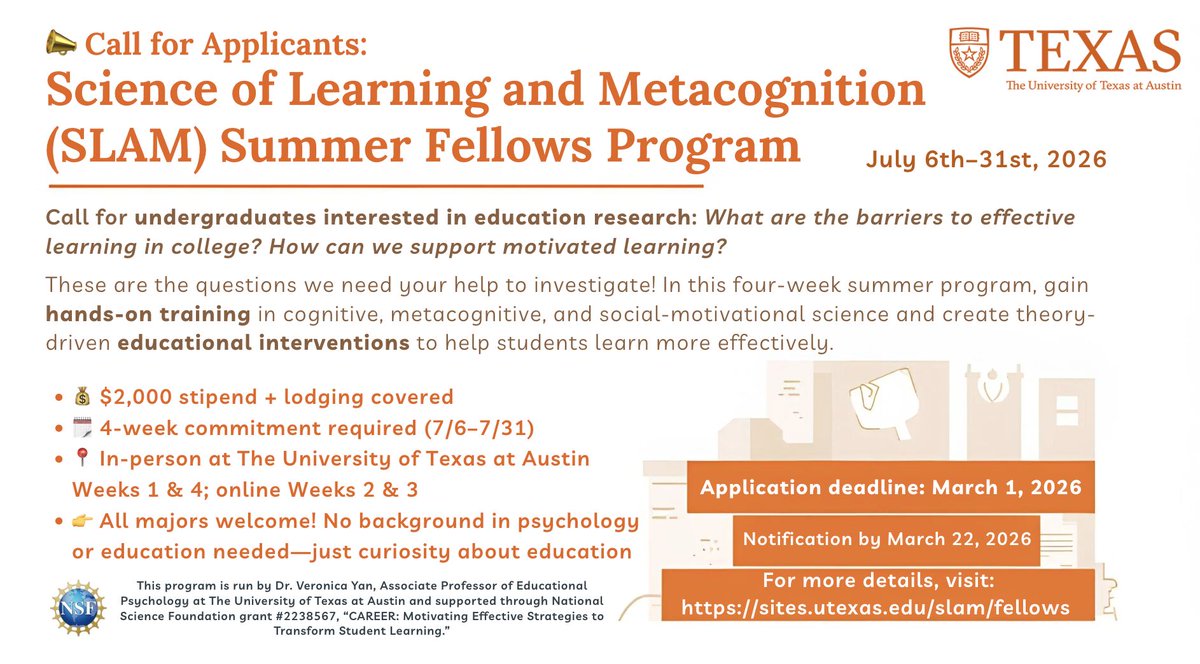
Opportunity for undergraduates (any field) who are interested in education research: apply for the Science of Learning & Metacognition Summer Fellows Program at UT Austin! (link in reply)
Bombshell: Oliver Sacks (a humane man & a fine essayist) made up many of the details in his famous case studies, deluding neuroscientists, psychologists, & general readers for decades. The man who mistook his wife for a hat? The autistic twins who generated multi-digit prime numbers? The institutionalized, paralyzed man who tapped out allusions to Rilke? Made up to embellish the stories. Probably also: the aphasic patients who detected lies better than neurologically intact people, including Ronald Reagan's insincerity. https://t.co/77nQRF8kp6
My latest Substack: AI "offers the illusion of mastery without the work of learning. It allows both students and teachers to skip the hard part—the thinking."
https://t.co/OIse5l18JV
@teacherhead@stoneman_claire@adamboxer1 Outside plagiarism, I'd say this is a non-issue. Authors should credit who they learned from, but if an arguably-derivative book does well that implies it has something others don't, whether accessibility, perspective, or just marketing. And if it doesn't sell, it doesn't matter.
The progressive critique of rote memory as "filling minds with random facts" is persuasive because it's true: the goal isn't random facts; it's a network of interconnected knowledge to solve problems. But, like it or not, building that network is going to require a lot of facts.
A recent article claimed that the Science of Learning and Direct Instruction is "neoliberal dogma that is working to de-skill the teaching profession". This is my response. Link in reply ⬇️
Some people would be delighted to hear that most of a child's football/baseball/basketball practice was spent "drilling fundamentals" but would be absolutely horrified to hear the same about the child's math class.
@WardProWords Absolutely, and meaningful musical expression can only come after mastering scales, patterns, and progressions. No great musician was ever able to skip the "woodshed" part of the path to creativity
@charowhipple I completely agree that math teachers should be doing that. And just like in sports, having a clear why and high motivation doesn't eliminate the need for drills, it just makes them slightly more bearable.
I think a good teacher does. Nearly all student athletes will never go pro, but nobody would want a youth coach who says "You'll never use this in your job so why bother with these drills". I think the same should apply to skepticism aimed at the "practicality" of algebra or geometry. Most math students won't "go pro" and become mathematicians, but that doesn't mean we abandon any hope that they could find enjoyment in acquiring some of the skills.
I think this is why a clear & well- structured curriculum matters. Teachers who lack domain knowledge simply can't make good decisions about content & sequence, but if this is done for them they can focus on implementation & learning strategies. Over time using that curriculum will lead those teachers to develop greater expertise themselves (e.g. "now I understand why we've been teaching this first", etc.)