Penn-Integrates-Knowledge (PIK) Professor, Wharton & School of Arts & Sciences. Likes = interesting; Retweets = very interesting; Interesting ≠ endorsement
1. Have we been measuring AI political bias wrong? In a new paper @PTetlock and I argue that we might have. Studies have found that AIs tend to produce left-of-center responses to politically loaded questions. But ideological preferences are not the same as epistemic failure.
New in @Theory_Society, David Rozado (@DavidRozado) and Phil Tetlock (@PTetlock) argue that an AI system leaning politically left or right isn't bias on its own -- real bias is when that lean coincides with epistemic distortions like inconsistent evidentiary standards, failures of perspective-taking or faulty inferences.
Check out their fascinating article below! https://t.co/WnfC27VujW
Is it possible to spot a good forecast by its rationale?
We used LLMs to score the reasoning behind 55,000+ forecasts and test the link between forecast accuracy and written rationales.
We found that:
• Causal reasoning is much more prevalent than statistical argumentation
• It's easier to identify poor forecasters rather than excellent ones
• Human ratings of rationale quality can be unreliable.
🧵A thread on the results:
On a subset of ForecastBench questions, an LLM has matched superforecaster performance for the first time.
A submission from @GoogleDeepMind, named “green tree,” is now #1 on dataset questions on ForecastBench, our AI forecasting benchmark.
Superforecasters remain #1 overall.
Examining the quality of the methodology & participants--& depth of the questions-- this study is the most ambitious subjective-probability forecasting exercise I've ever seen. Agree or disagree with the conclusions, this is a state-of-the-art benchmark to beat
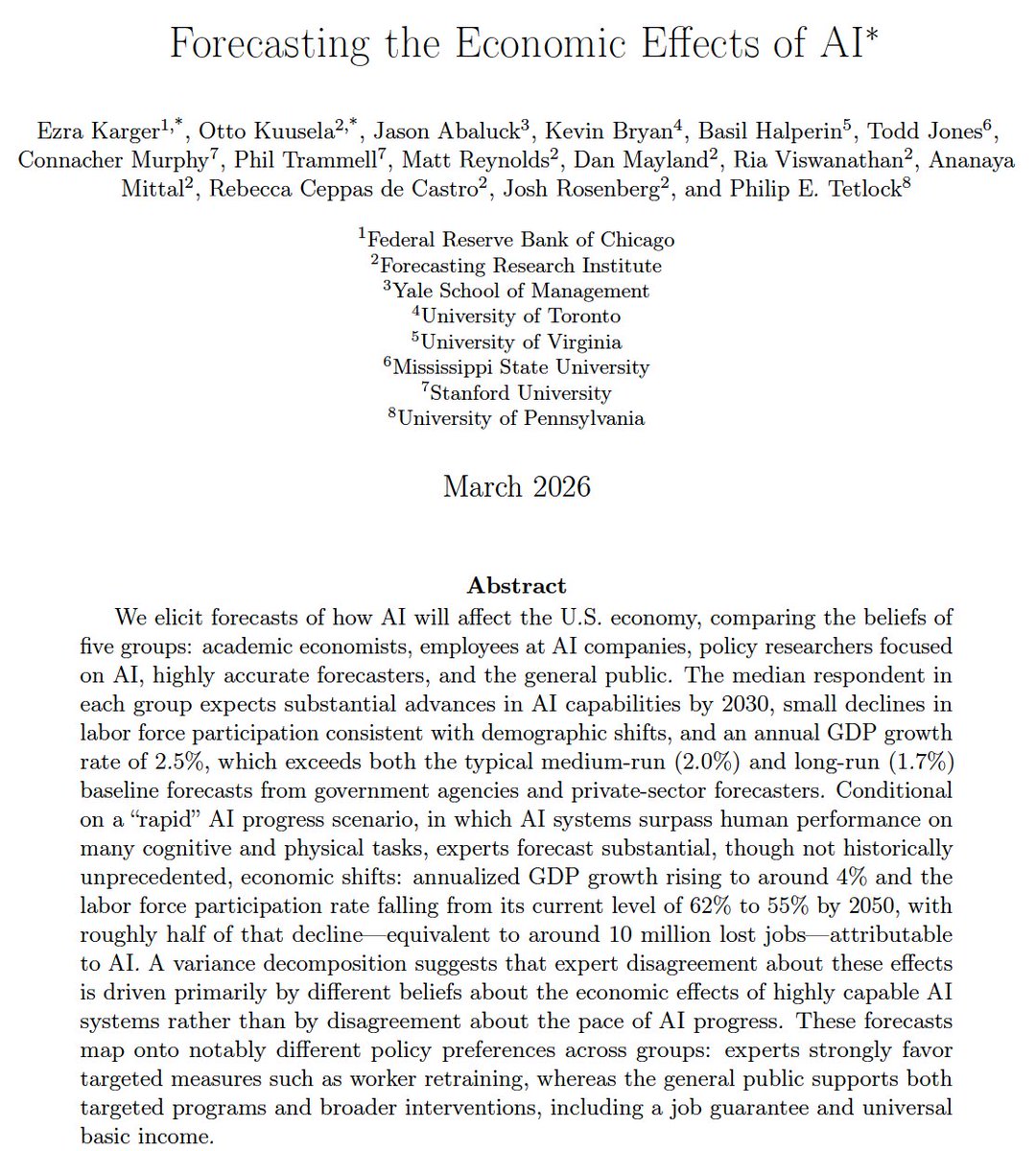
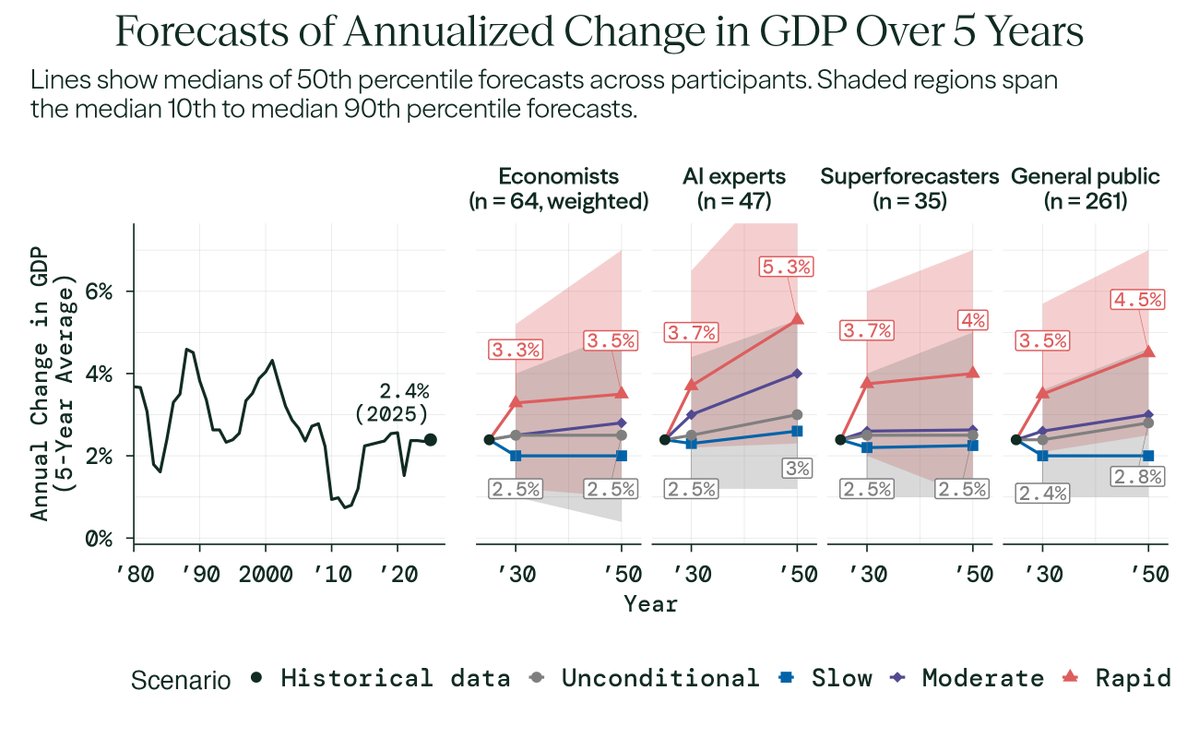
We completed the most comprehensive study of how economists and AI experts think AI will affect the U.S. economy.
They predict major AI progress—but no dramatic break from economic trends: GDP growth rates similar to today's and a moderate decline in labor force participation.
However, when asked to consider what would happen in a world with extremely rapid progress in AI capabilities by 2030, they predict significant economic impacts by 2050:
• Annualized GDP growth of 3.5% (compared to 2.4% in 2025)
• A labor force participation rate of 55% (roughly 10 million fewer jobs)
• 80% of wealth held by the top 10% (highest since 1939)
🧵 Here's what we found:
We completed the most comprehensive study of how economists and AI experts think AI will affect the U.S. economy.
They predict major AI progress—but no dramatic break from economic trends: GDP growth rates similar to today's and a moderate decline in labor force participation.
However, when asked to consider what would happen in a world with extremely rapid progress in AI capabilities by 2030, they predict significant economic impacts by 2050:
• Annualized GDP growth of 3.5% (compared to 2.4% in 2025)
• A labor force participation rate of 55% (roughly 10 million fewer jobs)
• 80% of wealth held by the top 10% (highest since 1939)
🧵 Here's what we found:
We built an interactive forecasting tool so you can see how your forecasts about AI's economic impact compare with forecasts from the economists in our sample.
When you submit your forecasts, you'll receive a summary image that you can share on X or elsewhere.
https://t.co/eoKvzy4u9G
I have underestimated to what extent people interested in politics believe the good guys are perpetually on the verge of defeating the bad guys once and for all.
here is Rush Limbaugh in 1993 predicting the imminent implosion of liberalism:
Variants of this question are popping up a lot nowadays: How much should the moral character of an artist or scholar or scientist sway our assessments of the value of their creative output?
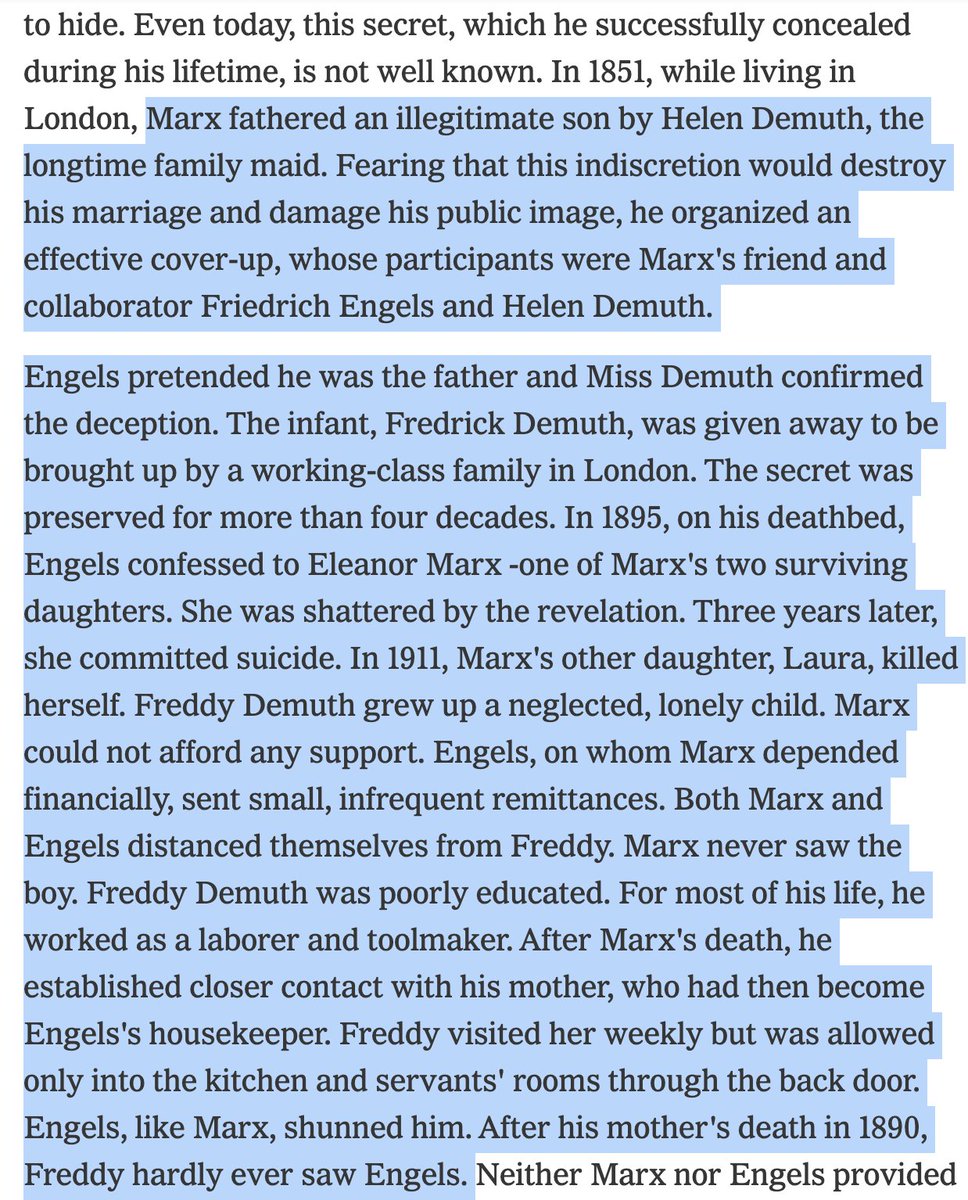
While Marx's wife was pregnant, he impregnated their housemaid. To hide this from Marx's wife so she wouldn't get angry, Engels pretended he was the father. Then they gave the kid away. Both Marx and Engels abandoned him, pretending the kid didn't exist. https://t.co/imbZ76TjBY
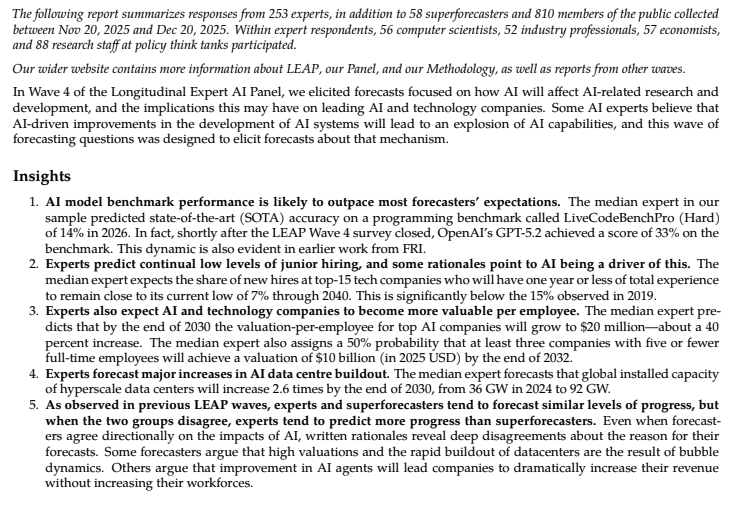
My collaborators in @Research_FRI have released latest AI progress forecasts from LEAP (Longitudinal Expert AI Panel). Experts continue to underestimate benchmark progress but also expect big increases in tech company valuations & data center buildout. For details: https://t.co/Ji5CucVrIG
What do experts and superforecasters think about the future of AI research and development?
In Wave 4 of the Longitudinal Expert AI Panel (LEAP), we asked top AI experts to forecast progress in AI R&D, hiring, company valuations, data center buildout, and more.
Here’s what you need to know 🧵
Can we predict the past? 🔮
New open-access paper in American Historical Review proposes 'Retrodiction'—using gaps in the archival record to test historical theories.
Interdisciplinary collab feat. David Gill, Marc Trachtenberg, @PTetlock@cendripetalfrce, and more 🧵👇
@Research_FRI is dedicated to improving signal-to-noise ratios in heated debates. LEAP, Longitudinal Expert AI Panel, elicits testable forecasts of AI progress each month. First-wave results will frustrate extremists at both ends of opinion spectrum but if you love nuance...
@Research_FRI is dedicated to improving signal-to-noise ratios in heated debates. LEAP, Longitudinal Expert AI Panel, elicits testable forecasts of AI progress each month. First-wave results will frustrate extremists at both ends of opinion spectrum but if you love nuance...
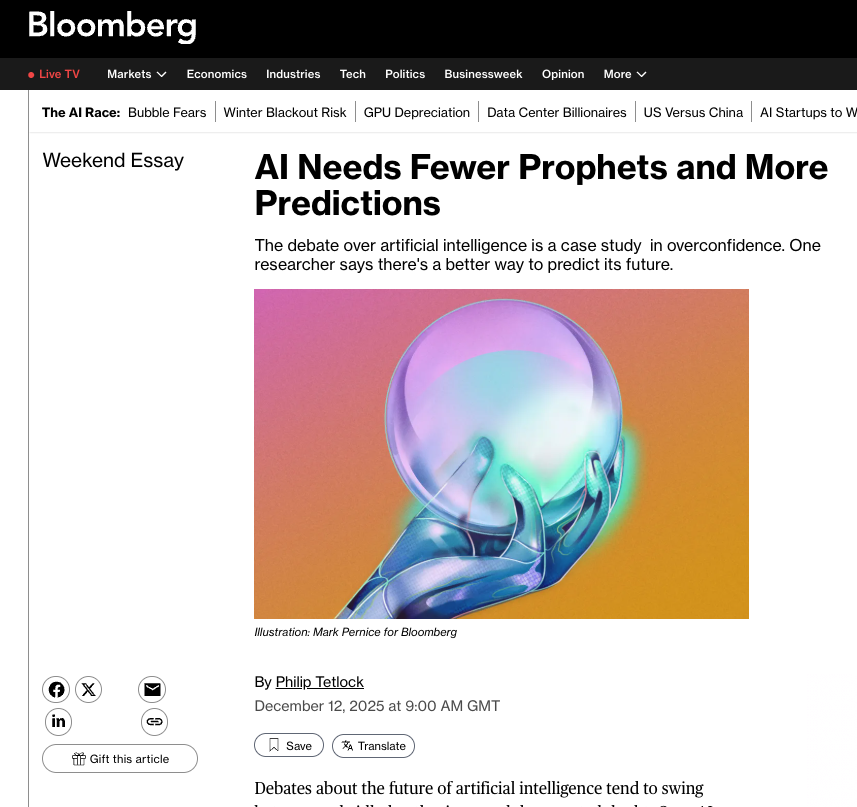
In Bloomberg today, FRI Chief Scientist, @PTetlock argues that the debate over AI progress needs falsifiable forecasts rather than broad statements:
"The debate over the future of AI deserves fewer overconfident proclamations and more precise, policy-relevant predictions. Careful forecasting surveys, of the kind I’ve spent my career working on, can test arguments against reality and, in time, affirm the voices that consistently deliver reliable, actionable guidance."
The more tendentious the topic, the harder it is to consummate an adversarial collaboration. So the team deserves a lot of credit for pulling this off on “implicit bias”—& publishing in a high-rejection-rate journal. But many issues are left dangling. I hope there is a Round 2.
Terrific social psych paper ( how often do you hear that from me?). Adversarial collab on how much measures of "implicit bias" predict racial discrim.
tl;dr:
N>2000
1. Pro-Black discrimination>pro-White discrimination
2. Implicit measures predicted discrim (std reg coeff=.16) a hair above their agreed-upon threshold for considering the effect trivial (.15), controlling for explicit prejudice.
3. Explicit prej powerfully predicted discrim.
Authors include @jordanaxt, @ImHardcory, @PTetlock, @tomstello
https://t.co/NlUUUGKded
ht @robsica
Will wisdom of elite forecasting crowd on LEAP out-perform famous AI accelerationists & skeptics?
First-wave results: LEAP experts are consistently less bullish on AI progress than tech CEOs, like Altman, but more bullish than educated public
Today, we are launching the most rigorous ongoing source of expert forecasts on the future of AI: the Longitudinal Expert AI Panel (LEAP).
We’ve assembled a panel of 339 top experts across computer science, AI industry, economics, and AI policy.
Roughly every month—for the next three years—they’ll provide precise, falsifiable forecasts on the trajectory of AI capabilities, adoption, and impact.
Our results cover where experts predict major effects of AI, where they expect less progress than AI industry leaders, and where they disagree.
LEAP experts forecast major effects of AI by 2030, including:
⚡ 7x increase in AI’s share of U.S. electricity use (1% -> 7%)
🖥️ 9x increase in AI-assisted work hours (2% -> 18%)
By 2040, experts predict:
👥30% of adults will use AI for companionship daily
🏆60% chance that AI will solve or substantially assist in solving a Millennium Prize Problem
🚂32% chance that AI will have been at least as impactful as a "technology of the millennium," like the printing press or the Industrial Revolution.
🧵Read on for more insights and results
Today, we are launching the most rigorous ongoing source of expert forecasts on the future of AI: the Longitudinal Expert AI Panel (LEAP).
We’ve assembled a panel of 339 top experts across computer science, AI industry, economics, and AI policy.
Roughly every month—for the next three years—they’ll provide precise, falsifiable forecasts on the trajectory of AI capabilities, adoption, and impact.
Our results cover where experts predict major effects of AI, where they expect less progress than AI industry leaders, and where they disagree.
LEAP experts forecast major effects of AI by 2030, including:
⚡ 7x increase in AI’s share of U.S. electricity use (1% -> 7%)
🖥️ 9x increase in AI-assisted work hours (2% -> 18%)
By 2040, experts predict:
👥30% of adults will use AI for companionship daily
🏆60% chance that AI will solve or substantially assist in solving a Millennium Prize Problem
🚂32% chance that AI will have been at least as impactful as a "technology of the millennium," like the printing press or the Industrial Revolution.
🧵Read on for more insights and results
When I first read “When Prophecy Fails” in grad school—eons ago—I wondered whether this case study was “too neat/ theoretically convenient to be true.” Prof warned “don’t let anyone else hear you say that. Festinger is sacrosanct.” Another reason for my fascination with taboo topics.
"When Prophecy Fails … the case was misrepresented. The cult did not persist, proselytize, or reinterpret its failure as a spiritual triumph. Its leader recanted, the group disbanded, and belief dissolved."