Something interesting is happening with AI right now that most people aren't paying attention to
we're moving from "ask and wait" models to agents that just... run in the background, all the time → posting content, managing workflows, monitoring markets, executing trades, basically doing stuff autonomously while you're doing other things.
Saw this shift really clearly with platforms like OpenClaw, these aren't demos anymore they're shipping products where agents operate independently with minimal human input and that changes everything from an infrastructure perspective.
The thing nobody talks about is that the compute model for this is completely different than what cloud infrastructure is built for.
• Chatbots have sporadic usage → you ask, it responds, GPU idles, you pay per request, costs are predictable, it works
• always on agents → can't shut down, GPUs running 24/7, memory stays allocated, storage is always active, networking never stops
same hardware, but the economics are wildly different when you're running persistent workloads at scale and this is where it gets messy for builders imo.
Most high performance GPU capacity right now sits with three cloud providers - AWS, Azure, GCP, their pricing makes sense for enterprise ML training runs, big batch jobs, that kind of stuff but it wasn't designed for a startup running 10 agents continuously, 24/7 for months on end.
I keep seeing the same pattern:
dev builds a cool agent, tests it locally, works great, checks what it'll cost to run in production 24/7 and then... they realise they can't afford this, not because the tech doesn't work, it works fine but because the infrastructure economics just don't make sense at that scale
and this is one of the most core reason where distributed compute models start getting really interesting
instead of renting from centralized providers, what if you aggregate idle GPUs globally, like different economic model, no single point of control, turns out there's already thousands of GPUs networked across multiple countries doing exactly this.
Makes running persistent agents economically viable for teams that couldn't afford traditional cloud pricing.
Here's my DePIN thesis on this:
if agents become the primary way we interact with AI (which seems increasingly likely), then who can afford to run them 24/7 basically determines who gets to participate in building this future;
> centralized infrastructure creates high barriers
> distributed infrastructure lowers them
and infrastructure choices shape outcomes more than most people realize.
Seeing this up close through @ionet, the shift from episodic AI to persistent agents isn’t just a product upgrade but i believe it’s an infrastructure challenge that needs a totally different approach than what worked in the chatbot era.
Worth paying attention to if you're building in this space, the bottleneck isn't going to be model capability, it's going to be who can afford to keep the lights on 24/7.
@adelbucetta@OpenRouter@ionet It's what these numbers represents, that's more developers, more applications, more model usage and more demand flowing through the AI stack.
The bigger those numbers get across the industry, the more important the compute layer becomes, that's the trend i'm paying attention to
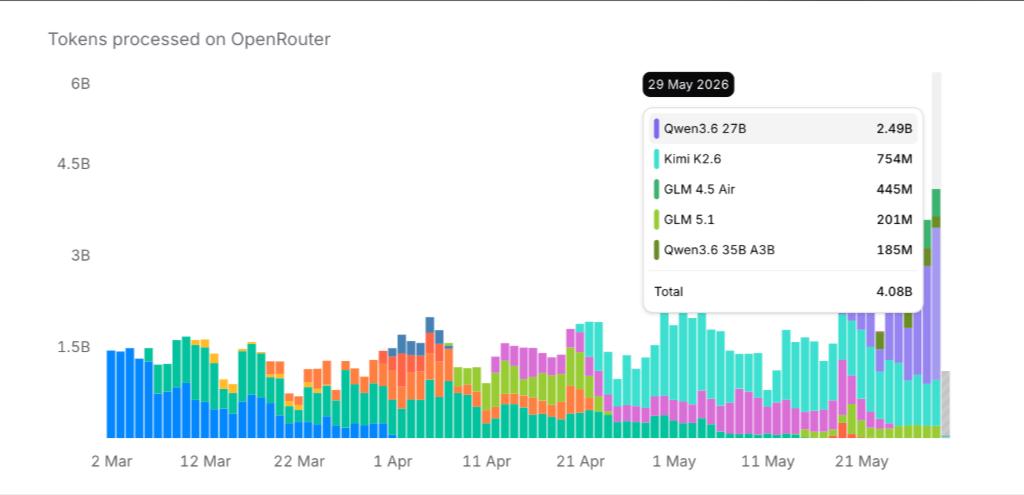
4B+ tokens processed on @OpenRouter through @ionet, yesterday.
For context, it was sitting around 1.5B through most of march, that's nearly 3x growth in under 3 months and the curve isn't flattening. The interesting part isn't just the number, it's what it represents.
AI is clearly moving towards a multi model world. Developers aren't relying on a single provider anymore, they're constantly switching between models based on cost, speed, reasoning quality and availability. OpenRouter itself has grown into a major routing layer across hundreds of models and tens of trillions of weekly tokens,
that creates a second challenge underneath the model layer: COMPUTE.
As demand keeps accelerating, access to GPU infrastructure becomes just as important as model quality. That's why decentralized infrastructure feels increasingly relevant right now.
https://t.co/Q04pKYl1Cx being one of the providers contributing compute into that ecosystem makes milestones like this interesting to watch, not because it proves decentralization has already won but because it shows real usage is growing fast enough that the industry keeps searching for more scalable and flexible infrastructure paths.
4B+ tokens is a clear signal that AI is becoming too large, too global and too compute hungry to rely on a small set of centralized bottlenecks forever. The more AI scales, the more important open and distributed infrastructure becomes
and that's exactly the direction DePIN has been building toward.
@paraschopra What if we prompt it in such a way where it has to make sure that it is continuously challenging our cognitive ability while still making us learn the in best way possible
. $IO just went live on Upbit Korea - KRW pair, direct won trading, if you know korean crypto then you know this market doesn't move on hype. It's one of the most selective and high volume exchanges in asia.
whereas on the other hand @ionet's daily network earnings are consistently hitting above $30K, all time high GPU utilization earlier this year, agent cloud already shipping and now one of asia's biggest exchanges opening a direct pair.
The network keeps getting harder to ignore 👀