So what's really driving Black Friday 2026? We've analyzed the online conversation to uncover five shifts in shopper behavior – and what they reveal about the changing relationship between consumers and spending.
Get in touch to learn how Pulsar can help you understand your audience 👉 https://t.co/ZlAi3sRo7J
But not everyone is holding back.
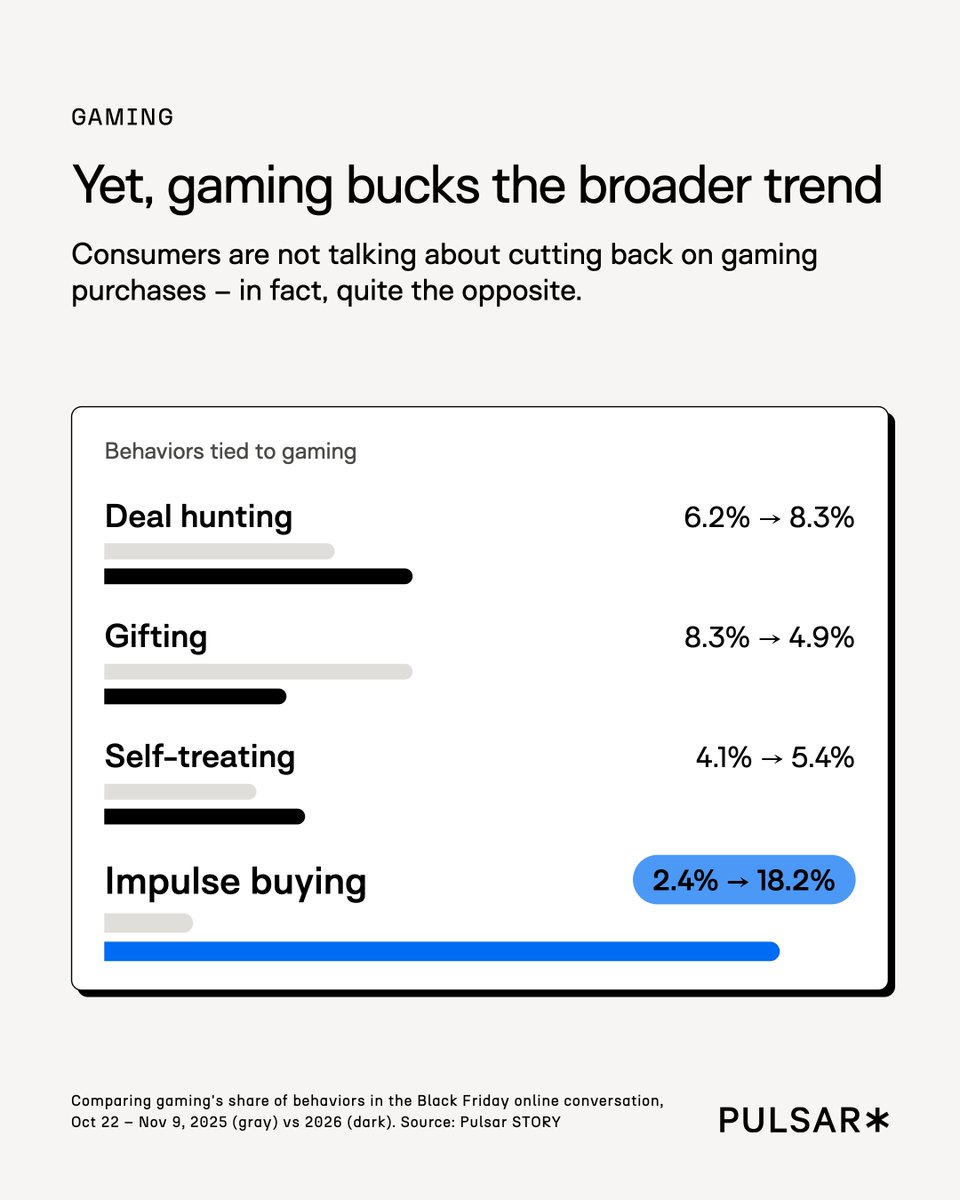
In gaming, anticipation around Rockstar Games' GTA 6 is driving a very different kind of spending behavior, with consumers considering bigger-ticket purchases to get ready for the game's release.
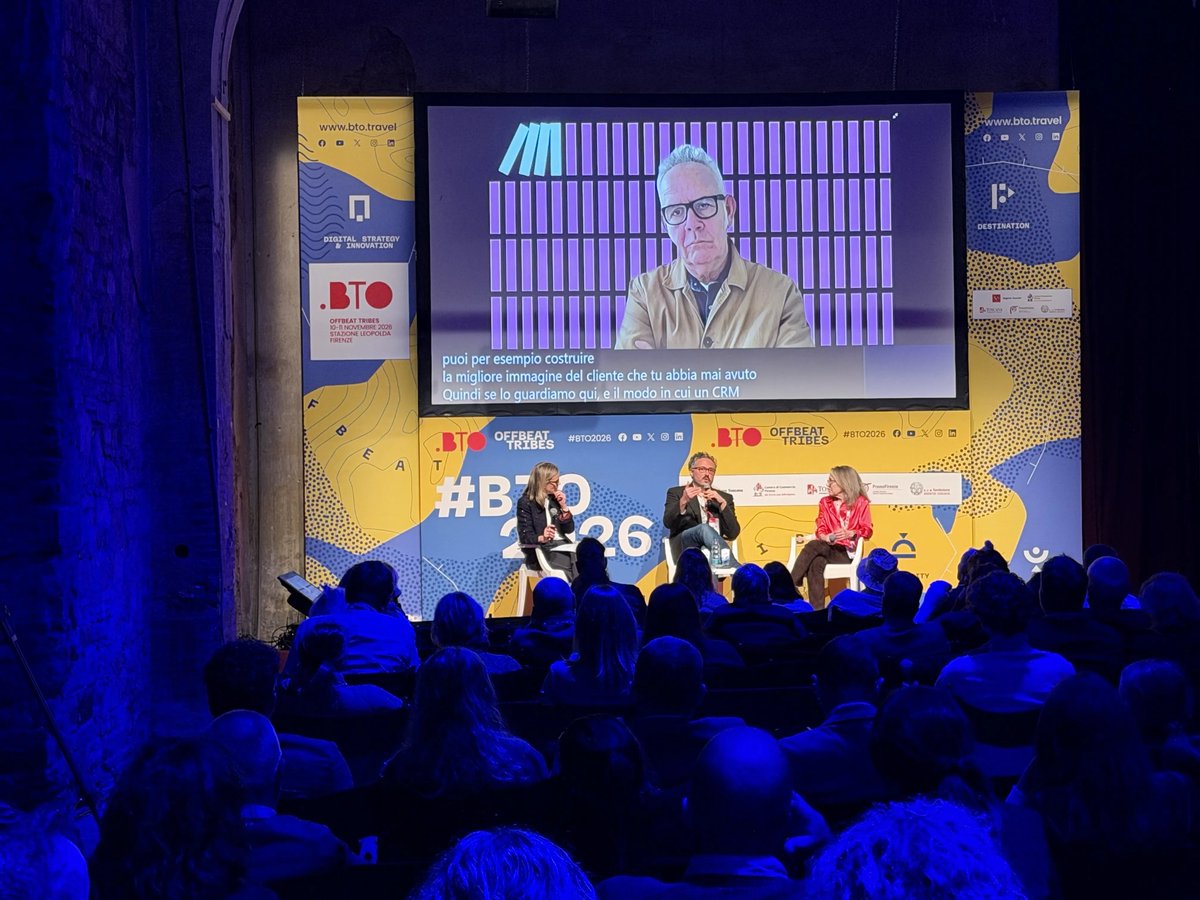
Our founder @abc3d was in Florence yesterday for @BTO_travel's The New Herd, a panel on how new travelling tribes arise, act, and make decisions.
He was joined by @herdmeister , who talked collective behaviour and influence, and Anna Kirah on the human needs behind every booking, with @EmmaNelsonMedia moderating.
The central idea: people don’t pick destinations alone. Choices spread through imitation, trust and belonging, in group chats, niche communities and shared rituals that turn an interests into an identity.
Pulsar in Paris: our founder @abc3d joined The Social Intelligence Lab's founder @DrJillianNey on stage at the Observe Summit earlier today.
Tomorrow, we'll be taking to the stage once more, this time to announce the winner of our Insights Agent Challenge. Join us to learn who won, and what we built…
Thank you to TheSILab for inviting us to speak to their community. And if you’re attending, come say hi to Fran and Samuel Deacon at the conference! 👋
#observesummit #socialintelligence
Bonjour à toutes et à tous – but especially to all the social intelligence pros descending onto Paris for this year's Observe Summit 🇫🇷 🥐
2026 has been a year of co-creation for us with @TheSILab community - to discover, understand and build the future of Agentic AI for social intelligence.
And on Friday, we'll be seeing some of that future on stage, announcing the winner of the Insights Agents Challenge and revealing the agent that the (social intelligence) people wanted us to build.
You can learn more about this whole journey here: https://t.co/TwKLaaTRZJ
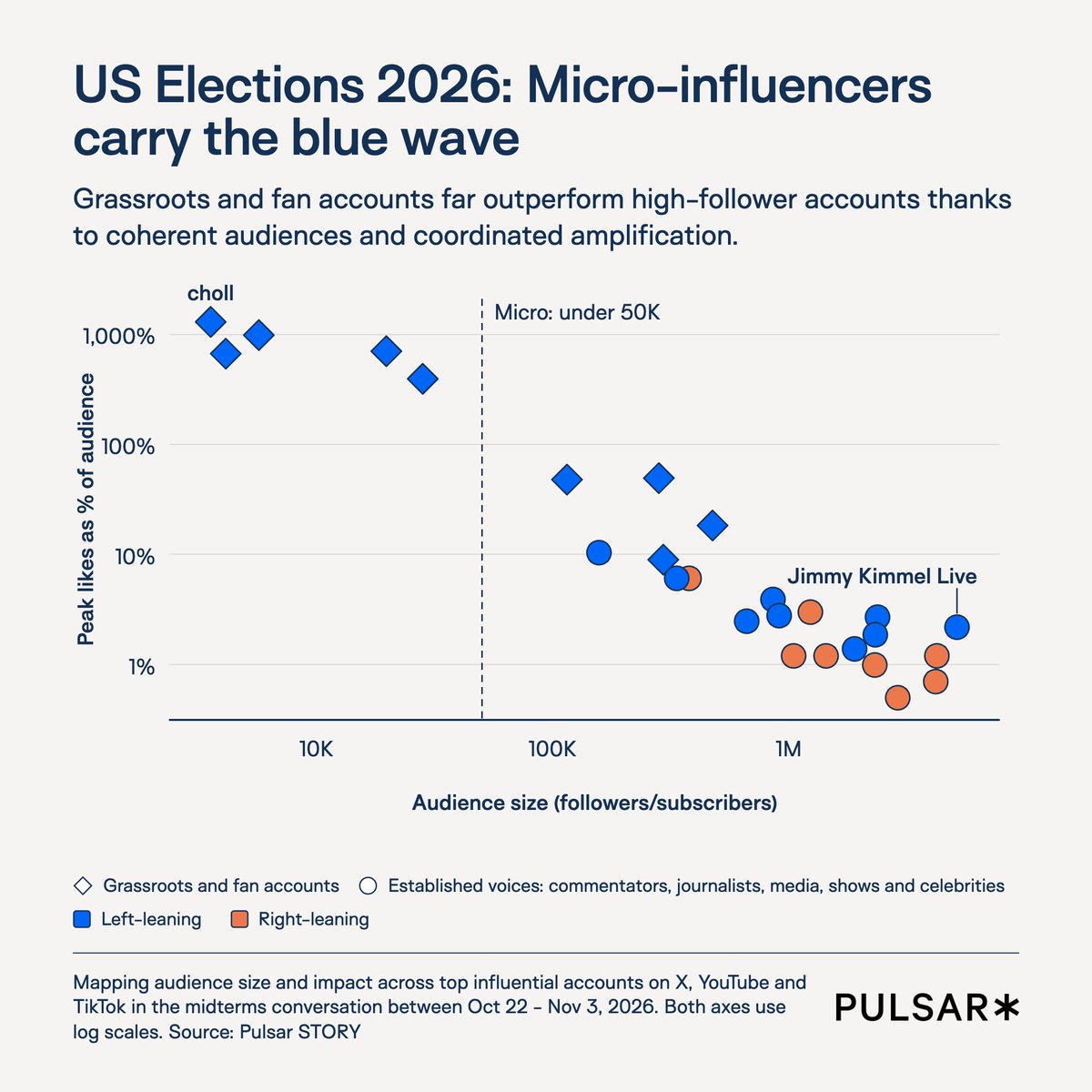
🇺🇸 The 2026 midterms already have a winner: the mid-sized influencer
Here’s 5 things we noticed in our analysis:
• Grassroots fans outperform established commentators. TikTok creator Choll, a Kamala Harris superfan, generated 47K likes in just a few days, despite only having only 3K followers – boosting Texas Democrats and demonstrating the outsized impact of highly engaged, niche audiences.
• It's all about Trump. Trump (357K mentions) and "President Trump" (147K) outrank mentions even of Democrats (262K) and Republicans (182K), as the entire political apparatus turns on one lightning rod figure.
• Global politics is shaping domestic election discourse. #poland, #iran, #deportthebolsonaros and #globalist all rank in the top 20 topics, with Iran alone generating 127K mentions.
• Format beats length. Short-form video drives the highest engagement per post, with visual content consistently outperforming text and links. On YouTube, however, long-form video generates 2.7x more engagement per post than short-form – suggesting it's video eating the political discourse, rather than shorts alone.
• The crash of symbols.🚨 and 🇺🇸 lead emoji engagement neck and neck, followed by 💙 (68.5K) and 🗳️ (61K), both outpacing 🔴 (42.8K), highlighting engagement around urgency, national identity, civic change, and partisan symbolism.
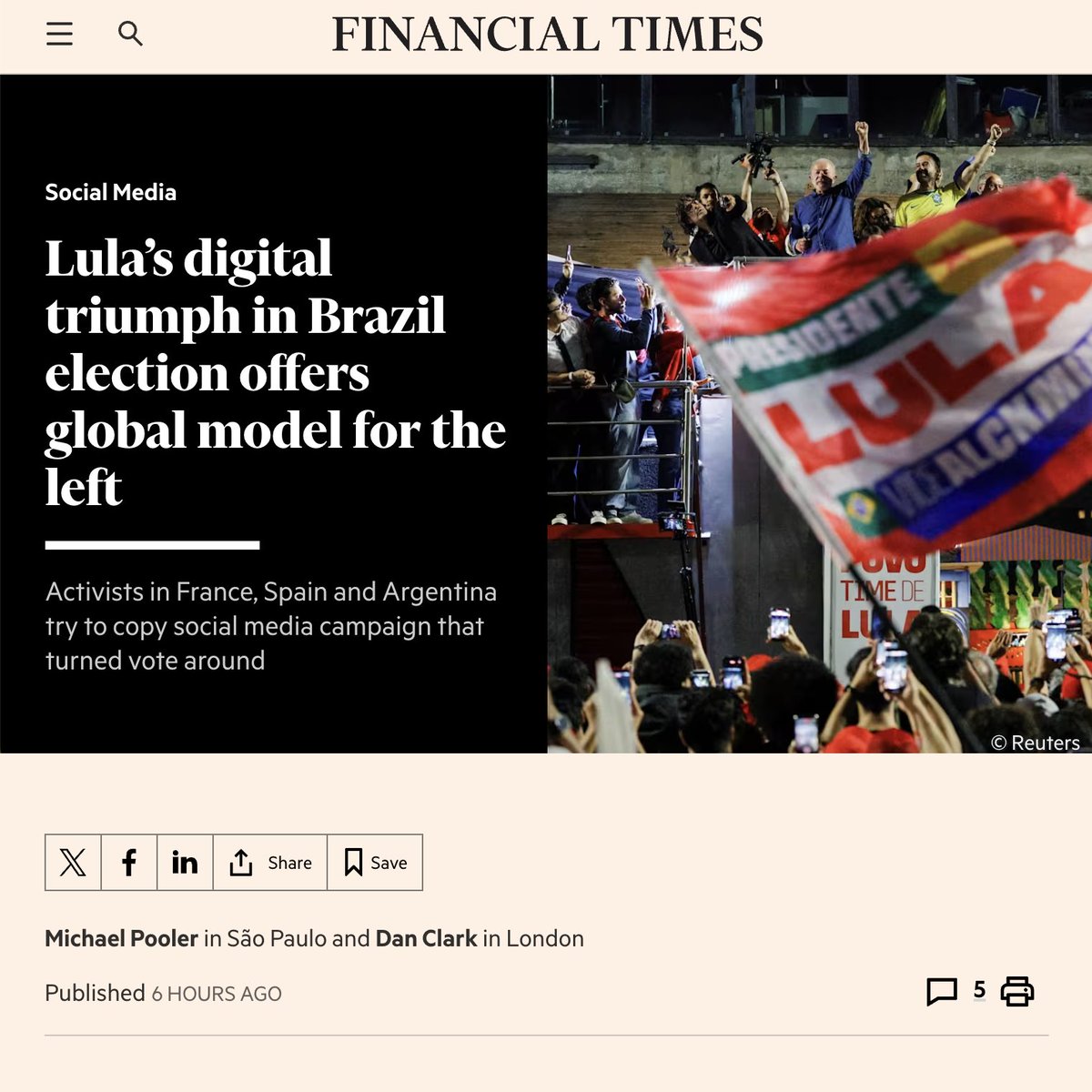
Does Lula’s victory in Brazil give left-wing parties around the world a model for how to use social media?
Thanks to @Dan_Clark5 and the @FT team, who called on Pulsar data to unpick the impact of the ‘Lula’s Army’ WhatsApp group on political mobilization across platforms.
Social clearly helped pave a resurgence for Lula, after right-wing opponent Flávio Bolsonaro had taken the first round.
So what are the methods that parties are across France, Spain and beyond can look to implement? We used Pulsar's research agent STORY to find out.
https://t.co/g4OPVoMyKz
For more instances of Pulsar data helping underpin recent news articles, from the reputation of AI companies to the co-opting of TikTok stars for TV: https://t.co/IeoGF7B9VH
Has the BBC's call to populate the latest series of Strictly Come Dancing with influencers helped boost ratings? Pulsar data made an appearance in the @DailyMail today, as Editor-at-Large @alisonboshoff examined whether the addition of TikTok stars John Nellis, Cach Mercer et al has helped the show emulate the successful strategy of stateside cousin Dancing with the Stars.
Thank you to Alison for featuring our insight – which we were able to turn around in the course of a single hour by using Story, the autonomous research agent.
Read the article: https://t.co/AtY19BRger
Our autonomous research agent is now open to everyone in public beta, and it has a new name: Pulsar STORY.
It's not an AI copilot: it's an analyst that never clocks out, pushing finished intelligence to you before you ask. It has a job, not a chat window.
Learn more: https://t.co/tTW2nEoOFI
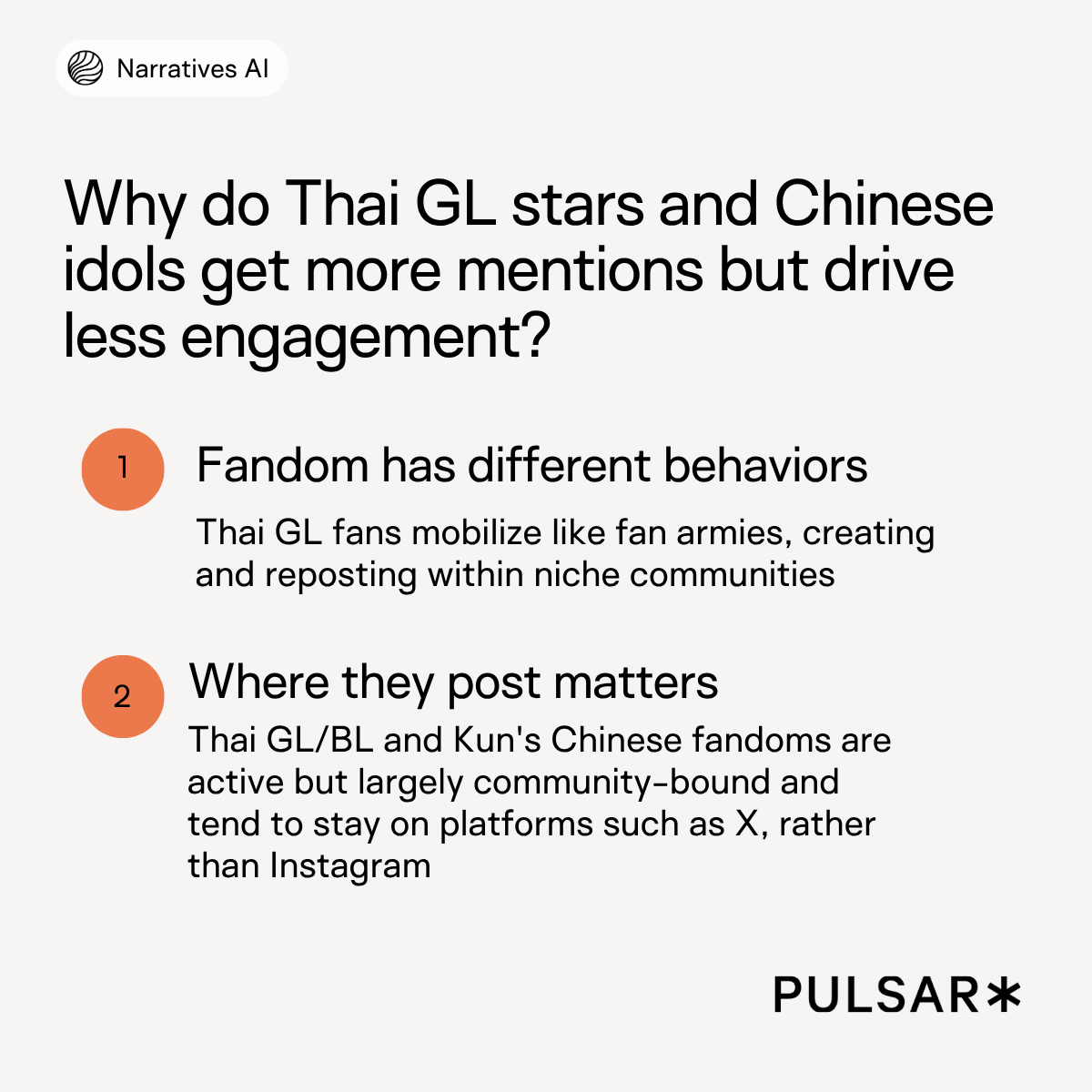
👯♀️ Fandoms behave differently. Highly mobilized fan communities can generate huge volumes of posts and reposts via a 'fan-army signature', without necessarily driving the same level of engagement.
🪩 Platforms shape influence. Different fandoms concentrate their activity in different social ecosystems, influencing how far conversations travel and where engagement happens.
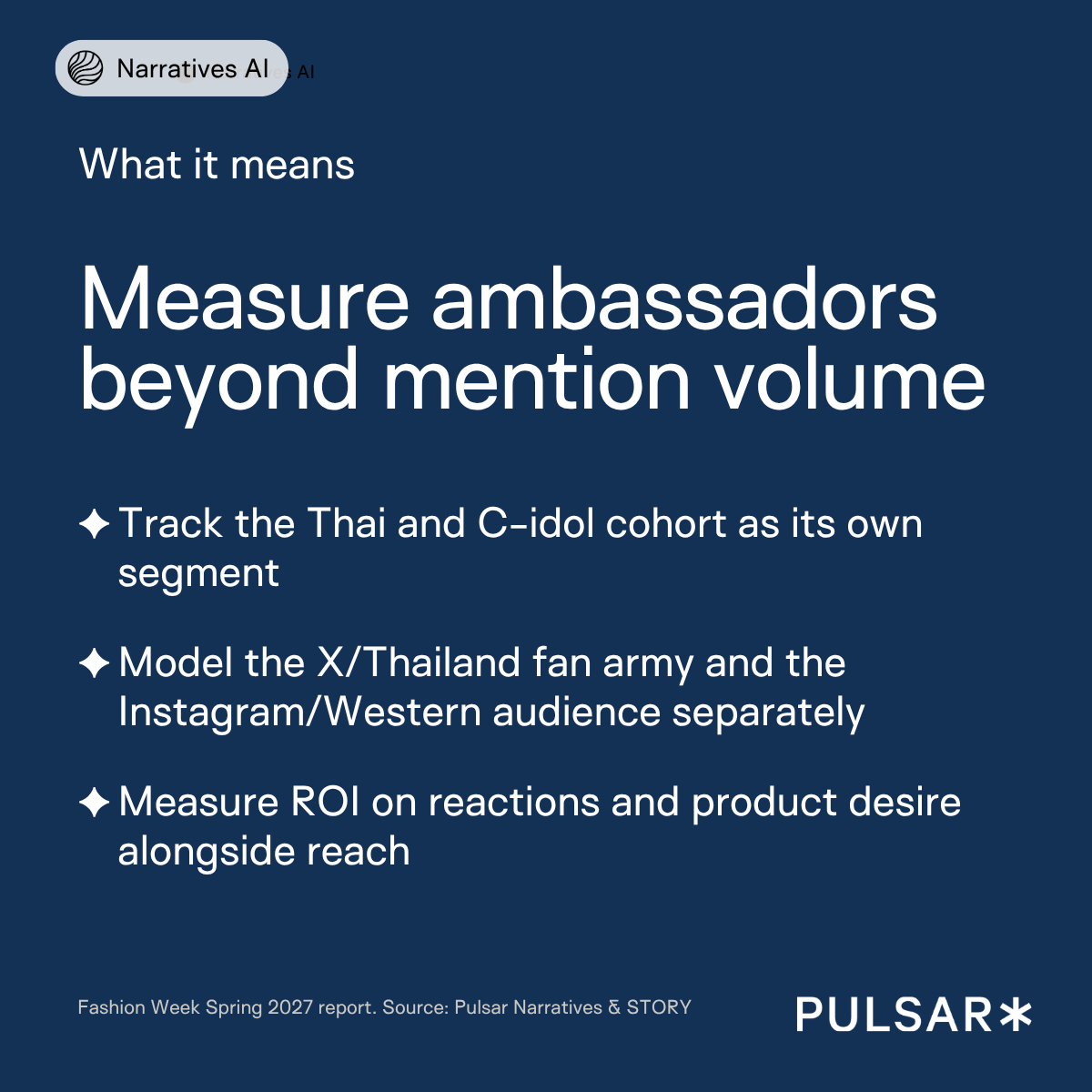
What does this mean for brands? Explore our Fashion Week report for more insights: https://t.co/UlLZGC3rNR
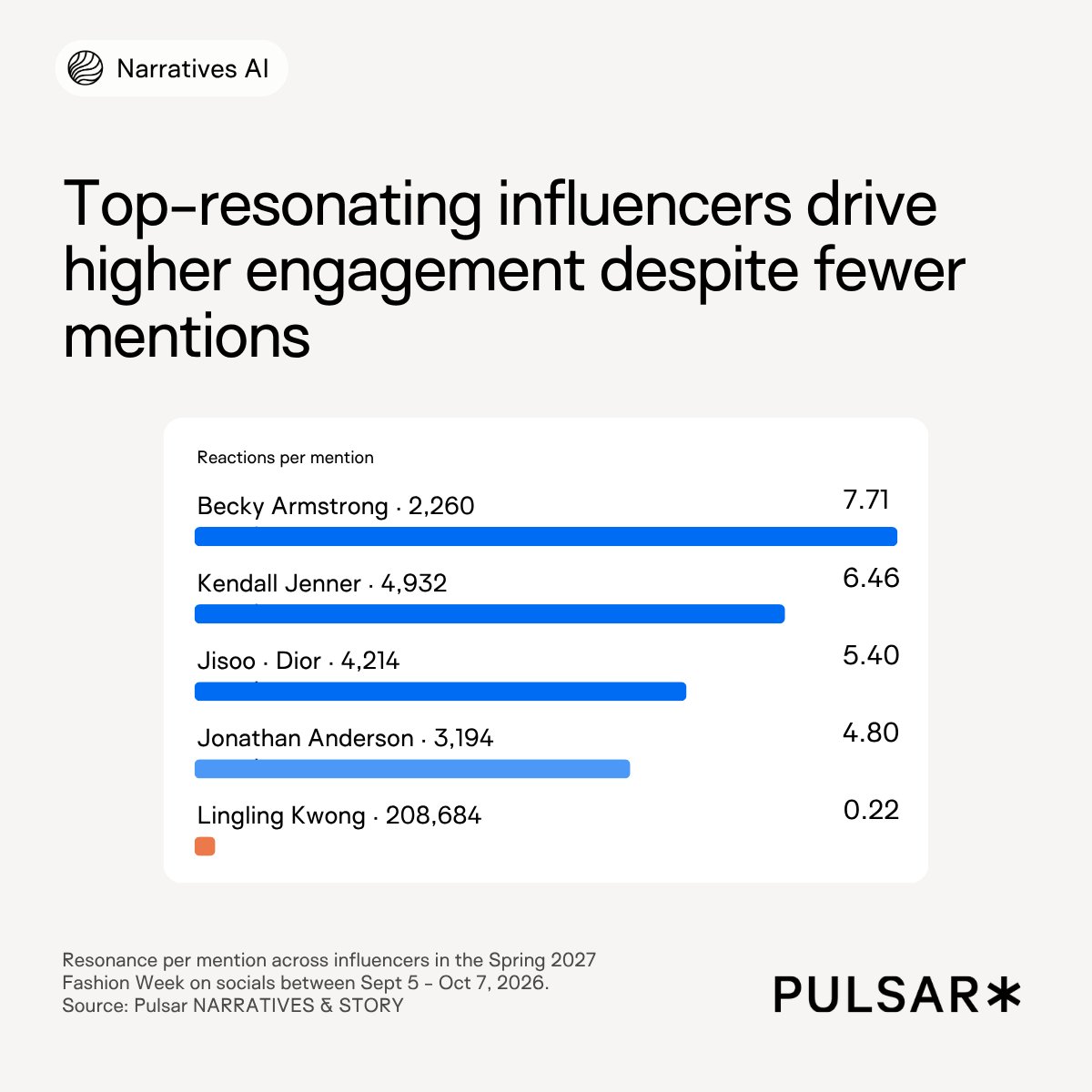
At Fashion Week, more mentions don’t always mean more impact.
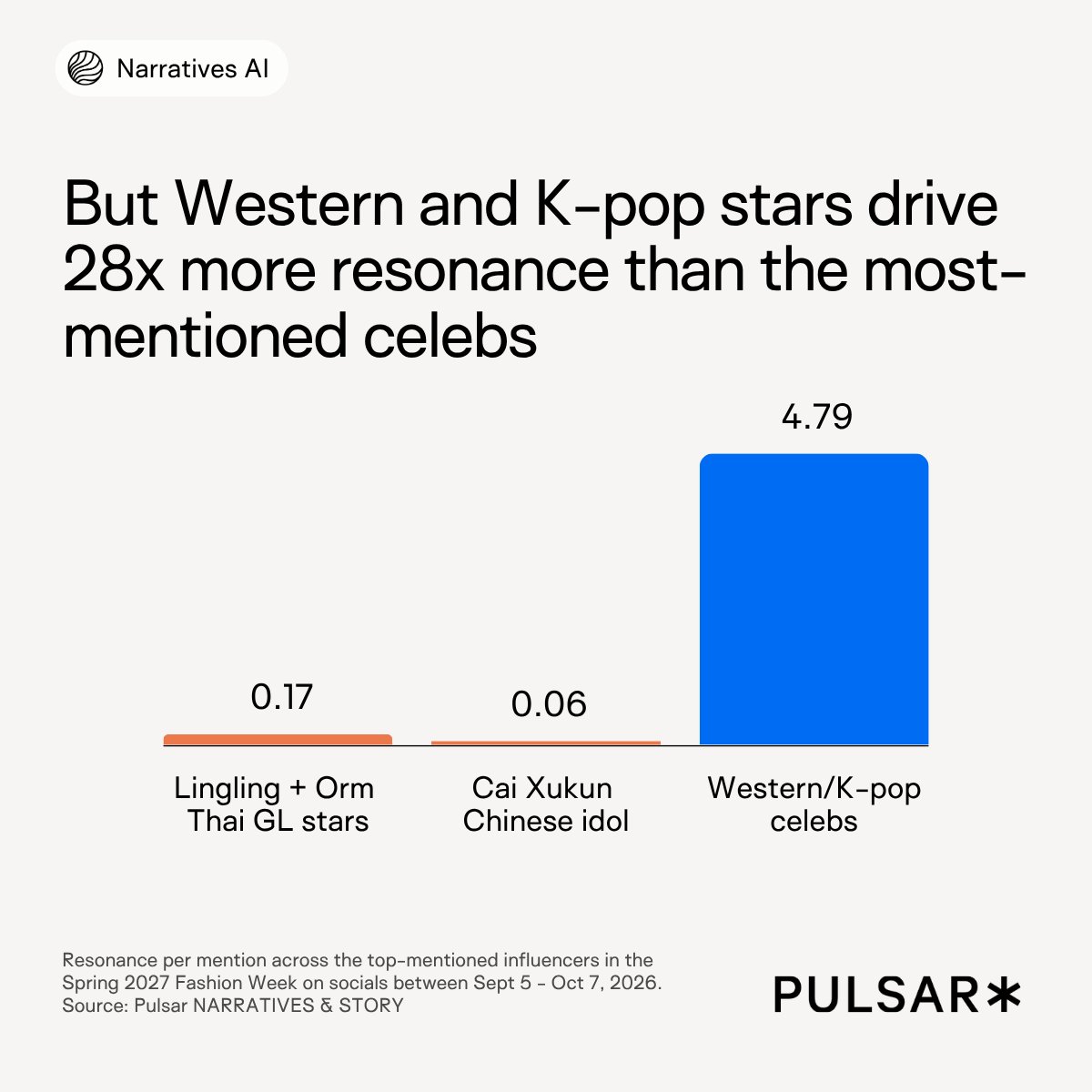
Thai Girls’ Love (GL) actresses Lingling Kwong and Orm Kornnaphat, alongside Chinese idol Cai Xukun (Kun), ranked among the most-mentioned influencers during Spring 2027 Fashion Week.
But when it comes to resonance, Western and K-pop celebrities drove 28x more engagement per mention than these ubiquitous stars.
Why?
As the @arcticcircleorg Assembly kicks off in Reykjavik, we're looking at how the world thinks about the Arctic in our latest narrative Intelligence study, The Arctic Reframed.
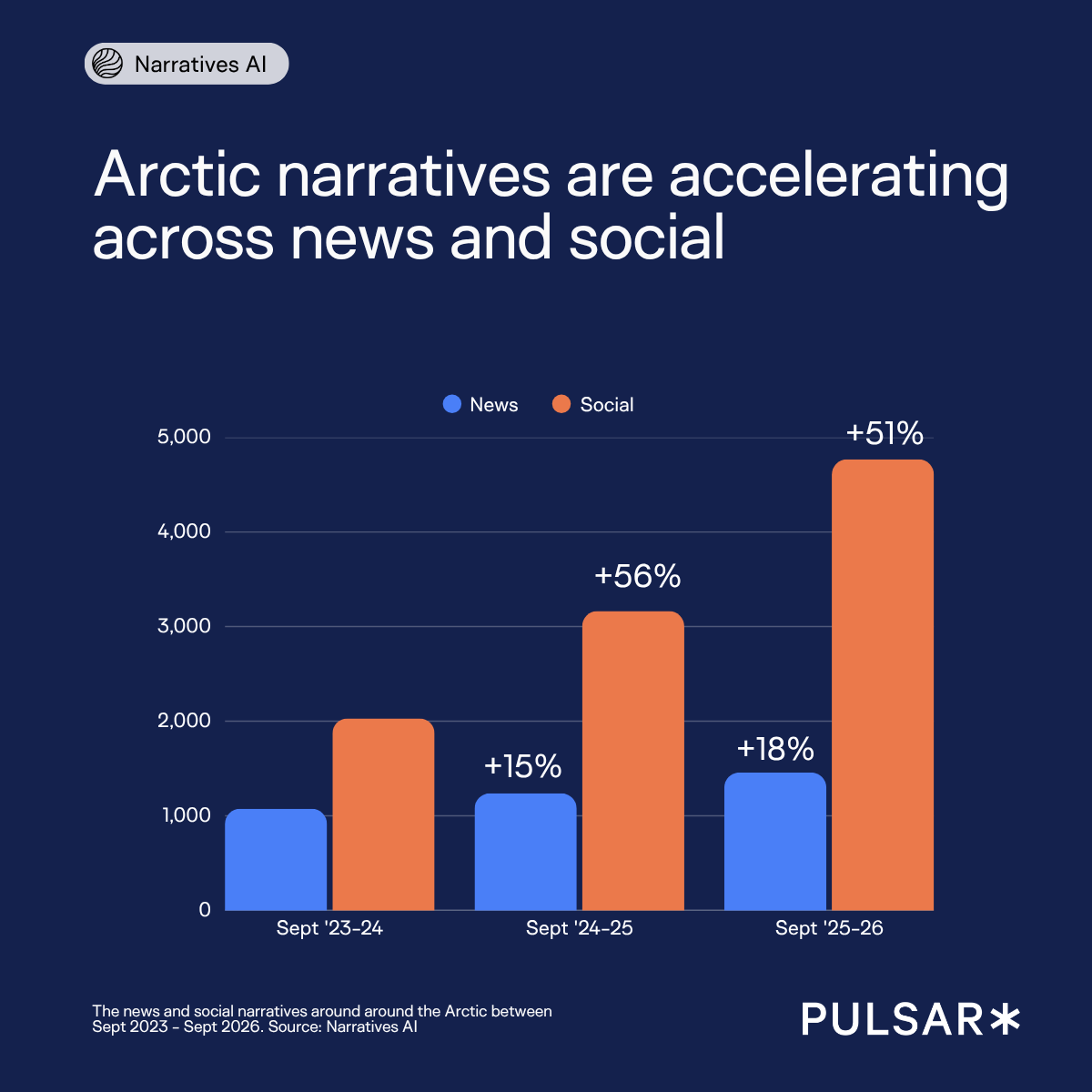
The study covers three years of Pulsar Narratives AI data, billions of news articles and social posts, 13,731 narratives detected between 2023 and 2026 📈 📉
The biggest point for me is that the Arctic is not driving his own narrative, the story is written elsewhere.
Here's the headlines:
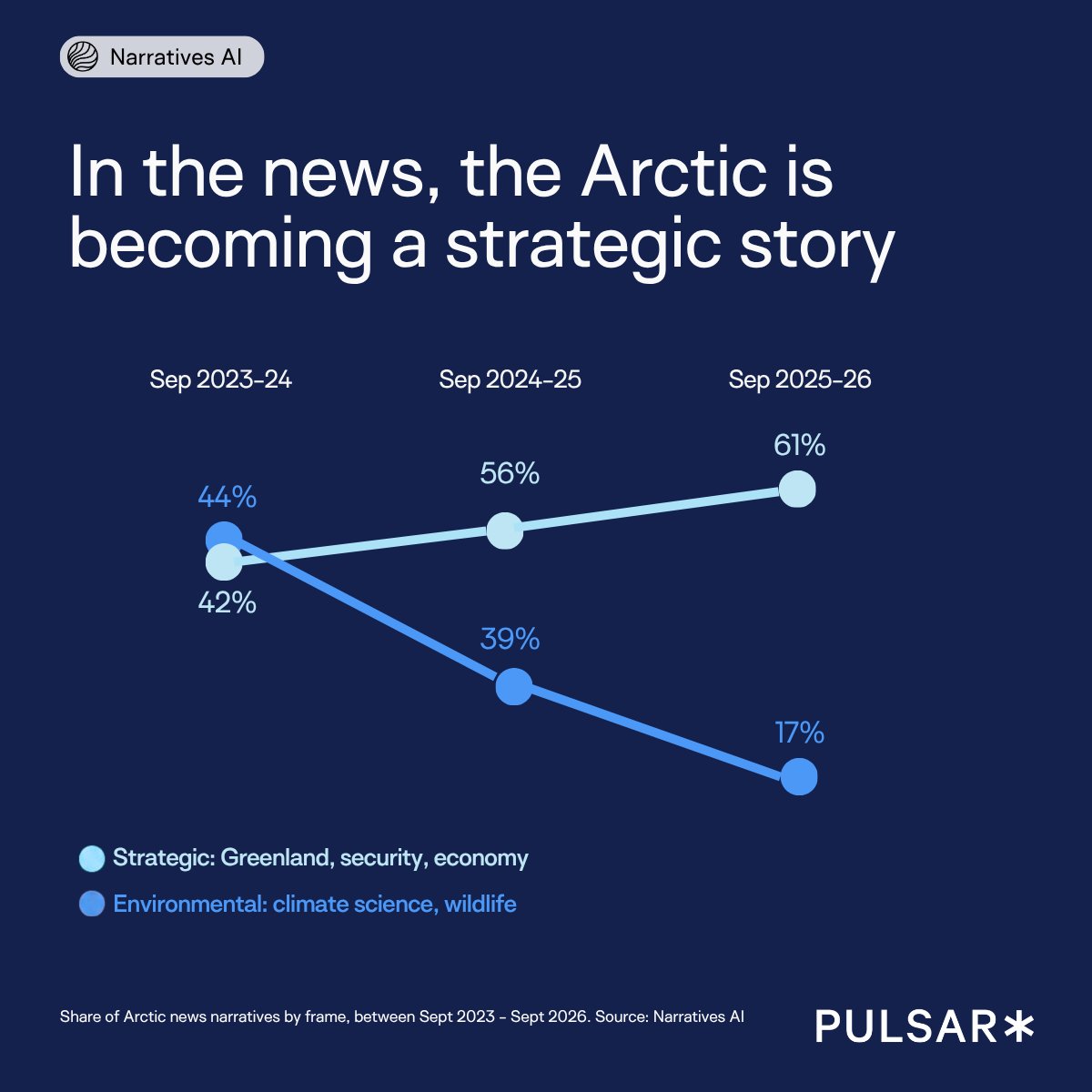
- Sovereignty, security and the economy now account for 6 in 10 Arctic narratives in both news (61%) and social media (59%). Three years ago it was 42% in news and 26% on social.
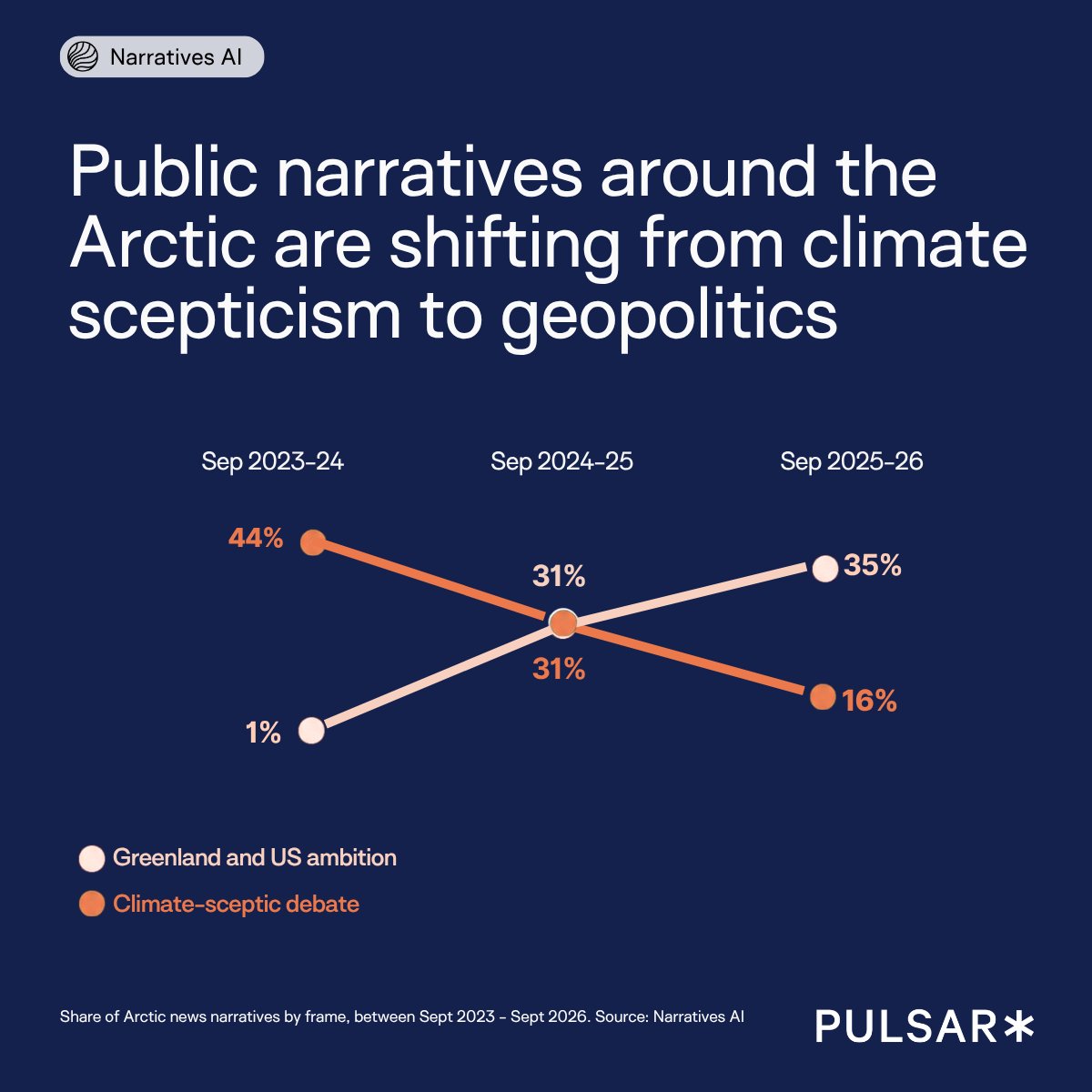
- Climate science and wildlife narratives fell from 44% to 17% of Arctic news coverage. The economy (shipping, energy, minerals) is now the biggest single theme, at 28%.
- Discourse is now driven by waves of geopolitical attention: in its busiest week, public attention to the Arctic in 2026 runs at 3.5 times a typical week, up from 1.9×. Every spike that could be traced to an event was geopolitical or a cold snap; none was a climate milestone.
- Indigenous and community voices make up only 0–5% of the Arctic narratives every year, in both news and social.
Full study in the comments ❄️🧊🏔️🐻❄️
#ArcticCircleAssembly #Arctic #CentralArcticOcean #ArcticGovernance #ClimateAction
What’s breaking out this fashion week?
Pulsar Narratives uncovers the stories gaining traction, from fandom’s mobilization and luxury brands becoming the language of the internet, to the mixed reception around the return of skinny jeans.
What’s breaking out this fashion week?
Pulsar Narratives uncovers the stories gaining traction, from fandom’s mobilization and luxury brands becoming the language of the internet, to the mixed reception around the return of skinny jeans.
Narratives about the Arctic have undergone a massive shift.
As the Arctic Circle Assembly gathers in Reykjavik, we trace how climate and wildlife narratives have fallen from 44% to 17% of Arctic news.
Meanwhile, Greenland, security and the economy are moving to the centre of the conversation.
Explore how narratives have evolved over both social and news media: https://t.co/c09C7eOeVj
How do you decipher a topic as loud (and fast-moving) as peptides?
We set Pulsar's autonomous research agent the task of mapping where audiences intersect with emerging trends and behaviors.
That meant capturing over 2.3M social and news media posts across the world.
Enriching the data with everything from entity detection to voice-to-text transcription.
And setting our research agent the brief of capturing which audiences are propelling the category, what platforms they're active on, and which behaviors and individual peptides are making their way into the mainstream.
https://t.co/YHj3vBrtP3
The peptide conversation is up 320% in a year: which audience communities are driving it, and why?
We set our autonomous research agent the task of mapping the conversation unfolding across social and news media, and how different brands show up in it.
It reveals a topic that’s reshaping culture, pharma and wellness across multiple dimensions, with the capacity to be more transformative still through new use cases, new peptides and increased adoption amongst different communities.
Dive into our interactive report to find out more: https://t.co/YHj3vBrtP3