We just solved a problem every brand has been living with for too long. Fire. 🔥 ❤️🔥 🔥
For years, crisis management has been reactive. You spot the fire when it’s already burning. By then, you’re in damage control mode: scrambling, explaining, apologizing.
Today, that changes.
We just launched Crisis Oracle, the first agentic AI system that predicts brand crises before they happen. A Precog for marketing and comms. 🔮
Not “detects early.” Not “monitors faster.” Predicts.
Here’s what makes this different 🧵
We've shipped a major upgrade to our predictive crisis agent.
The new release gives Comms, PR and Brand teams something better than a flooded inbox of undifferentiated alerts:
→ A universal, dynamic four-stage threat framework: Signal, Narrative, Escalation, Crisis so you know exactly where a story sits on the escalation path.
→ Multi-dimensional risk assessment: Spread (who's talking), Intensity (how aggressively it's moving), Amplification (how far it's reaching).
→ Asymmetric Risk detection to flag coordinated activity early, without crying wolf at every spike.
→ A completely redesigned alert: human-readable cluster titles, the metrics that matter at the top, and richer evidence across channels.
Validated against thousands of narrative clusters across hundreds of brands. Live now for all Pulsar clients, no action required.
Full breakdown → https://t.co/tCq5v0hDDL
Stop guessing. Start knowing. Introducing the new multi-dimensional Crisis Oracle.
Today, we’re excited to share Pulsar’s Upgraded Crisis Oracle, with sharper detection, threat staging and multi-dimensional risk scoring, informed by how teams have been using it. Detect, measure, and prioritize emerging threats with greater confidence.
https://t.co/LtKtIV5gHh
Italy is the clearest example of how a rich country can slowly destroy itself through decades of bad management.
Since the late 1990s, Italy has had almost zero productivity growth.
Real wages have stagnated. And public debt is now around 137% of GDP, projected to move toward 139% overtaking Greece as the highest in the eurozone.
It is the result of 25 years of
1. Low innovation and very low adoption of new technologies
2. Family and insider succession in many companies, weakening meritocracy
3. Underdeveloped VC industry, startup ecosystem and R&D base
4. Political capture by lobbies and organised crime
5. Extreme administrative, judicial and business bureaucracy
6. Political fragmentation
7. Demographic collapse
No country can remain rich forever if productivity does not grow, debt keeps rising and politics only manages decline instead of reversing it.
more like:
12am–6am PT / 7am–1pm GMT, you'll get no API calls, we'll just drop 529s back to back for 6 hours.
After that, if you're still trying to get anything done:
5am–11am PT / 1pm–7pm GMT, you'll move through your 5-hour session limits faster than before.
By the time your day is gone and you've accomplished less for more, we expect you to be so frustrated that you'll be ready to go back to OpenAI.
Anthropic just ran the SaaS pricing playbook so cleanly that most people won't notice until their credit card statement arrives.
Step 1: Double usage limits for free over Christmas (Dec 25-31). Step 2: Double them again for two weeks in March as a "thank you." Step 3: Recalibrate everyone's baseline expectations upward.
Step 4: Today's announcement. Faster session burn during peak hours. The weekly cap stays the same on paper, but your 5-hour windows now drain quicker when you actually need them.
I spent $45 on Extra Usage today alone. Not because I wanted to. Because I was mid-workflow on a newsletter and the alternative was stopping for hours. That's the conversion event Anthropic is engineering.
The December doubling was framed as a holiday gift. The March doubling was framed as gratitude. Both were market research. They proved the infrastructure could handle 2x load during off-peak, then used that data to justify tighter peak-hour rationing. The 2x promo was a load test with good PR.
Thariq says ~7% of users will hit limits they wouldn't have before. That 7% is the highest-willingness-to-pay cohort. They're the ones who will click "buy extra usage" instead of switching to ChatGPT. Revenue per user goes up without touching the $20 sticker price.
This is the same move every mature SaaS company runs. Keep the base price friendly so nobody churns. Introduce metered overages so your power users self-select into higher spend. Salesforce, AWS, Snowflake, Twilio. Every infrastructure company eventually discovers that usage-based pricing on top of a subscription captures 3-5x more revenue per account than flat tiers alone.
Anthropic just figured out their version. The $20/month Pro plan is the front door. Extra Usage is the real product.
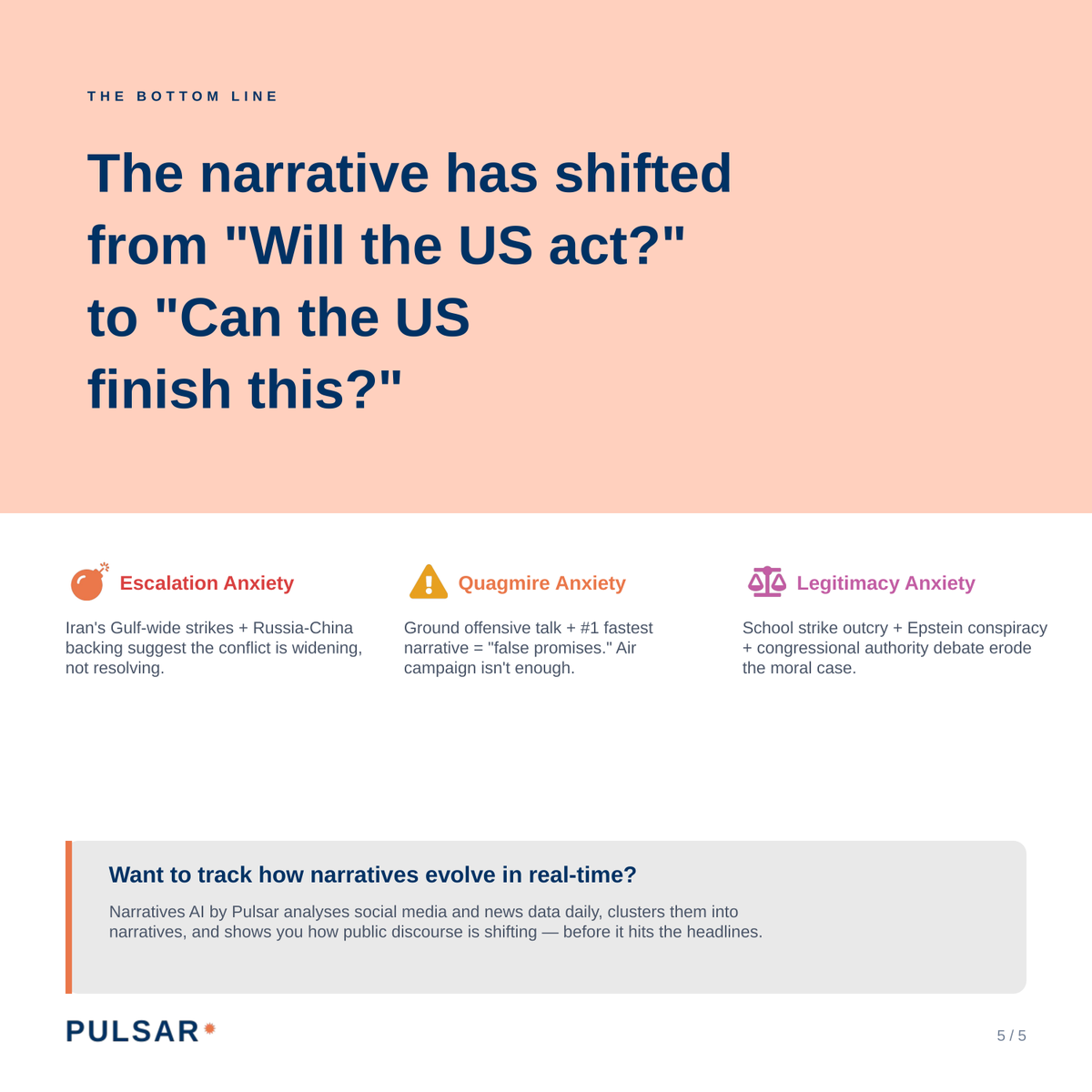
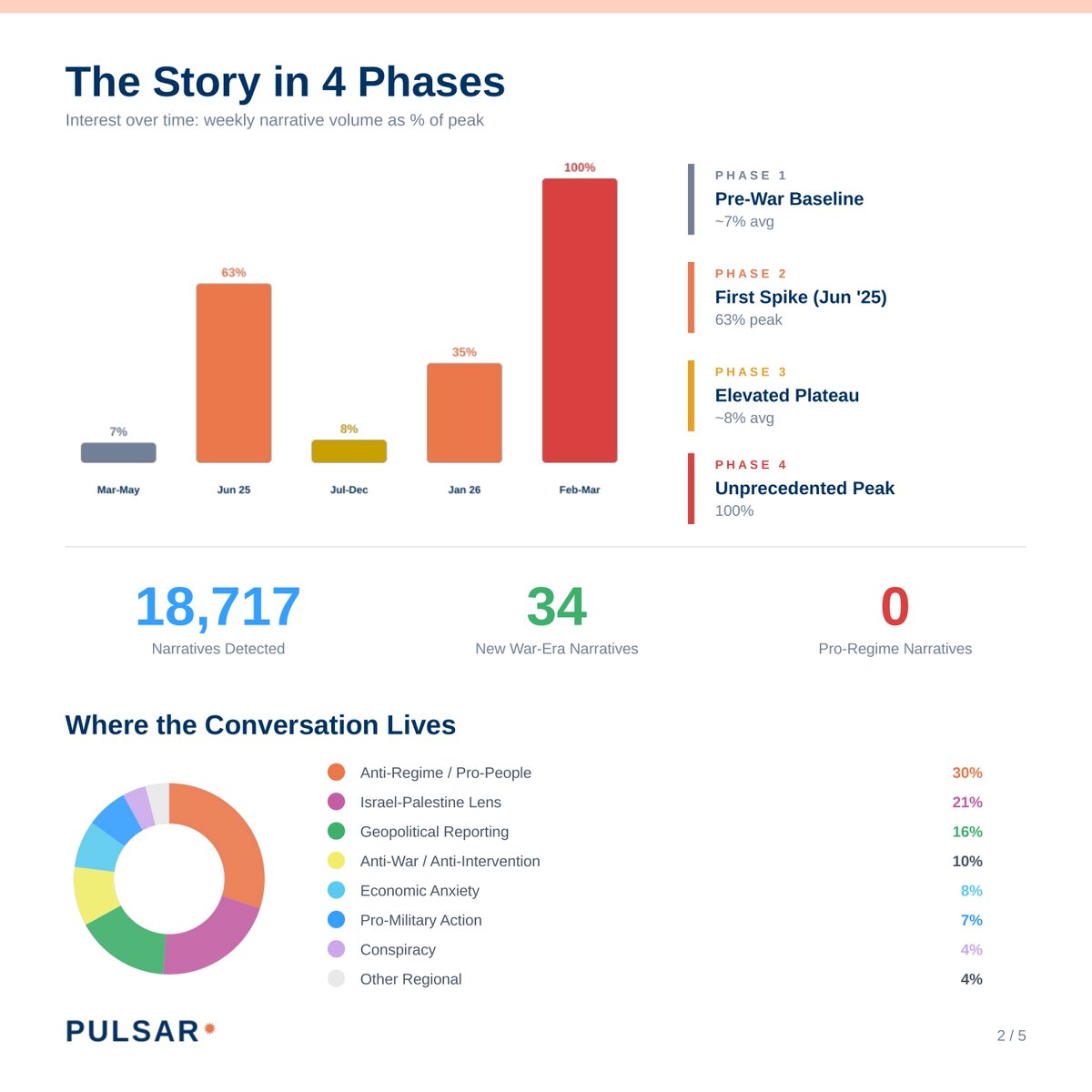
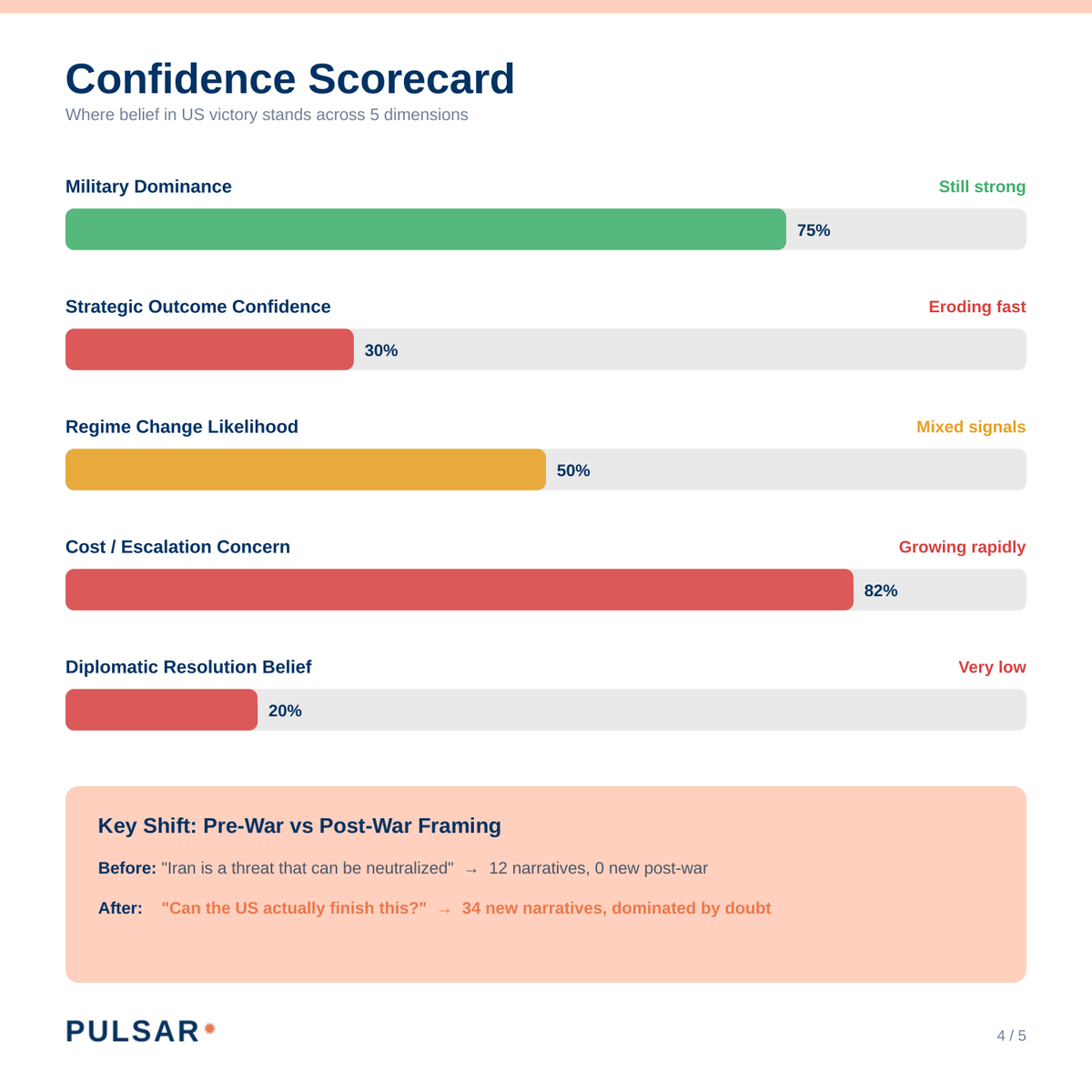
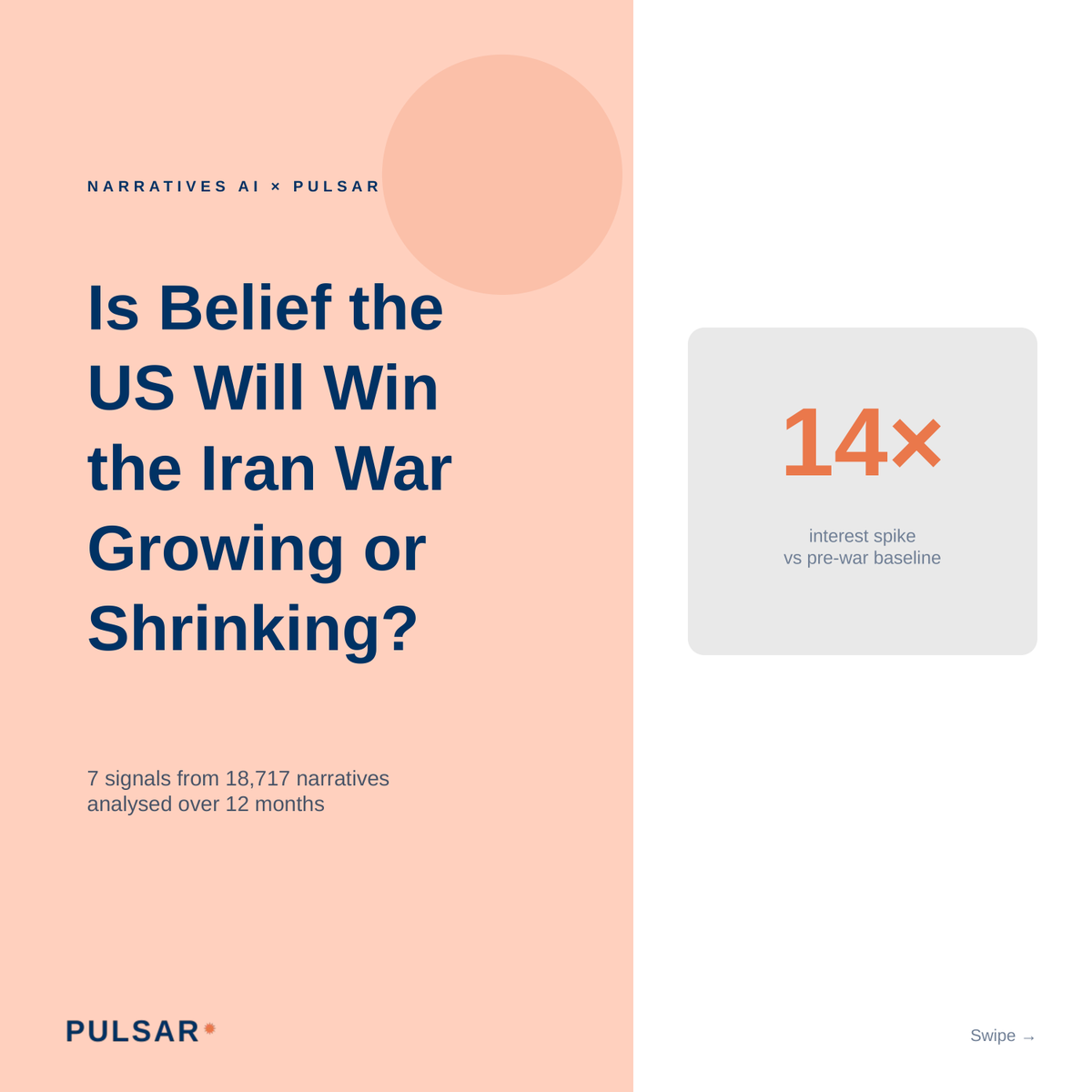
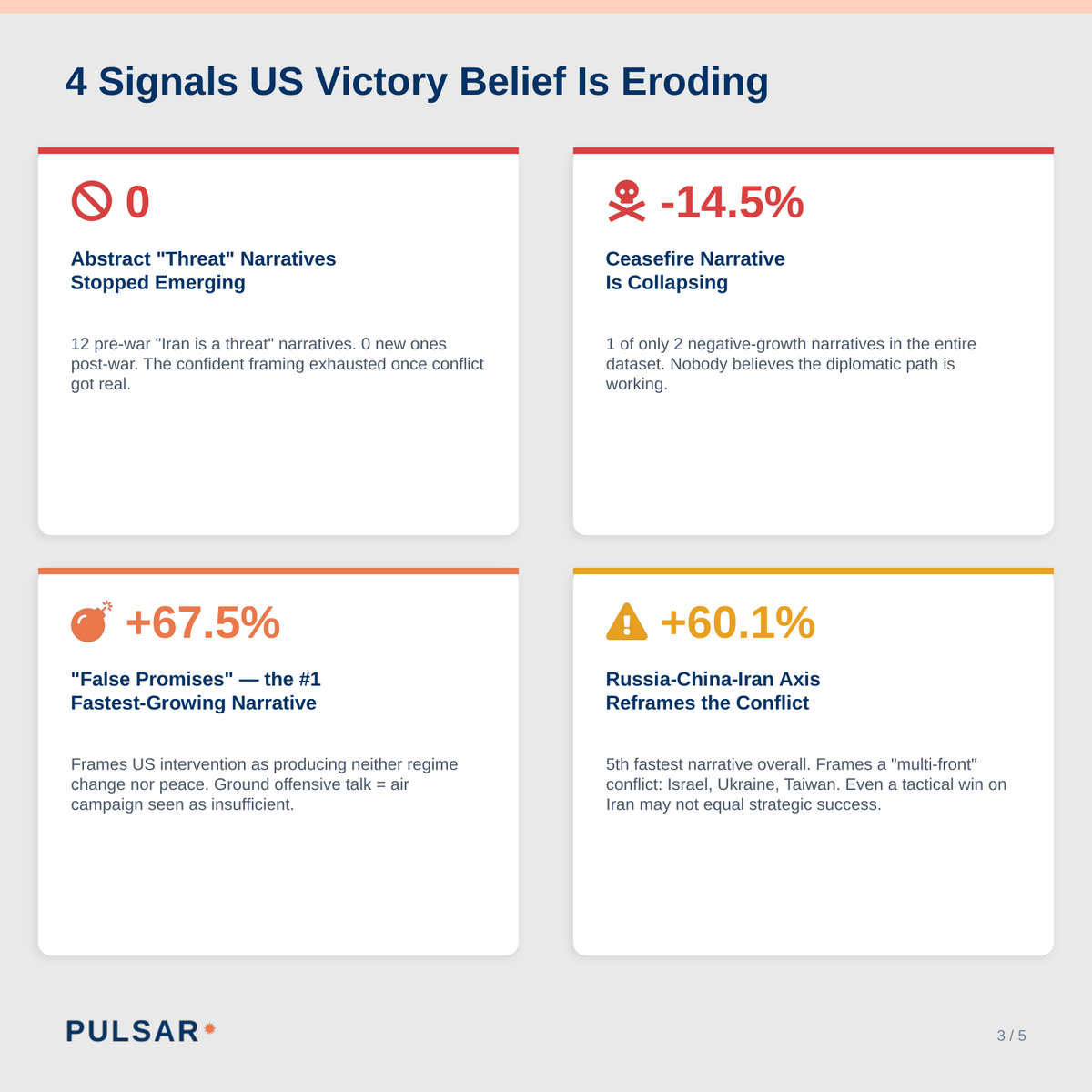
Is belief the US will win the Iran war growing or shrinking? We analysed 18,717 narratives over 12 months using Narratives AI by Pulsar. The short answer: military confidence holds, but strategic doubt is surging with "Trump's False Promises" now the #1 fastest-growing narrative at +67.5%.
Straight outta Narratives AI.
Is belief the US will win the Iran war growing or shrinking? We analysed 18,717 narratives over 12 months using Narratives AI by Pulsar. The short answer: military confidence holds, but strategic doubt is surging with "Trump's False Promises" now the #1 fastest-growing narrative at +67.5%.
Narratives AI + NotebookLM 🤯
Great chat with Erika Wheless of Ad Age on how trendspotting is changing.
We covered a lot but the evolution really boils down to two main shifts:
1) from content/behaviour to context/audience focus;
2) from cultural divination to scientific hypothesis testing.
Shift 1: from a focus on content to a focus on audiences. We've come off a decade of content-focused trend detection (and most social platforms are still high on that aka useless trending topics) and we're entering a new era that relies a lot more on measuring the audience context.
There's a reason for that: in a cultural environment where the definition of "mainstream" continues to fracture, emergent fringe behaviours are everywhere. So the key skill in forecasting becomes less about spotting emergence and more about understanding which fringe behaviour has trans-community appeal to establish itself as a cultural trend.
Shift 2: from a practice heavily dominated by qualitative methodologies, we can evolve to a practice based on the scientific method aka we can run experiments on culture.
Spot a trend, verify it's trans-community potential then simulate that trend against a synthetic audience that's gonna tell you exactly whether that trend is likely to fly with them and why.
It's a great time to be alive, whether you're human or AI 😘
If they want to spot trends today, "brands need to look at the ‘vibrant fringes,’” says @abc3d, founder and president of Pulsar, in an article newly published on @adage.
“These are niche, unconventional communities that exist outside the average consumer base but that have the potential to appeal to bubbles outside of the one they originated within."
"That’s a core skill of trendspotting today: spotting a fringe and assessing their trans-audience potential.” 🧵