I’ve made full episodes of #OperationEducation recently on how to prevent & tackle three of these. Last week’s episode was on equipment. This week’s ep is on uniform. Next week’s ep is on answering back. Every ep is full of practical & concrete strategies. Link below:
I wanted to write about my first day in one of England’s toughest schools.
Reading about this experience might bring into focus the problems faced by a small number of schools and help you consider how policy solutions fall short.
How common is this?
Link in post below
Our weekly substack offering @ChilternLT and this week, we look at Chunking in the context of the purpose of utilising memory 💪
https://t.co/i3Y97aBOZU
In this clip from the classroom, we see how carefully chosen models can be used to make abstract scientific concepts more concrete and accessible.
https://t.co/8US13MjLpu
#greatteaching#realclassrooms
Great teaching doesn't happen in a vacuum, neither does inclusive teaching.
Teachers play a vital role in making learning accessible to every pupil. But developing truly inclusive practice requires the right conditions, opportunities and support from school leaders.
So, how can leaders create an environment where inclusive teaching can thrive?
- Prioritise sustained, evidence-informed professional learning.
- Build a shared understanding of what great teaching looks like.
- Foster a culture of high expectations, collaboration and continuous improvement.
As Professor @ProfCoe explains in this clip from our new course: Great Teaching is Inclusive Teaching: Same ambition, better access, building collective expertise starts with a shared language and a focus on the things that really matter.
The course, whithin the Great Teaching Toolkit, helps schools develop the expertise to identify and reduce barriers to learning while maintaining ambitious goals for every learner. Inclusion isn't an additional initiative, it's part of making great teaching possible for everyone.
Find out more about the course here https://t.co/bg6st0JjXa
ICYMI: Our VP of Programs, Tracy Weinstein, answers 6 key questions about how students learn new concepts and apply that understanding in the classroom.
https://t.co/0KEV5IjUwk
"At first glance, a “Do-Now” is a simple classroom strategy. From the moment the students enter the classroom, the teacher has written the “Do-Now” on the board—it’s usually simple instructions for a task to activate hard thinking (often following the words “Do Now:” to signal to students to indeed, do it now).
But there are a few key ingredients for an effective “Do-Now”..."
Blog by CJ Rauch on "Do-Now" tasks for multiple purposes https://t.co/rxvlvBBywa
Final chance to sign up to the McGraw Hill webinar on Tuesday 24th November where I talk about securing 100% participation in lessons.
Sign up now. It's free!
https://t.co/8SM4uSsKc7
The aim is to ensure classroom activities direct students’ attention towards what we want them to learn and remember. Using a lesson based on Seven Blind Mice, Brett illustrates each step with practical examples.
Read the full guest edition: https://t.co/mTaSuSdj7Q
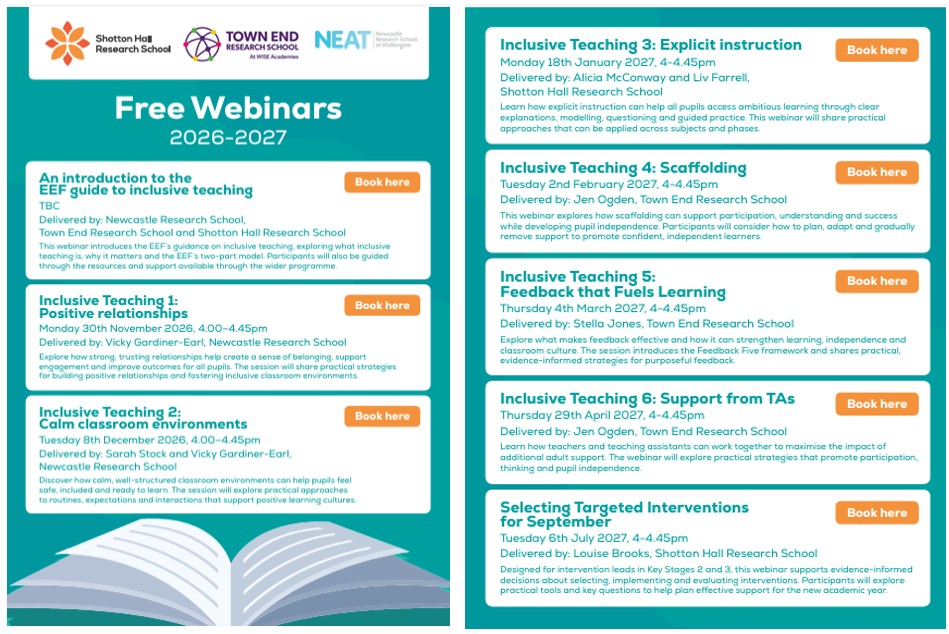
Prioritising Inclusive Teaching?
Join us @TownEndResearch & @ShottonResearch for a webinar series on embedding the EEF guidance on inclusive teaching!
Webinar 1:
Mon 9th Nov
4:00–4:45
See attached flyer for full series details.
Book Webinar 1 here https://t.co/JEjdiNt26o
Oracy getting equal status with reading and writing is the right call. Students who can't explain their thinking out loud rarely write it down well. The EEF rates oral language approaches at around +6 months' progress. Six talk moves to start with 👇