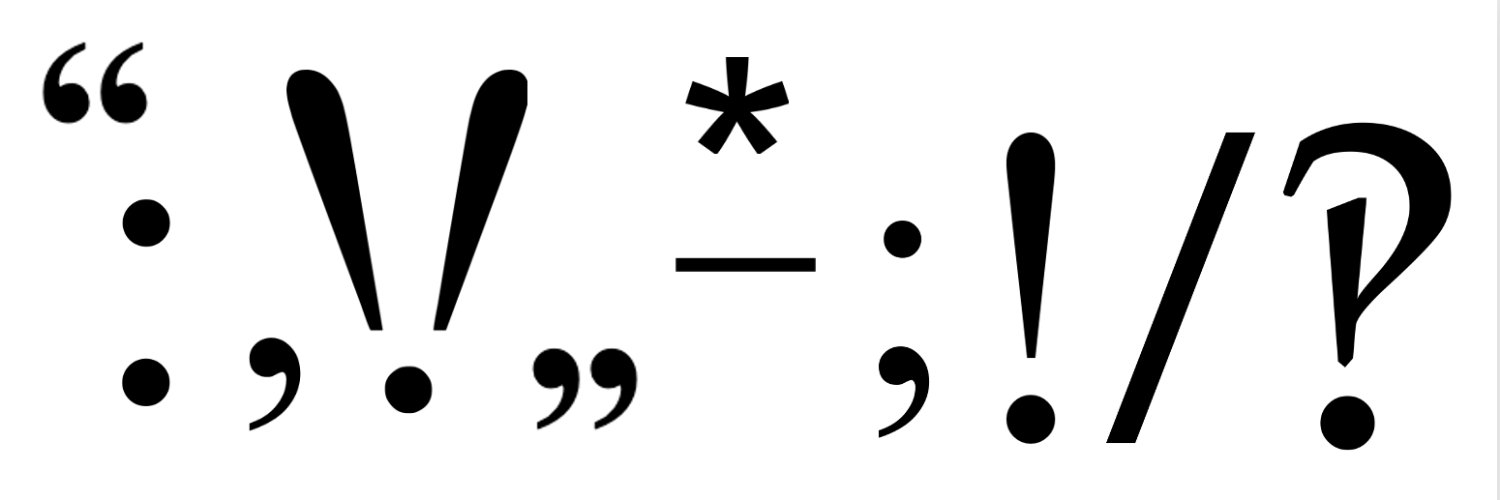
As a follow-up to yesterday's post: The @NewYorker really brought punctuation marks to life! See these wonderful and humorous dating profile descriptions of the most common punctuation marks by @theillustrious.
https://t.co/nB9mAs2PV1
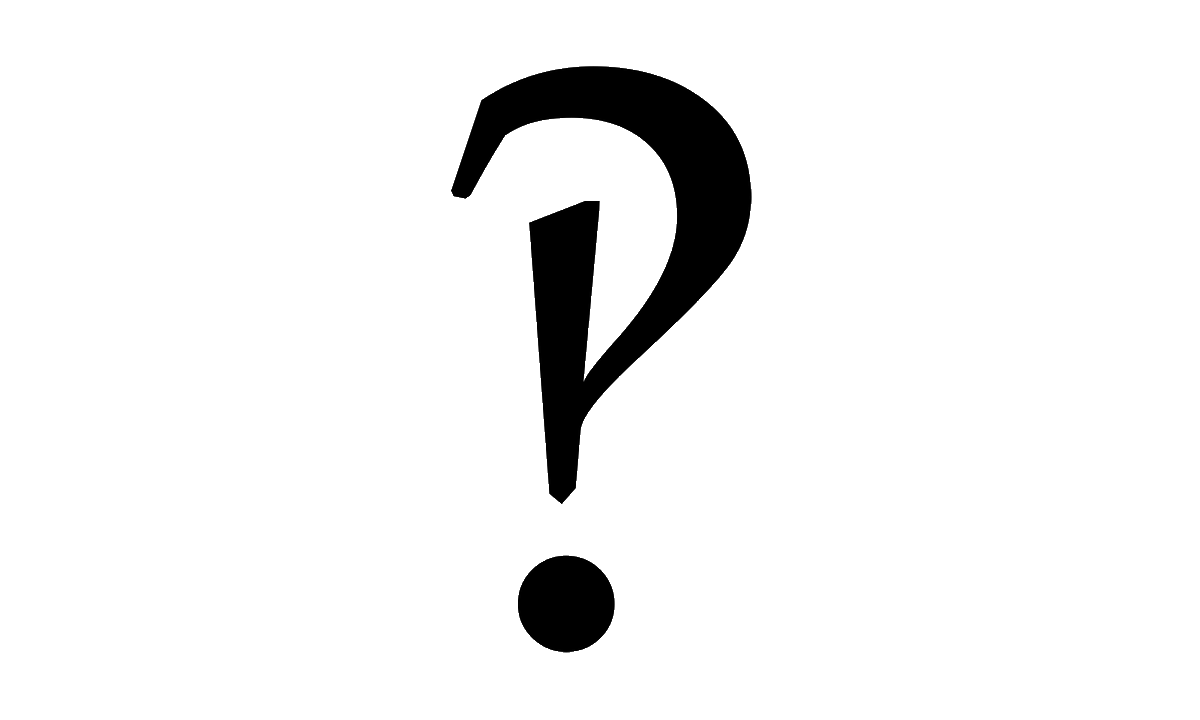
The interrobang can be used to express shock, excitement, bemusement, or disbelief in one single character. For example: 'How much did you pay for those shoes‽' Moreover, it can ask a rhetorical question like 'Who wouldn't want to be a millionaire‽' (2/2).
There are a number of alternative punctuation marks, the most famous one is probably the interrobang ‽, which was introduced by Martin K. Speckter in 1962 in New York. It combines an exclamation mark with a question mark (cf. @BBC_Culture; @PunctuationTalk). (1/2)
The colon and the semicolon are sometimes confused with each other. Both of them link together parts of a sentence, but how do they differ? What is their specific function? @TheSchoolOfLife wonderfully explained this in the video below: https://t.co/pTwWu0cxgD #colon#semicolon
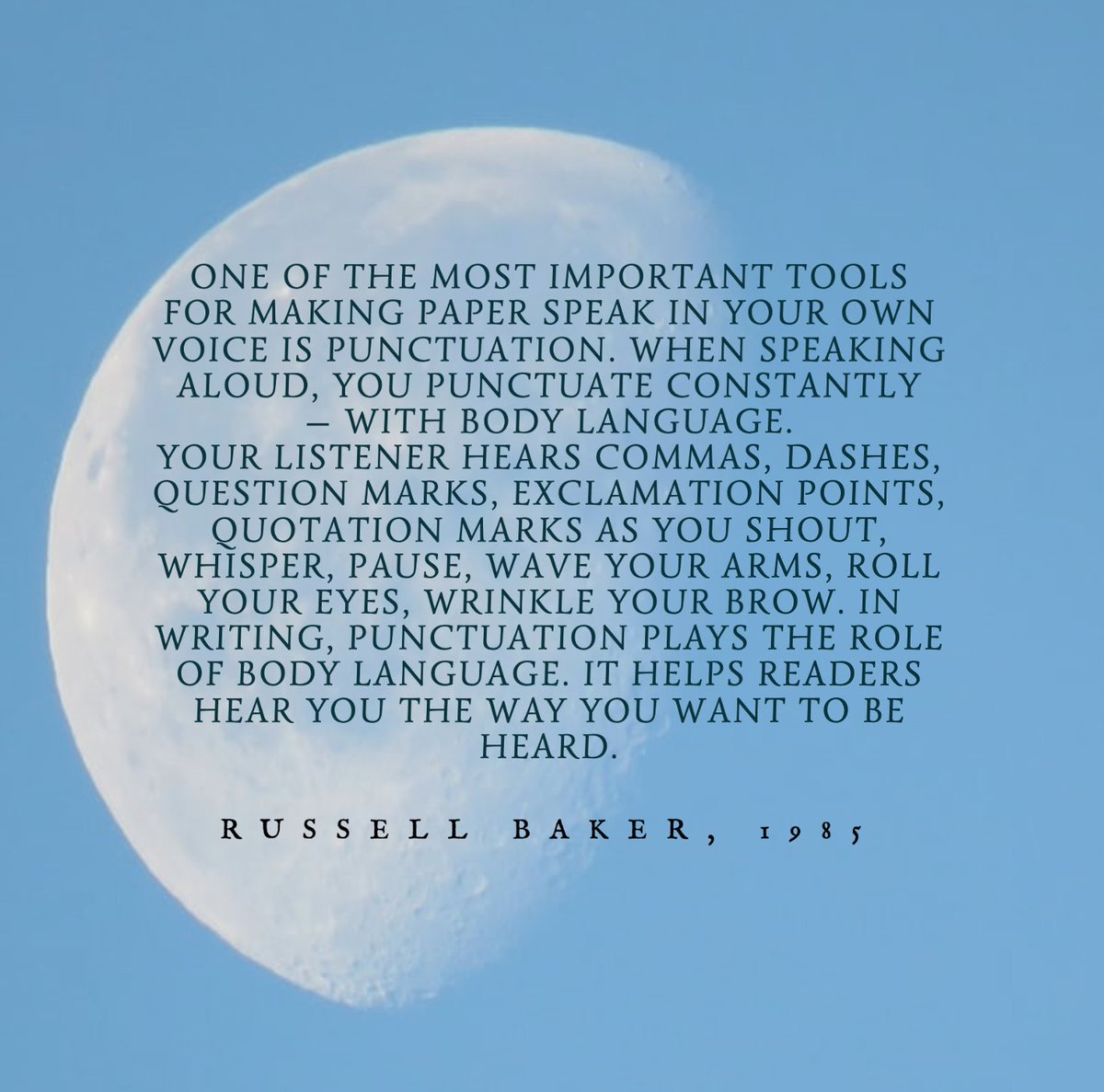
The American Pulitzer Prize-winning author Russell Baker compared punctuation to body language, see the quote below (cf. Baker, R. (1985). 'How to punctuate', in: How to Use the Power of the Printed Word). #punctuation#bodylanguage#russellbaker
Our modern punctuation systems didn't evolve until the 19th century. But experimentation with new marks and debate on existing marks are existing up to this day. This is where this account wants to build on: viewing the field of punctuation from various perspectives! #punctuation
When and how did punctuation evolve? Consider the inscribed stone 'Mesha Stele' from ca. 840 BC. It is written in the Phoenician alphabet and is regarded as the earliest known document that uses punctuation, at least an early sort of it, see below (cf. @EugeneByrne@HistoryExtra)
However, during this period of time, there was still lots of experimentation with punctuation marks. New ones were invented and discarded constantly. Also, the function of e.g. the comma or semicolon were to be gradually defined (cf. @g_blandin).
In ancient Chinese (400-300 BC), symbols to mark the end of sentences and chapters were used. However, in ancient forms of other languages like Sanskrit, Japanese, Korean, Arabic, and Latin no punctuation was used.
Around 260 BC, the Greek Byzantium introduced a formal system with dots placed at different heights: a dot on the baseline ended a unit smaller than a clause (komma), a dot at midheight ended a clause (kōlon), and a high dot ended a sentence (periodos) (cf. Otha Wingo 2011, Wiki)
To begin with: What is punctuation actually?
The word 'punctuation' stems from the Latin punctuare 'to mark with points and dots' and describes the insertion of marks into a text to divide structural units, indicate pauses, and aid interpretation (cf. @MerriamWebster, @OED).
Hello, world!
The purpose of this account is to share different perspectives on the linguistic field of punctuation. How did punctuation evolve? How does it differ between languages? What is the function of specific punctuation marks? Are there new punctuation marks developing?