Instant Ice With Fire.
No Electricity Needed.
You do not need any electricity to freeze water artificially. One effective approach relies on a surprising source: a strong fire.
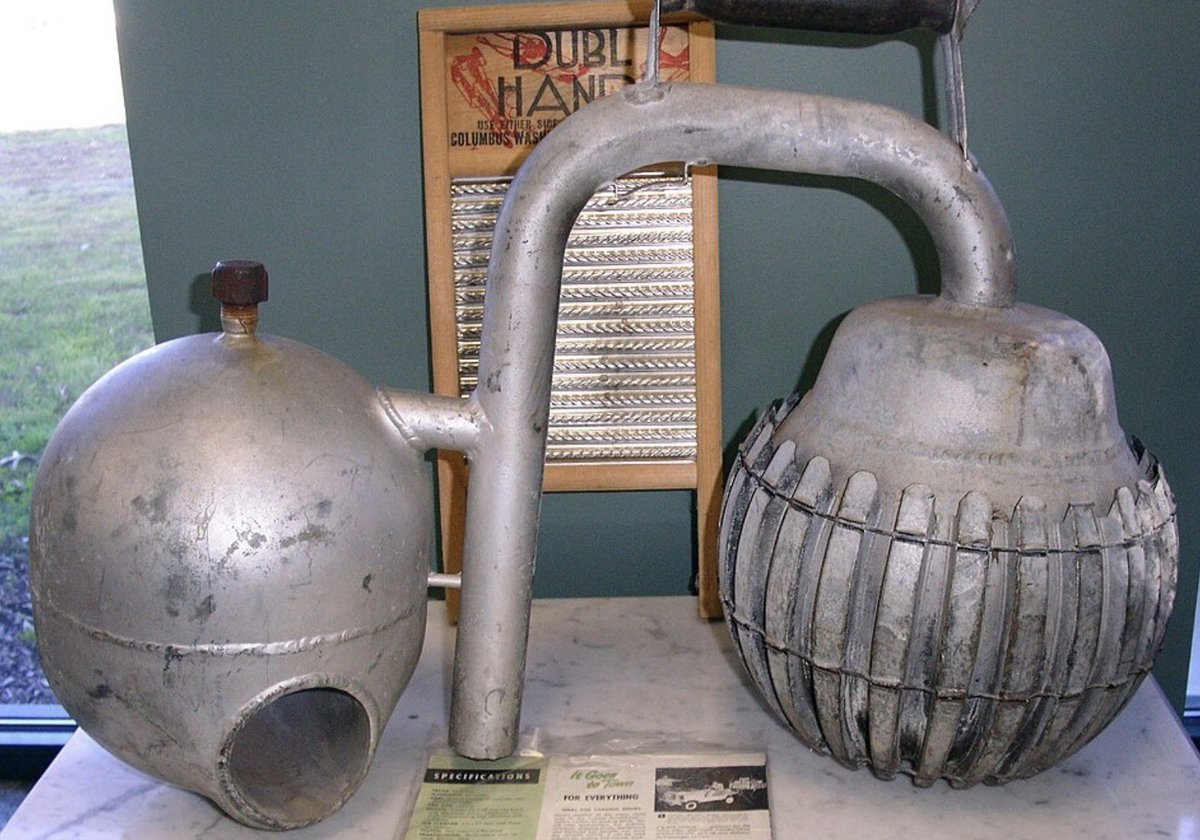
In the 1920s, before rural regions gained power, inventor Powel Crosley Jr. introduced the Icyball, a portable absorption refrigerator built for off-grid use. The unit features two large metal spheres linked by a thick steel pipe. A sealed blend of water and ammonia sits inside.
A Crosley Icyball refrigerator from the 1920s. The device relies on a sealed ammonia-water mixture to create ice without electricity. Photo by Jeremy Mikesellis licensed under CC BY-SA 3.0.
To operate it, someone sets the “hot” sphere over a kerosene heater or wood fire for roughly 90 minutes. The heat drives ammonia from the water. This gas moves through the pipe and turns into liquid in the “cold” sphere, which stays chilled in a water bucket during heating.
After heating ends, the unit leaves the fire, and the cold sphere goes into an insulated cabinet holding a water tray. As the hot sphere cools to room temperature, internal pressure falls. The liquid ammonia in the cold sphere then evaporates and returns through the pipe to mix with the water. This quick evaporation absorbs enough heat to drop the cold sphere below freezing, turning the tray’s water into ice cubes.If you lack a vintage appliance, you can freeze water through chemistry.
Dissolving ammonium nitrate—the active ingredient in instant cold packs and many fertilizers—in water breaks chemical bonds and absorbs ambient heat. Mixing equal parts by weight in a large bucket can drop the slush to 5°F (-15°C). A smaller metal cup of fresh water placed in this bath can freeze solid within minutes.
A third approach uses the cold vacuum of space. Ancient Persians constructed shallow pools behind tall walls to block sun and desert winds. On clear, dry nights, water radiated thermal energy into the sky. Because the atmosphere does not block this infrared radiation easily, water can freeze even when air reaches 41°F (5°C). The ice was stored in large, insulated domed structures called yakhchals to supply ice during blistering summer months.
Stringman is now $795 and has an MCP server for agentic control. Use it to give your desk-bound arms access to any item in the room. It's a cable robot suspended from the ceiling by braided line. https://t.co/1PJvFdtVzv
Photographer Hadlee Renjith captured the rare Melanobatrachus, also known as the Galaxy Frog, deep in the forests of Munnar, Kerala. Its skin is dotted with tiny blue speckles that look like stars across a night sky.
(Via @hadlee_renjith)
@haywardm913@DamonStrong I would actually like to see every possible humiliation and torture method tested out on him. Nothing should be quick about his end.