"…from the very inception, the RSS was anti-Congress and they were willing to join hands with the British. When the biggest movement (the Quit India Movement) happened, the RSS and the Hindu Mahasabha were collaborating with the British. They were also collaborating with the Muslim League to form government."
— Prof. Aditya Mukherjee
Watch the full interview: https://t.co/0mi6aliaqy
An enumerator from Rajasthan told The Hindu on condition of anonymity, “In the mobile app, if we enter that a household has a tin roof, we are asked by our superiors to change it to concrete. Are we supposed to lie? Similarly, if the house does not have a toilet and occupants are defecating in the open, we are told to check if there is a toilet nearby, even that of a neighbour or a relative, which they may be using occasionally or even a public urinal. Then the entry can be changed from ‘open defecation’ to having access to a toilet.”
📢 We're hiring!
Join our team at Sansad Hub and help shape progressive public discourse through policy research, stakeholder engagement, and strategic communication.
📩 Send your CV: [email protected]#Hiring#PublicPolicy#ThinkTankJobs
There is a memory I carry with me from my years as a civil servant. It has never left me....
Back then, I had just been transferred as Collector to Mangalore, a city then shadowed by communal violence and a menacing sand mafia. Before I left, word came that the Chief Minister wished to see me personally. It was unusual. Collectors don't typically get called in. I walked into his chamber with a knot in my stomach.
He looked at me, that familiar, unreadable face. Steady. Unhurried.
"Banri…" he said. (Come in.)
"Nimage ondhe kelasa… alli ennum communal aaga baradhu."
(You have only one job there. No communal incident should happen.)
That was it. No preamble. No politics. No performance. Just a Chief Minister, alone with a young IAS officer, telling him exactly what mattered. In that single sentence lived an entire philosophy of governance. one rooted not in optics, but in the protection of ordinary people from extraordinary hatred.
Fifteen days later, Mangalore erupted. Two communal murders, two communities, one city on edge. He called me again. Just as directly.
"DC... Do what is required. Take anyone into custody, even our party people. Don't bother. But stop this within a day."
To a young collector, those words were everything. They were permission. They were protection. They were political will at its most honest.
I have known the contrast too. Under a different dispensation, in a similar crisis, the instruction from the top was the opposite. Do nothing strongly. Let things fester. …That silence said everything about who governs for whom.
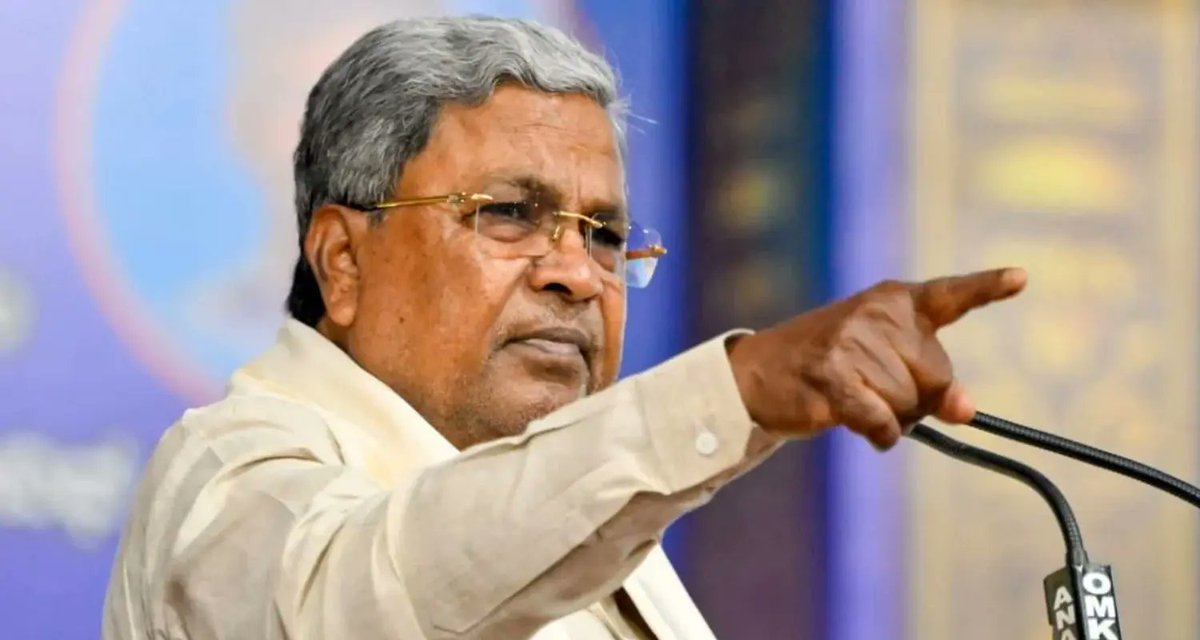
Siddaramaiah Ji was never that kind of leader.
He carried government finances in his fingertips and social justice in his spine. He refused to tour places that reeked of feudalism. He spoke plainly, governed sharply, and stood on the side of the last person in the room.
If there was one political figure I have genuinely admired, from the stage and up close, it has been him. His legacy is not in the schemes he launched or the budgets he read. It is in the kind of Chief Minister he chose to be when no one was watching. . On that quiet phone call. In the way he asked a nervous young officer to go out and keep the peace.
And now, as he steps back with the same quiet dignity with which he always led, I find myself moved. He has handled this transition with the grace of someone who always knew that principles outlast positions.
Siddaramaiah Ji....long life, good health, and please keep guiding us. The Congress, and this country, still needs the kind of moral clarity only you carry so naturally.
A few weeks back I had spoken at the Launch of the book “The Business of Business is (not) just business : How Behavioural Tools Can Drive Real Change” written by @sutapaban published by Harper Collins.
The session was moderated by Safi Rizvi and Sutapa and I were panelist’s.
I was reminded of this when I just saw a piece in The Print about it
https://t.co/xTPTzipMNC
The book is full of insights about how knowledge of human behaviour gives insights that can influence and drive businesses and business strategy.
In my chapter in this book I discuss how observation of my colleagues’ behaviour provided the germ of the idea of https://t.co/BkHdgvhlm7
One other gem that Sutapa spoke about at the launch was that it has been proven that males display alpha behaviour on the trading floor and end up taking excessive risk and therefore lose money precisely because they are men and have excessive testosterone. Female traders don’t exhibit the same behaviour. She implies that trading and investing firms should hire more females.
A book worth reading and thinking about.
https://t.co/9oXQnaC2da
Disclosure - Sutapa and I are
Colleagues on the Eternal board. She chairs the Audit Committee.
@zomato@letsblinkit@deepigoyal@albinder@akshant_g@InfoEdgeVC@kitty_agar
In June 1954, two legendary Indians were touring the USSR for entirely different reasons - the brilliant scientist and statistician P.C. Mahalanobis, and the prominent writer and filmmaker K.A. Abbas. Wherever Mahalanobis went, he was amused by the constant, reverent references to Prime Minister Jawaharlal Nehru. Attending a Sunday church service in Leningrad, he observed, "Some of the women were so overcome to speak of India and Nehru that they began to cry softly - tears came to their eyes in an upsurge of feeling."
Meanwhile, in a completely different part of the country, Abbas was touring with his Soviet writer friends. When they stopped in a small town for lunch, one of his comrades raised a glass, "To Nehru-the most important man in the world today." To Abbas's utter surprise, everyone in that small luncheon, including the waiters and waitresses, instantly joined in the toast.
That was the sheer popularity and charisma of Jawaharlal Nehru. He didn't need to burn millions hiring PR agencies to stage manage his image like the politicians of today. He left us on this very day in 1964, perhaps broken by the aftermath of the Sino-Indian War but he was a giant of a man. If our democracy still functions even at a fraction of its potential today, it is because his years in office laid the foundational stepping stones.
#Nehru
Ref : Planning Democracy - Nikhil Menon
Pic : The Hindu
PM @narendramodi is again asking Indians to bear the cost of his Govt’s failures. The question is why we’re repeatedly asked to sacrifice so much (after 12 years of supposedly strong leadership forging a Viksit Bharat & Amrit Kaal). In @thewire_in.
https://t.co/CzeGRXXSK9
The @BJP4India’s relentless attack on regional parties may transform India into a bipolar or a one-party polity. The latter will inevitably also mean one leader, ideology & way to be Indian.
I explore how progressives can fight back in @thewire_in today.
https://t.co/7iRr4LhaRl
"Jana Gana Mana" (Bengali: [ɟənə gəɳə mənə]) is the national anthem of India, originally composed in Bengali by poet Rabindranath Tagore, who was awarded the #NobelPrize in Literature in 1913.
Pictured: An English translation of Jana Gana Mana by Tagore
Every government since independence has prudently championed India’s aspirations & needs globally, while striving to forge an equitable world order.
Unfortunately, these efforts have been methodically undermined by the @BJP4India who has pursued a myopic ideological alliance with right-wing & far-right parties. This is costing India dearly, which conscientious patriots are deeply concerned about. @PushparajVD & I write in @the_hindu today. @INCIndia@RahulGandhi@kharge@AICCMedia
I was startled by @PushparajVD 's reminder that we have only '1,100' days until the next general election. So much for the opposition to do in such a short span of time, it's nerve-racking.
The @BJP4India’s relentless attack on regional parties may transform India into a bipolar or a one-party polity. The latter will inevitably also mean one leader, ideology & way to be Indian.
I explore how progressives can fight back in @thewire_in today.
https://t.co/7iRr4LhaRl
From non-alignment to blind alignment with right-wing conservatism - India’s foreign policy has taken a clear downgrade.The country is already paying the price. A scathing piece by @salman7khurshid ji & @PushparajVD ji.
The BJP government’s growing alignment with right-wing regimes and partisan networks across the United States, Europe, and West Asia is steadily eroding India’s long-standing tradition of independent and balanced foreign policy.
Such ideological adventurism has already led to diplomatic strain, damaged India’s credibility, and weakened our moral leadership in the Global South while exposing the country to avoidable geopolitical and economic costs.
India’s global standing was built on strategic autonomy and principled internationalism. It must not be compromised by partisan foreign policy choices.
#ForeignPolicy #StrategicAutonomy #GlobalStanding #GlobalSouth
Opinion | BJP’s global right linkages raise concerns over India’s image. Such alignments may carry diplomatic costs and shape its global role. Implications for foreign policy remain in focus, writes @salman7khurshid and @PushparajVD
https://t.co/zJI9UVUEyx






![NobelPrize's tweet photo. "Jana Gana Mana" (Bengali: [ɟənə gəɳə mənə]) is the national anthem of India, originally composed in Bengali by poet Rabindranath Tagore, who was awarded the #NobelPrize in Literature in 1913.
Pictured: An English translation of Jana Gana Mana by Tagore https://t.co/8HFwLDToKh](https://pbs.twimg.com/media/HHnP9vYWIAUirCp.jpg)


