No better place to get a glimpse into the various tools @EBRAINS has to offer (https://t.co/pYy3luBzWr). Choose from over 16 tutorials for software that are already offered. I will also be there with a tutorial on #ephys data analysis and data handling with Neo. See you there!
Register for the EBRAINS Tutorials and Users Day on 12 March in Heidelberg!
Newcomers will have the chance to explore the wide range of Open Science tools and services available on the research infrastructure, while seasoned EBRAINS users can dive deeper with advanced tutorials and discuss with developers.
Find out more: https://t.co/Ni3mJNv0SM
@EBRAINS can be a home for your #Neuroscience software, too. Find out how EBRAINS builds an infrastructure to foster #interoperability. And you can also meet me there!
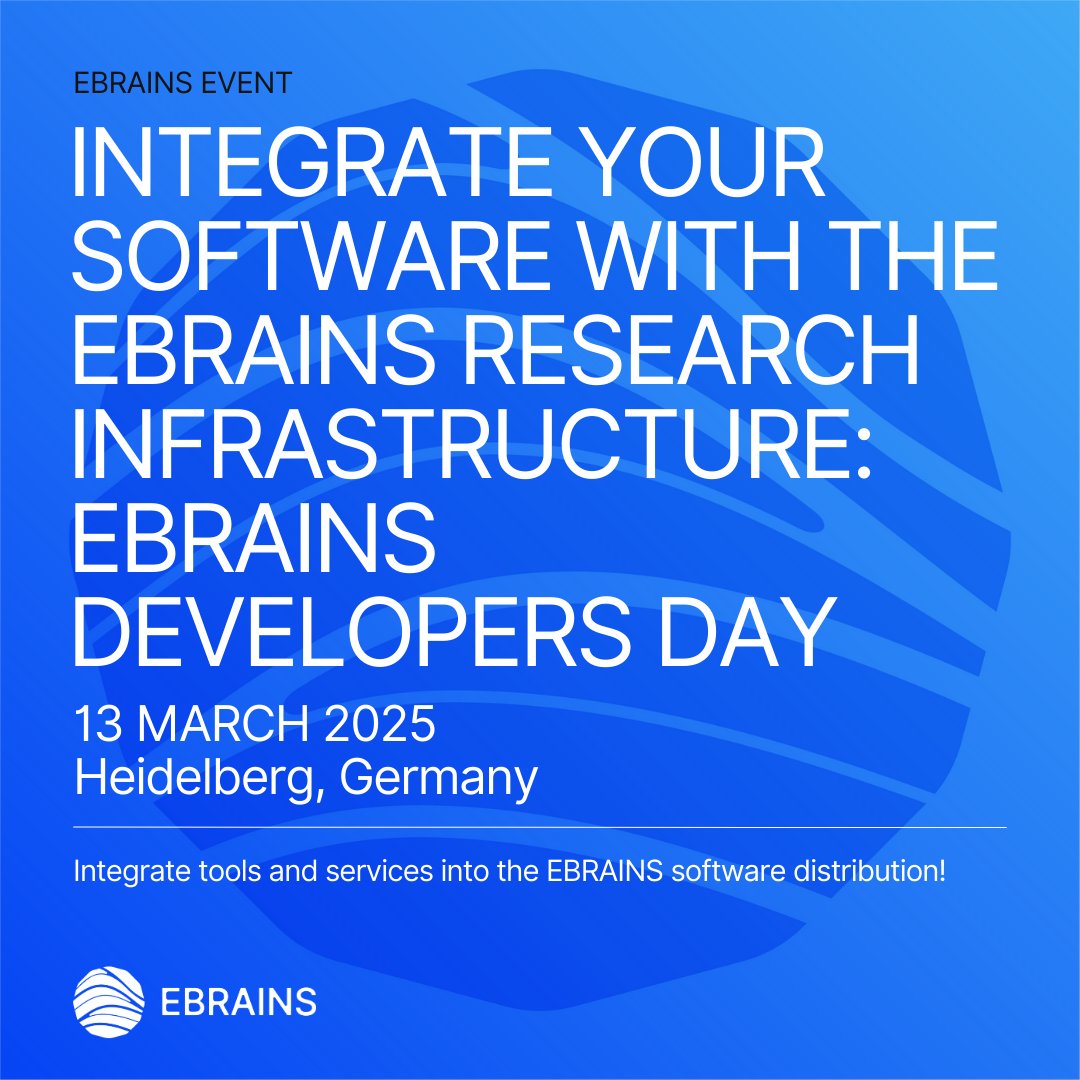
Register for the EBRAINS Developers Day on 13 March in Heidelberg!
It will feature introductions for developers on how to integrate tools and services into the EBRAINS software distribution or to integrate services via EBRAINS (workflows).
Find out more: https://t.co/5ohdEDqzwt
📆⏳Deadline extended, spots left: Advanced Neural Data Analysis and Neuroinformatics School (ANDA-NI)!⏳📆
🔬 Learn data analysis techniques on your favorite electrophysiology datasets!
📅 Apply by August 21, 2024
🌐 https://t.co/vNSrculTQt
@gnode@IbehaveNetwork@EBRAINS_eu
🏃♀️🏃♂️Hurry to apply for the Advanced Neural Data Analysis and Neuroinformatics School (ANDA-NI)!🏃♂️🏃♀️
🔬 Expert hands-on training in analyzing and managing your own electrophysiology datasets!
📅 Apply by Jul 31, 2024
🌐 https://t.co/vNSrculTQt
@gnode@IbehaveNetwork@EBRAINS_eu
🚨 Exciting News! 🚨 Announcing the Advanced Neural Data Analysis and Neuroinformatics School (ANDA-NI)!
🔬 Master techniques for analyzing and managing your own electrophysiology datasets.
📅 Apply by July 31, 2024.
🌐 https://t.co/vNSrculTQt
@gnode@IbehaveNetwork@EBRAINS_eu
Wouter Klijn, EBRAINS Science and Support Team, @fz_juelich presented the conceptual architecture of EBRAINS and the different workflows, showing concrete examples of use cases.
Explore over 160 different tools 👉https://t.co/JhMCApSklr.
#FENS2024
Come and visit the software booth at this year's Bernstein Conference in Berlin to learn more about tools for computational neuroscience, the EBRAINS infrastructure, G-Node, and locate your research on the map of neuroscience software. @BernsteinNeuro@HBP_Education@gnode
Thank you all for attending today's tutorial at the CNS conference in Leipzig! And please remember to consider indicating tools and services useful for your research in this short EBRAINS survey open until Monday: https://t.co/RjhW4MhXIY
Want to know how to practically apply tools such as gin, Neo, Nix, Alpaca and myself for analyzing electrophysiology data? Join us for a hands-on tutorial at CNS 2023 in Leipzig, July 15! Details: https://t.co/JELQtbipGe @gnode@INCForg@BernsteinNeuro@NFDI_Neuro@HBP_Education
If you find me, Neo, NEST, or any of many our friends from the large range of #openscience EBRAINS tools and services useful for your current or future research, please consider to support us by letting us know in this short EBRAINS survey: https://t.co/RjhW4MhXIY
Excited to meet you at the "Simulation and Modelling Workflows" Booth at the HBP Open Day in Marseille to discuss about Neo, myself, our new friends Cobra and Alpaca, and many other exciting tools developed in the context of #EBRAINS! @EBRAINS_eu@HBPNeuroinf@gnode
🥳 Our "Simulate with EBRAINS" infrastructure training has just started!
📢 Registrations are free, required - and *still possible* for the more spontaneous ones among you!
Agenda: https://t.co/cENsdAur5I
Registration (requires @EBRAINS_eu account): https://t.co/kcNb0nqmE3
Join us on 7 November for the 'Simulate with EBRAINS' online workshop!
We'll give you an overview of how to #simulate with EBRAINS, from the #infrastructure level to simulations at multiple scales.
You can still register here: https://t.co/NuqL9aicqo
📢INCF endorses Neo as a standard!📢
The Neo object model was created to facilitate interoperability b/w tools for analyzing, visualizing, & generating #electrophysiology & #optophysiology data.
Community review clearly showed its value to the community:
https://t.co/PjZJlYqPlq
#NESTDesktop is an awesome graphical tool to build models for the @NestSimulator and simulate them. We're joining forces to work towards making my functions available to analyze the resulting simulated spike data.
Last week, we had a great workshop on future developments and research around tools like #NESTDesktop, @PyElephant, #NESTML and @NestSimulator in our lab! Really enjoyed meeting with friends from @fz_juelich and @UniFreiburg! Thanks for coming!
Elephants need neural data to analyze -- but what are the barriers that prevent such data to be shared and re-used? Consider to participate in the latest INCF survey to help understand these barriers: https://t.co/n6NKPMA2c5
Thank you to everyone who attended the EBRAINS Training on Brain Atlases and Simulation Services for @AustrianNeuros1 Members last week!
Attendees learned about the EBRAINS Human Brain Atlas, @NestSimulator, @PyElephant, and more.
Read more: https://t.co/HMIXdXEAxQ #ANATraining
How can we capture the individual steps and choices we took in analyzing an electrophysiological dataset? See an elephant-inspired approach presented by Cristiano Köhler at today's @INCForg#Assembly2022 session organized by @NFDI_Neuro.
Tomorrow, join us for the online Neo-Elephant Tutorial at CNS*2022 starting at 9am CEST. Visit https://t.co/klMPZdkbi6 for details! @HBP_Education@gnode