Q-Chem provides a comprehensive ab initio quantum chemistry program, allowing scientists worldwide to solve computational problems quickly and accurately.
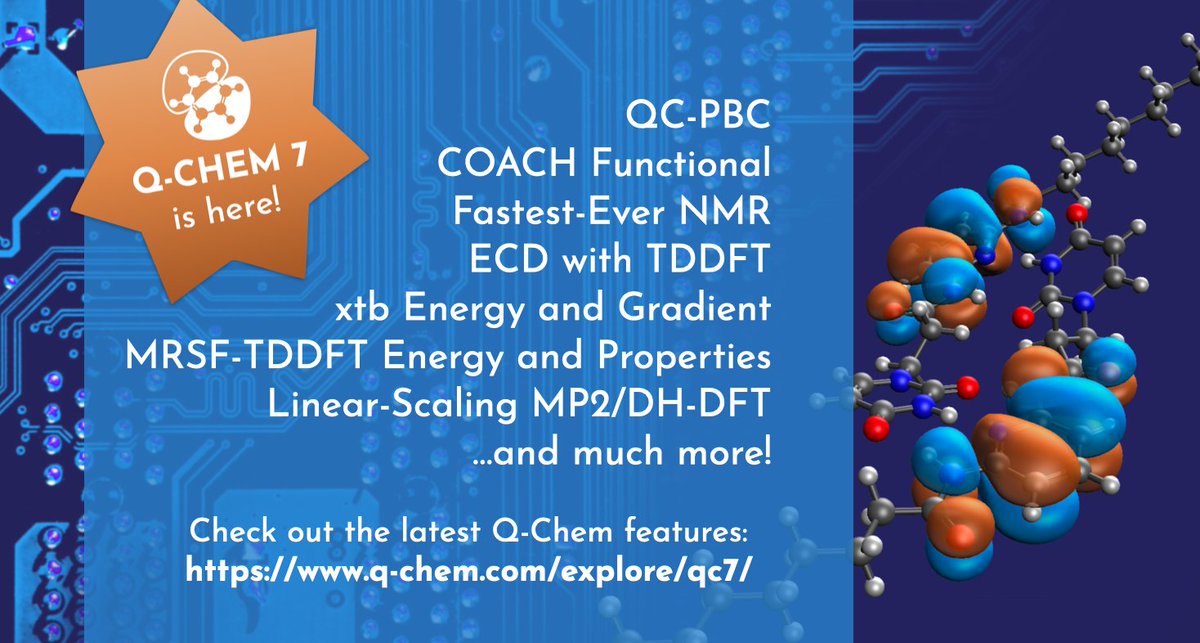
Q-Chem 7 is here! Read about the latest features, including new DFT functionals, numerical sparsity speedups, faster NMR, MRSF-TDDF, and more: https://t.co/eD8aArkboF
Request a free, month-long demo of Q-Chem and QC-PBC, free of charge: https://t.co/qkB9eRD0wW
#compchem
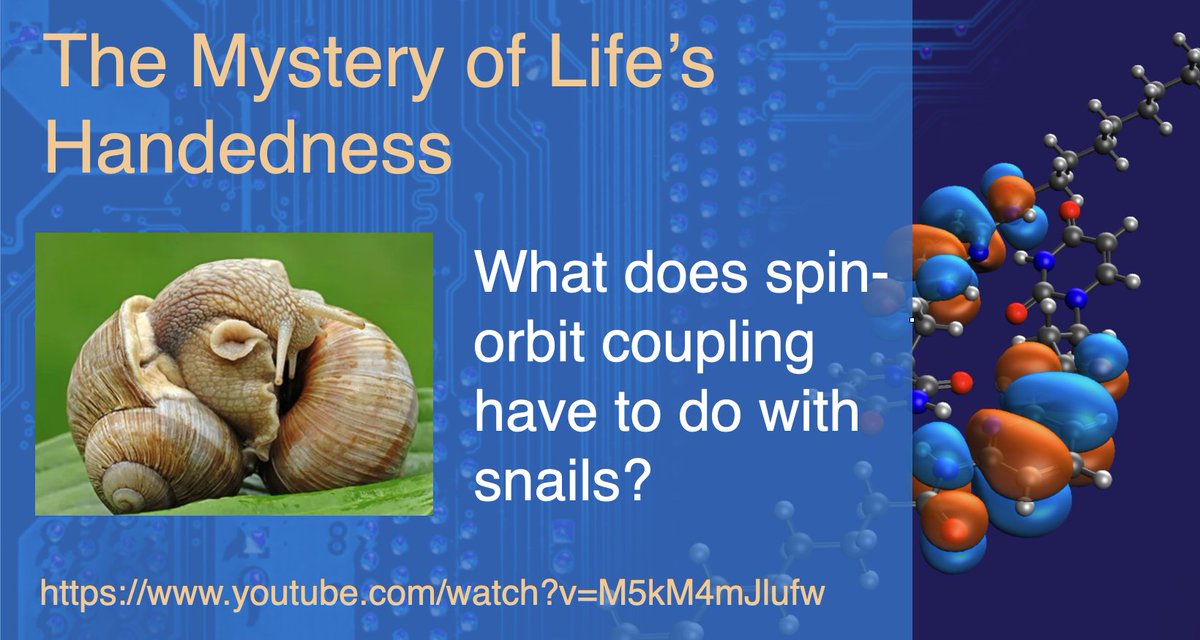
Explore the mystery of life's molecular chirality and how recent research using Q-Chem reveals a possible quantum-mechanical explanation for its origins. https://t.co/pfMJqCZx1L
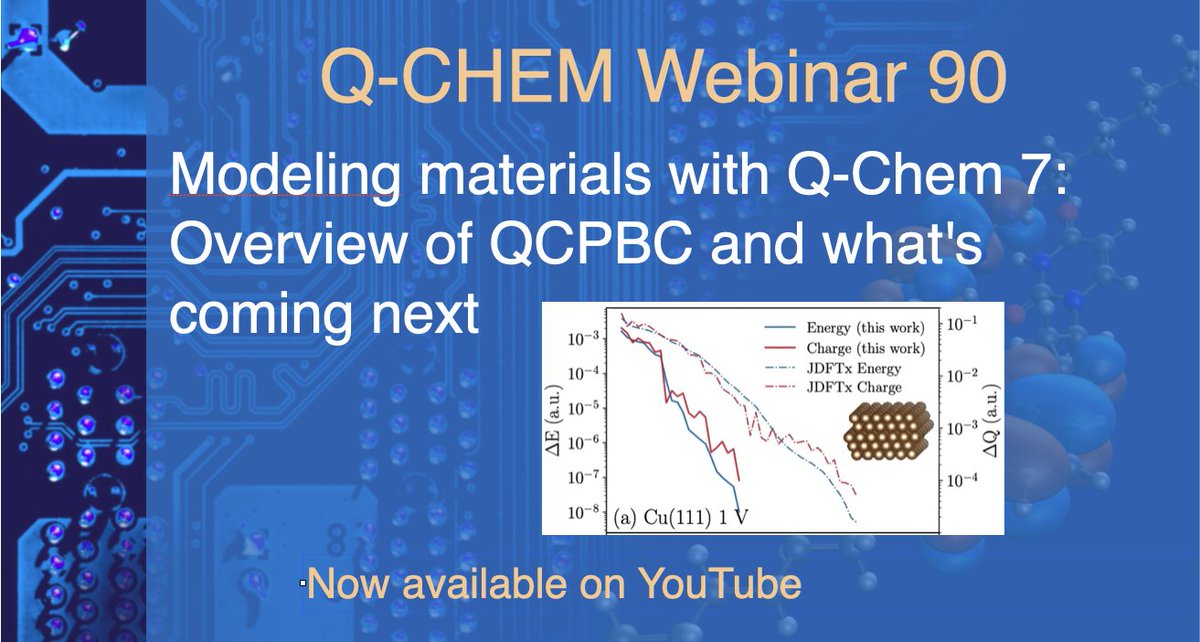
Learn more about Q-Chem's periodic boundary conditions code by watching Joonho Lee's recent webinar about QCPBC, now available on YouTube: https://t.co/sfExZO2AHm
Find out more about QC-PBC, our new GPW-based package for modeling materials, at this week's webinar by Joonho Lee.
Register here: https://t.co/hUjZR7Dp6m
In this recent paper, authors study the effect of pendant anionic substituents on the redox properties of ruthenium catalysts for water oxidation. They use Q-Chem's DFT and analyze geometries and charge/spin population data using IQmol. https://t.co/PQjmkZoWQT
Correction: The caption indicates that AVIXIO was the largest benchmarked in the preprint, when in fact it was just the largest within the large-systems testbed. (The largest system tested in the preprint overall was AVIXIO1, with 8,792 basis functions!)
New preprint: Spin-unrestricted linear-scaling double-hybrid #DFT! Here, authors generalize their earlier linear-scaling MP2 implementation to the spin-unrestricted case, enabling asymptotically linear-scaling DH-DFT for open shell and reactive molecules. https://t.co/fZMB0QKKWr
In this recent preprint, authors use Q-Chem's CCSD and ezFCF to help explain their experimentally-observed high-resolution photoelectron spectra for excited TiO2 anions. https://t.co/5ec0cuWB0P
Try spectroscopy features in Q-Chem 7: https://t.co/qkB9eRD0wW
DFT/XCIS for valence and core-level spectroscopy has been extended to open shell molecules! In this new preprint, developers discuss their new implementation and use it to model spectra of several systems: https://t.co/odVqwcrl1W
Try XCIS-CVS in Q-Chem: https://t.co/qkB9eRD0wW
Don't forget: The new COACH #DFT functional is now available in Q-Chem 7! COACH is a new range-separated hybrid (RSH) meta-GGA functional that strikes a balance between simplicity, accuracy, and transferability. https://t.co/xMr45bjbiH
Try it in Q-Chem 7: https://t.co/qkB9eRD0wW
Researchers recently used wavenumber power scaling to derive scaling factors for fundamental harmonic vibrational frequencies and thermodynamic corrections. They used Q-Chem to obtain geometries and frequencies with MP2, CCSD, and >40 DFT functionals. https://t.co/bQK4rhvRI4
New in Q-Chem 7: ECD with TDDFT! ECD enables studies of chiral molecules; Q-Chem's EOM-CC ECD can provide high-level benchmarks for medium-sized systems, while the new TDDFT implementation extends this capability to large systems.
Try it in Q-Chem 7: https://t.co/qkB9eRD0wW
In this recent paper, authors study the low-lying ππ* excited states in five-membered ring heterocycles, using both VB and MO theory and leveraging Q-Chem's ADC(1), ADC(2), ADC(3), and TDDFT capabilities. https://t.co/K6iQeZiSiH
Try Q-Chem 7: https://t.co/DKMgNYqOMT
In this new paper, authors use a combined experimental and theoretical approach to study the structure and temperature of glycerol aerosols. They use Q-Chem to model the X-ray absorption spectra with EA-TDDFT. https://t.co/QTnxqDDH8n
Try Q-Chem 7 today: https://t.co/qkB9eRD0wW
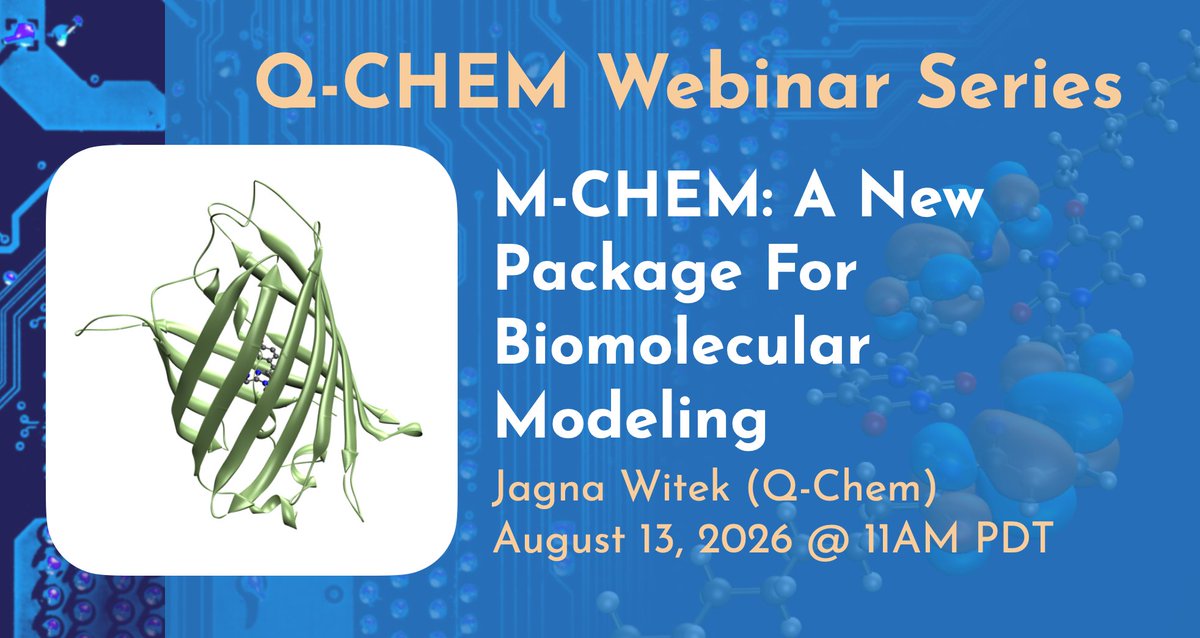
Did you miss last week's webinar on M-Chem, our new biomolecular modeling package? Not to worry; the recording has now been posted on our YouTube channel. Watch it here: https://t.co/F6x0ivJt6r
Check out this recent preprint, which uses the new #MP2#EDA in Q-Chem 7 to characterize a variety of hydrogen, halogen, and tetrel bonds. https://t.co/GD1IT6hN07
Try correlated wavefunction EDA in Q-Chem 7: https://t.co/qkB9eRD0wW
Don't forget about our upcoming webinar on M-Chem! Learn about the exciting developments in our new biomolecular modeling package: https://t.co/LVluJwtlha
Want a preview? Read the M-Chem paper: https://t.co/0MRUSrHWzf
Join us this Thursday at 11AM PDT for a webinar from developer Jagna Witek on M-Chem: Q-Chem's new module for biomolecular modeling! https://t.co/LVluJwtlha
Can #AI be used to model X-ray spectra? In this preprint, researchers at LBNL present an agentic AI framework for automated first-principles X-ray spectroscopy modeling, using Q-Chem's ∆SCF as the molecular component for their back-end. https://t.co/niZxESW0fh
Q-Chem 7 features new super-fast #NMR code! It's up to 150x faster than previous versions when run in parallel, and includes #OpenMP and #MPI parallelization for vastly improved performance. Request a free trial of Q-Chem 7 to try it yourself: https://t.co/DKMgNYqOMT
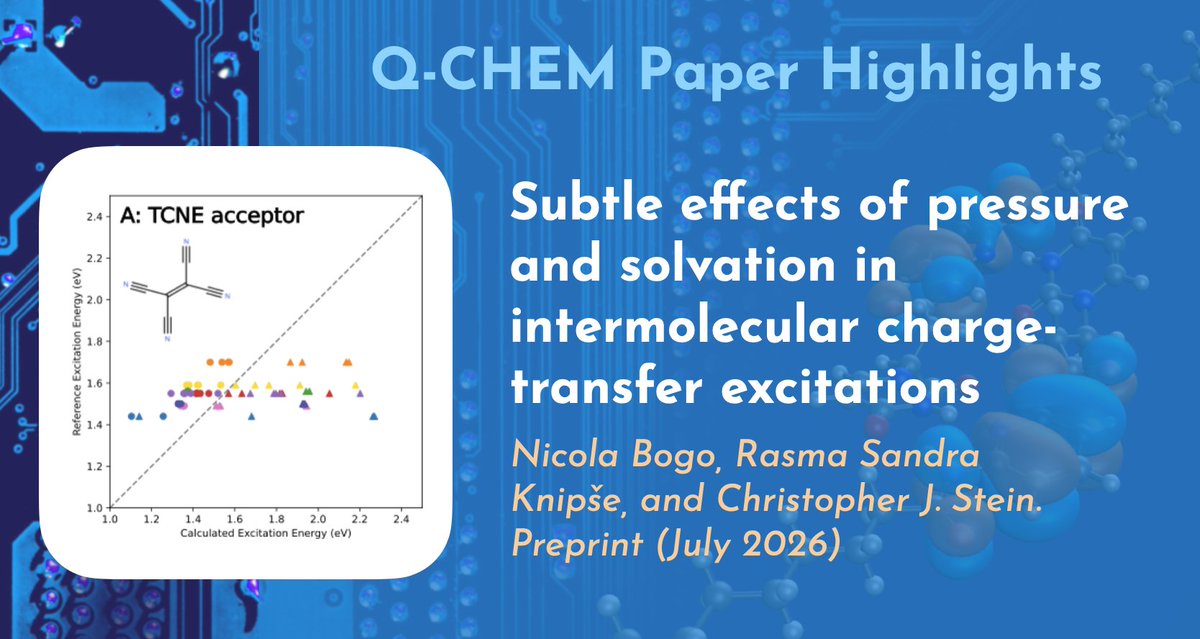
In this recent preprint, authors probe the effects of pressure and solvation in intermolecular charge-transfer excitations using TD-DFT and ALMO-SGM in Q-Chem. #compchem#TDDFT
Read the paper: https://t.co/JYs2qW1cAw
Try Q-Chem today: https://t.co/DKMgNYqOMT