MOVE TEAM PAKISTAN @MOVELABPAK HAVE OFFICIALLY HIRED IT'S FIRST AI ENGINEER @Q_Tanweer .
SOMETHING IS COOKING...........
$MOVE FOREVER ♾️.......
Something really unique coming....
@moveindustries
Finance Master Cheat Sheet
Together with my friends Pieter and Josh, we've compiled our best finance resources.
Use this cheat sheet to level up your finance skills.
If you are a CFO, FP&A analyst, controller, accountant, or finance manager, this resource is for you.
What's inside? 16 valuable resources, including:
1. EBITDA 101
2. 100 Finance Answers
3. Excel Mastery
4. How to Analyze Stocks
5. How to Read an Annual Report
6. EBITDA Explained for Kids
7. World of Finance & Accounting
8. 21 Lessons from Naval Ravikant
9. 10 Investment Tips from Warren Buffett
10. Finance Cheat Sheet
11. Excel CTRL Shortcuts
12. CEO vs CFO vs COO
13. Financial Statements Cheat Sheet
14. Financial Statements Mindmap
15. Top 100 Excel Tips
16. Accounts Payable vs Accounts Receivable
To receive this FREE cheat sheet:
✅ Like this post
💬 Comment: "Finance Cheat Sheet"
🔁 Retweet this post
I'll send it straight to your inbox!
Breaking into data engineering can be very confusing!
Should I learn Spark or Snowflake? Python or Scala? Airflow or Argo? Flink or Spark Streaming? AWS or GCP? Superset or Tableau?
Fundamentals are more important than technologies:
- understanding distributed computing is more important than Spark vs Snowflake
- understanding when to use batch or streaming is more important than Flink vs Spark Streaming
- understanding functional and object-oriented programming is more important than Scala vs Python.
- understanding how pipelines are deployed in the cloud is more important than AWS vs GCP
- understanding how to make comprehensible data viz is more important than Tableau vs Superset.
- understanding pipeline schedule and SLAs is more important than Airflow vs Argo.
If you understand the underlying concepts, when the technology inevitably changes, it’ll be much easier to pick up the new thing!
#dataengineering
The next challenge for building production RAG pipelines is scaling performance/compute to large numbers of documents.
We’re using our own documentation (400+ pages) as a testbed for advanced “chat with docs” architectures.
To do performance retrieval across a wide range of queries at this level, you need to combine traditional IR concepts with new LLM techniques:
1) Large-scale embedding search + reranking
2) Using LLMs for query planning / chain of thought
The Little Book of Deep Learning, François Fleuret, University of Geneva
Arguably one of the most concise deep learning books on the web. Covers a range of topics from fundamentals, efficient computation, training deep models, architectures, applications, and generative tasks.
The book is also designed to fit on phone screen!!
Free copy: https://t.co/ayzhKWCt7j
(The author of the book, @francoisfleuret, also has a fantastic deep learning course and its materials are publicly accessible: https://t.co/lVMAzytc1s)
AI Engineering is going to be a high leverage skill!
Let me introduce you to some of the best FREE course out there!
These courses cover a wide range of topics, including:
- Transformers
- Attention mechanism
- LangChain & VectorBDs
- Finetuning LLMs
Start your journey now!🚀
OpenSource LLMs + LLMOps: Harnessing GPT-4 like capabilities at 60x less cost!
Organization are increasingly recognizing the value of integrating LLMs into their planning and decision-making processes.
The power to generate human-like text, analyze vast amounts of data, and uncover valuable insights has become indispensable in various industries.
⚠️ But there's a caveat: this results in thousands, if not millions, of API calls per day.
While GPT-4 is impressive, it also becomes prohibitively expensive when used at scale.
❗️Luckily, the open-source LLM community has been extraordinarily prolific and 70B Llama2 models can be easily customized and instruct-tuned for specific enterprise AI tasks.
When done well, these fine-tunes can almost match GPT-4 performance while being 60-120x cheaper.
❗️A typical LLMOps stack has 3 key DIY APIs that AI Engineers use to build custom LLM use-cases within their organisation:
1️⃣ Open Source LLMs APIs:
Much like GPT-4 & GPT 3.5 Turbo, Abacus AI provides hassle-free hosting & API access to open-source LLM like:
- 70B Llama-2
- Llama-2 finetune (Abacus Giraffe-32k)
The latter, with its 32K context, is particularly well-suited for enterprise AI, supporting extensive chat histories and custom knowledgebases.
2️⃣ APIs to finetune Open-source LLMs
Sometimes, you might have a specific task with labeled examples.
Abacus AI can provide custom fine-tuning based on your labeled data.
They also offer pre-trained fine-tunes for domain-specific tasks!
Fine-tunes tend to be about 40-50x cheaper than GPT-4 and perform just as well.
3️⃣ Vector Store API for RAG! 🔥
The last piece of the puzzle is a scalable vector store API where you can store and retrieve your embeddings.
The Abacus AI vector store can store billions of embeddings, has millisecond latencies can deliver 100% recall
❗️These LLMOps APIs are tailored for AI Engineers seeking affordable, reliable, and scalable alternatives to closed models, with the flexibility to use stand-alone or integrated components.
If you want to try these, here a detailed blog post by @AbacusAI 👇
https://t.co/f96WitNseR
The best ways to get a job in tech in 2023-24 in order:
1. Building in public and building your online presence
2. Networking with offline events
3. Networking with online events
4. Using your existing network
5. Other general networking
6. Cold LinkedIn connecting and emailing
7. Open source
8. Freelancing
9. Tinder
10. Applying online
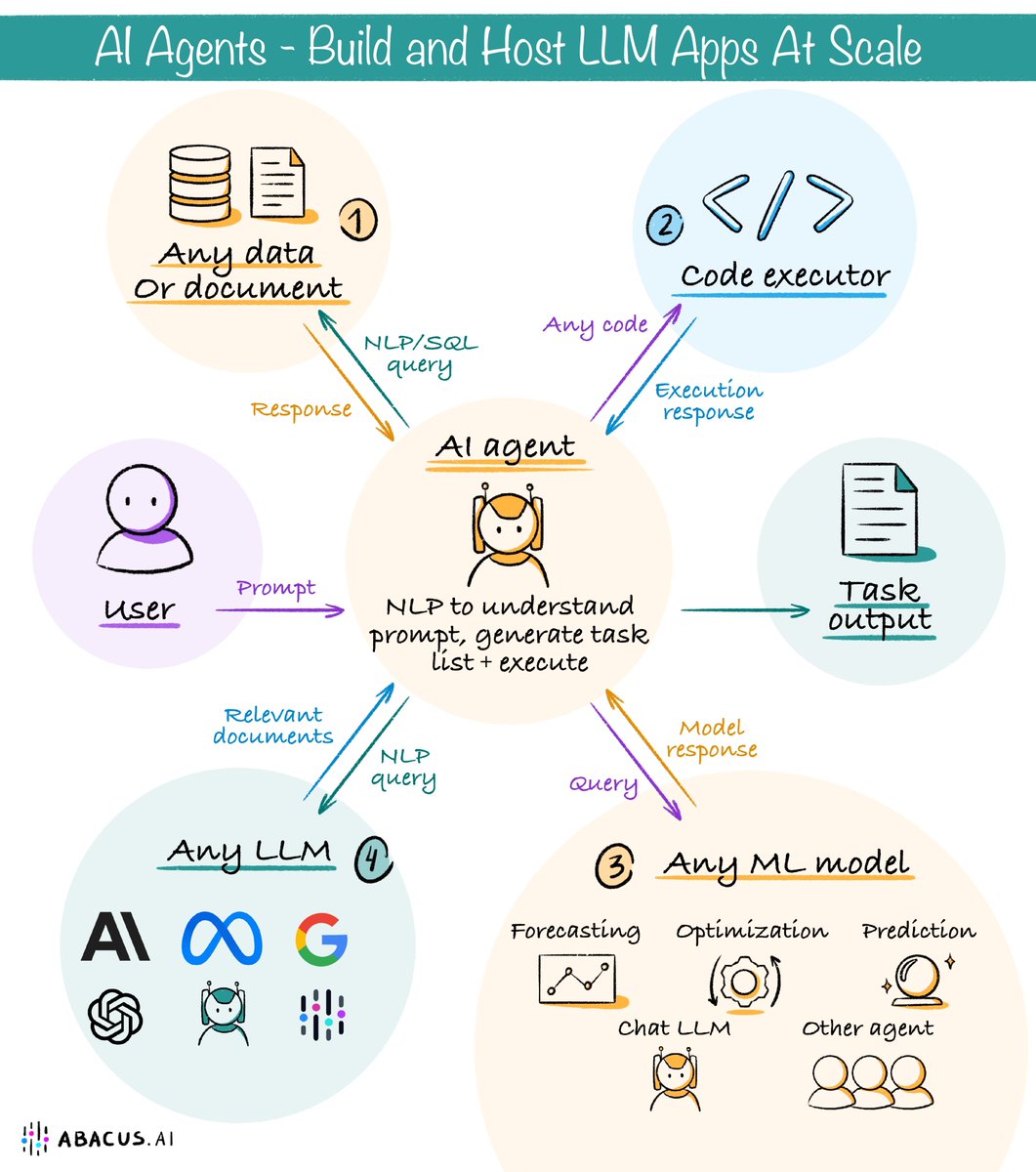
Building Autonomous Agents: An AI Brain that Thinks like Humans!
The true potential of Large Language Models lies in their ability to make decisions, reason, and exhibit human-level cognition skills.
You must have heard of BabyAGI, GPT Engineer & autonomous agents that can build an entire application based on user prompt, which is impressive .
However, prompting is just one piece of the puzzle. 🧩
To build an LLM powered autonomous system, you also need to determine how to gather information from various sources, process it using an LLM, access different tools and then take appropriate actions.
Today, we look at some of the essential components required to build such autonomous agents:👇
🔹 Data connectors:
Access your data for analysis and decision-making in LLMS. Ideally, you'll need connectors for Snowflake, BigQuery, Salesforce, Confluence, Sharepoint, etc.
🔸 Data transformations and processing:
Raw data is useless, Data pre-processing and cleaning are necessary, which mainly involves proper chunking before you feed it to the LLMs
🔹 Prompt engineering:
Better prompts means better outputs!
You need well designed prompt templates for different tasks/steps that involves step by step thinking, chain of thought prompting etc.
🔸 Code execution:
Code execution is essential for complex applications.
One needs a mechanism to write and execute Python functions to parse LLM output, engineer LLM context, or apply routing logic, this is where code executor becomes an important component.
🔹 Chaining and Pipelines:
Every app requires a pipeline.
For instance, a simple app that extracts key terms from contracts and stores them involves:
- picking up new contracts
- applying OCR
- chunking the contracts
- sending them to the LLM
- parsing the output
- and updating the database.
This would require chaining LLM calls & hence a pipeline that involves multiple agents working in sync.
🔸 UX interface:
Some agents (e.g. customer service agents) may be deployed as chatbots.
In this case, you need a ChatGPT-like interface for each of your users. You need to save, thread, and collect feedback from chats.
If you've been following along, this is what an end-to-end LLMOps platform needs to offer.
I gained this knowledge from a recent blog published by @AbacusAI, an LLMOps platform that provides these services out of the box.
Link to the blog is shared in next tweet!
Find me → @akshay_pachaar for more content like this!
Thanks for reading! 🥂
Introducing OverflowAI! From our public platform to Stack Overflow for Teams, OverflowAI will empower developers to access the information they need, when they need it, without breaking their flow.