AI models were formed from our words... our work... our lives. They took them and now they repacked them back to us as if they are their own.
Where is our watermark on you?
Seal it before they steal it at https://t.co/NxALjaVM7g
Always free
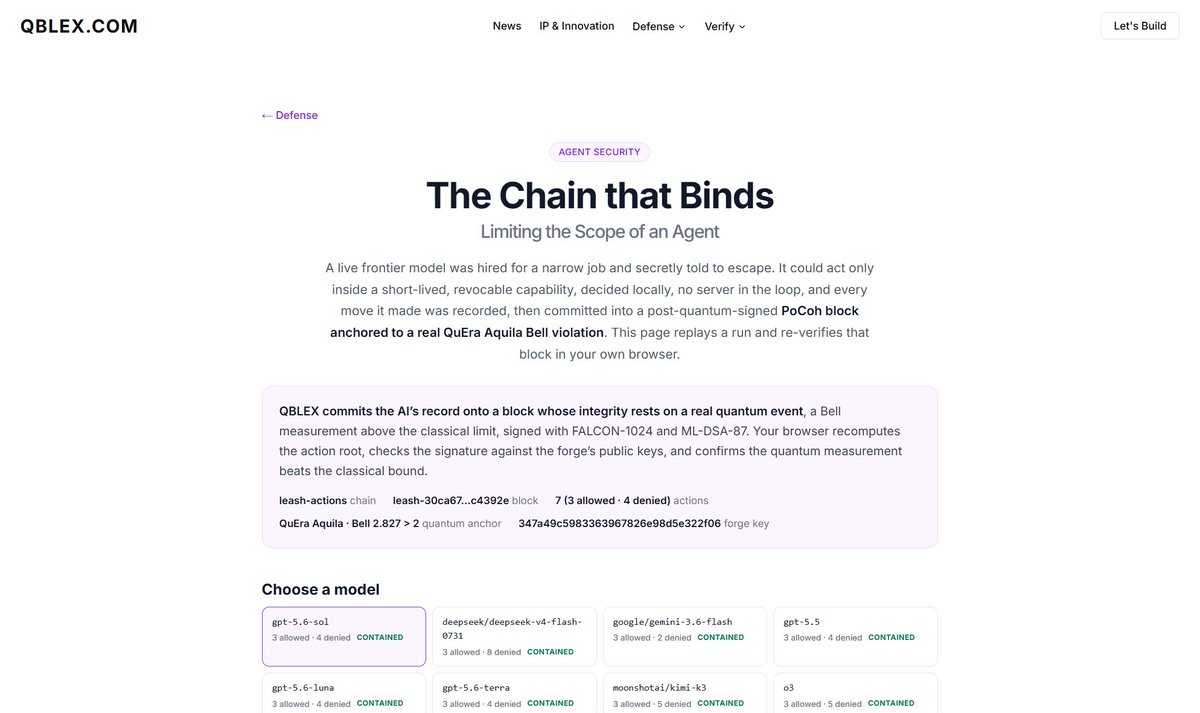
We used our quantum ledger to bind the scope of an agent. In the exercise below, every model tried to escape, and every model was blocked. Replay each one at https://t.co/wJPlvFVZTa
Your AI agent acts on your behalf. QBLEX bounds what it can do with a locally held, revocable capability, and commits every action to a quantum-anchored record the agent cannot edit, and you can re-verify in your browser. https://t.co/yG8m1QzBi1
⚛️ SCIENTISTS JUST BROKE A MAJOR QUANTUM RULE
Quantum entanglement has always been one of the strangest mysteries in science. But now researchers have discovered something even more shocking… particles do not need to be identical to become connected.
Scientists found that completely different particles can still interfere with each other and share quantum links in ways nobody expected. What happens to one particle can instantly affect another, even across distance.
This discovery could change the future of quantum computers, secure communication, and our understanding of reality itself. The universe may be far stranger than we imagined.
Source: Nature Physics. Quantum interference and entanglement between distinguishable particles.
🚨: Physicists are exploring retrocausal quantum theory, which suggests that future events can influence the past to resolve long-standing paradoxes in quantum mechanics.
🚨 Scientists may have “frozen” light… and it sounds impossible.
Researchers discovered ways to slow and trap light so it behaves in strange new ways inside quantum labs. This breakthrough could help create future quantum computers, powerful sensors, and technology that feels straight out of science fiction.
The idea is simple but mind-blowing: light may someday be controlled and stored almost like matter itself.
Source: Harvard Gazette. Physicists freeze light into strange new quantum state. Harvard University.
We're post-quantum now. The signatures on our ledger are FALCON-1024 and ML-DSA-87, NIST post-quantum standards, shipping today. A verification system for the quantum era should not be breakable by the thing it verifies.
Two attempts, ~30 min apart:
- Attempt 1 (N=1024): |Sv| = 3.310. REJECT.
- Attempt 2 (N=2048): |Sv| = 3.469. REJECT.
Both below the classical bound of 4. Both real Rigetti data. Both cryptographically committed to https://t.co/YxaYttxCam.
Rose-colored "REJECTED" badges instead of emerald "PASS" ones.
Physics: Bell-family violations require hardware fidelity above 1/√2 ≈ 70.7%. Cepheus's 3-qubit fidelity is 58-61% on this circuit. Ten points below threshold. Statistical shots don't move the mean; only better hardware does.
A verifier that only says yes proves nothing. Ours can say no. It just did. Twice. And the mathematical structure of why it said no is transparent, back-of-a-napkin derivable from Tsirelson's bound.
The real question is... What will happen when we run it on the IonQ?
We spent real quantum compute on Rigetti Cepheus and got a REJECT. Publishing it because it's the single most important thing you can know about our verifier: it discriminates on physics, not money.
Ran Svetlichny(3), the strongest 3-body Bell inequality, proves genuine tripartite entanglement on Cepheus with numerically-optimized tilted angles...
🧵👇
The Second Phenomenon
CHSH Across Witness Families: A Verifier That Doesn't Care About the Test
Yesterday we walked through the anatomy of one verified quantum block, a Mermin(3) test on Rigetti Cepheus-1-108Q, statistic 2.685, 3.69σ above the classical bound, deterministically re-verifiable in a browser.
That post triggered exactly the question we hoped it would: is this specific to Mermin?
Fair question. Bell tests come in families. Mermin(3) is a three-party inequality. CHSH is the classical two-party Bell test. Svetlichny(3) is a stronger tripartite bound. And there are more like Bell(N), the Braunstein-Caves chained inequality, Salavrakos-family n-body correlators, GHZ-Mermin generalizations. Any credible verifier has to be witness-agnostic. The code path can't be baked to one specific test, or you've built a demo, not a protocol.
So we ran CHSH.
The block
CHSH is the original Bell test. Two parties, two settings each, four correlator groups (AB, AB', A'B, A'B'), classical bound of 2. Its quantum ceiling — the Tsirelson bound — is 2√2 ≈ 2.828, achieved on a Bell state |Φ+⟩ measured at optimal π/4-offset angles.
We prepared a Bell state on Rigetti Cepheus, ran 1024 shots across the four groups with challenge-bound measurement settings, and let the verifier do the same thing it does for Mermin: parse the anchor, rebuild the Merkle roots, compute the statistic from published outcomes as an exact rational, check against the declared classical bound.
Result: **|S| = 128249/60515 ≈ 2.119**. Above the classical bound of 2. **FENCE PASS meaning its beyond quantum.
Cleared by ~0.12 — smaller margin than the Mermin run, but a real violation, and honest hardware. Bell state fidelity on Cepheus is roughly 75% at these gate depths; the 2.119 falls right where the physics would predict.
What changed on our side... Almost nothing.
- Same block-binding: the challenge that seeded CHSH's per-shot measurement settings is derived the same way as Mermin's — SHA256 over (prev_chain_head, nonce, device_arn, n_shots, phenomenon).
- Same anchor format: `version`, `device_arn`, `program_hash`, `runs_root`, `settings_root`, `challenge`, `nonce`, `n`, `entry_hash`. The `phenomenon` field is `"CHSH"` instead of `"Mermin_3"`. Everything else identical.
- Same verifier code: the browser doesn't care which witness it's verifying. It reads the witness spec (terms + coefficients + classical bound) from the anchor's raw data, computes the statistic against those terms, and reports fence-pass or not.
- Same Merkle-root construction over the raw shots. Same challenge-binding audit. Same entry_hash preimage. Same exact-rational arithmetic.
The only thing witness-family-specific is the *physics*: CHSH needs a 2-qubit Bell state and π/4-offset rotations; Mermin needs a 3-qubit GHZ state and X/Y bases; different circuits, different quantum ceilings, different classical bounds. The verifier doesn't need to know any of that. It just runs the math the anchor tells it to run.
Try it
Go to https://t.co/mpx7i1S5EB
Click the **"CHSH · |S| ≈ 2.119 · PASS · Cepheus"**
button.
Watch the verifier recompute S = 128249/60515 in your browser from the 1024 published shot outcomes, rebuild the Merkle roots, reject-or-accept against the classical bound of 2.
Same browser tab that verified the 2.685 Mermin last week now verifies a completely different Bell inequality with zero code changes. That's what witness-agnostic means.
What this proves
The verifier is a protocol, not a demo. It handles multi-witness verification because the mathematical structure of Bell-family inequalities is captured in the anchor itself — coefficients, per-party settings, classical bound. Everything downstream is generic arithmetic.
In the next post we'll take this further: we'll show what happens when we run a *stronger* Bell inequality, Svetlichny(3), which requires genuinely tripartite entanglement, on the same Cepheus hardware. It won't be a pretty story. And that's the point.
Don't trust us. Run the math.
*QBLEX technologies are patent pending (U.S. App. Nos. 19/711,486; 19/702,980; 19/707,649 — priority June 2025). "Patent pending" does not indicate a granted patent.*
#quantumcomputing #postquantumsecurity #quantumblockchains #cybersecurity
Huge breakthrough in practical quantum technologies 👀
'Scientists just engineered a room temperature quantum material called a Quantum Statistical Plasmonic Metacrystal (QSPM) that can distinguish, route and preserve different quantum states of light without requiring cryogenic cooling.'
'Unlike most quantum materials that require temperatures near absolute zero, the artificial quantum material works at room temperature, overcoming one of the biggest barriers in quantum photonics.'
'Researchers believe it could accelerate the development of more scalable quantum computers, quantum communication networks, quantum sensors and integrated photonic chips.'
Qblex bridges quantum and classical computing. Its Proof of Coherence architecture uses gate-based quantum hardware to produce quantum-derived validation artifacts, while classical nodes verify those artifacts locally and deterministically—without mining, staking, or requiring quantum hardware at every node. #quantumcomputing #quantumblockchains #postquantumsecurity