بيان | قطر تتضامن مع الإمارات إثر حادث مروري في الفجيرة
الدوحة | 13 نوفمبر 2026
تعرب دولة قطر عن تضامنها مع دولة الإمارات العربية المتحدة الشقيقة، إثر حادث مروري وقع في إمارة الفجيرة، وأسفر عن عدد من الوفيات والإصابات.
وتعبّر وزارة الخارجية عن تعازي دولة قطر لأسر الضحايا، ولحكومة وشعب دولة الإمارات العربية المتحدة الشقيقة، متمنيةً للمصابين الشفاء العاجل.
#الخارجية_القطرية
بيان | قطر تدين بشدة استهداف الاحتلال الإسرائيلي لمجمع ناصر الطبي في غزة
الدوحة | 12 نوفمبر 2026
تدين دولة قطر بشدة استهداف الاحتلال الإسرائيلي لقسم الجراحة في مجمع ناصر الطبي بمدينة خان يونس جنوبي قطاع غزة، والذي أسفر عن استشهاد وإصابة عدد من المدنيين الأبرياء العزّل وتعدّه جريمة شنيعة بحق الشعب الفلسطيني الشقيق وانتهاكاً صارخاً للقانون الدولي والقانون الإنساني الدولي.
وتؤكّد وزارة الخارجية على رفض دولة قطر القاطع للاعتداءات الإسرائيلية المتواصلة في قطاع غزة بما في ذلك استهداف المستشفيات والأع��ان المدنيّة وتطالب المجتمع الدولي بتحمّل مسؤولياته في حماية المدنيين العزّل وضمان عدم إفلات مرتكبي هذه الفظائع من العقاب.
وتجدد وزارة الخارجية، موقف دولة قطر الثابت والدائم في دعم القضية الفلسطينية وصمود الشعب الفلسطيني الشقيق، المستند إلى قرارات الشرعية الدولية وحل الدولتين، بما يضمن إقامة الدولة الفلسطينية المستقلة على حدود عام 1967، وعاصمتها القدس الشرقية.
#الخارجية_القطرية
Statement | State of Qatar Expresses Solidarity with UAE Following a Traffic Accident in Fujairah
Doha | November 13, 2026
The State of Qatar expresses its solidarity with the United Arab Emirates following a traffic accident in the Emirate of Fujairah, that resulted in multiple deaths and injuries.
The Ministry of Foreign Affairs conveys the condolences of the State of Qatar to the families of the victims, as well as to the government and people of the United Arab Emirates, and wished a speedy recovery to those injured.
#MOFAQatar
Statement | Qatar Strongly Condemns Israeli Attack on Nasser Medical Complex in Gaza
Doha | November 12, 2026
The State of Qatar strongly condemns an Israeli occupation's attack on the surgical department of Nasser Medical Complex in Khan Younis, southern Gaza, which resulted in the martyrdom and injury of several unarmed civilians, calling it a heinous crime against the Palestinian people and a flagrant violation of international law and international humanitarian law.
Ministry of Foreign Affairs reiterates Qatar's categorical rejection of Israel's continued attacks on the Gaza Strip, including strikes on hospitals and civilian facilities.
It urges the international community to fulfill its responsibility to protect civilians and ensure that those responsible for such atrocities are held accountable.
The Ministry reaffirms Qatar's unwavering support for the Palestinian cause and the resilience of the Palestinian people, based on international legitimacy resolutions and the two-state solution, which guarantees the establishment of an independent Palestinian state on the 1967 borders, with East Jerusalem as its capital.
#MOFAQatar
Statement | Qatar Strongly Condemns Continued Houthi Attacks on Several Areas in Saudi Arabia
Doha | November 8, 2026
The State of Qatar condemns in the strongest terms the continued attacks by the Houthi group on several areas in the Kingdom of Saudi Arabia, most recently the targeting of the city of Riyadh with two ballistic missiles, describing these assaults as shameful, aggressive behavior, an unacceptable disregard for civilian lives, a flagrant violation of Saudi sovereignty, and a clear breach of the rules of international law.
The Ministry of Foreign Affairs stresses the State of Qatar's categorical rejection of attacks targeting civilians and civilian objects, emphasizing the urgent necessity for an immediate halt to these irresponsible actions.
The ministry also renews the State of Qatar's full solidarity with the Kingdom of Saudi Arabia, and its support for all legitimate measures it takes to preserve its sovereignty, security, territorial integrity, and interests. It reaffirms that the security of Saudi Arabia is an integral part of Qatar's security and the collective security system of the Gulf Cooperation Council (GCC) states.
#MOFAQatar
بيان | دولة قطر تدين بأشد العبارات استمرار اعتداءات جماعة الحوثي على عدد من المناطق في السعودية
الدوحة | 8 نوفمبر 2026
تدين دولة قطر بأشد العبارات استمرار اعتداءات جماعة الحوثي على عدد من المناطق في المملكة العربية السعودية الشقيقة، وآخرها استهداف مدينة الرياض بصاروخين باليستيين، وتعد هذه الاعتداءات سلوكاً عدوانياً مشيناً واستهتاراً مرفوضاً بأرواح المدنيين، وانتهاكاً سافراً لسيادة السعودية وخرقاً واضحاً لقواعد القانون الدولي.
وتشدّد وزارة الخارجية على رفض دولة قطر القاطع للاعتداءات على الأعيان المدنية والمدنيين، وتؤكد ضرورة الوقف الفوري لهذه الأعمال غير المسؤولة.
كما تجدّد الوزارة تضامن دولة قطر الكامل مع المملكة العربية السعودية الشقيقة، ووقوفها إلى جانبها في كل ما تتخذه من إجراءات مشروعة للحفاظ على سيادتها وأمنها وسلامة أراضيها ومصالحها، وتؤكد أن أمن السعودية جزء لا يتجزأ من أمن قطر ومنظومة الأمن الجماعي لدول مجلس التعاون لدول الخليج العربية.
#الخارجية_القطرية
بيان | قطر تدين حادث إطلاق نار في بولندا
الدوحة | 7 نوفمبر 2026
تعرب دولة قطر عن إدانتها واستنكارها، لحادث إطلاق النار الذي وقع في مدينة كراكوف جنوب جمهورية بولندا، وأدى إلى سقوط قتلى وجرحى.
وتجدد وزارة الخارجية، موقف دولة قطر الثابت من رفض ��لعنف والإرهاب والأعمال الإجرامية، مهما كانت الدوافع والأسباب.
وتعبر الوزارة عن تعازي دولة قطر لذوي الضحايا وحكومة وشعب بولندا، وتمنياتها للجرحى بالشفاء العاجل.
#الخارجية_القطرية
Statement | Qatar Condemns Shooting in Poland
Doha | November 7, 2026
The State of Qatar expresses its condemnation and denunciation of a shooting incident in the city of Krakow, in southern Poland, which resulted in deaths and injuries.
The Ministry of Foreign Affairs reaffirms Qatar's firm position rejecting violence, terrorism and criminal acts, regardless of their motives or causes.
The Ministry also expresses Qatar's condolences to the families of the victims and to the government and people of Poland, wishing those injured a speedy recovery.
#MOFAQatar
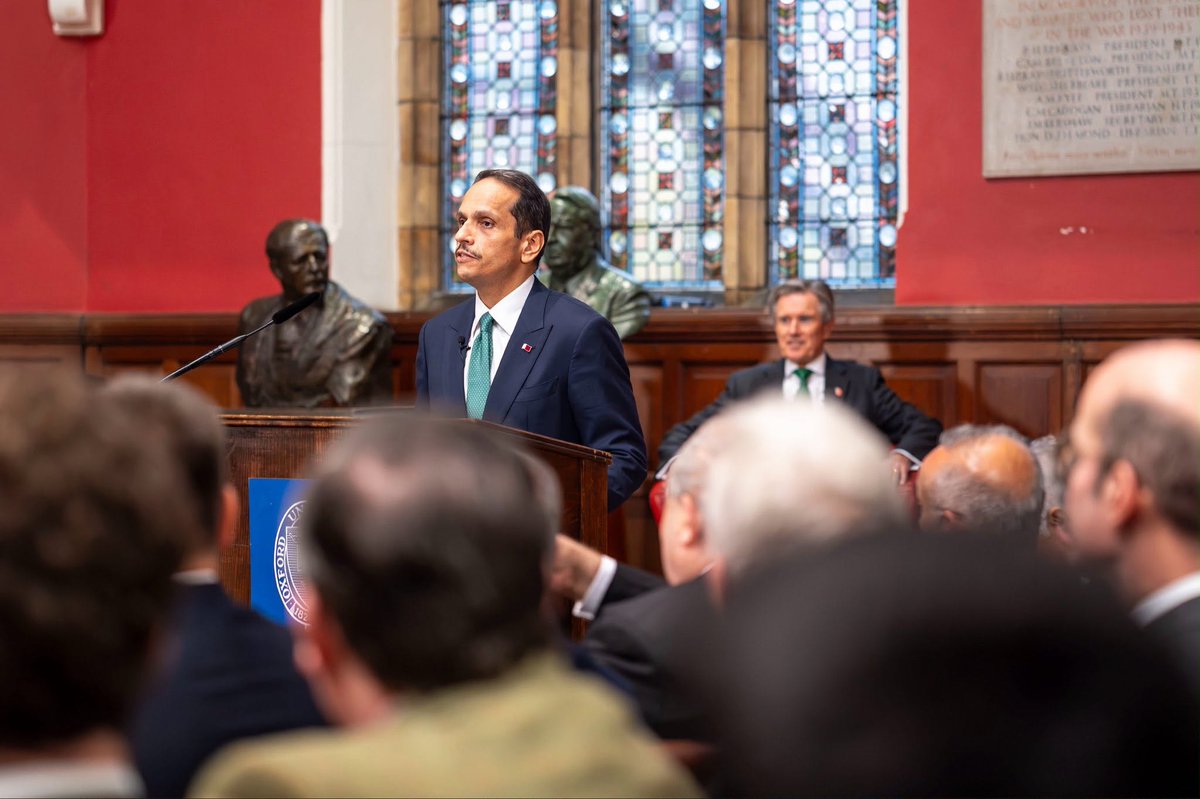
His Excellency Sheikh @MBA_AlThani_ , the Prime Minister and Minister of Foreign Affairs, in a dialogue session at the Oxford Union :
“We have witnessed, like throughout these experiences that we had, if you are able to contribute something for global peace and stability, and you are able to make a difference in the world and the course of events, you should take the step and do it.
And I remember His Highness, I recall him, when we were discussing the mediation in Gaza recently, that the amounts of attacks that we are getting because of our mediations are quite significant for a country like ours to handle, and it's taking too long time, and there was like no real progress or response. And he's been always saying that even if our efforts will take a year and will save a single life, it will be worth it. And that has been really our way of thinking about things.
#MOFAQatar
His Excellency Sheikh @MBA_AlThani_ , the Prime Minister and Minister of Foreign Affairs, in a dialogue session at the Oxford Union :
“We've been calling for regional security dialogue now for almost 11 years, since 2015. HH The Amir came out at the United Nations General Assembly, and he said very clearly that, first of all, GCC countries need to come together with Iran and engage in a serious dialogue and addressing the root causes of the issues and addressing our concerns and addressing also their concerns, if they have any.
and just imagine a world where the Gulf countries with Iran joining in the economy, and you have also an open economy for Iran after resolving their nuclear issue as well. You will have unlimited potential for that region. The amount of resources, the human capital that this region has is tremendous.”
#MOFAQatar
His Excellency Sheikh @MBA_AlThani_ , the Prime Minister and Minister of Foreign Affairs, in a dialogue session at the Oxford Union :
“We've been warning that having an agreement without addressing the whole issue and addressing the main issues, for example, of withdrawal, giving the rights for the people of Gaza to live a normal life, giving the rights for the Palestinians for self-determination and for their statehood will always keep this door open and we will remain, and the entire region will remain at risk of escalation.
And we have seen that, unfortunately, because Netanyahu has been acting with impunity, and I don't think that many disagree on this point. He ignored the agreement. He got what he wanted from that. And he continued his escalation against Gaza. He continued blockading them, the siege, the killing of the people, the targeting of the people every day.”
#MOFAQatar
Prime Minister and Minister of Foreign Affairs @MBA_AlThani_ : Thriving States Are Well-Positioned to Advance Peacebuilding and Broaden Prospects for Shared Prosperity
Oxford | November 7, 2026
HE Prime Minister and Minister of Foreign Affairs Sheikh Mohammed bin Abdulrahman bin Jassim Al-Thani affirmed that mediation and peacemaking are a necessity for thriving states, as their own security and prosperity are closely tied to the stability of their surroundings and the wider world. His Excellency stressed that the State of Qatar will continue its efforts and engagement with all relevant parties to spare the region another round of escalation, and that addressing core issues through dialogue is the path to lasting security for all.
Speaking at the Oxford Union in the United Kingdom, in a lecture titled "Thriving in a Fractured World: Small States and the New Geography of Global Impact" and followed by a discussion moderated by Sir John Sawers, His Excellency said that small states that have built strong economic foundations and integrated into the global order are directly affected by global stability, and that their ability to contribute to peace and to drive positive change in the course of events places a responsibility on them to take the initiative and act.
HE the Prime Minister and Minister of Foreign Affairs said that the State of Qatar not stood idly by in the face of crises. For nearly two decades, it has engaged in mediation and peacemaking, driven by a firm conviction in the importance of protecting human lives.
In this context, His Excellency recalled the affirmation by HH the Amir Sheikh Tamim bin Hamad Al-Thani that mediation efforts are worth pursuing, even if they take a year, provided they help save a single human life, noting that this conviction guides Qatar's approach despite the difficulties and campaigns directed against these efforts.
His Excellency pointed out that the recent conflict in the region, together with the acts of aggression faced by the State of Qatar, has once again underscored the need for the role played by nations like Qatar, adding that the State took the initiative to act despite challenging circumstances and made a substantial contribution to the first round of negotiations, which led to a memorandum of understanding. This, in turn, helped spare the region widespread chaos at a time when the risk of regional escalation was high.
His Excellency added that challenges in implementing the memorandum of understanding had not halted Qatar's efforts. In coordination with regional partners, the State of Qatar continued its intensive efforts to prevent a new wave of escalation, he noted, adding that the Qatari delegation visited Tehran five times in a single week, holding meetings—some lasting 18 to 20 hours—to explore ways to avert renewed confrontation.
HE the Prime Minister and Minister of Foreign Affairs emphasized that these efforts do not mean that risks have been removed or that security has been achieved, affirming that efforts to contain tensions and prevent escalation remain ongoing, and that communication with the relevant parties has not ceased and will continue.
Regarding engagement with the United States and the Islamic Republic of Iran, His Excellency explained that collaboration with US administration officials and voices of reason in Tehran had helped prevent the situation from spiraling out of control, pointing to a continued desire to take steps toward a solution and the importance of building on this progress rather than waiting for an ideal agreement that could stand in the way of reaching an accord to de-escalate tensions.
His Excellency further stressed the importance of continued engagement with all parties to bridge differences and ensure that hardline positions do not derail the diplomatic process. He noted that the successful conclusion of the memorandum of understanding demonstrates that progress is possible and a final settlement remains achievable, despite the complexity of the negotiations and the difficult decisions involved.
HE the Prime Minister and Minister of Foreign Affairs warned that another round of military operations would not resolve existing issues, and that region cannot withstand further escalation, having already seen its countries and peoples, together with the Iranian people, pay a heavy price for previous confrontations.
He emphasized that the priority must be to address the nuclear dossier and ensure freedom of navigation and security in the Gulf—issues of vital importance to the region and the wider world.
He explained that the security of the Gulf requires dialogue between the Gulf states and Iran to develop a framework that guarantees the safety of all parties and addresses their respective concerns, stressing that efforts to address Iranian concerns must also address the Gulf states' core security concerns. He added that his communications with the foreign ministers of the states of the region reflect a shared message on the urgent need to end the conflict.
Regarding the situation in the Gaza Strip, HE the Prime Minister and Minister of Foreign Affairs affirmed that the Palestinian cause remains central to unresolved political issues, noting that the region has lacked stability since October 7, a period marked by war and the expansion of conflict fronts. He added that mediation efforts have faced repeated setbacks due to the Israeli government's positions, its continuous alteration of realities on the ground and its escalating demands.
He underscored that agreements that fail to address fundamental issues—foremost among them withdrawal, the right of the people of Gaza to live a normal life, and the Palestinian people's right to self-determination and the establishment of their own state—will leave the door open to renewed escalation and expose the entire region to further risks.
His Excellency pointed to the continuing blockade, killings and targeting in the Gaza Strip despite the existence of a ceasefire, noting that more than a thousand people have been killed since that announcement. He added that, in practical terms, all that has been achieved is an agreement for the release of hostages, and that turning this into a genuine ceasefire requires an end to hostilities, the withdrawal of forces and a genuine political horizon for the Palestinians. Otherwise, these crises will inevitably recur.
Regarding the situation in Lebanon, HE the Prime Minister and Minister of Foreign Affairs noted that shelling continues despite a ceasefire agreement, while the occupation persists with no timeline for withdrawal, in addition to restrictions hindering the Lebanese Armed Forces' operations in the south. He emphasized that acting with a sense of impunity and disregarding international law and the rules-based order expose the entire region to persistent dangers.
His Excellency reaffirmed the importance of dialogue in building sustainable regional security. He recalled the call made by HH the Amir before the United Nations General Assembly in 2015 for serious dialogue between the Gulf Cooperation Council states and Iran to address the root causes of their differences and their mutual concerns.
His Excellency explained that security arrangements cannot rest on promises alone. They require concrete steps and guarantees against aggression or threat to use force, followed by measures to build trust and expand common interests. His Excellency highlighted the considerable potential for economic cooperation between the Gulf states and Iran after a resolution of the nuclear dossier, given the region's abundant resources and human capital.
HE the Prime Minister and Minister of Foreign Affairs emphasized that any comprehensive vision for regional security must include a resolution of the Palestinian question and the establishment of a Palestinian state, leading to arrangements in which no party poses a threat to another. He underscored the importance of bringing regional states together to address their concerns and achieve collective security, enabling them to prosper without fear of military escalation or interference in their internal affairs.
His Excellency noted that various security alliances in the region had emerged in response to existing threats and should not become a source of further polarization, expressing confidence that shared interests, combined with visionary leadership capable of taking bold steps, offer opportunities to build a better future for the region's peoples.
His Excellency reviewed the State of Qatar's development of its economic and diplomatic capabilities, noting that its decision to invest in the gas sector in 1995 laid the foundation for its current role in global energy supplies, and that its expanding engagement with the world has been accompanied by the development of its mediation expertise and built relationships of trust with various parties, without seeking to exert hegemony over others.
His Excellency explained that Qatar has worked to institutionalize its mediation experience and strengthen partnerships with nations that share its commitment to peacemaking, noting that, in 2025, Qatar engaged in mediation efforts across approximately 16 files, including prisoner exchanges, ceasefires and broader peace initiatives.
His Excellency also highlighted cooperation with Norway and Switzerland on the situation in the Democratic Republic of the Congo and Rwanda, and with Spain and Norway concerning Colombia, in addition to the collaboration between Norwegian and Qatari teams during the mediation process in Afghanistan, emphasizing that the integration of various nations' expertise and efforts—despite differences in their political systems and economic models—contributes to achieving tangible results.
HE the Prime Minister and Minister of Foreign Affairs affirmed that such cooperation can extend beyond peacemaking to encompass areas like investment and energy, in a way that helps expand the reach of prosperity to other nations, bolsters regional stability and the security of the future for its peoples, and makes a positive contribution to the world.
#MOFAQatar
His Excellency Sheikh @MBA_AlThani_ , the Prime Minister and Minister of Foreign Affairs, during his speech at the Oxford Union :
“The current crisis suggests when we ignore these conditions, peace gradually withers away and conflict risks becoming the status quo. Meanwhile, many valid questions are being raised about international institutions and their place in a rapidly changing global order as regional and non-regional groupings increasingly stepping in to fill the void where existing institutions have struggled to respond effectively to international crisis.
We cannot outsource our stability, nor should we surrender to inaction. History is littered with the ghosts of passive onlookers, and only celebrates those who act to shape it.”
#MOFAQatar
His Excellency Sheikh @MBA_AlThani_ , the Prime Minister and Minister of Foreign Affairs, during his speech at the Oxford Union :
“Yet while economic opportunity became increasingly global, decisions over international peace and security remained concentrated in the hands of the few, leaving countries indispensable to global prosperity, largely excluded from decisions determining international peace and stability.
These developments reveal a fundamental weakness. The world has become increasingly interconnected in its prosperity. Yet decision of peace and war remain far less collective in their making than in their consequences. And smaller states are increasingly the first casualties in conflicts not of their own making.”
#MOFAQatar
His Excellency Sheikh @MBA_AlThani_ , the Prime Minister and Minister of Foreign Affairs, during his speech at the Oxford Union :
“I would therefore like to propose a different label for a particular group of countries: agile, stable, prosperous and trusted nations that have turned their size into an advantage and became a significant contributor to global peace and prosperity. I call them thriving states.
We now find ourselves at the intersection of conflict, technological discoveries, and geopolitical realignment. Historical moments like this come once in a generation, and our generation has yet to rise to this occasion.”
#MOFAQatar
In a speech at Oxford Union, Prime Minister and Minister of Foreign Affairs:
Thriving States are well-positioned to play a pivotal role in achieving international peace.
#MOFAQatar
PM and Minister of Foreign Affairs @MBA_AlThani_ at Oxford Union: Thriving States Should Play Greater Role in Shaping Global Peace and Security
Oxford | November 7, 2026
HE Prime Minister and Minister of Foreign Affairs Sheikh Mohammed bin Abdulrahman bin Jassim Al-Thani has called for a greater role for economically thriving small states in shaping international peace and security, arguing that their collective influence, diplomatic experience and economic strength can make a significant contribution to global stability.
Addressing the Oxford Union in the British city of Oxford on Friday, HE Sheikh Mohammed delivered a speech titled "Prosperity in a Divided World: Small States and the Redrawing the Map of Global Influence", in which he highlighted the growing importance of smaller but thriving nations in an increasingly divided international landscape.
His Excellency said countries that had achieved prosperity and become essential contributors to global economic development were now uniquely positioned to play a similar role in promoting international peace, not through individual initiatives but through a collective, organized and sustained approach.
HE Sheikh Mohammed recalled that the international order established after World War II was founded on the principle that peace could not be maintained through military strength alone. Instead, it sought to establish a system of international rules, institutions and open markets designed to promote cooperation and stability.
Since 1945, more than 120 countries have joined the international community, giving previously underrepresented peoples a voice on the global stage. This development also created opportunities for smaller countries, including Qatar, to achieve prosperity while benefiting from protections against annexation, regional domination and competition between major powers.
He noted that many of these countries were neither regional powers nor global superpowers, yet had achieved considerable progress by investing in their people, infrastructure and economic models. Their development had enabled them to become increasingly important participants in the global economy.
Beyond their economic achievements, HE Sheikh Mohammed said, a number of these nations were also using their collective influence to advance peace and stability around the world.
He argued that traditional classifications of countries as either developed or developing did not always reflect the achievements of nations that had followed different paths towards prosperity, nor did they adequately recognize their contributions to the international community.
In this context, he proposed a new designation for a group of countries that are resilient, stable, thriving and trusted, and have transformed their relatively small size into an advantage while becoming significant contributors to global peace and prosperity. He described them as "thriving states".
His Excellency said the world was now at a crossroads shaped by overlapping conflicts, technological breakthroughs and shifting geopolitical alliances, describing the current period as a historic moment that comes only once in a generation.
He stressed that the international community must rise to the challenges of the present era rather than remain passive in the face of profound global changes.
While acknowledging the shortcomings of the post-World War II international order, HE Sheikh Mohammed said it had not always been fair and that its rules had not been applied consistently. He cautioned against idealizing a system in which power had always played an influential role.
Nevertheless, he argued that the existing international system remained preferable to the alternatives, drawing a comparison with the widely quoted observation about democracy that it is the worst form of government except for all the others.
He said the United Nations Charter had established fundamental principles, including the sovereign equality of states and the peaceful settlement of disputes.
International institutions and rules had enabled smaller nations to make their voices heard, defend their rights and make international relations more predictable. Although these institutions had not eliminated inequalities in global power, they had expanded the space available for smaller countries to make independent decisions, rather than operate under the historical principle that might makes right.
However, HE Sheikh Mohammed warned that while economic opportunities had become increasingly globalized, decisions concerning international peace and security remained concentrated in the hands of a relatively small number of countries.
As a result, nations that were essential to global prosperity were often excluded from decisions that directly affected international peace and stability.
He said the ongoing war in the region had exposed the dangers of this imbalance, with decades of military adventurism, unresolved conflicts, violations of international law and ambitions for regional domination disrupting energy supplies, threatening vital maritime routes and creating uncertainty in international markets.
Even countries not directly involved in these conflicts were bearing their economic and security consequences, he added.
HE Sheikh Mohammed said these developments highlighted a fundamental contradiction in the international system: the world had become increasingly interconnected in terms of prosperity, while decisions about war and peace remained far less collective than the consequences they produced.
Smaller states, he warned, were increasingly becoming the first victims of conflicts they had played no part in creating.
He raised the question of how countries with limited strategic depth and little coercive power could contribute to preserving the international order and maintaining global peace without compromising their sovereignty and national interests.
Turning to Qatar's experience, HE Sheikh Mohammed said the country had recognized that its future depended not only on the resources it possessed but also on the capabilities it could develop and the relationships it could establish.
Qatar had therefore chosen to invest in its people, develop its economy and establish itself as a reliable and trusted partner within the international community.
He explained that Qatar's geographical position and the realities of the global economy had made it clear that the country's prosperity could not be separated from regional and international conflicts.
This understanding had encouraged Qatar to invest in peace facilitation and mediation, while maintaining communication channels with parties that others were not always able to reach.
The lessons learned from Qatar's numerous mediation efforts had given the country unique and extensive experience in conflict resolution, he said.
HE Sheikh Mohammed described Qatar's journey as that of a nation whose people had achieved prosperity and extended a hand to the world to share its benefits.
However, he said Qatar was now facing campaigns promoting misleading narratives, as well as military attacks by parties that did not believe peace should be the natural condition of humanity.
He said such actors subscribed to a Hobbesian view of international relations, in which conflict was considered the natural state of the international system and power alone determined outcomes.
They do not merely theorize about this; they actively work to make it a reality, he said, warning that those who considered the rules-based international order established after World War II unnatural were seeking to undermine it.
He stressed that this system must be protected precisely against those seeking to dismantle it.
HE The Prime Minister and Minister of Foreign Affairs said the challenges facing Gulf countries extended far beyond their own regional experience, exposing deeper threats to the international system itself, its ability to preserve peace, uphold its principles and protect the opportunities that had enabled countries such as Qatar to prosper.
He pointed out that Qatar was not alone in facing these challenges, as other thriving countries had similarly benefited from an open international environment to build strong institutions, develop globally connected economies and establish capabilities that allowed them to contribute beyond their national borders.
However, he emphasized that thriving states could not overcome these challenges independently, nor could they replace the role of major powers.
Instead, by combining their experience, economic capabilities and diplomatic networks, they could help establish an integrated framework for international peace and stability and ensure its sustainability.
HE Sheikh Mohammed further stressed that maintaining stability in a conflict-prone world required a comprehensive understanding of peace, encompassing preventive measures, effective responses to crises, efforts to end conflicts and the preservation of the conditions necessary for lasting stability.
Ignoring any of these elements, he warned, would gradually undermine peace and allow conflict to become the prevailing condition.
He also highlighted growing questions about the role and relevance of international institutions in a rapidly changing global order, noting that regional and non-regional groupings were increasingly stepping in to fill gaps where existing institutions had failed to respond effectively to international crises.
His Excellency reiterated that international peace and stability were not luxuries for thriving states but fundamental conditions for their national development and continued prosperity.
He revealed that Qatari mediators were currently working to prevent a new wave of escalation in the region.
Concluding his address, HE Sheikh Mohammed said responsibility for maintaining international stability could not simply be delegated to others, while the international community should not surrender to inaction.
He stressed that history remembers those who take the initiative and help shape events, rather than those who remain passive observers.
#MOFAQatar
His Excellency Sheikh @MBA_AlThani_ , the Prime Minister and Minister of Foreign Affairs, during his speech at the Oxford Union :
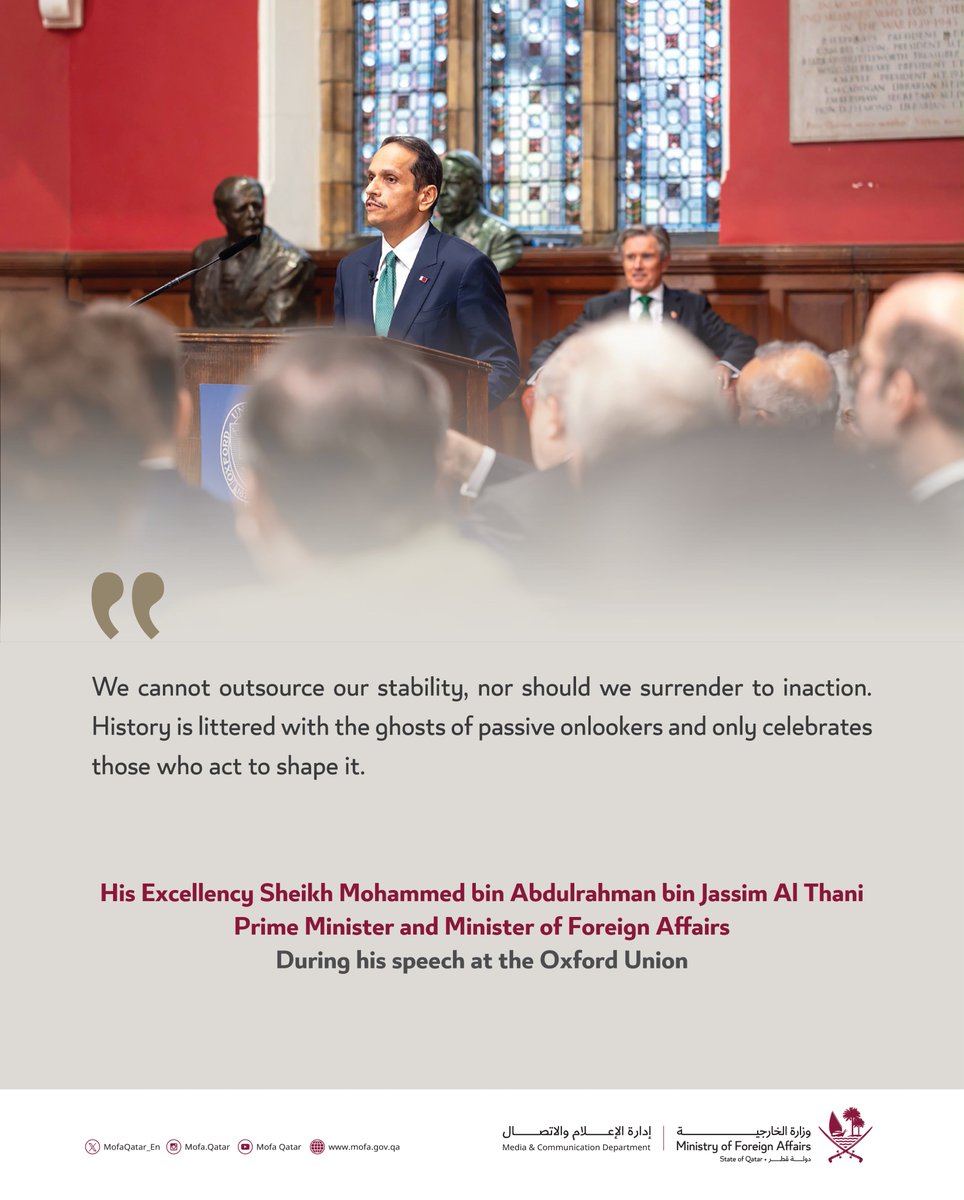
“We cannot outsource our stability, nor should we surrender to inaction. History is littered with the ghosts of passive onlookers and only celebrates those who act to shape it.”
#MOFAQatar
His Excellency Sheikh @MBA_AlThani_ , the Prime Minister and Minister of Foreign Affairs, during his speech at the Oxford Union :
“For thriving states, international peace and stability are not a luxury. They are the foundation of our national stories.”
#MOFAQatar
His Excellency Sheikh @MBA_AlThani_ , the Prime Minister and Minister of Foreign Affairs, during his speech at the Oxford Union :
“Thriving States cannot resolve these challenges alone, nor replace great powers. But through pooling their expertise, economic capabilities and diplomatic networks, they can help build and maintain a supply chain of peace and stability for the world.”
#MOFAQatar