GOOGLE'S AI AGENTS JUST MADE A QUANTUM ALGORITHM 290X CHEAPER.
Google DeepMind put teams of Gemini 4 AI agents to work improving well-known quantum algorithms.
Every four hours, the agents met at a virtual conference to trade ideas, argue and compare notes. Then every result was proven correct by a math checker, line by line.
The results:
290x cheaper for arcsin, a routine quantum computers use to load numbers into a quantum state
11.8x cheaper for a fusion energy simulation
8.2x cheaper for a photochemistry simulation
2.5x cheaper for a drug metabolism simulation
2.57x fewer rounds for a version of Grover's search
These are proven algorithm improvements, not results run on a quantum computer yet. But every cut means a smaller machine can do the job.
$GOOGL $INFQ $IONQ
QUANTUM PCS ARE COMING, ONE JUST RAN AT ROOM TEMPERATURE ON A CHIP SMALLER THAN A PAPERCLIP
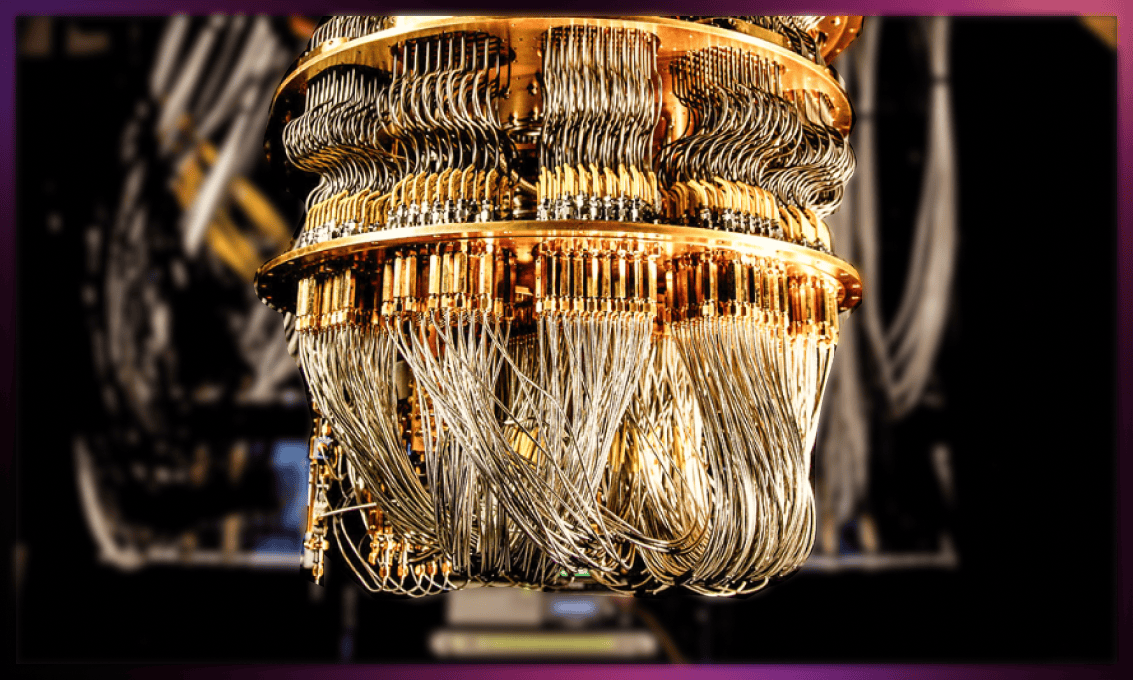
Google's ($GOOGL) and IBM's ($IBM) quantum computers live inside giant fridges colder than outer space. Most others need vacuum chambers and tables full of lasers.
This one has nothing cold in it at all. Not the light source, not the processor, not the detectors. The whole thing runs at room temperature.
It's a photonic chip just 18 by 4 millimeters, built by a startup called Rotonium. It packs multiple qubits into single particles of light.
Their roadmap:
2028: a desktop quantum computer.
2029: a quantum card that plugs into a computer like a graphics card.
It's only 4 qubits for now, so it's a prototype, not a powerhouse.
But the quantum PC just went from science fiction to a roadmap with dates on it.
WE NEEDED THIS QUANTUM BROS
$IONQ +18%
$INFQ +13%
$QNT +12%
$QBTS +20%
$RGTI +18%
$XNDU +12%
$PSQL +5%
$IQMX +9%
Still a long way to go but a great day for sure.
NASA IS SENDING A QUANTUM SENSOR INTO SPACE TO SEE EARTH'S GRAVITY.
That lumpy planet is Earth's real gravity, exaggerated so you can see it. Gravity pulls harder where there's more mass underneath and softer where there's less.
Measure it precisely enough and you can see what's underground without digging.
From orbit, this sensor could track the world's fresh water, melting ice and even oil reserves. The mission also lists navigation and national security among its uses.
"We could determine the mass of the Himalayas using atoms," says NASA JPL's chief Earth science technologist.
The sensor is a cloud of rubidium atoms cooled to near absolute zero. Nothing like it has ever flown in space.
$INFQ Infleqtion is building its quantum core. NASA has put $40 million into the mission, which launches around 2030.
Most people think a quantum computer tries every answer at once. Though if it did, it would be useless.
A quantum computer can hold every possible answer at once. But the moment you look, you get just one, picked at random. With a million possible answers, you'd almost always get a wrong one.
The real trick is interference.
Every answer has a wave, and waves can add up or cancel out, like noise-canceling headphones.
A quantum algorithm is a recipe that makes the waves of the wrong answers cancel, and the wave of the right answer grow. Only then do you look.
Grover's famous search recipe works like this:
Flip the right answer's wave upside down.
Mirror every wave over the average.
The wrong answers shrink, and the right one grows.
Then repeat, with a million possible answers, it takes about 800 rounds. A normal computer could need up to 1,000,000 checks.
Watch the video below to learn more!
$INFQ $IONQ $QNT
WHILE EVERYONE WATCHES THE AI RACE, CHINA'S NEW SUPERCOMPUTER JUST SOLVED CHEMISTRY'S HOLY GRAIL, A PROBLEM ONLY QUANTUM COMPUTERS WERE SUPPOSED TO CRACK.
It took 105 minutes. The team behind it just won the Gordon Bell Prize, known as the Nobel Prize of supercomputing.
The molecule is FeMoco. Bacteria use it to pull nitrogen out of the air and turn it into ammonia, the base of the fertilizer that grows our food. Humans need giant factories to do the same job, burning about 1–2% of the world's energy.
For almost a decade, FeMoco has been the poster child for quantum computing: too complex for any normal machine, so only a quantum computer could crack it.
China ran it on LineShine, now the fastest supercomputer on Earth.
The best published estimate for a future quantum computer doing the same job: 8.6 hours.
Computation continues to advance rapidly.
$IONQ $INFQ $QNT
A SECRET CIA TOOL REPORTEDLY FOUND A DOWNED PILOT IN IRAN BY HIS HEARTBEAT.
QUANTUM SENSORS ARE SAID TO BE THE KEY.
In April, an American airman was shot down over southern Iran. He hid in a mountain crevice while Iranian forces searched for him.
The rescue was real. How they found him is the mystery.
According to the New York Post’s unnamed sources, the CIA used a classified tool called “Ghost Murmur.” It uses quantum sensors to pick up the magnetic signal of a human heartbeat, then AI to pull that one heartbeat out of the noise.
The President said the CIA spotted him from 40 miles away.
Physicists say the physics doesn’t work:
Your heart’s magnetic field is barely detectable 4 inches from your chest, even in a shielded lab.
At 3 feet, it’s about 1,000 times weaker.
At about half a mile, one physicist estimates it’s a trillion times weaker.
At 40 miles, it would have to beat Earth’s magnetic field, power lines and every animal heartbeat in the desert.
So either the CIA has sensing technology decades ahead of anything public, or “Ghost Murmur” is a cover story for how they really found him.
If it’s real, it’s the biggest leap in sensing in 50 years. If it’s not, quantum just became the perfect cover story.
$INFQ $IONQ $QNT
MICROSOFT IS BUILDING A QUANTUM COMPUTER OUT OF A NEW STATE OF MATTER.
Not solid, liquid or gas. Microsoft calls it a “topological” state, and it’s the foundation of its Majorana chips.
Most qubits are fragile and fall apart at the slightest disturbance. Microsoft’s qubits are designed to be protected by the physics itself, so they’d need far less error correction.
It started with Majorana 1 in February 2025. Microsoft said the design could one day fit a million qubits on a chip that fits in your hand. Physicists pushed back hard, questioning whether Microsoft had proven the exotic particles were really there.
Microsoft answered with Majorana 2. It says its qubits now hold their protected state for about 22 seconds, more than 1,000x longer than the first chip. It now targets a scalable quantum computer by 2029, and says it has cut its timeline in half.
The Pentagon is taking it seriously. Microsoft is one of six companies in the final stage of DARPA’s Quantum Benchmarking Initiative, which is testing whether a truly useful quantum computer can be built by 2033.
The Majorana 2 results come from Microsoft’s own paper and haven’t been peer-reviewed yet, so the debate isn’t settled.
If it works, Microsoft skips the error-correction grind everyone else is stuck in. If it doesn’t, it’s the biggest gamble in quantum.
$MSFT $IONQ $INFQ