QUANTUM SATELLITE'S ARE COMING
Remember the one gap in my last post? Quantum satellites, the domain China has owned since Micius launched. Turns out a US company has been quietly assembling the response, piece by piece, and you can buy it on the NYSE.
IonQ's stated mission: the world's first space to space and space to ground quantum key distribution network. The first company with both a quantum network AND a quantum computer in space.
Look at the shopping spree:
ID Quantique: the world leader in quantum safe networking, already running QKD with SK Telecom.
Capella Space: an American satellite company with a deployed constellation and top secret government contracts. Closed July 2025.
Skyloom: space based optical communications, the fiberless internet for orbit.
Plus Qubitekk, Lightsynq, Vector Atomic, and a ground terminal deal with Intellian.
That's a vertically integrated space quantum company assembled in 18 months, the quantum tech, the satellites, the optical links, the ground stations.
Why space? CEO @NiccoloDeMasi says the most vulnerable links in modern communication are ground to space, space to space, and space to ground. Every military and bank on earth runs traffic through satellites that quantum computers will eventually crack. Whoever secures those links first sells to every government on the planet.
China proved it works with one satellite. IonQ is building a constellation.
The catch is that nothing quantum is in orbit yet, and this spree helped push IonQ's burn to $127M a quarter.
The space race and the quantum race are coming together.
$IONQ $RGTI $INFQ $QBTS
THE QUANTUM INTERNET IS COMING
Remember when I said China leads the quantum network race? The US just answered twice in the same week.
Result one: Stony Brook and Brookhaven National Lab sent quantum information through open air across 13 miles. No cable at all. The first US demonstration of its kind.
Result two: a NIST led team transmitted entangled photons across 62 kilometers of fiber. Not lab fiber but an existing, ordinary, already in the ground telecom cable. The toughest real world test the quantum internet has passed.
Why both are hard: entanglement is the resource that makes quantum networks work, and it's absurdly fragile. Temperature, vibration, atmosphere, the noise of regular traffic in nearby fibers, all of it destroys quantum states. Getting them through 38 miles of commercial cable, or 13 miles of open sky is a massive feat.
But kilometers aren't the whole story.
China's famous 12,000 km quantum backbone runs on an older architecture, trusted relay nodes. Every few hundred kilometers the signal stops, gets measured, gets re-sent.
What NIST demonstrated is the next architecture which is entanglement over real infrastructure, end to end, no trusted middlemen. And it rides fiber that's already underground. Every telecom on earth already owns the hard part.
What Stony Brook demonstrated is the path off the ground entirely. Free space links are the stepping stone to quantum satellites, the one domain China has monopolized since Micius launched (Though its had its problems).
So overall, China built more kilometers of the old design over a decade. The US just demonstrated the new design on buried cable AND in open air, in seven days.
This race has just begun.
$IONQ $RGTI $INFQ $QBTS
JAPAN JUST BUILT THEIR FIRST NEUTRAL ATOM COMPUTER AND PICKED INFLEQTION
Hours ago, Japan announced "Shunkai" is operational. The country's first full stack neutral atom machine, built under its national Moonshot program with Hitachi.
The quantum processor inside came from Infleqtion.
Here's what makes that wild. Japan's Moonshot program is its moonshot, a national initiative to transform Japan's economy and security by 2050. Out of every quantum company on earth, Japan's Science and Technology Agency selected exactly ONE foreign partner. $INFQ.
The machine: laser controlled atoms as qubits, scaling toward 500. The roadmap is 10,000 physical qubits with error correction by March 2031, opened to outside researchers. The lab is run by Kenji Ohmori, whose team made two-qubit gates on atoms two orders of magnitude faster.
Now zoom out, because there's a pattern.
The UK's national quantum center runs an Infleqtion neutral atom testbed.
Illinois is building an Infleqtion machine targeting 2027.
The US Army: contracts their quantum sensors.
Japan just switched on a national computer with their QPU inside.
One company's atoms, deployed inside FOUR allied government programs.
America's most quiet quantum company is making the most important moves early on, integrating themselves among the whole worlds quantum programs.
$INFQ $IONQ $QBTS $RGTI
A MILLION QUBITS OR NOTHING
Every quantum company climbs a ladder. Small chips, cloud access, papers, progress.
PsiQuantum skipped the ladder everyone else sells from. No small machines for customers, no cloud access, no revenue steps. Ten years, mostly in secret, engineering toward ONE commercial goal. A MILLION qubits made of light. It pays off at full scale or the decade doesn't pay at all.
Their qubits are photons. Particles of light racing through mazes of beam splitters near absolute zero. Early designs needed a computer the size of California. They shrank it to a building.
They needed a crystal that didn't exist at scale. So they built a factory and grow it themselves. 100 steel cabinets flooded with liquid helium. Two sites rising at once: Chicago and Australia.
Lockheed, Mercedes, and Airbus already signed up. For a computer that doesn't exist.
The prize: chemistry that takes 10 years to test today, simulated in 4 minutes.
DARPA has audited them since 2023. Eleven companies made Stage B of the Pentagon's verification program, IBM and IonQ included. Only two ever reached the final stage, Microsoft and PsiQuantum. The company that publishes nothing survived the hardest audit in quantum.
AND a cofounder is Schrödinger's grandson.
$INFQ $QBTS $IONQ $GFS
THE QUANTUM INTERNET IS COMING
Remember when I said China leads the quantum network race? The US just answered twice in the same week.
Result one: Stony Brook and Brookhaven National Lab sent quantum information through open air across 13 miles. No cable at all. The first US demonstration of its kind.
Result two: a NIST led team transmitted entangled photons across 62 kilometers of fiber. Not lab fiber but an existing, ordinary, already in the ground telecom cable. The toughest real world test the quantum internet has passed.
Why both are hard: entanglement is the resource that makes quantum networks work, and it's absurdly fragile. Temperature, vibration, atmosphere, the noise of regular traffic in nearby fibers, all of it destroys quantum states. Getting them through 38 miles of commercial cable, or 13 miles of open sky is a massive feat.
But kilometers aren't the whole story.
China's famous 12,000 km quantum backbone runs on an older architecture, trusted relay nodes. Every few hundred kilometers the signal stops, gets measured, gets re-sent.
What NIST demonstrated is the next architecture which is entanglement over real infrastructure, end to end, no trusted middlemen. And it rides fiber that's already underground. Every telecom on earth already owns the hard part.
What Stony Brook demonstrated is the path off the ground entirely. Free space links are the stepping stone to quantum satellites, the one domain China has monopolized since Micius launched (Though its had its problems).
So overall, China built more kilometers of the old design over a decade. The US just demonstrated the new design on buried cable AND in open air, in seven days.
This race has just begun.
$IONQ $RGTI $INFQ $QBTS
THE QUANTUM INTERNET IS COMING
Remember when I said China leads the quantum network race? The US just answered twice in the same week.
Result one: Stony Brook and Brookhaven National Lab sent quantum information through open air across 13 miles. No cable at all. The first US demonstration of its kind.
Result two: a NIST led team transmitted entangled photons across 62 kilometers of fiber. Not lab fiber but an existing, ordinary, already in the ground telecom cable. The toughest real world test the quantum internet has passed.
Why both are hard: entanglement is the resource that makes quantum networks work, and it's absurdly fragile. Temperature, vibration, atmosphere, the noise of regular traffic in nearby fibers, all of it destroys quantum states. Getting them through 38 miles of commercial cable, or 13 miles of open sky is a massive feat.
But kilometers aren't the whole story.
China's famous 12,000 km quantum backbone runs on an older architecture, trusted relay nodes. Every few hundred kilometers the signal stops, gets measured, gets re-sent.
What NIST demonstrated is the next architecture which is entanglement over real infrastructure, end to end, no trusted middlemen. And it rides fiber that's already underground. Every telecom on earth already owns the hard part.
What Stony Brook demonstrated is the path off the ground entirely. Free space links are the stepping stone to quantum satellites, the one domain China has monopolized since Micius launched (Though its had its problems).
So overall, China built more kilometers of the old design over a decade. The US just demonstrated the new design on buried cable AND in open air, in seven days.
This race has just begun.
$IONQ $RGTI $INFQ $QBTS
China is further along in Quantum than most give them credit for, and it's a key reason why the US keeps increasing funding and legislation. Here's where China stands.
Start with the only number you can pin down: $10 billion. And it's a single building. The Hefei National Laboratory, 37 hectares, the largest quantum facility on earth. Everything else in "China's quantum spending" wraps around that lab such as university grants, a 12,000km quantum network, a satellite. A decade of infrastructure.
But it's about to get bigger. In March, China's Five-Year Plan named quantum the #1 future industry in the country. That designation triggers procurement mandates, subsidies, and a $17.5B venture fund behind it. Provinces are stacking their own quantum funds on top, and China Telecom took a controlling stake in the nation's quantum crypto champion with $1.4B+ more planned.
The goals are explicit, a general purpose quantum computer prototype by 2030, and 3,000 deployed quantum applications by 2030.
China already leads in quantum communications, and it's not close. First quantum satellite, longest unhackable network on earth. Two major results in Nature and Science this last January alone.
Where China trails: the part that matters for useful computing. Logical qubits and error correction. No verified Chinese result comes close to Quantinuum's 94 logical qubits or Google's error correction breakthrough. Their best machine runs 180 physical qubits.
The most interesting part is that Alibaba and Baidu both shut down their quantum labs and handed the hardware to the state.
These next decades will get interesting and it will only spark more US innovation and funding.
$IONQ $RGTI $INFQ
Every quantum power on earth has one machine they point to. Here's the best quantum computer each country possess.
🇺🇸 USA: Quantinuum Helios. 98 trapped ion qubits, 99.921% two-qubit fidelity, the most accurate commercial quantum computer ever built. It turned 98 physical qubits into 94 logical ones. Superconducting rival IBM holds the size record: 1,121 qubits.
🇨🇳 China: Jiuzhang 4.0. A photonic machine that fires 1,024 squeezed light states and finishes a sampling task in 25.6 microseconds. Their estimate for a classical supercomputer: 10^42 years. For gate based computing, Origin's Wukong 180 runs 180 qubits on a fully domestic supply chain.
🇨🇦 Canada: Xanadu's Aurora. 12 logical qubits in photonics, the first large scale logical qubit demo using light. Went public on Nasdaq this year.
🇯🇵 Japan: the Fujitsu-RIKEN machine. 256 superconducting qubits today, with a 1,000-qubit system installing this year and 10,000 targeted by 2030.
🇫🇮 Finland: IQM's 54 qubit systems, the most deployed quantum computer in Europe. Just went public via SPAC in June.
🇦🇺 Australia: Silicon Quantum Computing's atom machines. Individual phosphorus atoms placed in silicon with sub-nanometer precision, the most exact qubit fabrication on earth. Australia landed 2 of the 11 spots in DARPA's fault-tolerance program.
Notice something interesting, six countries, six different answers to "best" accuracy, raw speed, photonic logic, size roadmap, deployment count, atomic precision.
Nobody agrees on a single winning strategy. This will get very interesting.
$IONQ $QBTS $INFQ
I'm excited to introduce my newest project: @Qtumanalysis
A week ago I founded Quantum Analysis, with a goal of breaking down the latest news from the quantum space and real analysis on your favorite companies, modalities, and breakthroughs.
I truly believe quantum will be one of the most revolutionary technologies to ever exist. The machines are getting real, the money is flooding in, and almost nobody covers it properly.
Quantum Analysis keeps you at the forefront.
Let's have an amazing decade.
$INFQ $IONQ $QBTS $QNT
Remember the wiring wall?
IBM just took its shot at it.
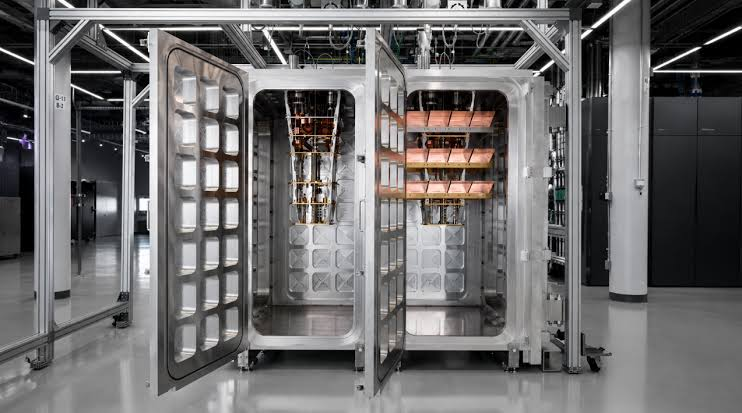
Yesterday they connected two cryo chambers into one ultra cold environment. First time at this scale.
A quick recap: superconducting qubits need cables into a fridge. Fridges run out of room and the biggest chip ever, 1,121 qubits, hit that ceiling. IBM never built a bigger one.
So they stopped making bigger fridges. The new design scales by adding modules.
Box shaped cells that connect in a row. Each one 12x the wiring space, ~2,000 qubits. Two cells just cooled to 15 millikelvin as one system. The key piece is L-couplers, Meter long superconducting cables carrying quantum information between chips in different modules.
And the detail most missed, those cables attack superconducting's OTHER weakness too. Long range connections unlock error correction codes with ~10x less overhead.
One cable fixing Two problems, If it works.
Because yesterday's chambers were empty. No qubits inside. On chip couplers entangle across micrometers. These cables must do it across a meter. A million times farther.
The real test is late this year, IBM puts live chips in both boxes and runs operations across the boundary. If fidelity holds, the two biggest arguments against superconducting weaken in one experiment.
If not, the scaling story has a meter long hole in it. Empty boxes today. The most important test in quantum in months.
$IBM $INFQ $IONQ
We believe the most bullish long term quantum catalyst just came out, and it will truly change the industry forever.
The White House's quantum push now reaches into K-12 classrooms. The Office of Science and Technology Policy is driving quantum education standards through its Q-12 Partnership, Congress introduced the bipartisan Q-LEAP Act to fund quantum instruction in schools nationwide, and states are already moving. Texas wrote quantum principles into its curriculum standards. Tennessee just launched a K-12 quantum program where students train on real commercial quantum hardware.
History is very clear about what this means.
The last time Washington rewired American classrooms around a single technology was 1958. Sputnik terrified Congress into passing the National Defense Education Act, flooding schools with math and physics funding. The kids who came out of those classrooms built Apollo, ARPANET, and eventually Silicon Valley. One education bill, written in panic, produced fifty years of American technological dominance.
The same pattern repeated in the 1980s when computers entered schools while serious people still called them toys. The children who grew up on them built the internet economy.
Governments don't teach children a technology they expect to fail. Curriculum is the longest-duration bet a nation can make, because the payoff is twenty years out and impossible to reverse. When the same government that's taking $2 billion in equity stakes in quantum companies and mandating a working machine by 2028 also starts training eight year olds on qubits, it isn't speculating anymore. It's staffing.
Markets debate whether quantum is real yet the state is already raising its workforce. That gap between what traders believe and what governments are building is where the next decade of returns lives.
This is a massive long term signal and will pay off greatly for the US over a 20+ year horizon.
Note: This China news paper we created but it could be a tell into the future.
$INFQ $IONQ $QBTS
The White House just published its master plan for tech and national security.
24 pages of every technology the government considers critical. Quantum appears 7 times.
First, the big one. The strategy names exactly three technologies that could transform national security itself: AI, biotech, and quantum. Their words: future breakthroughs could have "profound implications for sensing, communications, computing, and information security."
The FBI now runs a dedicated Quantum Counterintelligence Protection Team. An interagency squad of quantum experts protecting US quantum research from foreign theft.
Americans are being restricted from investing in Chinese quantum. The Outbound Investment Program names quantum alongside AI and semiconductors, and the White House says it will keep tightening it.
Quantum is in the alliance deals. Tech prosperity agreements with the UK and Australia specifically expand quantum cooperation.
It's going into schools. The strategy calls for quantum concepts in K-12 education and new quantum degrees and certifications. They're building a 20-year talent pipeline.
Post-quantum cryptography is listed as critical infrastructure. The government is transitioning to PQC now, before it's too late.
Now the detail nobody will notice, Appendix B maps each technology to battlefield needs. Quantum's boxes are marked with parentheses, the document's code for "implications have yet to emerge but are on the horizon."
In other words, the Pentagon can't use quantum yet, and they're funding it anyway. That's not procurement but insurance against being second.
This is one of the most important technologies of our lifetimes and we keep you updated here at all times breaking down everything in quantum and ahead of the curve.
Credit @pennycheck for finding this document.
$IONQ $RGTI $INFQ $QBTS
China is further along in Quantum than most give them credit for, and it's a key reason why the US keeps increasing funding and legislation. Here's where China stands.
Start with the only number you can pin down: $10 billion. And it's a single building. The Hefei National Laboratory, 37 hectares, the largest quantum facility on earth. Everything else in "China's quantum spending" wraps around that lab such as university grants, a 12,000km quantum network, a satellite. A decade of infrastructure.
But it's about to get bigger. In March, China's Five-Year Plan named quantum the #1 future industry in the country. That designation triggers procurement mandates, subsidies, and a $17.5B venture fund behind it. Provinces are stacking their own quantum funds on top, and China Telecom took a controlling stake in the nation's quantum crypto champion with $1.4B+ more planned.
The goals are explicit, a general purpose quantum computer prototype by 2030, and 3,000 deployed quantum applications by 2030.
China already leads in quantum communications, and it's not close. First quantum satellite, longest unhackable network on earth. Two major results in Nature and Science this last January alone.
Where China trails: the part that matters for useful computing. Logical qubits and error correction. No verified Chinese result comes close to Quantinuum's 94 logical qubits or Google's error correction breakthrough. Their best machine runs 180 physical qubits.
The most interesting part is that Alibaba and Baidu both shut down their quantum labs and handed the hardware to the state.
These next decades will get interesting and it will only spark more US innovation and funding.
$IONQ $RGTI $INFQ
5. Encryption: Everything protected by RSA today gets broken by a big enough quantum computer. Which is why the US government is already forcing the migration to quantum-proof cryptography. The threat is priced into policy before the machine even exists.
Imagine a computer that doesn't calculate reality. It speaks reality's native language.
Every classical computer, including the phone you're reading this on, simulates nature by brute force. Molecules, materials, chemistry. Nature isn't classical. It's quantum. So we've been modeling the universe with the wrong math for 80 years, and it shows: designing one drug takes 10 years, $2 billion, and fails 90% of the time.
Here's the industries and companies Quantum will have the greatest impact on:
4. Finance: Portfolio optimization and Monte Carlo pricing are quantum native problems. JPMorgan isn't building a quantum team for fun
$JPM is also already partnered with $QNT and has been apart of multiple funding rounds.
Which quantum modality is the most expensive to scale?
The answer decides who survives or avoids major dilution.
Start with what one superconducting machine costs to house. A 750kg cryostat, 30kW during cooldown. Chilled water, vibration isolation, EMI shielding, and about $100K of helium-3 per refrigerator. Helium-3 comes from tritium decay, meaning the supply chain runs through nuclear weapons programs. And every qubit adds ~2 more cables into the fridge until the wiring physically doesn't fit.
Ions and atoms skip nearly all of it. Room-temperature vacuum chambers steered by lasers. Neutral atom systems ship in a standard server rack running on 3kW, a hair dryer and a half.
But the real cost is the overhead multiplier. Superconducting needs ~1,000 physical qubits per logical qubit. Quantinuum just made 94 logical from 98 physical ions. Infleqtion is targeting under 10 physical per logical. Whatever your per-qubit cost is, one modality multiplies it by 1,000 and the others by 10 or less. That multiplier applies to every fridge, cable, and chip you'll ever buy.
$RGTI (Superconducting): burns ~$16M a quarter, $569M cash, no debt. But their guidance says elevated 2026 capex for Fab-1 and dilution refrigeration capacity. The modality elevated cost is yet to hit, but their $100M Commerce LOI exists to subsidize exactly that.
$INFQ (neutral atoms): burns ~$14M a quarter, $582M cash, no debt, $12.6M revenue growing 116%, guidance raised. Similar burn to Rigetti, but no fridge costs. Their capex outlook: a "measured step-up." Their 2027 Illinois machine targets 50+ logical qubits from a server-rack footprint.
$IONQ (trapped ions): burns ~$127M a quarter, by far the most. But it's buying acquisitions and scale, funded by ~$3B in cash and $80M of quarterly revenue growing 287%. Cheap modality, but expensive ambition.
The pattern shows superconducting's costs are backloaded into capex that grows with every qubit. Atom and ion costs are frontloaded into lasers and physics talent, then scale gently.
The modality needing 100x fewer qubits per logical qubit fights it with 100x less infrastructure.
$IONQ $RGTI $INFQ