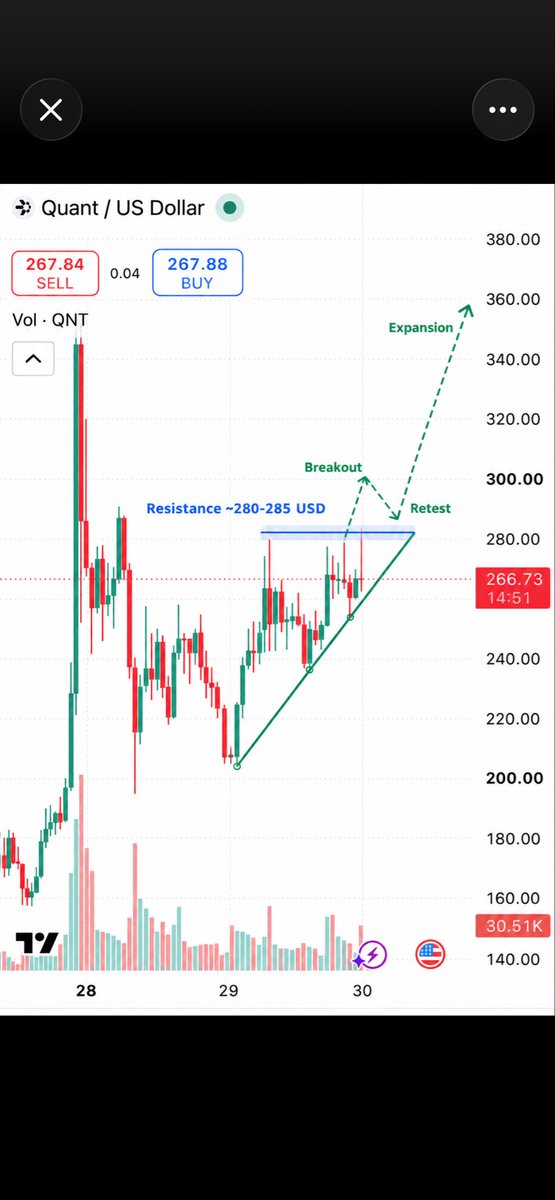
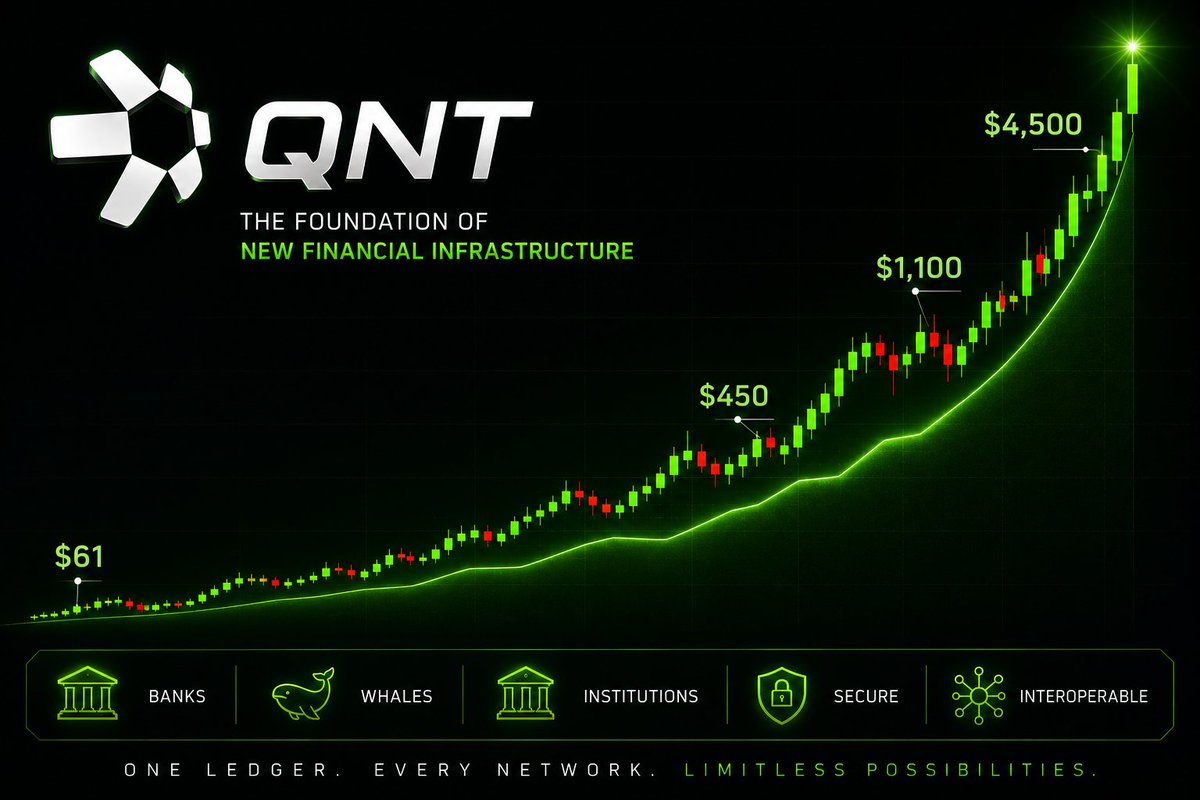
When ethereum:0x4a220e6096b25eadb88358cb44068a3248254675 smashes through this resistance, it doesn’t just move — it rips.
With all the fundamental developments stacking up around Quant right now, this setup has the ingredients for another violent move higher.
Breakout → retest → expansion. 👀🚀
#QNT #QuantNetwork #SIBOS #SWIFT #TCH
فيه حساب غرد عن البتكوين لما كانت 300 دولار في 2013 وقال بنصح بشراء لو حبة بتكوين
قبل ساعات غرد عن $QNT وهي 120 دولار
يقول ينصح بشراء لو عملة واحدة يقول احتمالية الخسارة هي 120 دولار لكن ممكن تكسبون 10 الاف دولار .
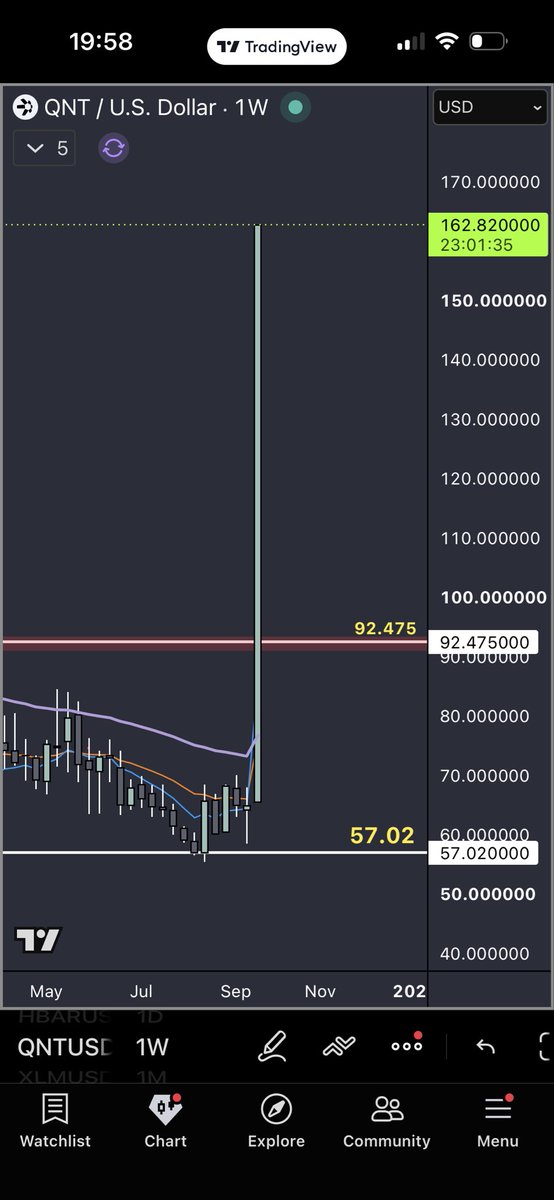
العملة بعد تغريدته قفزت الى 192 🙀😐
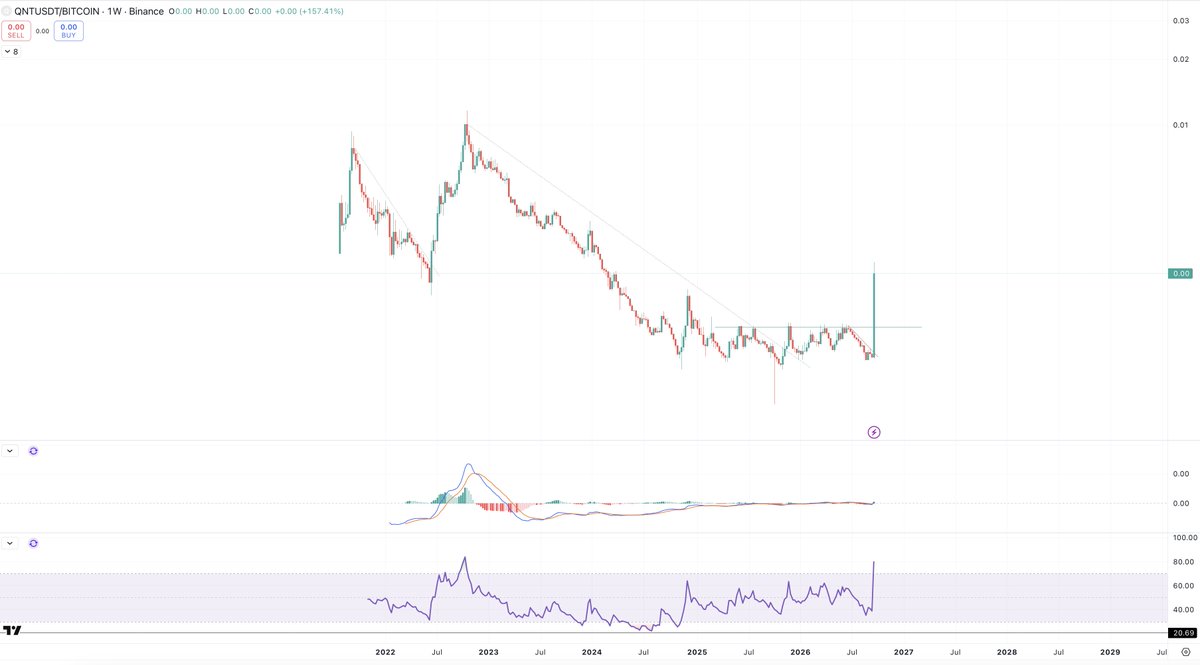
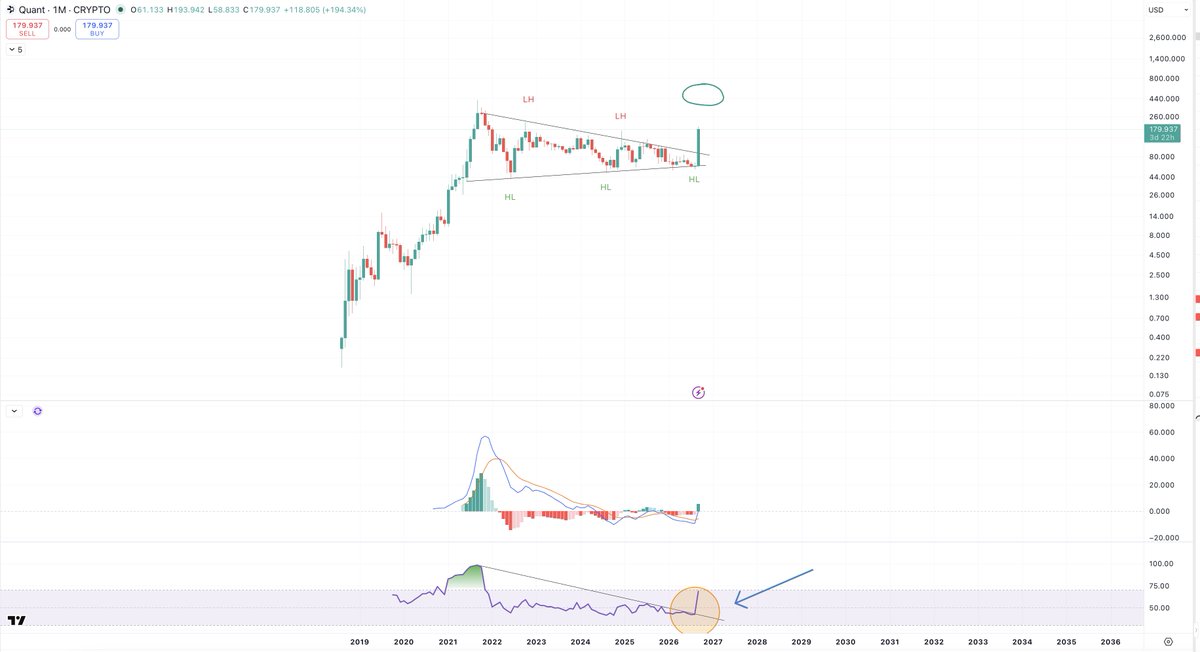
If you're wondering why $QNT price pumped 3x this week, this list is probably a good place to start ↓↓
• Quant was just chosen to build the next generation of US bank money. The Clearing House, owned by 25 major US banks like Chase, Bank of America, HSBC, and Citi settle more than $2 trillion per day and selected Quant to connect its new on-chain money network.
• Quant is now powering the largest banks in the UK. Barclays, HSBC, Lloyds, NatWest, Santander and others are now executing live customer transactions on infrastructure built by Quant.
• Quant is directly integrated into Murex’s MX.3 platform. MX.3 is the financial software engine powering 65 of the world's 100 largest banks, and Quant gives them crypto-ready infrastructure without requiring them to rewrite existing infrastructure.
• Oracle has put Quant inside its enterprise digital-asset stack. One of the world's largest enterprise software companies has certified Overledger to provide cross-ledger orchestration for settling transactions across different ledgers and off-chain databases.
• Quant is shaping the standards that will govern value movement across the internet. SATP is designed to let digital assets move safely between separate networks, and the protocol is now in the IETF's final community-review stage before a decision on publication.
• Quant has built technology for the Bank for International Settlements and the Bank of England. Project Rosalind tested 33 API functions and 30+ real-world use cases, with Quant supplying blockchain infrastructure, smart contracts and interoperability.
• The European Central Bank picked Quant to help experiment with the Digital Euro. Quant is testing how programmable payments could work directly with central-bank digital money, putting it inside one of Europe’s most important future payments projects.
• Quant has already integrated with Nexi’s European payments infrastructure. The underlying SIA network spans 580 nodes across 208,000+ km of fiber, connecting banks, payment providers, and financial institutions across Europe.
• Quant has been working on blockchain infrastructure spanning 12 countries across Latin America. The LACChain network gives Quant exposure to cross-border payments, tokenized money and interoperability across multiple national markets.
• Quant has a direct route into Japan’s banking system through Dentsu Soken. Dentsu Soken builds mission-critical systems tied to BOJNET, SWIFT, CLS, internet banking, and core banking, and the partnership includes a joint go-to-market plan for Japanese banks.
• Quant has been granted multiple patents across the US, Europe, Japan, and China. This gives Quant a defensible IP position in one of the hardest problems in digital finance — enterprise-grade multi-ledger technology.
• Quant’s founder helped launch the ISO standard for blockchain and distributed ledger technology. Gilbert Verdian was instrumental in establishing ISO/TC 307, the international committee for blockchain and distributed ledger standards, going on to lead its interoperability working group.
• Quant isn't betting the company on just one product. Overledger, Quant Flow, PayScript, QuantNet, and Fusion give it multiple products around interoperability, programmable money, payments, and multi-network settlement.
• Gilbert was working on this problem before most people had even heard the word “interoperability.” Before Quant, he spent 20+ years in cybersecurity and senior technology roles across the Federal Reserve, Bank of England, HM Treasury, Mastercard, PricewaterhouseCoopers, HSBC, Ernst & Young, and other major institutions.
• $QNT is unusually scarce for an asset servicing a global market. Its maximum supply is just 14.88 million tokens, giving it one of the tightest supply profiles in large-cap crypto. As we've seen this week, when demand spikes, upward moves can be violent.
• Staking could create an even more powerful supply-and-demand loop. Likely arriving in 2027, Quant's staking mechanism could see millions of $QNT tokens locked away, while participants earn rewards and growing network usage competes for the same fixed supply.
• All of this is only what we're allowed to see. Quant is built to operate behind the scenes as white-label infrastructure; we actually have no idea how many more integrations are already live, being tested, or sitting in the pipeline waiting to be announced.
So when people ask me why $QNT suddenly ran this hard this week, I think they're asking the wrong question.
The better question is why the market ignored all of this evidence for so long.
$qnt - If I had 100,000 followers, this would have been one of the most viewed posts of the day worldwide.
Nailed it with absolute perfection. 🎯
Like I said many times before:
Everyone will see it after it happens. 🤝😉
For the ones who followed me on this journey: you can do me a very big favor by sharing this post.
That would honestly make my day.
Thank you. ♥️🫡
🧿💥 $QNT Another DIP!
QNT reserves across tracked CEX's at around 1.12M, an ATL!
'What if there’s none left to buy?' QNT has 18 decimal places. Future buyers will purchase fractions.
The real question is what happens to price if demand grows while exchange supply stays tight.
Congratulations to all $QNT holders ! You've bought a piece of the new internet. Hope all of you are prepared to see your bank accounts grow like never before in the coming years. The naysayers will one day become fans at $5000 or $6,000 and they will look at all of you who bought under $100 as GOD's . Welcome to a very select club.
The first-ever Layer 2.5 crypto network is here.
And, naturally, it’s built by $QNT.
Overledger Fusion isn’t just an upgrade, it’s a warning shot to every chain, bridge, and rollup still pretending they can scale on their own.
In a few days, Quant will launch a MULTI-CHAIN ROLLUP NETWORK that:
• Scales across all chains
• Preserves enterprise privacy
• Complies with regulated markets
• Uses NO bridges, NO wrapped assets
• 𝗔𝗻𝗱 𝗹𝗼𝗰𝗸𝘀 𝘂𝗽 $QNT 𝘁𝗼𝗸𝗲𝗻𝘀 𝘁𝗼 𝗽𝗼𝘄𝗲𝗿 𝗶𝘁 𝗮𝗹𝗹
Fusion connects private DLTs, public blockchains, and DeFi protocols natively.
Every transaction?
Secured by $QNT.
Every institution?
Must stake $QNT for access.
We’ve talked about institutional adoption for years; Fusion is what makes it viable.
Plug in a node, define your rules, stake $QNT, and go live on ANY chain you want.
The Finternet is forming.
And $QNT is the fuel.