Too late for 'Situational Awareness'. They shoud have read papers on conformal prediction.
The best part? It is citing our 2017 paper on Conformal predictive distributions.
Only took finance 10 years to discover it.
#finance#conformalprediction
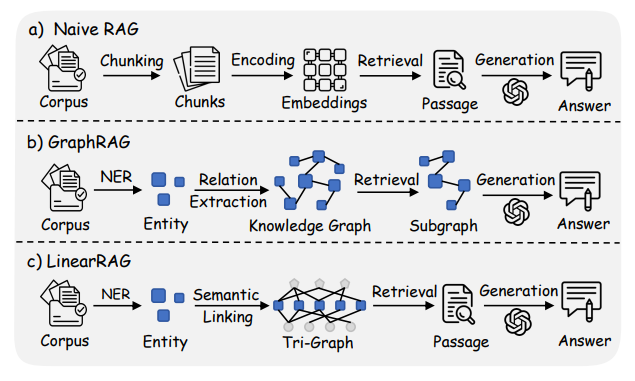
LinearRAG: Linear Graph Retrieval Augmented Generation on Large-scale Corpora
Relation extraction may be the weakest link in your GraphRAG pipeline.
A new paper, LinearRAG, traces the recurring underperformance of graph-based RAG systems back to one step: turning passages into subject-relation-object triples via an LLM. The authors show this process is both expensive and unreliable — negation gets flipped, so a sentence stating a fact wasn't true can be misrepresented as though it were, and unrelated categories get linked as if they were hierarchical, introducing structural noise before retrieval even runs.
Their fix: drop relation extraction entirely.
LinearRAG builds what it calls a Tri-Graph, connecting entities, sentences, and passages using only lightweight named-entity recognition and semantic linking, with no LLM calls required during indexing. Retrieval then runs in two stages: local semantic bridging to activate relevant entities, followed by personalized PageRank over the activated subgraph to surface the most important passages.
The results, benchmarked against HippoRAG2, the strongest triple-based system tested:
→ 66.95% vs 58.85% accuracy on 2WikiMultiHopQA
→ Indexing time cut from LightRAG's 4,933 seconds to 249.78
→ Zero LLM token cost during indexing
The takeaway for anyone funding a graph-based RAG build: relation extraction isn't a given. Audit whether it's earning its keep, or just adding latency and hallucination risk on top of a system a simpler entity-only index would beat.
By Luyao Zhuang, Shengyuan Chen, Yilin Xiao, Huachi Zhou, Yujing Zhang, Hao Chen, Qinggang Zhang, and Xiao Huang
LinearRAG: Linear Graph Retrieval Augmented Generation on Large-scale Corpora https://t.co/s0ScSsETaL
#RAG #GraphRAG #NLP #LLM #MachineLearning
--
Join the Conversation
Subscribe to the Year of the Graph newsletter for quarterly insights on #KnowledgeGraphs, #GraphDB, Graph #Analytics, #AI, #DataScience and #SemTech .
📧 Subscribe: https://t.co/7pg6gqWYvw
💼 Sponsorship inquiries: https://t.co/LCvoLhhBBt
This repo is a quant treasure.
"Microsoft Qlib": the open source engine that put 25+ published quant models into a single library.
The system that took quant research from hedge fund black boxes and fragmented notebooks to one unified, end to end pipeline.
The same framework that lets you reproduce published research and run backtests with a single command, while Wall Street charges six figures for tools that won't even show you the source.
Bookmark & If this helps you, pass it on.
1. Algebra is good for problem-solving.
2. Geometry is good for visual thinking.
3. Calculus is good for understanding change.
4. Statistics is good for decision-making.
5. Number theory is good for logical discipline.
6. Linear algebra is good for modern science and engineering.
7. Discrete math is good for computer science.
8. Differential equations are good for modeling the real world.
9. Optimization is good for smart planning.
10. Graph theory is good for network thinking.
11. Set theory is good for structured reasoning.
12. Practice is good for mathematical fluency.
13. Curiosity is good for lifelong learning in math.
The entire RAG industry is about to get cooked.
Researchers built a new RAG approach that skips almost everything traditional RAG relies on.
- No vector DB
- No embedding your data
- No chunking
- No similarity search
It's called PageIndex.
Instead of chopping your docs and stuffing them into Pinecone, it builds a tree index and lets the LLM reason through your documents like a human reading a book.
98.7% on FinanceBench. Beats every vector RAG on the leaderboard.
100% Free. Open Source.
The J-curve in Private Equity isn't a bug—it's a feature of #capital calls and deployment lags. But MIRR reveals the truth: that IRR drops significantly usually when realistic reinvestment rates are used. Always ask: reinvestment at what?
#MarketHedge#RiskReward#financeact2026
The CIA released a "Reading Improvement Course" that had been hidden from the public since 1955.
I read all 117 pages so you don't have to.
Here are the 10 most interesting quotes from it:
1) "Good reading is not necessarily rapid reading. The rate must be adjusted to comprehension requirements."
2) "To read well you must concentrate. No activity except perhaps writing or thinking makes more rigorous demands upon the whole mind than reading."
3) "Suggestions to develop your ability to concentrate: Be interested. There is no spur to concentration like honest interest."
4) "Some readers have found certain devices useful in keeping their minds on the subject. One device is to jot down key thoughts as one reads. These words act as a fence to confine our wandering thoughts. The practice of underlining key ideas and making notes at the end of each section serves the same purpose.
5) "Concentration is a habit and must be formed. Habits require, at first, a conscious effort of the will. Force yourself to let nothing come between your mind and the matter on the page before you."
6) "When our attention wanders, words slip by us and leave no trace of meaning. Under such conditions we cannot expect a harvest of logical thought. We go through the motions of study or reading, but do not get results. We waste time that could be used far more pleasantly and profitably."
7) "Drawing conclusions is the final step of the reading process and should be based on sound judgment of the author's qualifications, facts presented, methods of presentation, validity of arguments, or style of presentation."
8) There are 3 types of reading:
Intensive reading: when the purpose is to master new subject material, the skills required are translation, integration, analysis and evaluation. The best procedure is (a) rapid preliminary survey of the material, (b) formulation of questions prior to the reading, (c) careful reading, and (d) review and recitation of important points.
Extensive reading: with the purpose of acquiring a broader frame of reference and widening the range of knowledge. The skills required are integration, analysis, and evaluation. The best procedure is rapid and thorough reading of the material. The extensive reading rate should be as fast as the thinking process permits.
Scanning: for (a) the main idea, (b) specific information and (c) a preview of the material. To read effectively the reader must first review the material and the specific purpose for the reading.
9) The SQAR3 Reading Strategy:
"Scan: Quickly scan the introductory paragraph, subtitles, key sentences, key words, summary. Decide on the author's plan.
Question: Turn the title or key sentences into questions.
Anticipate: Before reading, try to answer these questions mentally.
Read: Read the entire selection and look for the author's ideas to answer your questions.
Recite: Close the book or magazine. Tell yourself in your own words what you have learned. Write notes on material that must be remembered.
Review: Later, to make your knowledge stick, review the gist of the article or chapter, again in your own words."
10) How to read with purpose:
-"Have definite questions which you wish answered through reading a given selection.
-While reading, make a mental note of the main points in the paragraph or article.
-From time to time stop to think over the material just read in preceding section.
-Notice the illustrations and examples that are used.
-Develop the habit of criticizing what you read."
My favorite quote from the report:
"Reading is a pleasure, a source of information, and the basis for most decisions that are made today. It deserves the liveliest interest and the best techniques we can master."
Why Soviet Math Students Were Strong
People often ask:
Why were Soviet and Eastern European students so strong in mathematics?
Why do Eastern European students dominate math olympics?
Part of the answer lies in the textbooks.
My girlfriend asked why I was smiling at my phone at 3AM.
I lost my job last week.
Rent due in 4 days.
No backup plan.
Then I found a 33-year-old nerd who turned $1,000 into $946,207 trading Bitcoin with a trick he stole from hurricane forecasts.
No finance degree. No trading desk. Just a method every meteorologist uses and every trader ignores.
The method: meteorologists never forecast tomorrow with a single model. They run 31 and count the votes. He applied that exact framework to Bitcoin.
Built a Claude agent that reads every 5-minute BTC candle and feeds it into MiroFish simulator running 31 parallel prediction paths.
Trade only fires when 28 out of 31 models agree.
Below 26 votes? Trade dies instantly.
The agent moves faster than any human trading desk:
→ Collects market data 24/7 without breaks
→ Runs continuous simulations inside MiroFish engine
→ Operates fully autonomous with zero manual input
→ Every trade executes only when consensus hits threshold
→ Every dollar captured is pure market inefficiency exploit
That is the entire edge.
Not prediction. Consensus.
Position sizing follows Kelly criterion. Signal fires or it does not. Most signals fail the vote count, so the system stays flat most days.
He spent years learning that certainty is a scam and consensus is the only edge that matters.
You only need Claude + device + 1 hour per day.
Giving this free for 24 hours.
To get it:
1. Comment the word Claude
2. Like and retweet this
3. Follow me @codewithimanshu so I can DM you
Save this post. Build the consensus system this week. Start with $200. Scale on evidence.
CDS basis ≈ 0 is a normal-times assumption only. In stress, bases widen because arbitrage requires funded access to the underlying. Basis trades are technical, not risk-free. The 2008 credit spiral taught us this brutally. 📉
#RiskReward#quantitativefinance
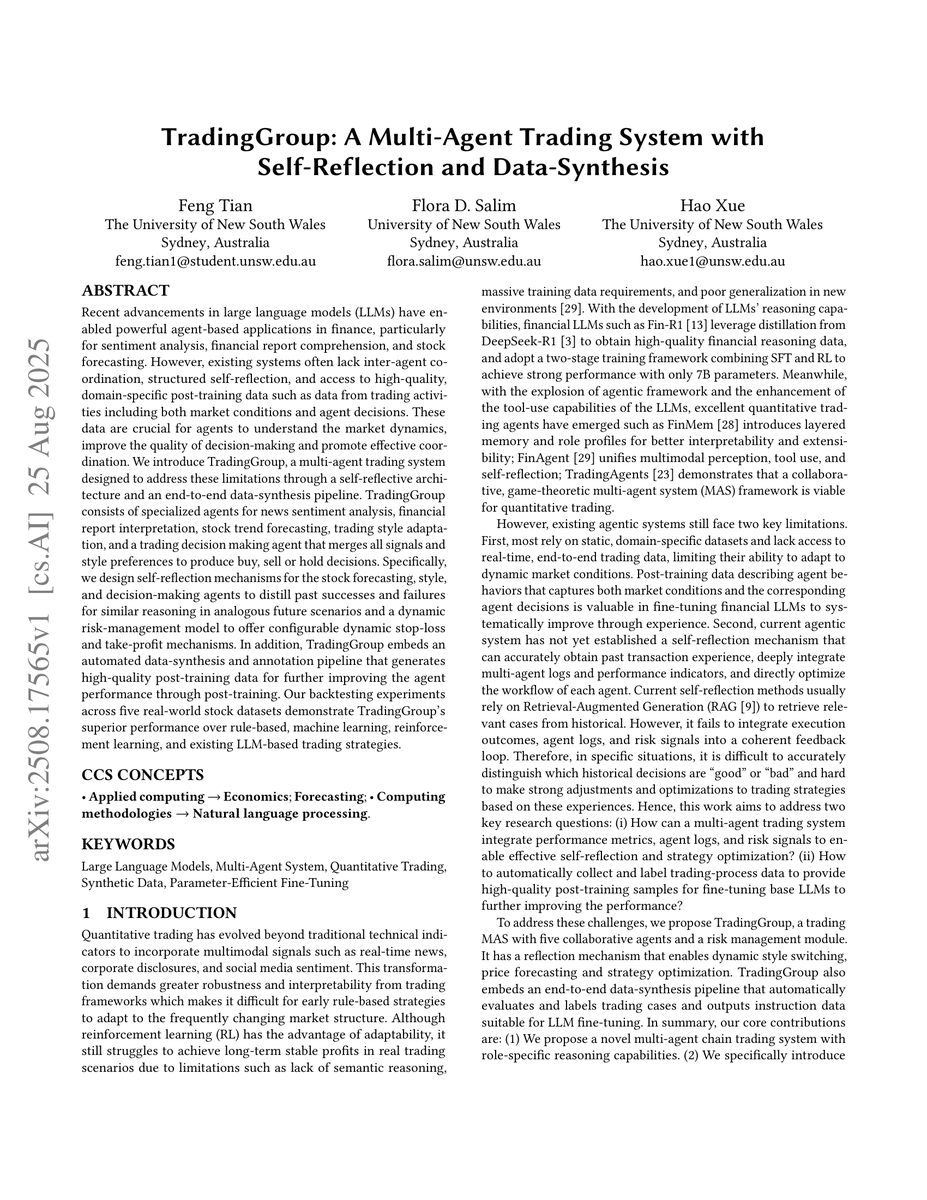
This paper completely changed how I think about self-correcting trading agents:
Execution trace → profit/loss labeling → experience summary → prompt injection → next decision → synthetic SFT dataset
Honestly, most llm trading setups lose track of what worked. This one remembers.
It stores every input, output, account state, and CoT, then builds reflection summaries from last 20 days.
Here is how it works:
/ trading-decision agent reviews past successes and failures before acting
/ style-preference agent adapts aggressive, balanced, conservative from PnL and holdings
/ forecasting agent merges sentiment, 10-K RAG, and technicals with reflection
/ auto pipeline filters positive reward_a and high w_hit samples for fine-tuning
Turns live trading history into training signal
Read the complete paper + article below
Bookmark it for future reference
You'll be better off if you can implement GraphRAG for contextualized workflows and even DRL to ensure the set up gets smarter with your data and ontology.
The easiest way to stand out in AI+DS in 2026?
Build a business decision-making machine:
• Takes docs + data
• Cites sources
• Runs analysis
• Outputs decision recommendations
RAG + agents.
👉Here's how: https://t.co/P6jZxC0iBL