Daily backtested rule-based strategies. Research since 2012 by Oddmund Grotte & Håkan Samuelsson, both longtime former prop traders
Join our Skool Community. ↓
9 EMA Trading Strategy: Rules, Setup, Performance And Backtest
The 9 EMA strategy involves using the 9-period Exponential Moving Average to make profitable trades in the market. This may include utilizing techniques such as risk management and adjusting the size of trades to maximize returns.
We backtest the following trading rules:
* When the close crosses above the 9-day EMA, we buy at the close.
* When the close crosses below the 9-day EMA, we sell at the close.
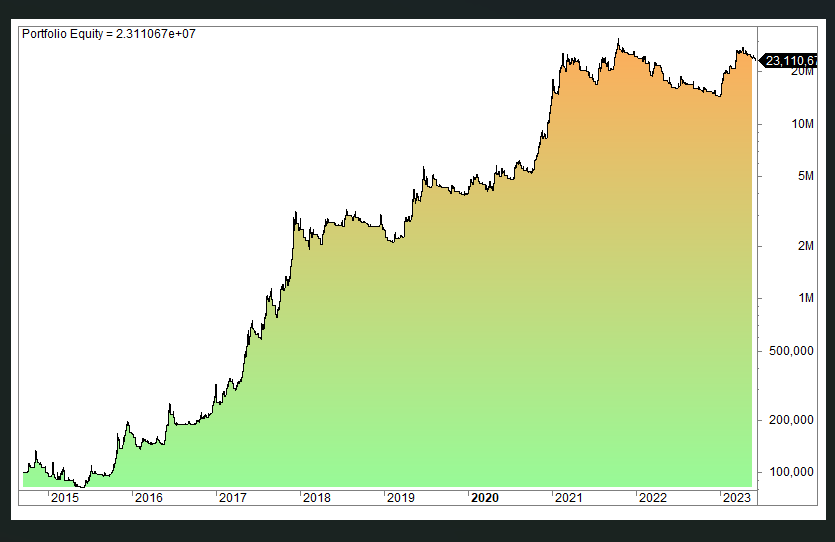
We employ the rules on Bitcoin, and we get the equity curve shown below.
Can the strategy be improved or made different? If you have any suggestions, please comment 👇
#TradingStrategies
If You Cannot Take The Next Signal, Your Position Is Too Big
A systematic trader must be able to take the next valid signal, even after several losses.
If fear prevents you from clicking the button, your position size may be controlling you.
Reduce size until following the rules becomes possible again.
Consistency Beats Emotion
Successful trading isn't about making exciting decisions.
The article explains that evaluating and trusting a thoroughly tested strategy helps traders remain consistent, even during periods of uncertainty, rather than reacting emotionally to every market move.
20 EMA Trading Strategy – Does It Work? (Rules, Setup, Backtest, Performance)
The exponential moving average is a type of moving average (MA) that places a greater weight and significance on the most recent data points. But a question arises: Can it be used to develop a profitable trading strategy?
In this article, we are going to look at what the 20-day EMA trading strategy is, backtest it, and improve it by adding an additional technical indicator.
We backtest the following trading rules:
* We buy the asset when the 20-day EMA is under the asset price
* We sell the asset when the 20-day EMA is over the asset price
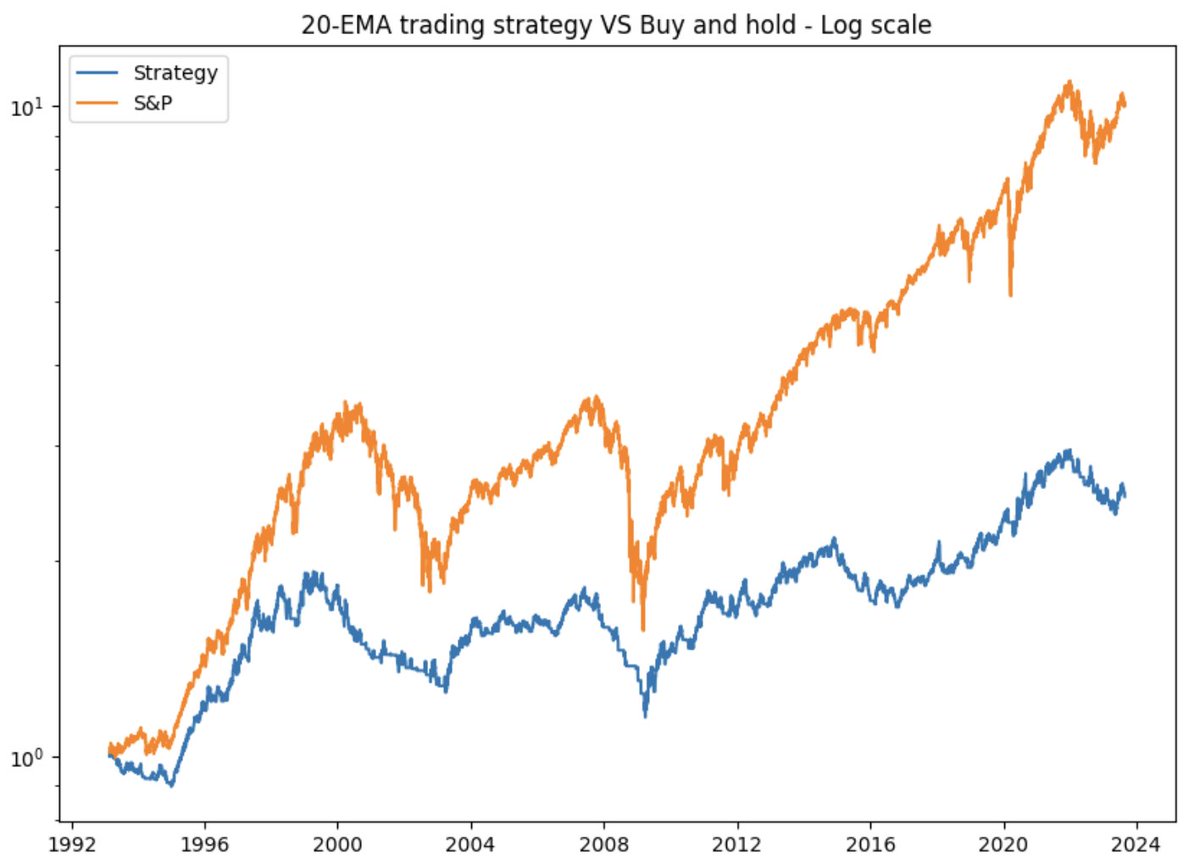
We backtested the strategy using the ETF version of the S&P 500, SPY. The data is not adjusted for dividends and splits. Below is the equity curve.
Can the strategy be improved or made different? If you have any suggestions, please comment 👇
#tradingstrategies
📈 Donchian Channel Strategy: +1,545.4% Historical S&P 500 Backtest
Can a simple strategy based on 20-day price extremes yield massive long-term returns? A historical S&P 500 backtest demonstrates how rule-based breakout systems can capture strong trends without complex indicators.
📊 What Is the Donchian Channel?
Donchian Channels form price boundaries based on historical ranges:
Upper Boundary: Highest high of the past 20 trading days.
Lower Boundary: Lowest low of the past 20 trading days.
🔍 Strategy Rules & Backtest Results
Market: S&P 500 (Long-only trend following)
Buy Signal: Close price breaks above the 20-day high.
Sell Signal: Close price falls below the 20-day low.
Historical Performance:
🟢 Total Return: +1,545.4%
🔴 Max Drawdown: -38%
🔥 Why the Strategy Works
Captures Momentum: Exploits emerging upside trends.
Follows Price: Reacts to live price action instead of forecasting.
Clear Rules: Systematic parameters reduce emotional decision-making.
Trend Participation: Stays invested during sustained market advances.
⚠️ Key Limitations & Considerations
False Signals: Prone to whipsaws in sideways or range-bound markets.
Lagging Exits: Exits occur after price drops from peaks, potentially missing initial market rebounds.
Execution Realities: Slippage, transaction costs, position sizing, and risk management significantly impact live performance.
💡 Key Takeaway
Systematic trading success doesn't require complexity—simple, well-defined breakout rules can successfully capture market trends. However, historical backtests aren't guarantees; robustness and risk management are essential.
ABOUT QUANTIFIED STRATEGIES
Run by former proprietary traders Håkan Samuelsson and Oddmund Groette, Quantified Strategies has published evidence-based research and backtested strategies since 2012. Our newsletter has 25,000+ subscribers, and our trading books have sold 30,000+ copies.
🚀 Want a more disciplined, evidence-driven trading approach?
Join our Skool community for backtested strategies, quantitative research, and systematic risk management.
👉 Link in bio!
#QuantifiedStrategies #DonchianChannel
9 EMA Trading Strategy: Rules, Setup, Performance, and Backtest
The 9 EMA strategy uses the 9-period Exponential Moving Average to identify potential profitable trading opportunities in the market. This may involve techniques such as risk management and adjusting trade sizes to help maximize returns.
We backtested the following trading rules:
➤ When the close crosses above the 9-day EMA, we buy at the close.
➤ When the close crosses below the 9-day EMA, we sell at the close.
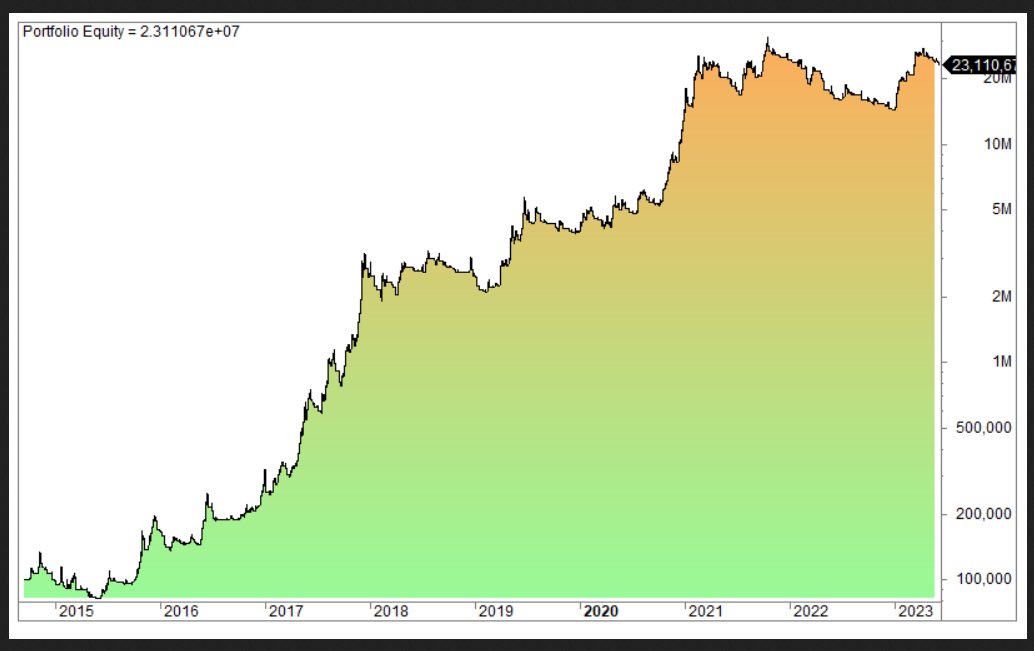
We apply these rules to Bitcoin and get the equity curve shown below.
Can this strategy be improved or modified? If you have any suggestions, please comment 👇
#TradingStrategies
We tested 100 stocks across 4,800 mean reversion backtests to find which bounce back most consistently.
Visa led in median profit factor, but another stock ranked #1 overall.
What made the difference? Watch our latest video to see what the data reveals.
https://t.co/zteaPmu8oj
Patience Is a Backtesting Skill
Here's something easy to underestimate.
Backtesting teaches patience by encouraging traders to wait until every predefined condition is met.
That discipline helps reduce impulsive decisions and can prevent unnecessary overtrading.
On Tuesday, QQQ's five-day return was approximately less than -2%.
Wednesday produced a substantial recovery.
More importantly, QQQ closed above the highs of both Monday and Tuesday.
Does this represent a potential transition from short-term weakness to renewed upward momentum?
End of Month Trading Strategy in S&P 500 – Update
The end-of-month seasonality is strong in stocks. A more updated version of the end-of-month effect was made not so long ago.
In plain English, the strategy is like this:
* Entry: Day 29, 30, or 31 of the month must be negative (this is calendar day – not trading days). Then enter at the close.
* Exit: Two successive positive closes in a row OR SPY hits a 1% target. (no stops). Exit at the close.
Results from 2005 until today are shown below.
The average per fill is 0.75% per fill. However, the equity chart is flattening lately, and 2014 was barely positive.
Can this strategy be improved or modified? If you have any suggestions, please comment 👇
#TradingStrategies