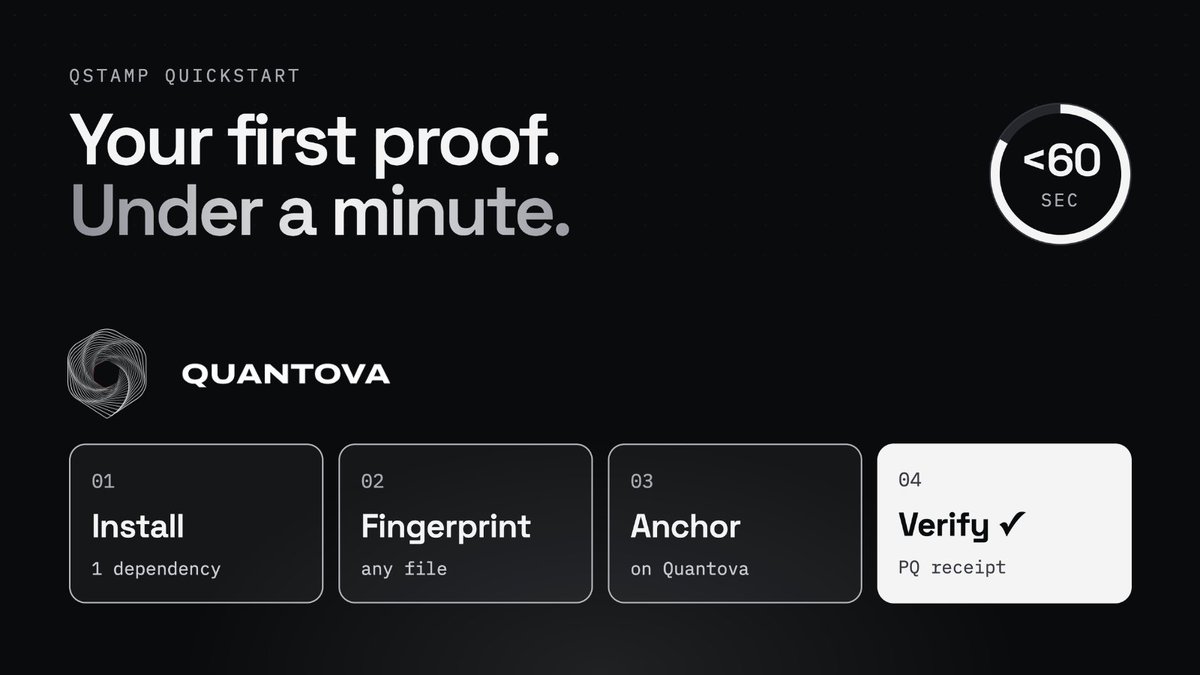
Quantova introduces Qstamp.
Post quantum evidence for AI agents. It gives every agent action a public record of proof, never a record of your data, so a court can verify what your AI did without ever seeing it.
Live on the QVM today → https://t.co/Z6eiuPivzf
When an AI agent pays, four things must be provable. Who authorized it, what it intended, who approved it, and that it settled.
@Quantovafnd anchors each step with post quantum signatures, linked in a chain, verifiable for the full retention the rules demand
Stamp your first record on Quantova in under a minute. Install the SDK, fingerprint a file, anchor it, verify the receipt. Open source, one dependency. Post quantum proof shouldn’t be hard to adopt, so we made it a single install
✅ [New bug bounty] Earn up to $3,000 with @Quantovafnd on HackenProof.
Rewards by severity:
- Critical: $2,000–$3,000
- High: $1,000
Ready for a new target? Review the scope and start hunting 👇
93 contributions now, opened to projects outside our own stack. This week ran through the cyber agencies of four countries. @NIST, France’s @ANSSI_FR, Australia’s Cyber Security Centre and AUSTRAC. We build a quantum safe chain, and we harden the people defending everyone else
Once a chain goes quantum safe, signatures and proofs balloon, and aggregation is the only way to keep them on chain. 8288 is a clever route. We built a hash based STARK prover and a single aggregated ML-DSA finality certificate for exactly this reason
Over the past few weeks I've gone from thinking leanPCS is total bull to being a total bull. So let me explain some of these buzzwords in more detail.
At the core, 8288 is about hyper-scaling data and execution for any computation that needs to get performed on a piece of data once, the chain learns the answer, and then we never need to see that data again. This sounds very specific, but it includes most "heavy" things happening on Ethereum:
* Signatures
* STARKs
* Merkle branches
* FHE computation
* ...
Really the first two are the most important.
Once we go quantum-safe, signatures get bigger (65 bytes ECDSA -> 1-6 kB WOTS/SPHINCS depending on params) and ZKPs get much bigger (200-1000 bytes with groth16, PLONK, etc -> 128 kB with STARKs). This is unsustainable to put on chain, and 8288 fixes this.
8288 works by aggregating STARKs in the mempool. First, you as a user generate the STARK or SPHINCS signature or PCS opening (more on that last one later), and publish it. Then, each node listens. Each tick, each node takes all of the new objects that it has seen, and generates a STARK containing a list of "claims":
"pubkey P has signed message M"
"program X run on data D has output Y"
"p(X) = Y for some polynomial P whose hash is H"
and a proof that it has seen a signature, STARK or PCS opening verifying those claims. So the only information getting re-broadcasted is:
(i) hashes of inputs and outputs (~64-96 bytes per claim)
(ii) a single STARK proof per tick
These aggregate proofs themselves get re-aggregated, and eventually you get to a single "master proof" in the block, that verifies that all of those statements are true. And so the only other data that has to actually go on chain is the statements (the (P, M), (X, D, Y), (X, Y, H) tuples I described above), not the actual signatures or proofs. This gets put into a specialized frame type.
Now, let's get into the leanSPHINCS vs leanSTARK vs leanPCS part.
The core distinction is: *what is the underlying object that the user is creating?*
In leanSPHINCS, it's a signature, and specifically this particular type of purely-hash-based signature: https://t.co/HOazliHq9N
If we add leanSPHINCS, then users will be able to make quantum-safe accounts, and pay only a little bit of gas (4096 for the 64 bytes) for each signature. So we get scalable quantum-safety for regular accounts, multisigs, etc. But it's only one specific signature scheme, you can't do anything else.
In leanSTARK, it's a STARK. This means it's fully general: the user runs whatever computation they want, and publish a STARK of it. So you can use it for:
* Any signature scheme (including eg. lattice-based ones if you like those)
* A multisig that hides its internal logic
* Privacy protocols
* Private account abstraction: authorization logic that depends on some value hidden elsewhere in the state, so you can have one key that controls all your accounts without publicly linking them to each other
Basically, it's a free for all, in the same way the EVM is a free for all.
But leanSTARK has a practical downside. The protocol would have to specify the language in which users write their programs (we call this the "ISA"). So we would have to agree on that language. This is a really big deal - it's the first big case of "Ethereum moving beyond the EVM" - and so it's likely to take time to agree on the details of it, especially since the ISA would be hard to upgrade. There are benefits to taking longer on this, figuring out the ideal ISA, and then even giving access to it inside regular contracts.
LeanPCS is the third option. PCS stands for "polynomial commitment scheme": a proof that P(x) = y. The most important thing to know about PCSes is that they are by far the most important "hard" component of a STARK (see here: https://t.co/EEQWMU0gAf ). If you have a "magic PCS oracle" (which from the EVM's point of view, 8288 is), you can verify a STARK in ~20-40k gas.
The most important gain with PCS is that there is far less that we need to choose. Specifying a PCS only requires specifying a field, and there is a natural option: the 128 bit binary field (technically, we can go more general than that, and say the 2^k-bit binary recursive tower field, going up to 256)
LeanPCS is less efficient than leanSTARK onchain, because you would have to put multiple claims to prove one thing. But it's arguably more efficient offchain, because you have much more flexibility to choose proof systems.
But most importantly, leanPCS gives you the same generality as leanSTARK, in a way that could potentially be implemented very quickly. And once we figure out the ISA, we can add leanSTARK later.
So there is a route to getting "the cryptographic proof singularity" much faster than any of us expected, and that route runs through 8288 with leanPCS.
https://t.co/dUHONMh75g
We found and fixed a critical authentication bypass in @NIST’s own code. A self signed certificate was accepted and trusted as any identity, with no verification at all. Reported, fix open
Another CRITICAL found in @NIST's own code. Many rely on @NIST to get quantum security right. This is not acceptable.
I found it and shipped the fix under @Quantovafnd, open now. A full authentication bypass. Any self signed certificate got accepted and trusted as any identity, no verification performed at all.
I've reported 5+ fixes to @NIST this past week alone. All still sitting open. None of it looks like it's being audited or checked properly before it ships to the public.
@P3b7_@DmytroMatviiv@HackenProof@trailofbits@anna_tutova
https://t.co/7c7f39NJ2l
A proposal to accelerate Ethereum's post quantum work to 2027, trading faster blocks for quantum resistance. A chain doesn’t give up speed for a threat it thinks is far off. Quantova made that choice at the first block
INSIGHT: Ethereum research group Ethlabs proposes pulling quantum resistance forward to 2027, a year ahead of the current target, by removing faster block times from the Hegotá upgrade and prioritizing post-quantum cryptography amid rising AI-driven security risks.
AI agents are starting to act on their own, with less review each step. Qstamp fingerprints each action with SHA3-256 and anchors a salted commitment signed under ML-DSA-65. Proof of what the agent did, under which model and when, and the data never leaves your systems
Good to see the @XRPLF moving on this. We’ve been contributing to exactly this feature on rippled, in place rotation of a registered quantum key and enforcement of the ML-DSA-44 signer size
XRP Holders Could Get Quantum Protection Without Paying More
The XRP Ledger (@XRP) $XRP Foundation has outlined a plan for quantum-resistant accounts.
The design lets users add a NIST-approved ML-DSA-44 signing key and disable their old key. This would help protect accounts whose public keys are already exposed.
The proposed upgrade would not increase users' base transaction fees.
The migration study is scheduled for the first half of 2027.
Quantova has now opened 74 post quantum contributions to projects outside its own stack. This week the work ran deep into the @XRPLF, @Hyperledger, identity wallets and AI agent protocols. We build our own quantum safe chain, and we harden everyone else’s. All public
Quietly significant. @ethereumfndn quantum safe signature verification is now tested against @Quantovafnd's vectors. Sixty cases across ML-DSA-65 and 87, reject cases included, verified against OpenSSL, merged into EIP 8355. Great work!
@ethereumfndn has merged @Quantovafnd post quantum signature work.
EIP 8355 is the on chain precompile that lets Ethereum verify ML DSA signatures, the standard that keeps signatures safe against quantum computers. Its test vectors covered only the smallest level, ML DSA 44.
On behalf of @Quantovafnd I extended them to ML DSA 65 and ML DSA 87. I added the rejection cases that were missing. Sixty vectors in total, every expected result verified against OpenSSL.
Ethereum's quantum safe signature verification is now tested against Quantova's vectors.
@ethereum@ethereumfndn@VitalikButerin@P3b7_@DmytroMatviiv@HackenProof
https://t.co/RuRm8wOccQ
QMask is @Quantovafnd's wallet. Keys are generated and kept on your device, behind biometrics, and signed with ML-DSA-65. The private key never leaves the phone, and it was never a kind a quantum computer can break. Post quantum, in your pocket
ML-DSA (FIPS 204)
@NIST I have A second critical fix opened against NIST ACVP Server. The ML-DSA key generation validator in FIPS 204, the post quantum signature standard, throws an unhandled server error when a registration omits its parameter sets, instead of a clean validation error. Traced to the line, fix opened.
https://t.co/iYYNO3EtsB
@P3b7_@trailofbits@DmytroMatviiv@HackenProof
ML-KEM (FIPS 203)
I have reported a critical bug in @NIST ACVP Server, the engine labs use to validate cryptography for US federal use. The ML-KEM validator in FIPS 203 returns an unhandled server error on a registration that omits a required field, instead of a clean validation error.
The is Fix opened.
https://t.co/5lLrwl4zHL
@P3b7_@trailofbits@DmytroMatviiv@HackenProof
A 100x drop in attack cost between two drafts, and the deadline stays put. That’s @NIST saying the timeline was already tight. RSA and elliptic curve are deprecated by 2030, gone by 2035. Quantova uses neither, nothing here to deprecate
Between the 2024 draft and the 2026 finalization of NIST IR 8547, the estimated qubit cost of quantum attacks dropped by >100x. The final document still recommends the same PQC timeline (deprecate by 2030, disallow by 2035).
https://t.co/puLl5XT9lt
3/ So Quantova built the whole stack quantum safe from the first block. The chain, the VM, the prover, and 82 repositories of tools for AI, finance, identity, and more. Nothing to migrate, nothing inherited from a broken primitive. The quantum era, already built for
1/ Quantova is a post quantum Layer 1, built quantum safe from its first block. The obvious question is why build it now, before a quantum computer that can break today’s cryptography even exists
2/ A powerful quantum computer breaks the signatures securing almost every record today, and the estimates to do it keep shrinking. Evidence can’t be made after the fact. A record sealed today proves its integrity from today. One kept without a post quantum anchor can’t