Black Friday is one day.
A sample size of one.
I don't trade sample sizes of one, so I'm not running a promotion on one either.
BlackMonth. All of November.
The point is not more trades. It's fewer days where everything is wrong at the same time.
Free for every new ProTrade subscriber until November 30. Not a forecast. Not a guarantee.
https://t.co/5eA0ZMA3Dd
The standard advice on diversification: own more tickers.
The problem: correlations go to 1 the week you need them not to.
There's another axis. Diversify the logic, not the instrument.
To make the cut, a system had to pass IS/OOS, walk-forward, Monte Carlo and parameter permutation and much more....
Then it had to add something the other 19 didn't already have. A strong system that duplicated an existing one was cut.
Black Friday is one day.
A sample size of one.
I don't trade sample sizes of one, so I'm not running a promotion on one either.
BlackMonth. All of November.
Each monthly delivery is a deployment pack, not signals:
Plain English rules
AFL (AmiBroker)
ELD (TradeStation)
Python notebook
Historical trades file
Daily timeframe. Liquid ETFs. Long or short. One every month since January 2024.
So the lesson isn't "stops don't work". It's narrower and more useful.
A stop is not free insurance. It's a trade you make against your own strategy, and the bill arrives in the positions that would have recovered — the ones you never see, because you closed them.
Being right about which trades to kill is a different thing from profiting by killing them.
August's edge — IYR, "The Absent Landlord" — ships without this overlay, and now I can say exactly why
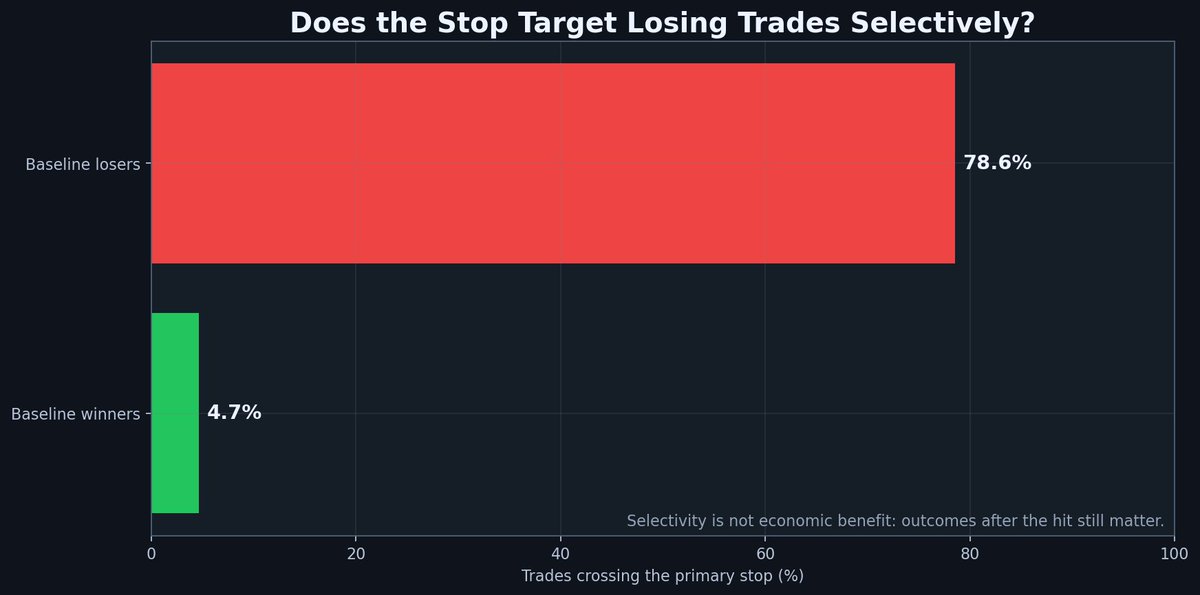
I added a disaster stop to this month's IYR system and tested twenty-five years of trades with it.
It caught 78.6% of the trades that went on to lose money.
It touched only 4.7% of the winners.
Almost perfect aim.
The obvious answer is "then move the stop".
I tested that: every fixed distance from 1 to 12 ATR, plus three different calibrations. Widen it and you keep more of the return — but it stops protecting anything worth protecting. Nothing tested cleared the bar.
It isn't a tuning problem.
So the honest map isn't "works everywhere".
Strongest in violent markets. Dependable in quiet ones. Unproven in the ordinary middle. Weakest when price goes nowhere.
That map is worth more than any single headline number — it tells me which results to trust and which are just the tide.
August's edge — IYR, "The Absent Landlord" — is written up in full → check bio.
Sideways markets are the outright soft spot: in both the normal and volatile ranging states, the cautious end of the range dips below zero.
Two more states had too few trades to judge at all, and I'd rather say that than dress up three trades as a finding.