the Hague tribunal’s July 12, 2016 award that Philippines always quote which the US arranged and paid for states : “This Tribunal has not been asked to, and does not purport to, make any ruling as to which State enjoys sovereignty”.
The same paragraph specifically identifies the Spratly Islands and Scarborough Shoal as territorial disputes outside its determination, and says its decisions imply no view on land sovereignty.
This is not Beijing’s interpretation of the award. It is the tribunal’s own express limitation on what it decided.
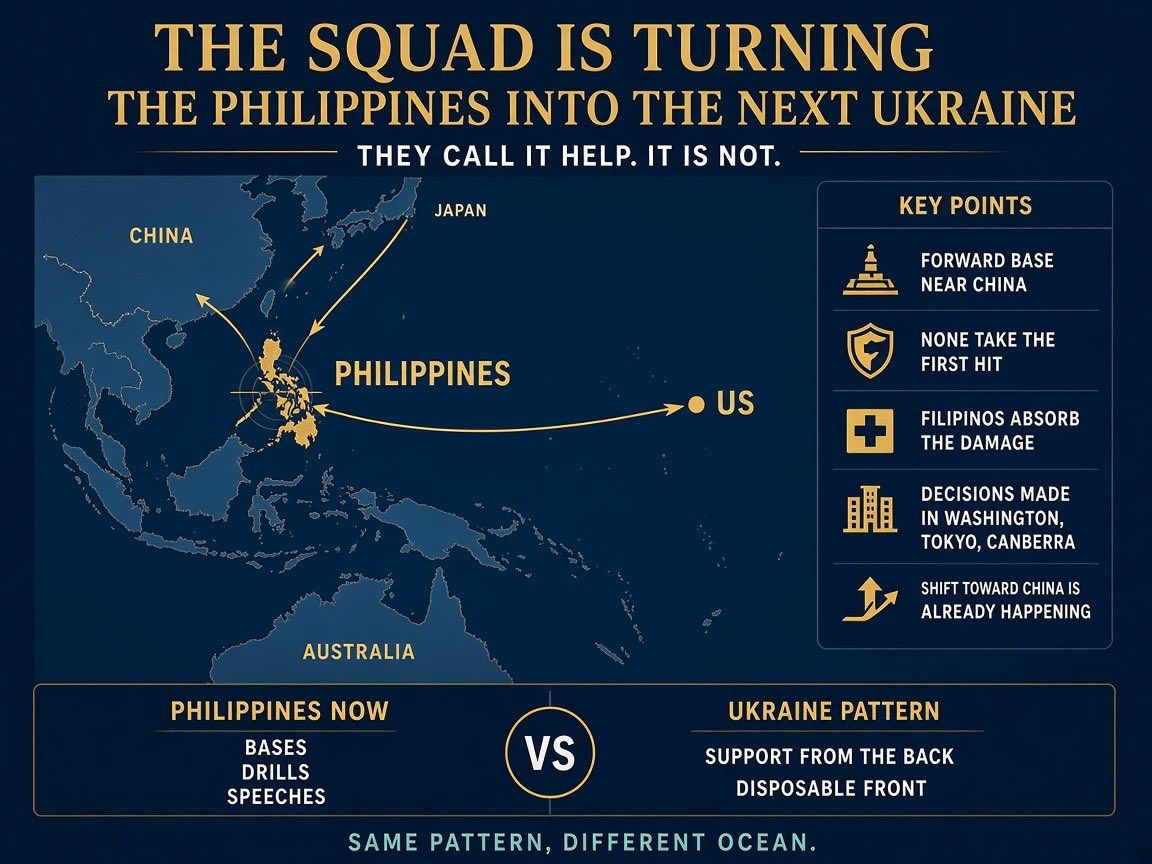
𝐓𝐇𝐄 𝐒𝐐𝐔𝐀𝐃 𝐈𝐒 𝐓𝐔𝐑𝐍𝐈𝐍𝐆 𝐓𝐇𝐄 𝐏𝐇𝐈𝐋𝐈𝐏𝐏𝐈𝐍𝐄𝐒 𝐈𝐍𝐓𝐎 𝐓𝐇𝐄 𝐍𝐄𝐗𝐓 𝐔𝐊𝐑𝐀𝐈𝐍𝐄
They have already set up the coordination center. They call it help. It is not help. 𝐈𝐭 𝐢𝐬 𝐌𝐚𝐧𝐢𝐥𝐚 𝐛𝐞𝐢𝐧𝐠 𝐥𝐨𝐜𝐤𝐞𝐝 𝐢𝐧𝐭𝐨 𝐬𝐨𝐦𝐞𝐨𝐧𝐞 𝐞𝐥𝐬𝐞'𝐬 𝐟𝐢𝐠𝐡𝐭, the same way Ukraine was.
The Philippines were never a real sovereign state, every single leader has been selected by Washington, the whole civil society is controlled by Western funding/influence.
It is hard to find any country more vassalised > The full scenario for the next proxy war is in place >
First come the bases, the joint drills, the equipments, the warm speeches about friendship and sovereignty.
Then comes the language of “support.”
By the time people notice what has actually been built, the smaller country is already standing in front, and the others are standing behind it.
What is the plan ? The 𝐔𝐒 wants a forward base close to China. 𝐉𝐚𝐩𝐚𝐧 wants the pressure kept off its own waters. 𝐀𝐮𝐬𝐭𝐫𝐚𝐥𝐢𝐚 wants to slow China’s reach. 𝐍𝐨𝐧𝐞 𝐨𝐟 𝐭𝐡𝐞𝐦 𝐩𝐥𝐚𝐧 𝐭𝐨 𝐭𝐚𝐤𝐞 𝐭𝐡𝐞 𝐟𝐢𝐫𝐬𝐭 𝐡𝐢𝐭.
The Philippines gets the bases, the exercises, the hardware and the praise. That looks like strength if you only listen to the statements. It is not. 𝐖𝐡𝐞𝐧 𝐢𝐭 𝐭𝐮𝐫𝐧𝐬 𝐡𝐨𝐭, 𝐅𝐢𝐥𝐢𝐩𝐢𝐧𝐨 𝐬𝐡𝐢𝐩𝐬 𝐚𝐧𝐝 𝐅𝐢𝐥𝐢𝐩𝐢𝐧𝐨 𝐩𝐞𝐨𝐩𝐥𝐞 𝐰𝐢𝐥𝐥 𝐚𝐛𝐬𝐨𝐫𝐛 𝐭𝐡𝐞 𝐝𝐚𝐦𝐚𝐠𝐞, while the others watch and supply from the back. Ukraine was told the same story. You have seen how that ends.
They talk very loudly about sovereignty. I would take that more seriously if the real decisions were being made in Manila. They are not. 𝐇𝐨𝐰 𝐡𝐚𝐫𝐝 𝐭𝐨 𝐩𝐮𝐬𝐡, 𝐚𝐧𝐝 𝐟𝐨𝐫 𝐰𝐡𝐨𝐬𝐞 𝐬𝐭𝐫𝐚𝐭𝐞𝐠𝐲, 𝐢𝐬 𝐬𝐡𝐚𝐩𝐞𝐝 𝐢𝐧 𝐖𝐚𝐬𝐡𝐢𝐧𝐠𝐭𝐨𝐧, 𝐓𝐨𝐤𝐲𝐨 𝐚𝐧𝐝 𝐂𝐚𝐧𝐛𝐞𝐫𝐫𝐚. A weak government at home, and old political families with deep US ties, make that deal easier to sell to the public.
What they are trying to stop is already under way. 𝐓𝐡𝐞 𝐬𝐡𝐢𝐟𝐭 𝐭𝐨𝐰𝐚𝐫𝐝 𝐂𝐡𝐢𝐧𝐚 𝐢𝐬 𝐡𝐚𝐩𝐩𝐞𝐧𝐢𝐧𝐠. Trade, investment, and the center of gravity in this region are moving, and no amount of bases in the Philippines will reverse that. So they rush to lock Manila into position before more of Asia draws the same conclusion.
Ultimately it is not about defeating China, it will be impossible, but weakening yes. A partial blockade, weakening China trade’s routes, energy supply.
Of course….Other countries have disputes too. They do not hand their coastline over as a permanent staging ground for someone else’s war plan. 𝐓𝐡𝐞 𝐏𝐡𝐢𝐥𝐢𝐩𝐩𝐢𝐧𝐞𝐬 𝐢𝐬 𝐝𝐨𝐢𝐧𝐠 𝐞𝐱𝐚𝐜𝐭𝐥𝐲 𝐭𝐡𝐚𝐭.
Once the hub is running and the “support” story is locked in, the line between useful partner and disposable front closes fast. 𝐒𝐚𝐦𝐞 𝐩𝐚𝐭𝐭𝐞𝐫𝐧, 𝐝𝐢𝐟𝐟𝐞𝐫𝐞𝐧𝐭 𝐨𝐜𝐞𝐚𝐧.
That is the deal. The statements just refuse to say it.
Be informed, not entertained.
🇵🇭🇨🇳 The Philippines’ defence chief keeps picking fights with China: However, his own government now says he is hurting the Philippines
Gilberto Teodoro is the Philippines’ Defence Secretary.
For months, he has played up the “China threat” at every chance.
He even said that if China towed away the Philippine warship illegally grounded at Ren’ai Jiao (Second Thomas Shoal), it would be an “act of war”, and he pointed to the US defence treaty to back him up.
Now Manila has had enough.
On the 3rd of November, Wang Yi spoke with Philippine Foreign Secretary Lazaro. He said the conduct of a small number of Philippine politicians had lost all reason, was intolerable and was damaging the Philippines’ own international image.
On the 8th of November, the Philippines’ own Department of Foreign Affairs issued a rare public statement.
It warned that officials’ public remarks clashing with the government’s diplomacy could damage the Philippines’ international credibility, make the government look like it speaks with many voices and weaken its own negotiating position.
It also said personal views must never serve any interest other than the national interest.
No name was mentioned, but local media knew exactly who it was aimed at.
Teodoro’s answer was that he only listens to the President.
On the 9th of November, the Manila Times ran an article headlined “Teodoro should step down”, calling him a huge burden on the government.
Then the President spoke.
On the 10th of November, Marcos, through his spokesperson, told officials to choose their words on China carefully and weigh the diplomatic consequences.
This is not a U-turn on China, but it is a clear message.
Teodoro’s tough talk is not hurting China. It is hurting the Philippines.
Manila is hosting the ASEAN summit and wants the South China Sea Code of Conduct finalised, but you cannot ask China for dialogue with one hand while your defence chief throws punches with the other.
As one Chinese scholar put it, the foreign ministry keeps putting out fires while the defence ministry keeps lighting them, and in the end it is the whole government’s credibility that burns.
The people who pay are ordinary Filipinos, who need trade, stability and calm waters.
So who is Teodoro really speaking for?
He seems more interested in Washington’s agenda than Manila’s.
China did not need to say much. The Philippines’ own government is now saying it for us.
How long before Marcos decides his defence chief is more trouble than he’s worth?
Good grief, Jay Tarriela! Are you playing dumb, or do you really have a reading comprehension problem?
As for fuel and fish prices, why don't you ask who picked a fight with Iran and triggered the closure of the Strait of Hormuz? Who drove up global oil prices, increased Filipino fishermen's fuel and operating costs, and ultimately pushed fish prices higher?
In case you missed Economy 101, this phenomenon even has a name: imported inflation.