The Quantum Biology DAO is a non-profit that supports the field with community building, governance tokens and an open competition for research grants.
What science are we missing because nobody wants to fund it?
Science funding often favors research with a clear path to results.
But some of the most important questions don't come with predictable outcomes, established methods, or immediate commercial potential.
And that's the paradox: we want groundbreaking discoveries, but groundbreaking research is often the hardest to justify funding.
The next major scientific breakthrough might be hiding in an experiment that never got the chance to happen. Maybe decentralized science is the missing piece that gives these ideas a chance.
What drives scientific progress?
Throughout history, some of humanity’s greatest breakthroughs have come from developing new tools that allow us to see what was previously invisible.
- The microscope revealed an entirely new world of cells and microorganisms, transforming our understanding of life.
- The telescope expanded our view of the universe, reshaping our understanding of our place within it.
- DNA sequencing technologies opened the door to understanding the genetic code, revolutionizing medicine and biotechnology.
New tools unlock new discoveries. New discoveries unlock entirely new industries... and we believe quantum biology could be one of the next great frontiers.
Imagine unlocking new ways to influence cellular processes, improve biomanufacturing, accelerate drug discovery, or develop entirely new approaches to human health.
These possibilities begin with understanding how quantum phenomena influence living systems.
From building instruments that can investigate quantum effects in living cells to supporting the research and innovation needed to turn discoveries into real-world applications, we're wanting to help lay the foundation for an emerging industry.
The next generation of breakthroughs won't happen by waiting for the future. They'll happen because we build it.
We're excited to help make that future possible. ⚛️
How can biology respond to magnetic fields?
Let's look into 4 possible ways:
1. Magnetite-Based Detection: Magnetotactic bacteria produce chains of magnetic crystals that act like tiny compass needles, helping them align with Earth's magnetic field.
2. Electromagnetic Induction: Sharks and rays have highly sensitive organs that detect weak electrical signals. One hypothesis is that movement through Earth's magnetic field generates electrical signals these animals can detect, although the exact mechanism remains debated.
3. New Physics Hypotheses: Some biological responses to magnetic fields remain unexplained. While entirely new physical mechanisms cannot be ruled out, researchers generally look for explanations within established physics first.
4. Radical-Pair Mechanism: This is where quantum biology comes in. Certain chemical reactions produce pairs of unpaired electrons whose spin dynamics can be influenced by magnetic fields, potentially changing reaction outcomes and downstream biological processes.
Importantly, a biological response to a magnetic field doesn't necessarily involve navigation. Researchers have also reported changes in cellular signaling, growth, development, and behavior under different magnetic conditions, although the evidence varies across systems.
If quantum effects are found to play a meaningful role in these responses, the implications could extend far beyond magnetic sensing. They could reveal previously unrecognized mechanisms influencing how cells function, communicate, and respond to their environments, opening new directions for biological research.
There is still considerable debate about the role of quantum effects in biological systems.
Quantum mechanics is fundamental to our understanding of molecular behavior, but that doesn't necessarily mean every proposed quantum mechanism has a meaningful role in biological function.
One of the challenges in quantum biology is determining whether an observed effect is actually relevant to how a living system works. This can be difficult to establish experimentally, particularly when the processes being studied are sensitive to their environment and the measurements themselves are challenging.
Researchers may agree on an experimental observation while disagreeing about what it tells us about the underlying biology.
But the possibility that quantum effects influence biological function is precisely why this research deserves attention. If these mechanisms turn out to play a significant role in living systems, they could change our understanding of how cells function and open up entirely new directions for biological research.
We believe the potential implications are significant enough to warrant serious investigation, even while the answers remain uncertain.
In 1931, physicist Maria Goeppert Mayer made a theoretical prediction that would help lay the foundation for a powerful technique used in biological imaging.
Using quantum mechanics, she described two-photon absorption, a process in which an atom or molecule can absorb two photons in a single quantum transition.
Her prediction was experimentally confirmed in 1961, following the development of the laser.
In 1990, other researchers demonstrated two-photon fluorescence microscopy, applying this physical principle to image biological samples. Today, the technique is widely used in neuroscience and biomedical research, particularly for imaging within living tissues.
Goeppert Mayer also shared the 1963 Nobel Prize in Physics for her contributions to the nuclear shell model, which describes how protons and neutrons are organized into energy shells in atomic nuclei.
Her story illustrates an important connection between fundamental physics and biology: theoretical discoveries can eventually make entirely new experimental techniques possible.
For quantum biology, this connection is especially relevant. The field asks whether living systems use quantum effects, but answering that depends on instruments sensitive enough to probe them. Her work is an early example of how a physics prediction can become a tool for seeing biology.
>> Learn more about Maria Goeppert Mayer: https://t.co/MtAiIsDM70
Greetings from @EFDevcon! 🇮🇳
Our Product Working Group Leader had the opportunity to attend, connect with the Web3 community, and explore the future of decentralized science.
Great to see new connections forming and the DeSci movement gaining momentum around the world! 🌍
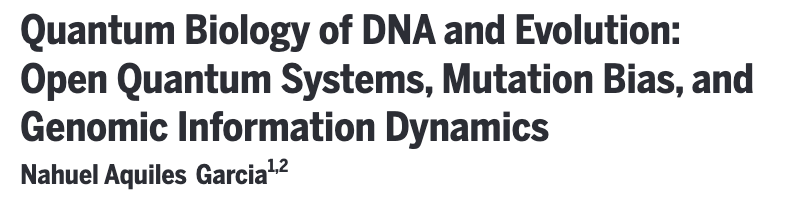
Sharing a new paper from Quantum Biology DAO community member Nahuel Garcia!
The review looks at how quantum-scale processes in DNA could influence mutation patterns, and what that might mean for our understanding of evolution.
Thanks for acknowledging the DAO community. Great to see this work published >> https://t.co/IoGBfhANAv
Sharing this recent preprint! Researchers modeled how electron spin dynamics in mitochondrial Complex I may influence radical-pair chemistry linked to reactive oxygen species (ROS).
The study explores how electron-transfer rates and spin relaxation affect predicted reaction outcomes >> https://t.co/9dHreB5eCT
Research Spotlight: Which proteins respond to magnetic fields? 🔬
At the Quantum Biology Institute (QBI), our research spans four connected areas: quantum, proteins, omics, and metabolism. Today, we're taking a closer look at our work on proteins.
Our goal here is to identify proteins that respond to magnetic fields and understand the molecular features that might explain this sensitivity.
One starting point is MagLOV2, an engineered protein whose fluorescence (the light it emits when illuminated) changes in response to magnetic fields. Building on this work, we're investigating whether similar responses occur in proteins found naturally across different organisms.
So, where are we today?
Our team has screened 34 naturally occurring LOV-domain sequences from bacteria and archaea. LOV (Light-Oxygen-Voltage) domains are light-sensitive regions of proteins, and our screening has identified several with measurable magnetic-field-dependent fluorescence, known as magnetofluorescence.
These include proteins from diverse groups of organisms, from cyanobacteria to archaea, suggesting that this property may be more widespread than previously understood.
We're also investigating flavoproteins naturally found in E. coli, where early experiments have identified a promising magnetofluorescence signal associated with thioredoxin reductase (trxB). At the same time, we're working to distinguish these responses from background fluorescence and better understand how illumination conditions influence what we measure.
Alongside these findings, we've experimentally supported some predictions from our kinetic model, which helps us understand how magnetofluorescence changes under different illumination conditions.
The next steps are to repeat and expand our screening, characterize the proteins showing promising responses, and investigate what they have in common.
Ultimately, we want to move beyond identifying magnetosensitive proteins toward understanding, and potentially predicting, the molecular features responsible for their responses.
Happy Quantaween (Halloween) from the Quantum Biology DAO!
May the quantum be with you all!
As you can see, Qubie decided to dress up as a virus this year. Scary enough for us! 🦠
Your NOSE might be doing quantum physics?? 👃
The usual explanation for smell is pretty simple: molecules fit into receptors in your nose based on their shape, kind of like a lock and key.
But what if shape isn't the whole story? There's a theory that your nose might also be picking up on how molecules vibrate.
And this is where quantum physics comes in. The idea involves quantum tunneling, where electrons can pass through energy barriers that classical physics says they shouldn't be able to cross. Some researchers think molecular vibrations could help electrons tunnel inside smell receptors, triggering the signals that let you recognize different odors.
It's still a debated theory, but the idea that quantum effects might play a role in something as ordinary as smelling your morning coffee is pretty neat.
Medicine has spent decades learning how to change biology through chemistry. What if physics offers another way?
Consider how many treatments are developed today. Scientists identify a biological process, find a molecule that influences it, and design a therapy around that interaction. But cells don't respond to chemistry alone.
Studies have reported that even weak magnetic fields can affect biological processes, including oxidative stress-related activity and cell proliferation.
Understanding these effects could eventually give medicine another dial to turn.
Instead of only asking which molecule changes this process?, researchers could one day also ask: which magnetic field conditions change it? Field strength, frequency, orientation, and timing could become variables for influencing cellular behavior.
The next generation of medicine might not just be about what enters the body, but also the physical conditions surrounding it.
What does quantum physics have to do with everyday biology?
In our latest video, we explore some of the most commonly discussed examples of quantum biology and how they connect to processes we encounter in everyday life.
While quantum biology might seem like an abstract area of science, many of the questions researchers are investigating are closer to home than you might think.
Watch here >> https://t.co/FPK3pRal7N