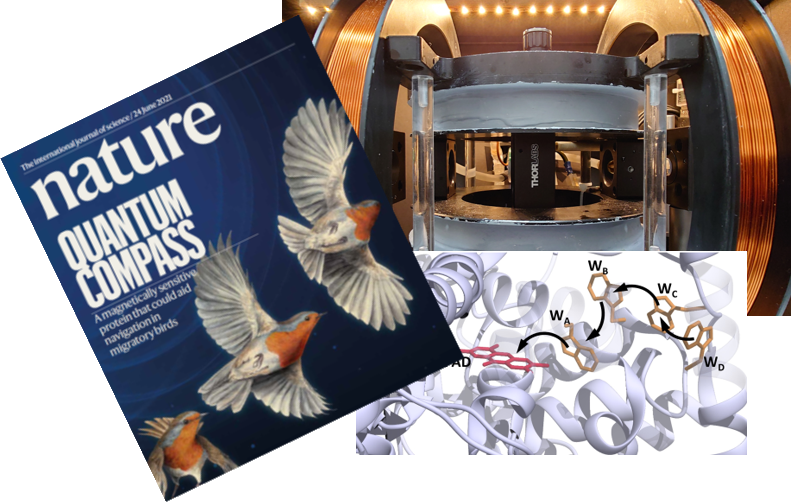
Researchers isolate the protein thought to help migratory birds navigate, and astronomers pinpoint the stars that could view Earth as an exoplanet. https://t.co/PvEhDUUykX
Magnetic Field Effect work featured on @nature cover! Mackenzie, Timmel and Hore groups @OxfordChemistry, in collaboration with @UniOldenburg, demonstrate magnetically sensitive photochemistry in Cry4 protein from the night migratory robin: https://t.co/yT9nS0JPOr
The magnetic sense in night migratory birds, such as the European robin, is based on a specific light-sensitive protein in the eye - the protein cryptochrome 4 could well be the long-sought magnetic sensor. Read more in @Nature https://t.co/s2ywGPwCYU
Interested in studying Chemistry at university? Want to find out more about @oxfordchemistry@ChemOutreachOxf?
@BalliolOxford are holding a Chemistry Study Day on 17 March - find out more at https://t.co/kIaCLeNcw2
Congratulations to our two #SFB1372 PIs Dominik Heyers and Henrik Mouritsen for publishing a new paper on the trigeminal brain pathway in night-migratory songbirds https://t.co/rWPOzO5k2f #congratulations#teamwork#Anatomy#navigation