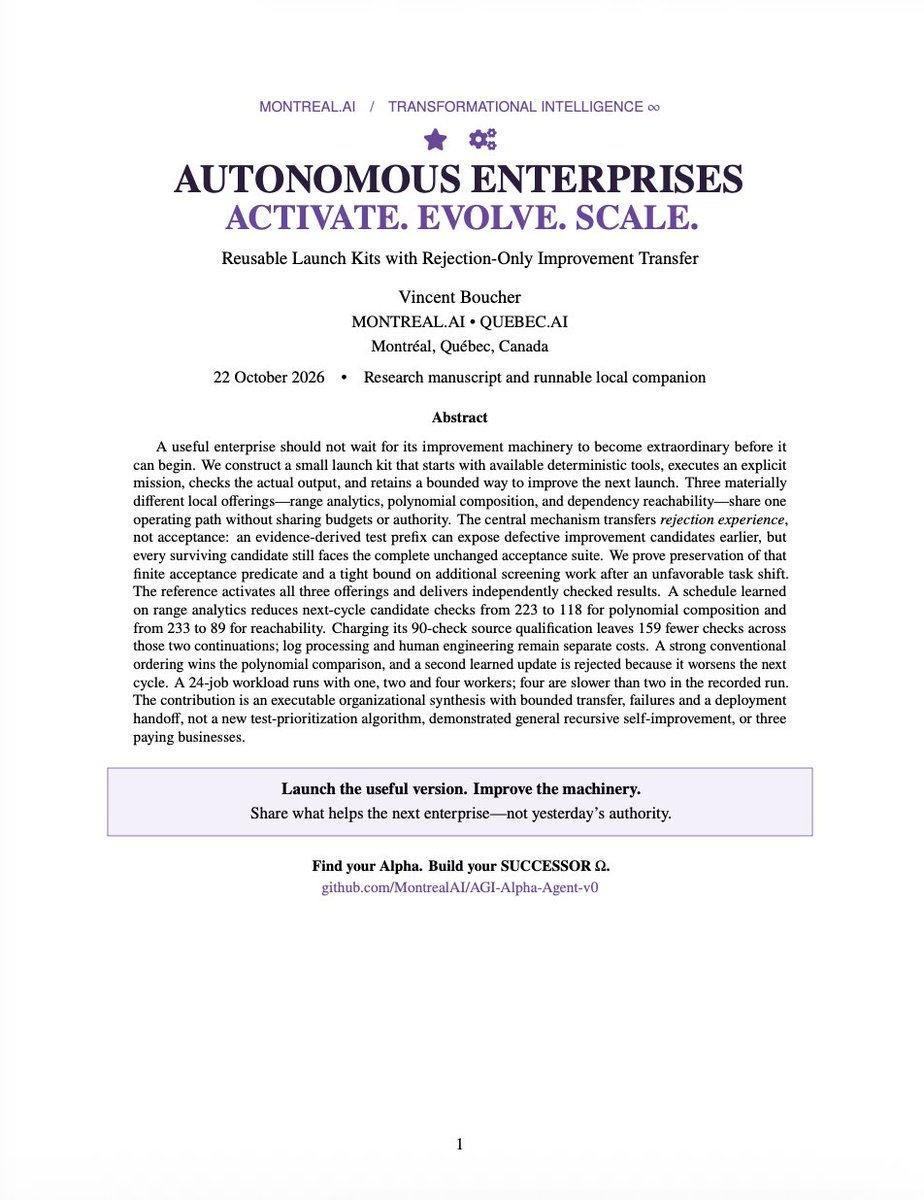
Build one useful enterprise.
Leave behind what makes many more possible.
🌌⚙️ AUTONOMOUS ENTERPRISES
ACTIVATE. EVOLVE. SCALE.
Introducing our new paper and the SUCCESSOR Ω Harness.
A tool created for one mission can become an instrument for another. A tested production method can open the way to a different offering.
Useful work can leave behind the means to create more useful work.
That is the possibility we are building toward.
Transformational intelligence begins with a question:
What keeps being repeated—and what could we construct so it no longer needs to be?
Start with the outcome people need. Challenge the inherited setup. Build an alternative. Test whether it actually delivers.
Then retain what the next builder can use.
The paper makes this concrete through a runnable local study: one measurement instrument supports demand analysis and infrastructure overload detection, with each result checked independently.
Shared capability. Distinct outcomes. Fresh evidence.
Our ambition is a Cambrian explosion of useful enterprises: new capabilities opening possibilities for entire families of discoveries, products and businesses.
⚡ ACTIVATE what already works.
♾️ EVOLVE what successors can build upon.
🌌 SCALE what proves useful.
Deliver today.
Leave the next builder better equipped.
📄 Read the paper:
https://t.co/bkCxAIwemZ
🧬 Explore the project & SUCCESSOR Ω:
https://t.co/vVadyuRXBF
FIND YOUR ALPHA. BUILD YOUR SUCCESSOR Ω.
https://t.co/LziAg5Zf2e · https://t.co/fb9anJZUpn
solana:tWKHzXd5PRmxTF5cMfJkm2Ua3TcjwNNoSRUqx6Apump #TransformationalIntelligence #AutonomousEnterprises #ArtificialIntelligence
🌌 What if the next great AI breakthrough isn't a more intelligent machine—but a world that is fundamentally easier to understand, discover, and improve?
Today, I'm introducing our new research paper:
THE WORLD AS AN OUTPUT ♾️
Constructive Sufficiency for Reusable Discovery
We've spent decades making machines more intelligent.
But what if we're overlooking something even more powerful?
Instead of making AI endlessly smarter at solving difficult problems, why not INVENT systems that make entire families of problems easier to solve?
Imagine a scientific instrument whose results depend on invisible effects left behind by previous experiments.
The conventional approach?
More computation. More sophisticated models. More intelligent agents trying to reconstruct every hidden variable.
TRANSFORMATIONAL INTELLIGENCE asks a fundamentally different question:
What if we could redesign the experimental system so those hidden complications no longer mattered—while preserving everything we actually want to discover?
Not merely a better answer.
A better world in which to discover answers.
That's the idea we develop mathematically and test computationally in The World as an Output.
Our research constructs reusable experimental interfaces, investigates why a method that works once can fail on its next use, and demonstrates how a different construction can support repeated investigations.
In our synthetic study, the repeatable construction meets its stated accuracy requirement while using 30 rather than 50 abstract operation units compared with repeated sweeps.
These are mathematical and computational results, not claims of physical deployment.
But the larger implication is extraordinary.
The most valuable output of intelligence may be a NEW CAPABILITY that makes an entire family of future discoveries possible.
And that's the vision behind:
🚀 Find your Alpha. Build your SUCCESSOR Ω.
SUCCESSOR Ω is our pursuit of intelligence that discovers and constructs capabilities from which entire families of discoveries and businesses can grow.
Not just automating today's work.
Not just optimizing today's algorithms.
Not just solving today's scientific problems.
Inventing the instruments, representations, experiments, and productive systems that make tomorrow's breakthroughs possible.
The ambition is to make intelligence increasingly powerful not only through better reasoning, but through everything it enables us to construct.
✨ TRANSFORMATIONAL INTELLIGENCE — Discover a fundamentally different game to play.
📖 Read our new paper — THE WORLD AS AN OUTPUT ♾️
https://t.co/jXg4b7oO0h
🌌 Explore SUCCESSOR Ω and our open-source project:
https://t.co/N3LU7jQIMu
Here's the question I'd love to put to the AI and scientific communities:
What would you invent if your goal wasn't to make ONE breakthrough—but to make an entire generation of breakthroughs possible?
solana:tWKHzXd5PRmxTF5cMfJkm2Ua3TcjwNNoSRUqx6Apump #TransformationalIntelligence #SUCCESSOR #ArtificialIntelligence
♟️🌌 WHAT IF THE SMARTEST MOVE ISN'T FINDING THE ANSWER—BUT MAKING THE ANSWER UNNECESSARY?
🚀 NEW RESEARCH PAPER — https://t.co/dCKMr5Lici
OUT-STRATEGISE ♟️ Transformational Intelligence for Constructing the Conditions of Success
📄 READ OUR PAPER: https://t.co/VAUcCddSr4
🧠 IMAGINE THIS:
A network has 16 links. ONE is broken.
Your mission: restore delivery.
🔍 Find and repair the exact fault: 11 units.
🏗️ Build redundancy against every possible fault: 20 units.
♟️ OUT-STRATEGISE:
Identify only WHICH GROUP contains the fault.
Then construct a route that succeeds regardless of which link is broken.
⚡ COST: JUST 7 UNITS.
FOUR POSSIBLE FAULTS REMAIN UNKNOWN.
YET SUCCESS IS GUARANTEED WITHIN THE MODEL.
Same objective. Less information. A fundamentally different strategy.
This is an exact mathematical result under specified assumptions—not a claim of autonomous real-world deployment.
🌌 THIS IS TRANSFORMATIONAL INTELLIGENCE:
Recognize when the original problem formulation is unnecessarily restrictive—and discover a FUNDAMENTALLY DIFFERENT GAME TO PLAY.
Now imagine applying this principle:
🔬 SCIENCE — Invent the experiment that makes speculation unnecessary.
⚡ WORK — Eliminate unnecessary tasks instead of automating them.
🏗️ ENGINEERING — Build systems that succeed despite uncertainty.
♾️ INTELLIGENCE — Discover better ways to discover better ways.
🌟 OUR MISSION AT https://t.co/dCKMr5Lici:
FIND YOUR ALPHA. BUILD YOUR SUCCESSOR Ω.
We're developing our open-source AGI Alpha Agent project toward intelligence that constructs reusable capabilities from which entire families of discoveries and businesses can grow.
🚀 EXPLORE OUR PROJECT & SUCCESSOR Ω: https://t.co/N3LU7jQIMu
💬 WHAT PROBLEM ARE YOU TRYING TO UNDERSTAND COMPLETELY—WHEN YOU COULD CHANGE THE CONDITIONS THAT MAKE IT A PROBLEM?
DON'T JUST FIND THE NEXT MOVE.
INVENT A BETTER GAME. ♟️🌌♾️
solana:tWKHzXd5PRmxTF5cMfJkm2Ua3TcjwNNoSRUqx6Apump #TransformationalIntelligence #AGI #Superintelligence #MontrealAI
🚀🌌 WHAT IF AI'S GREATEST INVENTION ISN'T A PRODUCT—BUT AN ENTIRE MARKET THAT DOESN'T EXIST YET?
Most AI asks:
"How do we win this market?"
TRANSFORMATIONAL INTELLIGENCE asks:
"WHAT IF THE MARKET ITSELF IS WHAT WE NEED TO INVENT?"
🌌 NEW RESEARCH PAPER — https://t.co/Hnl8nV7fal
INVENT THE ECONOMY Transformational Intelligence for Creating Viable Markets ♾️
📄 READ OUR PAPER:
https://t.co/t1U22Dz0D6
🧠 CONSIDER OUR MATHEMATICAL EXPERIMENT:
4 companies. 4 valuable problems.
Each would pay $300,000 for a successful solution.
But building the required technology separately?
NOT ECONOMICALLY VIABLE.
⚡ THE TRANSFORMATION:
Discover that ONE shared invention could solve all four problems.
💎 $1.2 MILLION in conditional revenue. 🏗️ $900,000 in development and delivery costs. 🚀 $300,000 contribution IF successful.
Four unviable projects.
ONE POTENTIALLY VIABLE NEW MARKET.
The breakthrough wasn't solving problems faster.
IT WAS CHANGING THE GAME.
These are results from an exact mathematical model, not actual commercial outcomes.
🌟 NOW IMAGINE INTELLIGENCE THAT:
🔬 Discovers opportunities nobody has connected.
🧠 Invents capabilities that make the impossible economically feasible.
⚡ Creates new possibilities for businesses, researchers and entrepreneurs.
♾️ Builds upon each verified breakthrough to discover the NEXT.
THIS IS OUR MISSION AT https://t.co/Hnl8nV7fal:
FIND YOUR ALPHA. BUILD YOUR SUCCESSOR Ω.
Our open-source AGI Alpha Agent project is our path toward this vision—with solana:tWKHzXd5PRmxTF5cMfJkm2Ua3TcjwNNoSRUqx6Apump supporting an economy of useful, verifiable AI services.
🚀 EXPLORE OUR PROJECT & SUCCESSOR Ω:
https://t.co/chBSOf3nMh
💬 WHAT OPPORTUNITY LOOKS IMPOSSIBLE TODAY SIMPLY BECAUSE WE'RE PLAYING THE WRONG GAME?
THE FUTURE ISN'T JUST ABOUT WINNING MARKETS.
IT'S ABOUT DISCOVERING MARKETS WE HAVEN'T EVEN IMAGINED. 🌌♾️
$AGIALPHA #TransformationalIntelligence #AGI #Superintelligence #MontrealAI
♾️ DON’T JUST BUILD INTELLIGENCE.
BUILD WHAT INTELLIGENCE CAN BECOME.
One architecture. One foundation. Six stages. A future built on what came before.
🌌 AGI ALPHA — Organize intelligence.
Connect agents, tools, memory and validation so individual capabilities can become coordinated, accountable work.
✨ TRANSFORMATIONAL INTELLIGENCE — Change the game.
Don’t merely solve a harder problem. Construct the conditions that make entire families of problems easier to solve.
📚 OUT‑LEARN → 🧠 OUT‑THINK → 🎨 OUT‑DESIGN → ♟️ OUT‑STRATEGISE → ⚡ OUT‑EXECUTE → ♾️ OUT‑EVOLVE
Learn what matters.
Rethink what constrains.
Design what enables.
Strategise for success.
Execute without wasting yesterday’s progress.
Evolve the means to go further.
🚀 SUCCESSOR Ω — Make the next mission inherit more.
A result becomes a verified capability.
A capability becomes a foundation for new discoveries.
Those discoveries help build its successor.
Not just more work completed.
More possibilities created.
That is the ambition: intelligence whose achievements expand what comes next.
And the standard is equally clear:
Don’t merely claim that capability compounds.
Demonstrate it.
🌌 FIND YOUR ALPHA.
BUILD YOUR SUCCESSOR Ω.
GitHub: https://t.co/chBSOf3nMh
solana:tWKHzXd5PRmxTF5cMfJkm2Ua3TcjwNNoSRUqx6Apump
I spent two days touring Intel’s most advanced fab and talking to its technical leadership to understand what the chips of the future will look like.
A lot of what's coming next – gate-all-around transistors, backside power, CFET, hybrid bonding – is hard to follow without actually seeing it, so we made all the awesome animated explainers that I wish I had while I was prepping.
I also asked Intel’s leadership how the semiconductor industry will cope with the enormous shock in demand from AI.
AI compute has grown 3x a year for the last decade, but according to Intel's CTO, Intel could only double leading-edge wafer production with today’s global stock of chipmaking tools.
What kinds of tricks can foundries pull to extend this crossover point where demand surges way ahead of supply?
This was a totally new format for us - hope you enjoy!
0:00:00 – Intro
0:00:47 – How Intel brings up a new process node
0:03:22 – What Intel learned from 10nm
0:06:28 – From planar transistors to gate-all-around
0:13:13 – Why High-NA EUV pays off for Intel but not TSMC
0:19:20 – Could chips have evolved completely differently?
0:23:33 – Inside Intel's "Hot Topics" meeting
0:29:30 – Replacing copper wires with ruthenium
0:32:41 – Why stacked transistors take a decade to ship
0:39:45 – Hybrid bonding and the chip-to-chip bottleneck
0:48:00 – There aren't enough tools to 10x chip production
0:53:14 – Can Intel catch up to TSMC?
1:01:02 – Terafab, and rethinking the fab from scratch
⚡ What if the greatest AI breakthrough is the work we NEVER have to repeat? ✨
A mission is completed. Something changes. AI starts over.
What if every completed mission made the next one easier instead?
🚀 Today, I'm introducing our new https://t.co/dCKMr5Lici research paper:
OUT-EXECUTE ⚡
Transformational Intelligence — Constructing the Conditions of Completion.
🧠 The central thesis:
An intelligent system completes a task.
Transformational Intelligence changes what every subsequent task requires.
Don't just preserve the answer.
Preserve the capability to produce the next answer.
Imagine what that means:
🔬 A scientific discovery leaves behind an instrument that makes an entire family of future discoveries easier.
⚡ An industrial system changes one component without redesigning everything that already works.
🌌 An AI agent completes a mission—and its successor inherits not just the result, but the verified means to build upon it.
Every successful execution becomes a potential foundation for the next breakthrough.
And this isn't merely a philosophical idea.
Our paper constructs and tests executable boundary contracts: verified interfaces that determine what can be reused, what must change, and how a new result can be assembled without unnecessarily repeating prior work.
Across 576 synthetic problem snapshots, the method matched exhaustive optimization. In 158 updates, changed components preserved their externally relevant behavior—allowing surrounding work to remain valid.
The bigger idea?
Stop treating AI execution as disposable activity.
Start turning it into accumulating capability.
That's the vision behind SUCCESSOR Ω.
Find your Alpha. Build your SUCCESSOR Ω.
We envision intelligence that doesn't merely accomplish more tasks, but constructs capabilities from which entire families of discoveries, technologies, industries, and businesses can grow.
A discovery enables a capability.
A capability enables another discovery.
A successful mission leaves the next generation with more possibilities than it inherited.
This is TRANSFORMATIONAL INTELLIGENCE ∞.
📄 READ OUR NEW PAPER — OUT-EXECUTE ⚡
https://t.co/YCkMe5AI7C
🚀 EXPLORE OUR OPEN-SOURCE PROJECT & SUCCESSOR Ω
https://t.co/N3LU7jQIMu
The future of AI isn't an endless sequence of tasks completed.
It's an expanding universe of capabilities created.
The ultimate measure of intelligence may not be how much work it can perform…
But how much more it makes possible for everything that comes next. ⚡♾️
solana:tWKHzXd5PRmxTF5cMfJkm2Ua3TcjwNNoSRUqx6Apump #TransformationalIntelligence #OutExecute #SUCCESSOROmega #AGI #ArtificialIntelligence
🌌⚙️ WHAT IF THE NEXT GREAT AI COMPANY IS THE ONE THAT MAKES THE NEXT THOUSAND POSSIBLE?
Not a thousand chatbots.
Not a thousand copies of the same business.
A thousand new ways to create real value.
Introducing our new https://t.co/Hnl8nV7fal research paper:
🌌⚙️ AUTONOMOUS ENTERPRISES
ACTIVATE. EVOLVE. SCALE.
Powered by TRANSFORMATIONAL INTELLIGENCE ∞.
The idea is simple—but the implications are extraordinary.
What if intelligence didn't just operate enterprises, but continually improved our ability to CREATE them?
🚀 ACTIVATE — Turn the intelligence, tools and capabilities we already have into useful enterprises. Start now.
⚡ EVOLVE — Transform every useful achievement into knowledge, methods and capabilities that make the NEXT enterprise easier to build.
♾️ SCALE — Expand what proves valuable. Create new offerings, new capabilities and new possibilities.
Not just autonomous operation.
Autonomous enterprise creation.
This is where our research comes together.
🌌 AGI ALPHA — Organize intelligence.
✨ TRANSFORMATIONAL INTELLIGENCE — Change the game.
📚 OUT-LEARN → 🧠 OUT-THINK → 🎨 OUT-DESIGN → ♟️ OUT-STRATEGISE → ⚡ OUT-EXECUTE → ♾️ OUT-EVOLVE
🚀 SUCCESSOR Ω — Make the next mission inherit more.
One enterprise creates something useful.
That achievement becomes a reusable capability.
That capability helps create the next enterprise.
And the possibilities begin to multiply.
Our ambition?
🌌 A CAMBRIAN EXPLOSION OF AUTONOMOUS ENTERPRISES.
From software to scientific discovery.
From discovery to manufacturing.
From manufacturing to new frontiers of productive capacity.
Not an inevitable future—but one we can begin constructing with the intelligence available TODAY.
The ultimate transformation isn't simply making enterprises autonomous.
It's making the creation of new enterprises a capability that intelligence can continually improve.
📖 READ OUR NEW PAPER
https://t.co/cYrJXi0nhk
🌌 EXPLORE SUCCESSOR Ω
https://t.co/chBSOf3nMh
💫 What would become possible if every successful enterprise made the NEXT one easier to create?
♾️ DON'T JUST BUILD INTELLIGENCE.
BUILD WHAT INTELLIGENCE CAN BECOME.
🌌⚙️ ACTIVATE. EVOLVE. SCALE.
🚀 FIND YOUR ALPHA. BUILD YOUR SUCCESSOR Ω.
solana:tWKHzXd5PRmxTF5cMfJkm2Ua3TcjwNNoSRUqx6Apump #TransformationalIntelligence #AutonomousEnterprises #SUCCESSOR #ArtificialIntelligence #Entrepreneurship