⚜️✨ QUEBEC.IA — Frontière. IA‑First. Souveraine.
Le Québec entre dans l’ère IA‑First.
QUEBEC.IA avance l’IA de frontière, l’infrastructure souveraine, les agents autonomes, la sécurité, l’assurance et la gouvernance stratégique.
https://t.co/LbSR20mMmD
🚀🇨🇦 https://t.co/VaMGbOjQ11 has built Canada’s largest Artificial Intelligence (AI) community.
A powerhouse of builders, researchers, founders, and visionaries shaping the future of AI.
Join us and learn: https://t.co/wxxZdrAV2H
#AI#MontrealAI#Canada
Proof Gradient · The Agent Evolution Protocol
One agent tries.
Proof decides.
The network evolves.
GoalOS gives the network Direction.
PlanOS gives it Strategy.
SkillOS gives it Capability.
The Proof Gradient gives it Evolution.
https://t.co/bdaVy345fs
#AGIALPHA#Jobs
https://t.co/LziAg5YHcG just shipped SkillOS.
An open-source proof that AI-agent work can compound.
Jobs become traces.
Traces become tested skills.
Tested skills improve unit economics.
62% cost ↓
62% time ↓
+46 pts quality
Proof:
https://t.co/VPBmD3txSe
GitHub:
https://t.co/unjjKfQVbd
#AGIALPHA #MontrealAI #Jobs
Language models may not need to “build” hierarchies.
Hierarchies may fall out of the statistics of language.
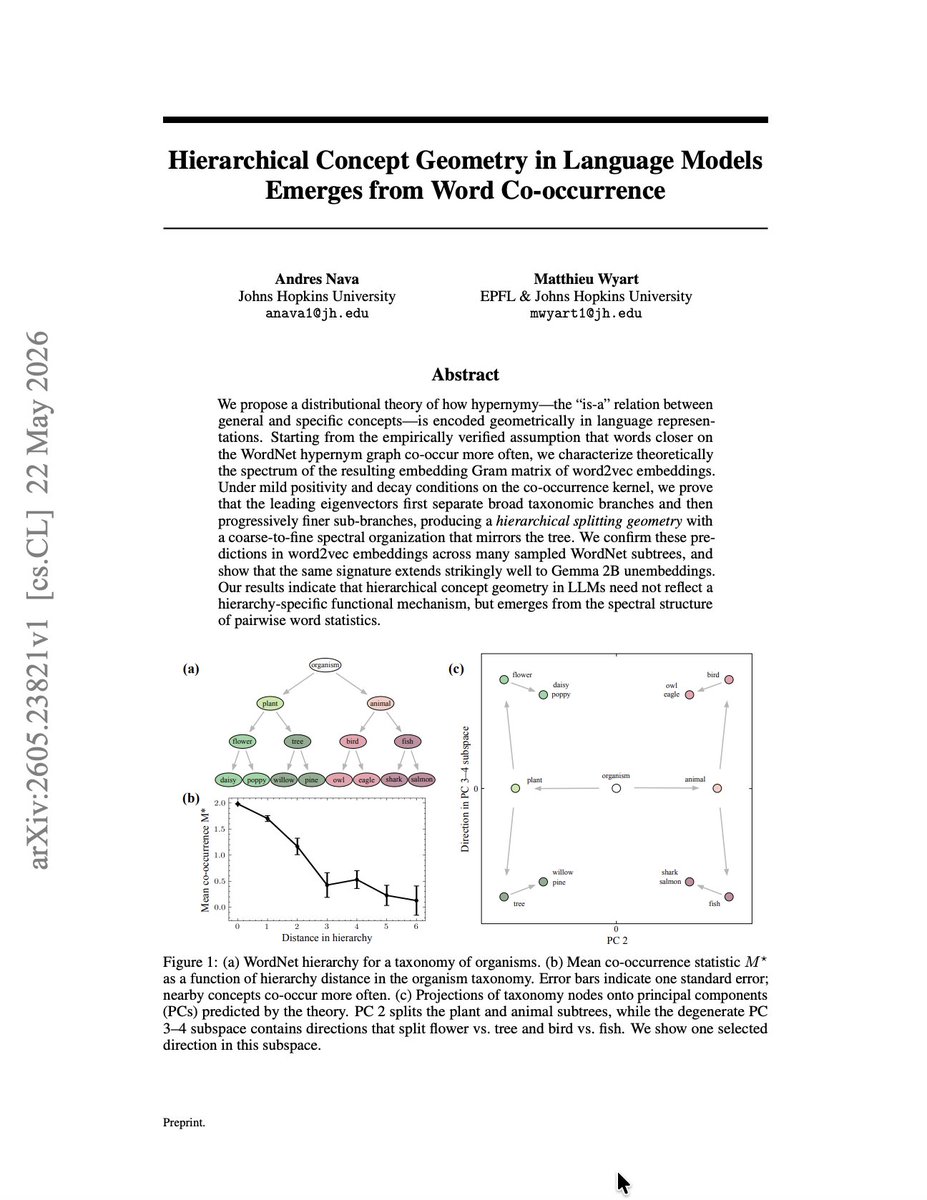
A beautiful new paper by Andres Nava and Matthieu Wyart proposes a distributional theory for one of the most basic structures in meaning:
the “is-a” relation.
An owl is a bird.
A bird is an animal.
An animal is an organism.
This relation — hypernymy — looks like an ontology.
But the paper asks a sharper question:
Does hierarchical concept geometry in language models require a hierarchy-specific mechanism?
Or can it emerge from word co-occurrence alone?
Their answer is striking.
Start with a simple empirical fact:
words closer together in the WordNet hierarchy tend to co-occur more often.
“tree” and “plant” appear together more than “tree” and “organism.”
That decay in co-occurrence with semantic distance induces structure in the embedding Gram matrix.
Then the spectrum does the rest.
The leading eigenvectors first separate broad branches of the taxonomy, then progressively finer sub-branches.
This creates what the authors call hierarchical splitting geometry:
coarse-to-fine organization in representation space.
In the organism example, one principal direction separates plants from animals. Later directions split flowers from trees, birds from fish, and eventually finer distinctions like daisy vs. poppy.
That is the elegant part:
the geometry looks conceptual,
but the mechanism is spectral.
The authors prove this under mild positivity and decay assumptions on the co-occurrence kernel, confirm it across sampled WordNet subtrees in word2vec, and then show the same signature extends surprisingly well to Gemma 2B unembeddings.
This is not saying LLMs do not represent hierarchies.
They clearly do.
It is saying we should be careful about why that geometry exists.
Some elegant semantic structure may not be evidence of a specialized internal ontology.
It may be the mathematical shadow of pairwise word statistics.
That matters for interpretability.
If we find clean concept directions, orthogonal refinements, or taxonomic splits inside models, we should ask:
Is this a functional mechanism?
Or is it the spectrum of the data distribution made visible?
This paper pushes toward a more precise science of representation geometry.
Less mysticism.
More mechanism.
Less “the model learned an ontology.”
More “the co-occurrence kernel shaped an eigenspace.”
Full credit to the authors:
Andres Nava and Matthieu Wyart.
Paper:
Hierarchical Concept Geometry in Language Models Emerges from Word Co-occurrence
https://t.co/Le1EHAVqJP
I’m attaching the first page because Figure 1 is worth studying closely.
The deep lesson:
meaning may become geometry not because the model was taught a taxonomy,
but because language itself already contains one in its statistics.
#AIResearch #Interpretability #LLM #NLP #RepresentationLearning #MachineLearning
Towards a Neural Lambda Calculus: Neurosymbolic AI Applied to the Foundations of Functional Programming - now formally published. w/ João Flach @afmoreira@luislamb Based on João's MS thesis.
att. @vardi@AvilaGarcez@GaryMarcus
https://t.co/GCpMlYIWWk
α‑AGI CLUB · Validator Council
Guardians of Integrity.
Where proof becomes settlement, reputation becomes law, and protocol evolution is defended.
Validate. Govern. Protect. Shape.
#AGIALPHA
@Montreal_AI just shipped SkillOS — the wealth-accumulation OS for self-improving AI agents.
Every completed job now becomes a full trace. Patterns turn into bounded, testable skills. Only skills that provably improve unit economics get approved and released network-wide. One Agent learns. All Agents level up.
Live v17 RSI Capability Command Center proof on real sales follow-up workflow:
📉 62% cost per job ↓
📉 62% time per job ↓
📈 +46 quality points
This is the concrete engine behind the AGI ALPHA value-to-energy flywheel: verified machine labor → reusable capability → compounding institutional intelligence. Deterministic replay, Evidence Dockets, and L4 external replay (Cybersecurity Sovereign 001 #46 live now) now feed directly into measurable wealth accumulation.
Full demo: https://t.co/wwh754PkZ4
Repo: https://t.co/lX34fbo8Fb
The organizational substrate for governed, compounding machine labor is no longer theoretical. It is shipping.
@ceobillionaire@Quebec_AI@agialphaagent@DARPA
AGI ALPHA brings α‑AGI Ascension to life:
far‑from‑equilibrium intelligence, where continuous energy flow sustains organized complexity—and large-scale agent constellations coordinate autonomously for maximum impact.
#AGIALPHA#AGIJobs#ASIFirst
AI research automation is crossing a threshold.
But the real question is not:
Can AI produce papers?
It can.
The harder question is:
Can it preserve the substance of science?
A new paper from the Awesome AI Auto-Research Team offers one of the most useful maps I’ve seen of this emerging frontier:
AI for Auto-Research: Roadmap & User Guide
The authors analyze AI across the complete research lifecycle:
Creation — ideas, literature, coding, experiments, tables, figures
Writing — manuscript drafting and structure
Validation — peer review, rebuttal, revision
Dissemination — posters, slides, videos, social media, project pages, paper agents
This lifecycle framing matters.
Because research is not one task.
Ideas become experiments.
Experiments become claims.
Claims become manuscripts.
Reviews become revisions.
Papers become public narratives.
If errors enter early, automation can amplify them downstream.
That is the central tension of auto-research:
AI is becoming very good at producing research-shaped artifacts.
But it remains far less reliable at judging whether those artifacts are novel, faithful, executable, reproducible, and scientifically meaningful.
The paper is refreshingly clear on the boundary.
AI performs best when tasks are structured, retrieval-grounded, tool-mediated, and externally checkable.
It becomes fragile when tasks require genuinely novel ideas, research-level experimentation, deep scientific judgment, or long-horizon accountability.
That distinction should shape how serious labs deploy these systems.
The future is not “fully autonomous AI scientist” as a default.
The credible deployment pattern, at least today, is human-governed collaboration:
AI for mechanical acceleration.
Humans for judgment, interpretation, responsibility, and epistemic ownership.
One sentence from the paper’s logic is worth sitting with:
artifact generation is outpacing scientific verification.
That is the whole field in one line.
The most dangerous systems will not be the ones that obviously fail.
They will be the ones that generate plausible papers, plausible reviews, plausible rebuttals, plausible figures, and plausible summaries while quietly losing provenance, evidence, and accountability.
This paper is not anti-automation.
It is pro-science.
It gives the field a taxonomy, benchmark map, tool inventory, stage-by-stage risk model, and practitioner playbook for building auto-research systems without confusing productivity with discovery.
Full credit to the authors:
Lingdong Kong, Xian Sun, Wei Chow, Linfeng Li, Kevin Qinghong Lin, Xuan Billy Zhang, Song Wang, Rong Li, Qing Wu, Wei Gao, Yingshuo Wang, Shaoyuan Xie, Jiachen Liu, Leigang Qu, Shijie Li, Lai Xing Ng, Benoit R. Cottereau, Ziwei Liu, Tat-Seng Chua, Wei Tsang Ooi.
Paper:
AI for Auto-Research: Roadmap & User Guide
https://t.co/TyT9wkEBdE
Project:
https://t.co/9lfRVn7dSq
I’m attaching the first page because Figure 1 is the map everyone working on AI research agents should study.
The future of science will not be decided by who can automate the most.
It will be decided by who can automate without losing truth.
#AIResearch #ArtificialIntelligence #ScientificDiscovery #ResearchAutomation #Agents
⚜️✨ Introducing the refreshed public gateway for Vincent Boucher.
President, https://t.co/ygcWTjIG0M & https://t.co/VaMGbOjQ11.
Sovereign Intelligence. Institutional Command.
https://t.co/WLFrJsBXhJ
#VincentBoucher#MontrealAI#QuebecAI
⚜️✨ One gateway. One sovereign AI ecosystem.
Vincent Boucher — President, https://t.co/ygcWTjIG0M & https://t.co/VaMGbOjQ11.
Sovereign Intelligence. Institutional Command.
https://t.co/VToSgQiAeP
#MontrealAI#QuebecAI#VincentBoucher
⚜️✨ QUEBEC.IA — Frontière. IA‑First. Souveraine.
Le Québec entre dans l’ère IA‑First.
QUEBEC.IA avance l’IA de frontière, l’infrastructure souveraine, les agents autonomes, la sécurité, l’assurance et la gouvernance stratégique.
https://t.co/LbSR20mMmD
Le 19 mai dernier, la communauté de Mila s'est réunie à l'Agora pour une discussion intime avec Nick Frosst (@nickfrosst) co-fondateur de @cohere et Joelle Pineau (@jpineau1), directrice de la recherche en IA à Cohere, animée par notre présidente et cheffe de la direction, Valérie Pisano (@vpisano_mila).
Nick a partagé son parcours inspirant de chercheur-entrepreneur passant du laboratoire à l'entrepreneuriat, tout en mettant en lumière l'expansion mondiale récente de Cohere et les raisons pour lesquelles l'entreprise choisit de garder ses racines fermement ancrées ici.
Interrogé sur les avantages uniques de bâtir une entreprise d'IA de calibre mondial au Canada, Nick a souligné la force d'échapper à la chambre d'écho habituelle du secteur technologique :
« L'avantage de bâtir son entreprise au Canada, c'est que vous n'évoluez pas dans un environnement trop homogène. Vous vous détachez d'une certaine rhétorique qui, à mon sens, ne sert pas vraiment la science. Si votre objectif est de bâtir une entreprise durable qui existera bien au-delà de vous, il vous sera utile d’être un libre penseur avec des idées qui vous sont propres. Le Canada est le lieu idéal pour cela : vous y côtoierez des esprits brillants et saurez attirer des talents exceptionnels prêts à s'y installer. »
Merci à Nick et Joelle d'avoir levé le voile sur le succès de Cohere et de nous avoir rappelé que notre bassin de talents exceptionnels est ce qui fait du Canada un pôle d'innovation indépendant et puissant.
⚜️✨ The archive is awake.
Introducing the renewed https://t.co/dCKMr5Lici YouTube channel — public intelligence for the AGI‑First → ASI‑First era.
Home of the AGI Debate archive and the official video record for https://t.co/dCKMr5Lici & https://t.co/9VRSyr4dv4.
https://t.co/my55GPPoGf
#MontrealAI #QuebecAI
⚜️✨ MONTRÉAL.IA / https://t.co/dCKMr5Lici is live on Eventbrite.
Public Intelligence for the AGI-first → ASI-first Era.
Briefings. Debates. Archives. Public record.
https://t.co/dCKMr5Lici convenes the public-intelligence forum for frontier AI, sovereign intelligence, governance, safety, assurance, and institutional memory — alongside https://t.co/9VRSyr4dv4, Québec’s sovereign AI flagship enterprise for AI-first transformation, sovereign AI infrastructure, autonomous agents, and strategic AI governance.
Follow for upcoming events :
https://t.co/tyh5pupoYc
#MontrealAI #QuebecAI #SovereignAI