We are deeply sorry for the disruption this incident has caused our customers and partners. We know the trust they place in our services and take that responsibility extremely seriously. We are seeing broad recovery and stability across our services.
This was a technical issue not related to cyber or AI / agents. The incident was introduced by an issue during an earlier network capacity upgrade that surfaced following a recent network change. We have addressed the underlying issue and continue to restore service to remaining customers and regions.
Given the scale of demand, we restored services gradually, validating stability at each stage. While this took longer, it helped ensure a stable restoration.
We will provide a full post-incident report once our review is complete.
Evidence is growing that we’re turning the corner on productivity.
US productivity grew at a 3.6% annual rate this past quarter.
That’s more than double the 1.5% average from 2007-2019.
The new numbers put me further ahead for my bet with Bob Gordon about productivity growth in the 2020s. 💪
Here’s how far the US is now ahead of the CBO estimate at the start of the decade (before they knew about the pandemic or LLMs) courtesy of @jasonfurman’s
Econvitals.
We knew we could use an efficient algorithm for NP problems to find proofs of mathematical theorems. Now that AI is doing that, is there anything remaining, outside of breaking codes, where P = NP solves practical problems that AI and optimization can't?
https://t.co/q34GzvuTJ3
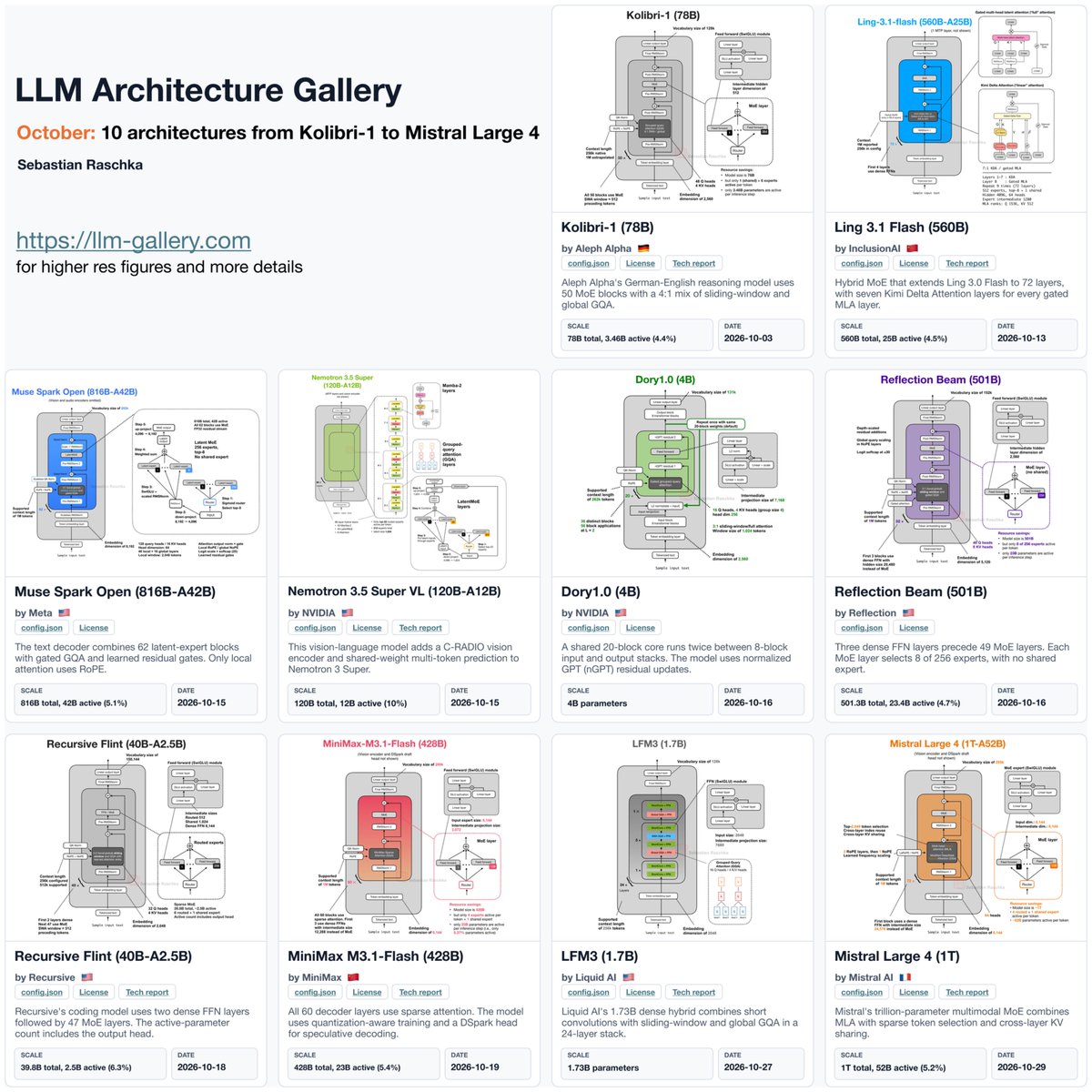
Catching up on the 10 (!) open LLM architecture releases from the past month. Quite a lot happened in October.
I guess we can call it "Open October"!
1. Kolibri-1 (78B): A notable model from Germany. Features classic Grouped Query Attention (GQA) and Sliding Window Attention (SWA) attention module.
2. Ling 3.1 Flash (560B): Uses Kimi Delta Attention and the eighth uses gated Multi-head Latent Attention (MLA) inspired by DeepSeek.
3. Muse Spark Open (816B): Besides Musse Glimmer, the first major open weight release from Meta (since Llama). Uses classic GQA + SWA but adds a LatentMoE.
4. Nemotron 3.5 Super VL (120B): Combines Mamba-2 layers with just eight attention layers. Also LatentMoE
5. Dory1.0 (4B): A looped transformer design.
6. Reflection Beam (501B): GQA+SWA architecture.
7. Recursive Flint (40B): Note that "Recursive" is the company name; the architecture is a fairly standard MoE with GQA and SWA.
8. MiniMax M3.1-Flash (428B): Uses their own MiniMax Sparse Attention module.
9. LFM3 (1.7B): Hybrid architecture that mixes short convolutions and attention.
10. Mistral Large 4 (1T) combines MLA with sparse attention.
Will probably cover/discuss things in more depth in the coming weeks!