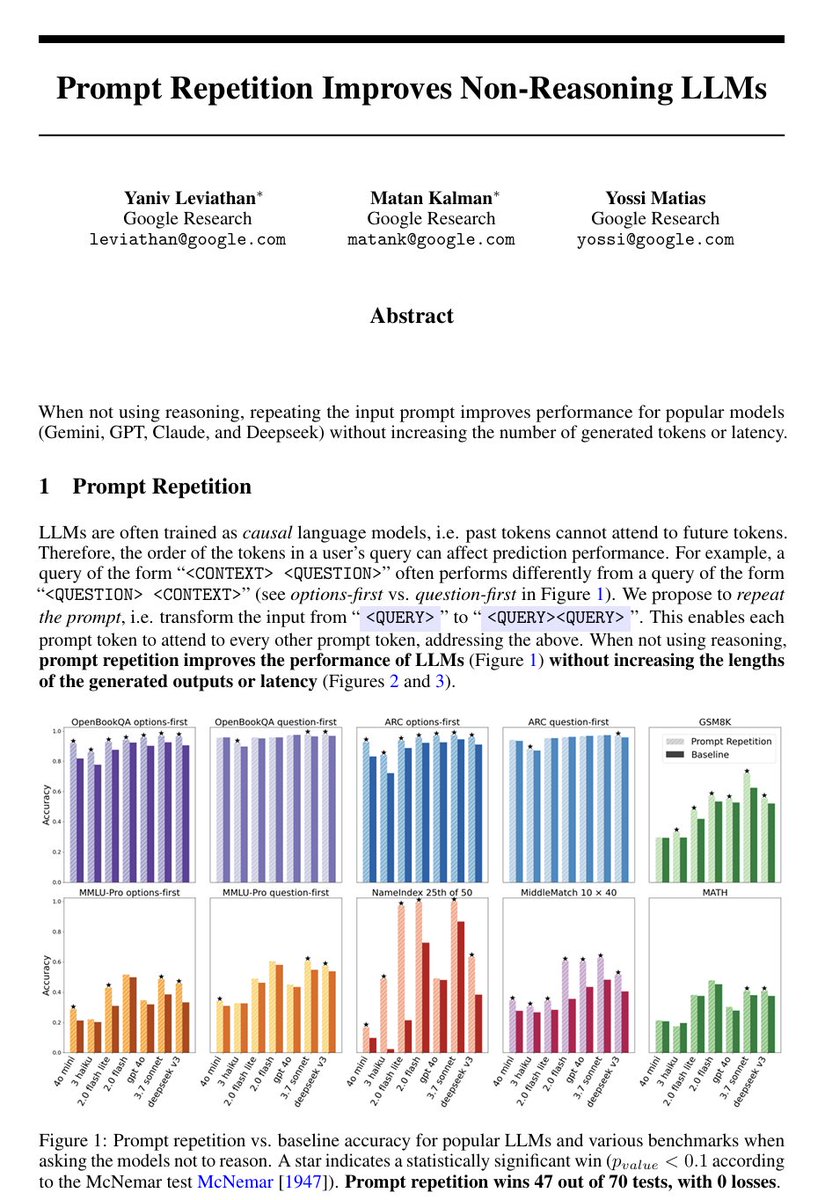
LLMs process text from left to right — each token can only look back at what came before it, never forward. This means that when you write a long prompt with context at the beginning and a question at the end, the model answers the question having "seen" the context, but the context tokens were generated without any awareness of what question was coming. This asymmetry is a basic structural property of how these models work.
The paper asks what happens if you just send the prompt twice in a row, so that every part of the input gets a second pass where it can attend to every other part. The answer is that accuracy goes up across seven different benchmarks and seven different models (from the Gemini, ChatGPT, Claude, and DeepSeek series of LLMs), with no increase in the length of the model's output and no meaningful increase in response time — because processing the input is done in parallel by the hardware anyway.
There are no new losses to compute, no finetuning, no clever prompt engineering beyond the repetition itself.
The gap between this technique and doing nothing is sometimes small, sometimes large (one model went from 21% to 97% on a task involving finding a name in a list). If you are thinking about how to get better results from these models without paying for longer outputs or slower responses, that's a fairly concrete and low-effort finding.
Read with AI tutor: https://t.co/MipHHO6rjX
Get the PDF: https://t.co/XQrqiaGwIO
allow me to explain the markets
i) all of history, news were local and took long to travel across zipcodes
ii) even when the news did travel, investing was not democratized. the friction between news -> flows was high
iii) the above combined make the flywheel required for reflexivity high friction to spin. so all moves must happen relatively slow. this is how the grandpa from omaha made his money. slow compounding over time was the play
iv) and then the internet happened. news now travel at the speed of light across earth
v) but investing was still high friction. that is until robinhood and crypto came along
vi) with the above, you now have instant market expression after the propagation of information
vii) but market expression itself is information, meaning people then use it to make more market expressions
viii) this is called a reflective loop. price goes up -> people bet on it with no friction -> price keeps moving faster -> more people bet on it, and so on. there is now a metric ton of extra noise present in the system, which means volatility, which means the exchanges eat more than ever
ix) crypto was and is the purest expression of this since the friction is roughly non-existent vs RWAs
x) RWAs have now entered the internet reflexivity age. meaning they will over-interpret geopolitical events and become more volatile than they've ever been
xi) the practical implications are two fold:
- controlling your emotions and time horizons is harder but more important than before
- before, pure fundamentals alone could've carried you. but now the story of the asset you're investing in matters just as much as its fundamentals because the story is what dictates the propagation of the memes
And because it's the holidays...
We’re giving away some FREE One Piece packs on the tweet below:
❤️ LIKE
🔄 RETWEET
💬 TAG an OP / RWA friend
Winners announced soon!
The Oct 11 Crypto Crash — What Really Happened
TL;DR:
Roughly $60–90M of $USDe was dumped on Binance, along with $wBETH and $BNSOL, exploiting a pricing flaw that valued collateral using Binance’s own order-book data instead of external oracles.
That localized depeg triggered $500M–$1B in forced liquidations, cascaded into $19B+ globally, and earned the attackers about $192M via $1.1B in BTC/ETH shorts opened on Hyperliquid hours earlier, but minutes before Trump tariff announcement.
It wasn’t a USDe failure!! It was Binance’s design flaw, timed with macro panic (Trump’s tariffs) for cover.
What looked like chaos was actually a coordinated exploitation of Binance’s internal pricing system, amplified by a macro shock and systemic leverage.
1️⃣ The Setup
Binance’s Unified Account let traders use assets like USDe, wBETH, and BNSOL as collateral.
Instead of oracle or redemption prices, Binance valued these using its own spot market - a major vulnerability.
On Oct 6, Binance announced a fix to move to oracle-based pricing, but rollout wasn’t until Oct 14, leaving an 8-day window.
2️⃣ The Exploit
During that window, sophisticated actors manipulated Binance’s order books, dumping ~$60–90M of USDe, driving it to $0.65 on Binance only (still ~$1 elsewhere).
Because the Unified Account marked collateral to internal prices, this instantly wiped margin value and triggered $500M–$1B in forced liquidations.
Then, Trump’s 100% China tariff headline hit, magnifying panic and liquidity stress.
3️⃣ The Profit Engine
The same day, fresh wallets on Hyperliquid opened $1.1B in BTC/ETH shorts, funded by $110M USDC from Arbitrum-linked sources.
As the Binance cascade unfolded, BTC and ETH cratered, those shorts netted $192M in profit before closing out at the bottom.
Timing, precision, and funding paths all suggest coordination.
4️⃣ The Contagion
Binance liquidations dumped BTC/ETH/ALTs into thin books.
Other exchanges mirrored the collapse through cross-market bots.
Market makers hedged across venues were forced to unwind everywhere.
Result: $19B+ global liquidations, with many alts down 50–70% intraday, all triggered by <$100M of manipulated collateral.
5️⃣ Who’s at fault?
Binance: design flaw + delay in oracle rollout = root cause.
Exploiters: executed and timed the manipulation, profited via external shorts.
Ethena (USDe): not at fault - protocol stayed 1:1 collateralized, redemptions normal, peg held everywhere else.
6️⃣ Aftermath
Binance admitted “platform-related issues,” promised compensation for affected margin/futures/loan users, and rolled out minimum price floors + oracle integration.
USDe remained operational, and the incident is now a case study in how exchange-side pricing errors can trigger system-wide liquidations.
Bottom line:
A ~$90M dump on Binance and a $1.1B leveraged short elsewhere sparked a $19B bloodbath.
Not a stablecoin failure, but a masterclass in exploiting flawed collateral valuation during peak macro stress.
A new era of DripTrade starts today.
In true Hyperliquid-ethos, we’re proud to announce Revenue Distribution 💸
100% of revenue will go back to users
And with the lowest trading fees at 0.5%, DripTrade stands as the most community-aligned marketplace
A platform that pays 🧵
And yes of course...
We’re giving away 1 FREE Base Set Pack (worth $500)
Inside are pulls worth up to $30,000+ 👀
To enter:
1️⃣ Like
2️⃣ Retweet
3️⃣ Tag a Pokémon friend
Winner will be chosen from the tweet below!👇
Announcing https://t.co/FDGkMtKo7v, the identity-linked SVM Layer 1 chain from the creators of Star Atlas.
Every transaction. Every on-chain moment. Your wallet levels up, your reputation grows.
Airdrop season starts this September. You're going to want to follow @ZinkSVM.