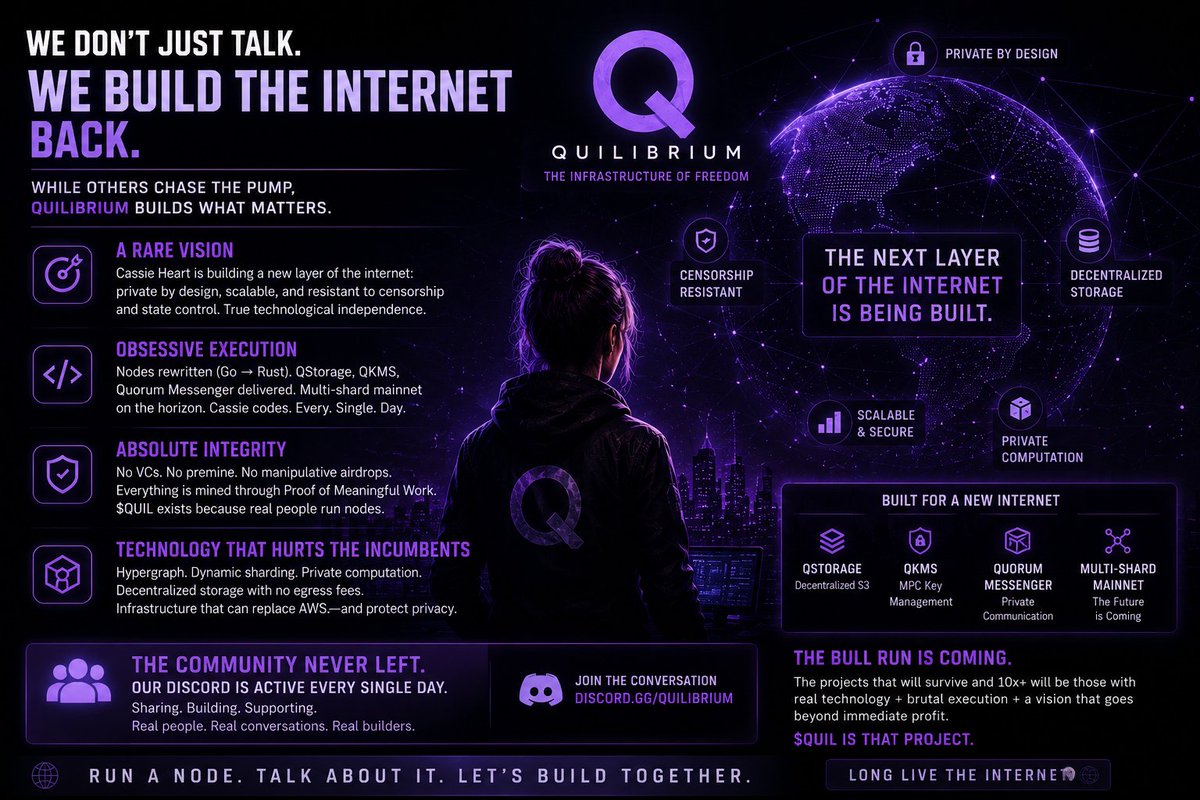
Quilibrium is building a better Internet: private, scalable and decentralized. This is the community account, not managed or endorsed by Quilibrium Inc.
Hey Q fam,
we are excited to share Quily, a community-built chatbot designed to help you navigate Quilibrium $QUIL!
👉 Try it now
https://t.co/k5hfQEjicw
Quily answers your questions about Q using:
→ Official documentation
→ Community-made docs
→ All livestream transcriptions
✅ How to use it
To chat with Quily, you'll need one of these:
→ A Chutes (@chutes_ai) account (sign in directly)
→ Your own OpenRouter API key
This keeps the bot free to host while giving you control over your API usage.
⚠️ Important disclaimers
→ BETA - We're actively testing and improving. Feedback welcome!
→ Community project - NOT endorsed by or affiliated with @QuilibriumInc
→ Open source - Check the code, or contribute (https://t.co/DliI5frGDT)
---
Built with 🔥 by @LaMat1111 for the Quilibrium community.
Many thanks to @0xsirouk for he help with the Chutes integration.
My long-term conviction in $QUIL hasn't changed.
In fact, after months of downtrend action, the chart is quietly starting to look very different.
No hype. No parabolic moves. Just a steady reversal, higher lows, increasing volume, and signs of accumulation.
The market usually ignores builders during the grind phase.
Then one day it wakes up and asks, "How did we miss this?"
Something feels like it's brewing beneath the surface.
Still early. Still watching. Still holding.
@QuilibriumInc
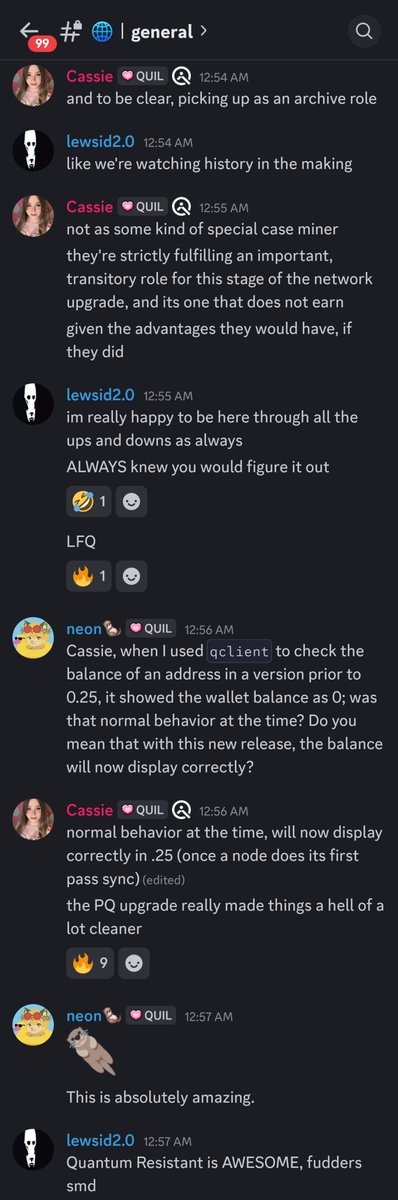
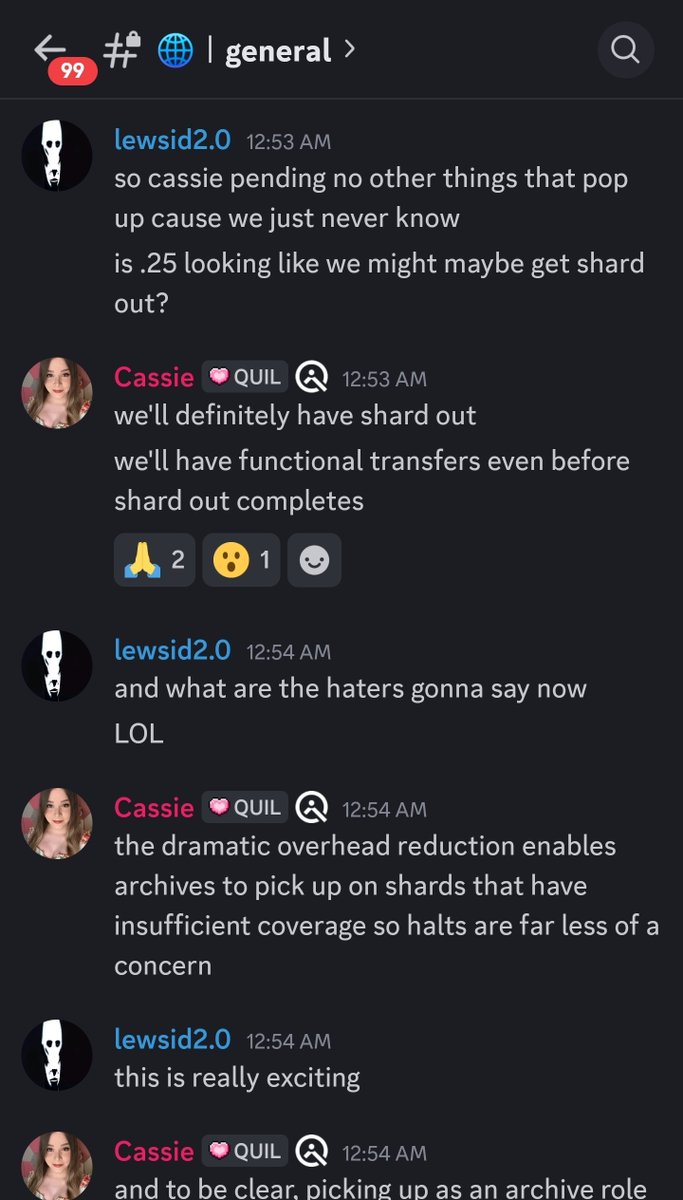
Most of you never want to see the ticker $QUIL again unless shard out is done and the network is live
So i'll just say this
If you believe the cypherphunk vision and that the tech is gud, and you're interested in investing...
you can wait for that announcement, and yes it will give you certainty the network works
But that news will make the chart pop, and by waiting you will lose the asymmetric RR set up that exists right now at $10m mc
To me the best opportunity is accumulating at the lowest possible price, as long as meaningful progress continues. And it has
I think the last update i gave was that there were still about 300 halt risk shards (the only thing standing in the way of the network going live)
Yeah well now thats down to single digits - Massive improvements and rewriting the protocol in rust have solved nearly all remaining hurdles
$QUIL is closer to going live than it's ever been. 8 or 9 years of development about to come to frutition...
a fully decentralized E2EE private-by-default AWS replacement, priced at $10m mc all because people got impatient
Its a generational opportunity.
And it's ripe for the taking if you have the risk tolerance for it.
No matter what you want to do, jump in the discord, you'll be first to hear when the network goes live
https://t.co/C7YczNAUn7
@QuilibriumInc Check check, still on, still accumulating, still bullposting
10 reasons $QUIL is the most undervalued tech in crypto right now
https://t.co/Wal7JKW543
Hey Q fam,
we have been working on a draft of governance rules for the Quilibrium Community Treasury.
The repo is now public and open for community input: https://t.co/5vlMConakr
What's in there:
a draft constitution covering signer responsibilities, spending guardrails, transparency, conflict of interest, and a set of genuinely open questions (donor recognition, yield strategy, what to do with QUIL holdings, etc.).
Important:
this is a draft, not an official treasury document. The aim is to think these questions through in public and develop something signers might eventually adopt.
How to contribute:
The README explains the structure and where each kind of discussion belongs.
All input welcome, especially on these open questions:
Q1:
Should donors receive any form of recognition or indirect benefit?
https://t.co/LiIGugyyut
Q2:
What happens to value created by treasury-funded projects?
https://t.co/yUFLdnDIDB
Q3:
Should the treasury run an endowment-style yield strategy?
https://t.co/bKmDrXJRSZ
Q4:
Should the treasury actively trade its QUIL holdings, or hold them passively?
https://t.co/vypYP8T8yz
$QUIL
Cassie is grinding away every day
$QUIL is looking more promising than ever as a high risk/ultra high reward investment
Here are the latest updates:
♦️ bringing in a deeper e2e test that spins up four archives and workers to take on shards with simulated network conditions unearthed some different issues that emerged in testing on the node runner tg as weird bugs that would appear and disappear (the "heisenbug"). these are almost fully ground out now, there's one that relates to hyperthreading that a lot of people on x86-64 machines have likely been hitting once the workers went active, that's the one left on the list for me
♦️ quorum mobile on android has some OOM issues, related to the batch processing of messages. I've shrunk the memory usage for batch processing to about a third of what it was using before and made the batching more "smart" to avoid this. the next QM update will also include some more QoL improvements.
♦️ klearu had a huge jump in capabilities, including a new hybrid model that basically does what the new ChatGPT Images 2.0 does, but as usual, on CPU and more efficient. since no models publicly exist for this, the training tools are also in this (this is already released). it also now supports flux, controlnet, and inpainting.
♦️ metavm is being hardened extensively and is getting some huge perf upgrades
The entry opportunity has literally never been more favorable at just $9m mc .... Its actually insane what you get for what you pay (if launch is successful)
Do with this info what you will. It's a bet I'm taking but it's not for everyone
Keep @cass_on_mars safe at all costs.
$Quil will be disrupting multi billion dollar corporations & their revenue models in a very high clip.
The tech can’t & wont be stopped.
Genie is almost out of the bottle 🪄
Hey Q fam!
Here is a summary of the latest live stream with @cass_on_mars (@QuilibriumInc founder).
✨ Quilibrium: What's new, 2.1.0.23, and more!
Cassandra Heart covers node rewrites, service updates, and a sharp critique of recent industry security failures.
▶️ Watch it on YouTube (English captions): https://t.co/kKr6DoCfEp
▶️ Watch it on X: https://t.co/GiAZ43Xt7j
✅ Key topics:
⦿ Node rewrite from Go to Rust (2.1.0.23)
⦿ Quorum Mobile App Store release and major UI overhaul
⦿ MegaRPC, QKMS SDK, QStorage, Klearu, and MetaVM updates
⦿ Industry security incidents: Vercel breach, https://t.co/axiEz3h3Bu DNS hijack, Layer Zero exploit
✅ Business Update: Zapme Social Goes Decentralized
Zapme Social has fully migrated its storage onto Q Inc. and is planning to move additional infrastructure components onto Q as new features of QConsole and Q web services are released.
✅ Node Release 2.1.0.22: What Was Fixed
The 2.1.0.22 release shipped earlier this month and included several bug fixes: improvements to the TUI, an activity eviction bug fix, a seniority merge bug fix, and heavy bandwidth fixes.
✅ The Big Change: Node Rewrite in Rust (2.1.0.23)
The 2.1.0.23 update represents the most significant architectural shift in Quilibrium's history: the node is being rewritten from Go to Rust.
The root cause was Go's garbage collector. Deep profiling via PPROF revealed that the GC's "stop the world" behavior was causing the BlossomSub pub/sub layer to drop messages, RPC resource access to halt, and the submission layer to stall — all due to the same underlying issue with message processing loops hanging at irregular intervals.
This is not the first time Go's GC caused problems. Every performance-sensitive component of the crypto stack, including BLS48581 and the Wesolowski VDF, had already been moved to Rust for the same reasons. The protocol's multi-instance worker model (master + capped workers) was itself a workaround for Go's inability to pin cores to single threads and its unpredictable GC behavior.
The move to Rust also enables a simpler architecture: in non-clustered mode, a single process can now manage all worker threads rather than requiring separate isolated worker instances.
Important clarifications:
⦿ QClient remains in Go and is not being migrated
⦿ All corresponding Go libraries remain compatible and unaffected
⦿ RocksDB migration from Pebble is straightforward
⦿ Most of the Rust groundwork was already done since ~version 0.18, when services like QNS and Quorum Mobile features were already being written in Rust
The 2.1.0.23 branch will be published as soon as all major deployment scenarios have been validated internally to minimize surprises during community testing.
✅ Quorum Mobile: App Store Release Incoming
Quorum Mobile has completed a major overhaul and is currently going through the App Store approval process. A TestFlight / Google Play beta update is also being released alongside the App Store version.
Key improvements:
⦿ Full UI redesign, including a space explorer for discovering public user spaces
⦿ All encryption, decryption, and network communication moved from JavaScript to native code, eliminating the React Native bridge overhead
⦿ Deep performance pass: memoization fixes, background thread optimization
⦿ Voice and video calls routed through Quilibrium's onion routing layer, preventing IP address and location leakage
⦿ Support for public profiles
⦿ Free Farcaster account onboarding built into the app
⦿ Ability to receive and send offers for QNS names directly in the app
⦿ iOS 26 "Liquid Glass" visual treatment supported
Users upgrading from TestFlight to the App Store version will need to go through two upgrade steps due to how Apple separates TestFlight and App Store app data. Cassandra acknowledged this is unavoidable but is working to make the migration as seamless as possible.
✅ MegaRPC: Now Live
MegaRPC has officially launched. It is a privacy-preserving RPC service that uses ORAM-based queries so user data cannot be linked or shared. It is described as "the first RPC service that can't be evil."
Wallet teams are already in discussions to integrate MegaRPC as an alternative to public RPC providers that charge high fees and cooperate with government data requests. Teams that do not want to run their own MegaRPC node can access the service via QConsole API keys.
✅ QStorage Update: Sub-Account Ownership
QStorage now supports sub-account ownership, allowing developers to create cryptographically enforced, compartmentalized access controls. Write keys are tied to specific sub-accounts rather than the root account, meaning the root account owner cannot access user-uploaded content if the policy is set correctly. This is particularly useful for social applications where user data should only be accessible to the user themselves.
✅ QKMS Update: New SDK with Drop-In Compatibility
The QKMS SDK has been updated with sub-account ownership and a new developer-facing API that is intentionally designed to be drop-in compatible with wallet-as-a-service SDKs like Privy. Developers familiar with those tools will feel at home immediately.
The SDK supports multi-party computation (MPC) key generation on the fly, including 2-of-2 threshold signing and configurable T-of-N group wallets. Supported key types include:
⦿ BLS12381 (Ethereum validator keys, enabling programmatic group validator wallets)
⦿ BLS48581, DCAF448, and ED448 (Quilibrium-native keys)
The SDK is published at https://t.co/IYIirLBqIG.
✅ Klearu Update: Multimodal and Classifier Expansion
Klearu, Quilibrium's MPC machine learning framework, now supports image classification via MPC. Use cases include verifying photo authenticity in crowdsourced apps (for example, filtering non-bird images in a bird-watching app) or pre-screening uploads in social media platforms for policy violations before content ever hits storage.
The LLM model has also been expanded to support multimodal input, allowing image submission to the model with text-based queries about the image content.
✅ MetaVM Update: EVM-to-Consensus Proofs Coming
MetaVM currently supports execution-layer zero-knowledge proofs. The upcoming update adds EVM-to-consensus proofs, enabling a full chain-of-custody proof for Ethereum transactions that covers:
⦿ Execution validity (Merkle-Patricia tree proof of the transaction and all SLOAD/SSTORE events)
⦿ Block production
⦿ Consensus layer binding
⦿ Epoch finality via Casper FFG (2/3+ of total stake attested)
The practical outcome: when querying a transaction through MetaVM, developers will be able to verify the full economic security of Ethereum as part of the proof, leaving no reliance on RPC trust.
✅ Other Releases: Balance, Hypersnap, FFX
Balance, Quilibrium's Communicating Sequential Processes language that enforces CSP constraints at the language level, is now available on GitHub.
Hypersnap has shipped several updates including nightly builds, expanded API compatibility (webhooks and notifications), and a preview of Snap Compute and Emulator (FIP21). A token is planned; details are discussed in Hypersnap dev calls.
FFX, Quilibrium's equivalent to AWS Lambda (part of MetaVM), is launching public access this week with Node.js support.
✅ Industry Security Incidents
Vercel was compromised in a global account breach, with credentials and API keys now circulating on the dark web. Cassandra noted that full account isolation would have mitigated the damage, and positioned FFX as a more secure alternative for Node.js serverless workloads.
https://t.co/axiEz3h3Bu's DNS account was compromised on EasyDNS via social engineering and redirected to attacker-controlled name servers; CoW Swap was also hit by a separate DNS hijack attack the same week. QNS is presented as a more proof-based and privacy-preserving alternative to traditional DNS.
The most substantial commentary was reserved for Layer Zero's incident report. A DAO exploit resulted in a compromised RPC node, attributed to Lazarus Group, that returned fraudulent transaction data. Two other Layer Zero-operated RPCs had been DDoSed offline, leaving a single compromised RPC that returned different responses depending on what was querying it.
Cassandra called out Layer Zero's statement that "RPC verification is a fundamental limitation of all off-chain services" as false and irresponsible, arguing that the real failure was not verifying execution proofs. Trusting an RPC without cryptographic proof of execution, inclusion, and finality is a design choice, not an inherent limitation. Full zero-knowledge proofs of the kind MetaVM provides make this class of attack obsolete.
The Q R-Bridge uses T-of-N MPC confirmation and is being upgraded to use MetaVM, making a single-node compromise insufficient to authorize any cross-chain action.
✅ Security Reminders
⦿ Do not trust links on Twitter/X claiming to be from Quilibrium, even if the URL appears correct. Short links can mask the real destination.
⦿ There is no wallet migration. Any Telegram group claiming otherwise is a scam. Report it immediately.
⦿ Always verify accounts before interacting.
$QUIL
Hearing some seriously promising things about $QUIL going live imminently
Look, ive been waiting for this and hodling for like 3 years
To buy now at all time lows and ride it up after launch could be a massive play
Worth paying attention
Stream incoming: April 20th, 8am UTC.
We’re going live to walk through everything that’s been building under the surface👇
• 2.1.0.23
• QStorage updates
• QKMS upgrades + new wallet SDK for developers
• Quorum Mobile — full UI revamp, miniapps, wallet features, voice/video calling, space explorer, public profiles
• F(x)
• Relational
• Hypersnap
Watch here on X or live on Twitch!
https://t.co/eES5o3F2Tz
If decentralization truly matters, build where it’s real.
✅️No single point of control.
✅️No off switch.
✅️Infrastructure grounded in math, privacy, and verifiable execution
➡️with native scalability enabled by a hypergraph architecture.
#Quilibrium@QuilibriumInc $QUIL
Zapme Social - Is now Decentralised (Part 1)
Zapme has just moved all social Video's, Images and Post uploads to QStorage on @QuilibriumInc 👏👏👏
#decentralized#socialnetwork
Want to know how Sharding in @QuilibriumInc and how the tech connecting the network and the data?
Read this info it will help you understand what is achived and what we are missing to fully operational network.
Quilibrium splits the entire global network state into exactly 3,098 shards (at this point) — each one holding only ~0.032% of the data.
At 100% shard coverage the $Quil mainnet goes live and fully operational
This is achieved once 0 halt-risk shards remain
The .22 update today addressed coverage issues and cut bandwidth consumption significantly (up to 90% reduction)
Halt-risk shards are already ticking down much faster since the update which is awesome
To give an idea of the progress and how much longer it might be... check the 1-week difference between these 2 screenshots
But keep in mind most of the progress during that week was before the update today which has sped it up further
You can see the halt-risk shards and watch them tick down in real time at https://t.co/woADaaPbL3
Cassie keeps shipping on all fronts
$Quil team continues to achieve industry-firsts one after another
Mcap keeps dropping lower
I keep buying
You keep saying "but mainnet not live"
But one day soon mainnet will be live (that's my bet for good reasons)
And I will own tons of $QUIL
And you will own none
Is that the future you want?
You still have time to capitalize
So place your bets
This is asymmetric upside potential
Hey Q fam!
Here is a summary of the latest live stream with @cass_on_mars (@QuilibriumInc founder).
✨ Quilibrium State of the Union: Node Updates, New Services, HyperSnap, MetaVM and the Full Tech Tree Roadmap
A comprehensive State of the Union covering business wins, node releases 2.1.0.18 through 2.1.0.22, new managed services, the Farcaster fork, and the ambitious road ahead for Quilibrium's decentralized web services platform.
▶️ Watch it on YouTube (English captions): https://t.co/wZEpFTUYcN
▶️ Watch it on X: https://t.co/iqy5aOnhhm
✅ Key topics:
⦿ Business development wins in key management, wallets, gaming and web hosting
⦿ Node updates from 2.1.0.18 through 2.1.0.22 (in progress), including major bandwidth reduction
⦿ Klearu: MPC machine learning framework released
⦿ MegaRPC: a privacy-preserving RPC service using ORAM-based queries
⦿ QNS updates, bug fixes and auction abuse enforcement
⦿ Quorum Mobile performance overhaul and App Store progress
⦿ HyperSnap fork of Farcaster's Snapchain and its decentralized governance
⦿ MetaVM: the first full hardware 64-bit RISC-V VM in zero-knowledge
⦿ Full tech tree roadmap walkthrough and AWS-parallel service scope
✅ Business Updates
Several business development wins have been secured recently. Without naming partners yet, the themes revolve around multiparty key management, crypto wallets, digital asset management (including gaming), the Farcaster fork, and web hosting. More details on partners will be shared at a later date.
The two biggest obstacles remain the Apple App Store approval process for Quorum Mobile and completing the shard-out process to unlock all network primitives and enable fee-based transactions.
✅ Node Updates (2.1.0.18 through 2.1.0.22)
Since the last stream, there have been four node updates with a fifth on the way:
⦿ 2.1.0.18: Introduced alt-fee-basis app shards (enabling service launches while the QUIL token shard-out is still in progress), proxy pub-sub improvements for nodes behind residential ISPs with limited port forwarding, seniority merge calculation updates, Ferret direct mode for faster buffer access without the RPC layer, and DKLS23 support for more efficient multiparty threshold ECDSA signing.
⦿ 2.1.0.19: Bootstrapping fixes for the DHT (distributed hash table) peer discovery layer.
⦿ 2.1.0.20: Significantly faster Docker image builds (reduced from 1-2 hours down to ~15 minutes, thanks to community contributor Hamoud), improved proposer logic for automated shard selection, and support for workers to leave less advantageous shards.
⦿ 2.1.0.21: Official release of QClient with all protocol messages finalized, immediate rejection support for shard proposals and leaves (no longer needing to wait the full 360 frames), and additional bug fixes.
⦿ 2.1.0.22 (in progress): Bug fixes for prover management in QClient, eviction-related bugs around coverage halt timeframes, seniority merger incorporation fix, and most importantly a massive bandwidth reduction. Global-level traffic was cut by approximately 90% by moving frame data and message data from the PubSub layer to direct RPC calls. The same optimization is being applied to worker-level traffic and is expected to be the last item before the release ships.
✅ Network Status at Time of Stream
At the time of the stream, the network had approximately 408 addressable public nodes. Shard coverage breakdown:
⦿ 256 shards in halt risk (fewer than 3 active provers)
⦿ 536 shards needing more coverage (fewer than 6 active provers, does not cause a halt)
⦿ 2,306 shards considered healthy
A future update will add libp2p relay functionality, allowing nodes behind residential ISPs to run without a public IP by routing through relay nodes. This is technically possible today but not yet officially supported to avoid the connectivity issues experienced in the early 2.0 days.
✅ Klearu: MPC Machine Learning
Klearu was released as Quilibrium's MPC (multiparty computation) machine learning framework, runtime and inference library.
✅ MegaRPC: Privacy-Preserving RPC
MegaRPC is a new managed RPC service coming to QConsole. Unlike centralized RPC providers such as Alchemy and Infura, which link users' IP addresses to wallet addresses, MegaRPC uses ORAM-based (Oblivious RAM) queries. This means the service cannot know what a user queried or associate their identity with their wallet. Even if IP addresses were logged along the network path, the cryptographic query format prevents any metadata leakage.
MegaRPC is already running live and powering Quorum Mobile. Conversations with wallet teams are ongoing about adoption, though some have declined because they rely on the analytics that traditional RPCs provide. QConsole access to MegaRPC is expected to be introduced this week. This is described as the first RPC service that "can't be evil."
✅ Alternative Network Transports and Internet Censorship
The stream touched on the topic of internet censorship in countries like Iran, where traffic is being actively blackholed. Thanks to libp2p's pluggable transports, Quilibrium can support unconventional connectivity methods such as LoRa (long-range radio) and Bluetooth. A broker node using Quilibrium's onion routing could allow users with long-range radios to connect through the mesh network, enabling communication without creating a digital trail. While radio waves can be triangulated, the sprawl of a mesh network makes surveillance far more difficult. This was tested previously using libp2p's WebSocket adapter, which worked with no changes to the node software.
✅ QNS (Quilibrium Name Service) Updates
QNS has received several bug fixes, particularly around auctions and offers. Some users attempted to exploit the state machine logic around orders, and the team has put them on notice: those transactions will be reprocessed and reversed. QNS has also switched to the new privacy-preserving MegaRPC on the backend. Additionally, the QNS interface received a significant UI redesign by community contributor Lamat, who also redesigned parts of QConsole.
✅ Quorum Mobile
Quorum Mobile is currently going through App Store approval, primarily held up by Apple's review process. Each update required for Apple also resets the Android release timeline to keep both platforms in sync. Key improvements include:
⦿ Space Explorer: significantly faster performance for discovering and joining public spaces
⦿ Native-side cryptography: the React Native JavaScript bridge for encryption/decryption has been moved entirely to native code, eliminating the worst performance bottleneck
⦿ Memoization and rendering: UI components no longer re-render on every new message, with memoization applied throughout
⦿ Public profile support: users can optionally create a public profile with a profile picture and exposed wallet addresses for receiving payments
⦿ Proper push notification support in the upcoming App Store release
Quilibrium's philosophy remains firmly opt-in: no user data is assumed or exposed by default. Users must manually opt in to any public-facing feature.
✅ HyperSnap: The Farcaster Fork
HyperSnap is Quilibrium's fork of Farcaster's Snapchain protocol. The backstory: around January, Farcaster's original development company (Merkle Manufactory) announced it was shutting down and selling all of its resources to Neynar (a Farcaster API and tooling provider). The Q team had an outstanding pull request, open since late November or early December, to join the validator set and help decentralize the network. Despite initial agreement to add them, the decision was reversed within 12 hours, and the team was told to fork instead.
Since then, HyperSnap has had multiple releases, with a new one imminent that makes running a HyperSnap node as simple as running a Snapchain node, complete with a dedicated Docker organization. Importantly, HyperSnap is not just a Q project: only one person from Q, Inc. is in the HyperSnap organization, with the rest being other Farcaster community members. This structure is intentional, as Farcaster's success requires multiple stewards rather than a single corporate benefactor.
HyperSnap runs as an alt-fee basis shard, enabling proofs to be incorporated onto the Q network. This allows QStorage-hosted files to be used as embeds on Farcaster. Quorum integrates Farcaster feeds through the protocol and also supports direct messages via the Neynar Farcaster API.
✅ MetaVM: Full Hardware Zero-Knowledge VM
MetaVM is the first full hardware 64-bit RISC-V virtual machine that operates in zero-knowledge. While other projects like Jolt offer 64-bit RISC-V VMs in ZK (using MPC lookup tables), MetaVM differentiates by enabling proof of execution at the hardware level across the entire OS stack. This means proving that from initial boot all the way to a chosen stop point, every computation step was performed correctly, whether running Linux, a web server, or even Doom.
The total proof size for the full OS and hardware execution is approximately 1.5 kilobytes or less. MetaVM also supports the Ethereum Virtual Machine and Solana's eBPF extensions, with proof outputs compatible with both Quilibrium and Ethereum. Proofs can be verified on Ethereum today using existing BLS12-381 point evaluation and pairing functions in a smart contract.
For Quilibrium's managed services, MetaVM enables AWS-compatible offerings such as Lambda-equivalent functions, EC2-style compute, and ECS/EKS container orchestration.
✅ Tech Tree Roadmap
The stream featured a walkthrough of Quilibrium's tech tree, a visual map of the entire ecosystem. The center nodes represent what has already been developed and released: Quorum, the node software/protocol, shared crypto intrinsics, Klearu, MetaVM, the EVM shard, and HyperSnap. The outer nodes show what is still in development.
For Quorum specifically, features still in development include video calls, voice calls, and group wallets.
The scope explicitly mirrors AWS service categories: machine learning, networking and content delivery, compute, application integration, storage, and more. Already released services include:
⦿ QNZM (IAM equivalent)
⦿ QKMS (Key Management Service)
⦿ QNS (Route 53 equivalent)
⦿ QQ (SQS-compatible queue service)
⦿ QPing (SNS equivalent)
⦿ QStorage (S3 equivalent)
QNS can already resolve to QStorage content on the backend, with frontend support still needed. When resolving to public QStorage buckets, Quorum's browser uses onion routing so that no traffic passes through clearnet and no one can identify what was requested or its size.
The overall mission: provide a fully decentralized, secure web services platform, an everything app for private communication (comparable to WeChat but private), and empower developers of all skill levels to build powerful privacy-first tools.
✅ Mainnet Status and Shard Coverage
Mainnet is currently running. The token shards are in a coverage halt phase, which blocks fee-based transactions, but alt fee-based transactions are fully operational, which is why all the other Q services are already live. Once the coverage halt ends, the network will have a warning period before any future halt would occur, giving node operators time to restore coverage to affected shards.
✅ QNS and QStorage Integration
QNS already supports resolving names to QStorage content on the backend, but the frontend UI currently only exposes resolution to Quorum public keys. Full linking between QNS and QStorage on the frontend is planned. Once available, browsing .Q names in Quorum will use onion routing for complete privacy, ensuring no clearnet exposure and no linkability.
$QUIL