Big News!🎉
We are proud to announce that we have raised $10M in Series B funding, to expand overseas markets further as a
japan-based quantum computer software startup.
Learn more about this capital and our plan here:
https://t.co/sUDJVueiho
#QuantumComputing
Inflow, outflow, and no-slip boundary conditions are implemented at the gate level, and the system is solved via a QSVT-based quantum linear solver. We show that both the gate count and qubit count scale logarithmically with the number of grid points.
【New Preprint Released 🎉】
Joint research with 1QBit, HPE, and Qolab on STAR architecture.
We identified a "Goldilocks Zone" where quantum advantage becomes feasible at the Mega-quop scale.
⬇️ Details & Publication
https://t.co/RVe2ipwads
【News】 The "QSCI" algorithm is moving from research to real-world use!
QunaSys has launched
▶️ "Awesome QSCI" (Tech Portal)
▶️ Official Partner Program
Accelerating the quantum ecosystem together.
Details▶️https://t.co/1eIWR6EAm5
#QSCI#QuantumComputing#QunaSys
[Joint Research Released🎉]
SoftBank (@SoftBank_RIAT)× QunaSys New Quantum White Paper✨
⭐️Quantifying Quantum Chemistry & CAE resources for 2030⭐️10 ideas for practical implementation.
Check out QunaSys's insights👀
Details▶️
https://t.co/dYPLYzxhcK
#QunaSys#FTQC@SoftBank
[New preprint on arXiv🎉]
In collaboration with Fujitsu Limited, we developed a method named Mirror subspace diagonalization to solve the ground state energy.
This method is based on the Quantum Krylov method and greatly improves the sampling cost👏
https://t.co/Ufvz46VTBj
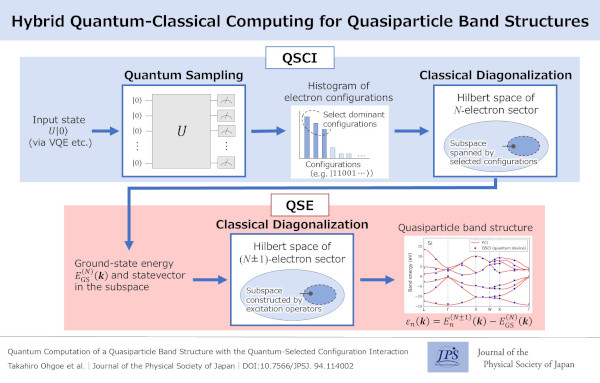
This article is on "Quantum Computation of a Quasiparticle Band Structure with the Quantum-Selected Configuration Interaction"
by Takahiro Ohgoe, Hokuto Iwakiri, Kazuhide Ichikawa, Sho Koh, and Masaya Kohda
https://t.co/9KjLNripW0
[Paper published🎉]
Our joint research with Panasonic Holdings Corporation has been published in Journal of the Physical Society of Japan, and featured as one of the Hot Topics by the Physical Society of Japan!
https://t.co/RwKTkEpxin
https://t.co/BpLrcZTYae
New preprint🎉
In collaboration with Panasonic Holdings Corporation, we’ve posted a paper on arXiv summarizing our results from ab initio quasiparticle band structure calculations performed with a quantum device using the quantum selected configuration interaction (QSCI) method.
🎉We are proud to announce that Yuya Nakagawa, a QunaSys researcher, has been selected as one of UNESCO’s Quantum 100 — recognizing 100 outstanding quantum researchers worldwide.
Congratulations on this remarkable achievement!🚀
#Quantum100#QuantumScience#UNESCO#QunaSys
This first-quantized mapping is crucial for practical bosonic computations (condensed matter, chemistry, cold atoms), suggesting that the Bose-Hubbard model is an excellent early candidate for achieving quantum advantage on FTQC devices.
[New preprint 🎉]
We’re excited to announce that our team has published new research on bosonic simulations using quantum computers!
https://t.co/2u5wOHk2dS
Major finding in quantum simulation!
First-quantized boson mappings are shown to be superior to second-quantized mappings in terms of qubit and gate efficiency for general bosonic models in a finite basis. Less resource, more power!
【New preprint🎉】
We proved that simulating the hardware-efficient ansatzes (HEA), widely used in near-term algorithms, belongs to the class known as BQP-complete.
This result strongly suggests that such simulations are classically intractable.
https://t.co/olwMyJmxLA
【New preprint🎉】
Our joint work with Fujii Lab (UOsaka) on a new FTQC architecture “MB-FTQC”!
Measurement-based approach aiming for large-scale QC on near-term devices, with new schemes like “higher-order zero-level magic state distillation.”
https://t.co/uGOCHj8NVx
[New preprint on arXiv 🎉]
We have posted a paper proposing a quantum algorithm for nonlinear plasma fluid simulation and its numerical verification.
The method yields ~4th-order speedup in time scaling with grid size and polylog space complexity.
https://t.co/0jcEGZMyAI
Why this matters: The chemical space for potential drugs is unimaginably vast. By bringing quantum-inspired generative models into the process, we can more efficiently explore this space and align generated molecules with real-world pharmaceutical requirements.