WGS results of a Tajik from Kapisa, Afghanistan, with R2-F1758.
YFull. https://t.co/AyLSEwGBRa
YFull ID. YF147161
R2a-F1758 is today most commonly observed among Mizrahi Jewish populations, while outside of them it appears to be relatively rare. In the Hindu Kush region, however, the lineage has previously been identified among Kalash, Nuristanis and Kho. Most of the R2a identified among the Kalash also appears to fall under F1758.
The connection between Hindu Kush populations and Mizrahi Jews is ancient rather than evidence of any recent shared ancestry. Available estimates place their common paternal ancestry several thousand years ago, well before the historic era.
One possibility is that Jewish F1758 descends from an undersampled or now-extinct population farther west, perhaps in Iran or Mesopotamia, while eastern branches survived among populations of the Hindu Kush. Their relationship may therefore reflect much older Chalcolithic-era ancestry connecting populations of the Iranian plateau, Mesopotamia and the Hindu Kush.
New Pakistani Kashmir Gujjar Big-Y (R2) Results:
The results align with a more NW Pakistan origin as seen by the matches in the tree:
https://t.co/OjUmRYMQ22
A general warning: AncestryDNA & MyHeritage raw data no longer includes Y-DNA . For males, we don’t recommend these tests. Autosomal DNA tests like FTDNA’s Family Finder are better. FTDNA also offers full/deep Y-DNA testing.
https://t.co/FDhpReYxjx
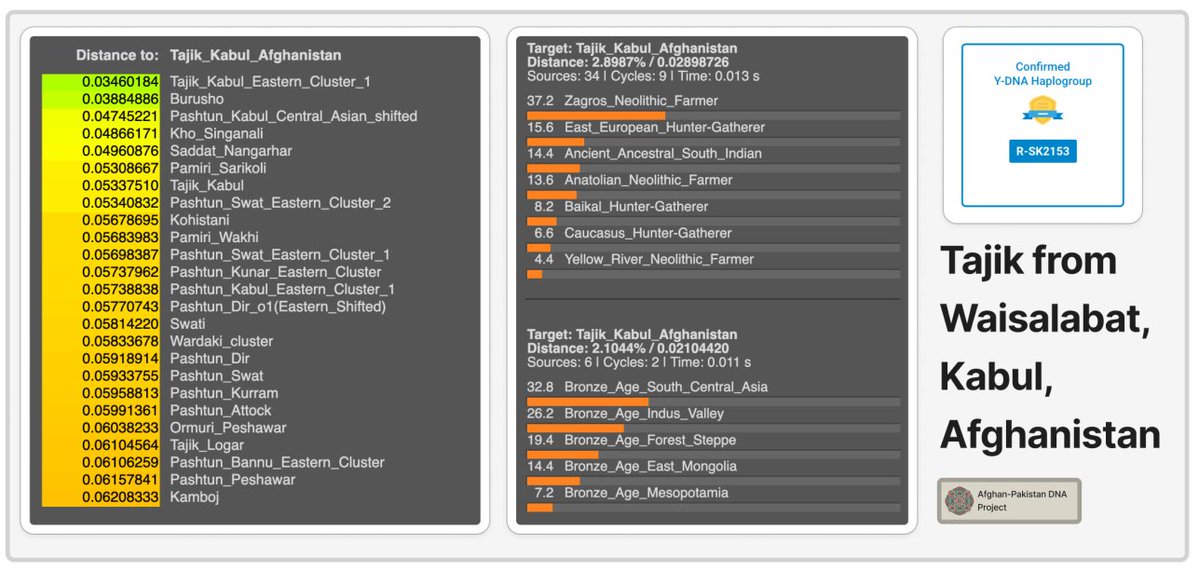
Global25 results of a Tajik from Kabul, Waisalabat
Y-DNA: R2a2b1b2b - R-SK2153
YFull: https://t.co/POSScObyuL
FTDNA https://t.co/kpNg9FjUJ4
The profile shows an East Asian and Dardic shift, resulting in a relatively close genetic distance to Burusho populations. Similar profiles have previously been observed in Kabul among Tajiks and even some Pashtun individuals from Kabul those with admixture from Kashmiri, Dardic and Tajik groups can also show a similar genetic profile.
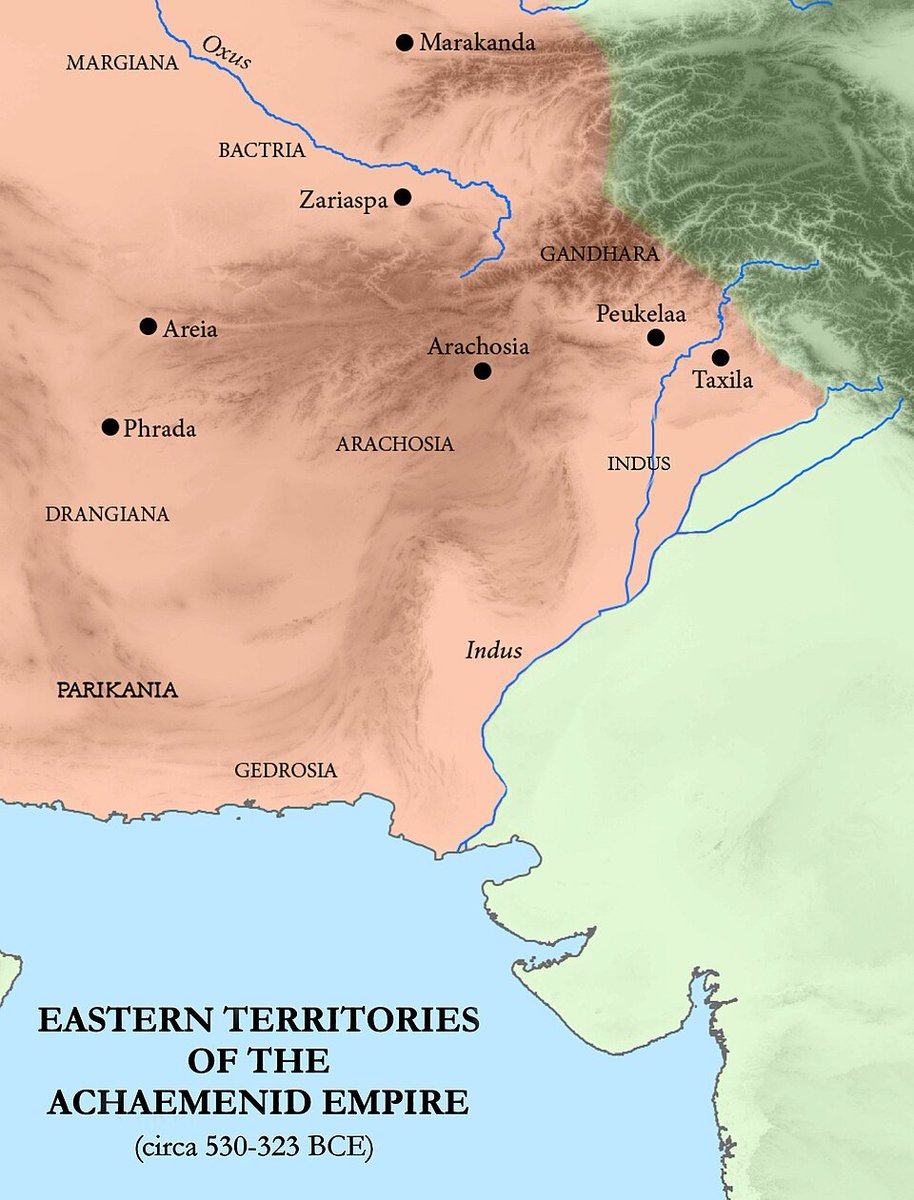
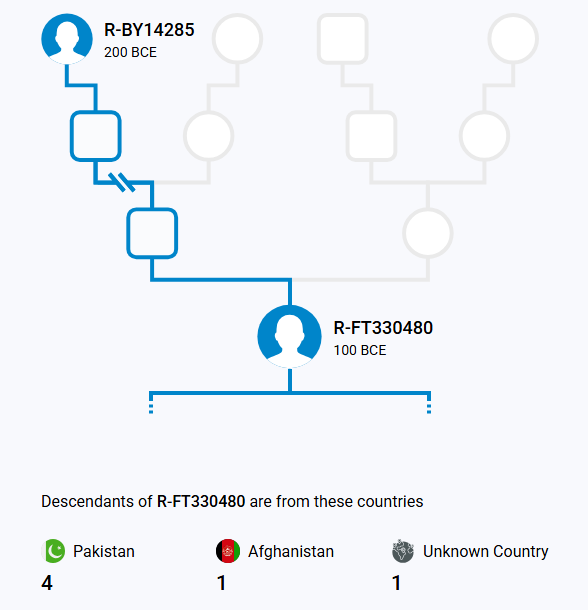
Making a prediction for the clade has been tricky, but the distribution, alongside the TMRCA of R-BY14285, and R-FT330480 could hint towards Arachosia, an Eastern Province of the Achaemenid empire, in what is modern day Southern Afghanistan.
Only a theory at the moment😄
Big Y Result of a Safi Pashtun from Kapisa Province, Afghanistan
R-M207>M479>P249>M124>P267>FGC12586>M9710>V1180>FGC17608>V3714>Z29158>SK2153>V3467>V2434>Y1346>FGC18150>V1024>FGC18152>BY14285>FT330480
https://t.co/bwQdJfrqLl
At the moment, not much details are known about the Pakistani samples, other than the fact that one is from Punjab province, but ethnicity is unfortunately not listed.
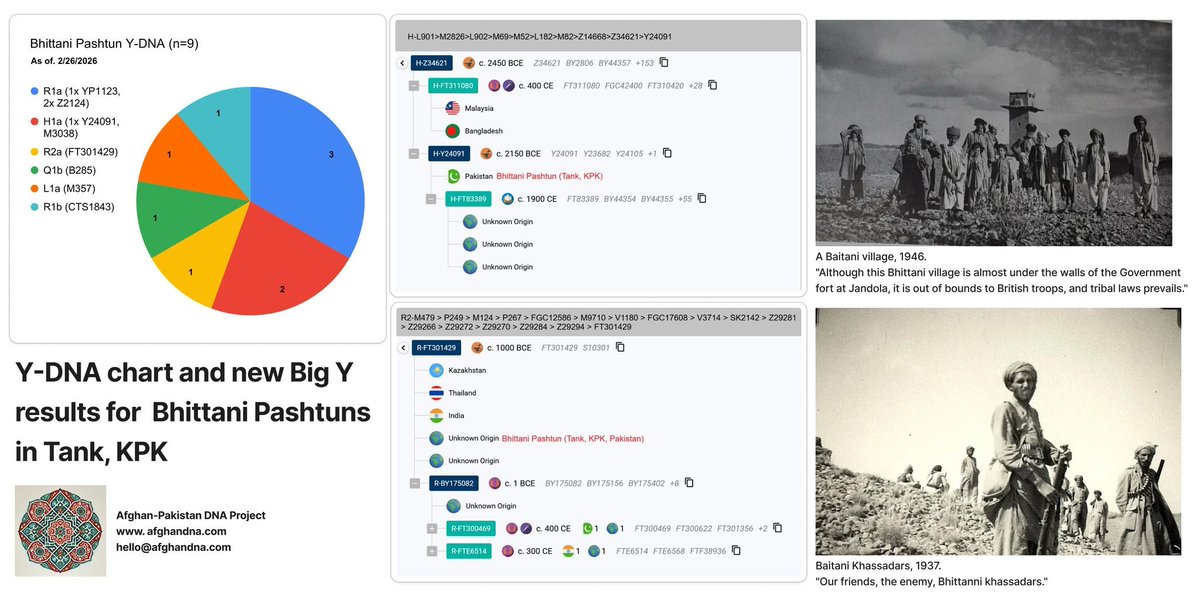
Our project has received H1a and R2a Big Y results from the Bhittani tribe of Pashtuns in Tank, KPK, Pakistan.
H1a Bhittani
Y-DNA: H1a1a1c - Y24091
H-L901 > M2826 > L902 > M69 > M52 > L182 > M82 > Z14668 > Z34621 > Y24091
https://t.co/q4eZ22z6jH
H-Z14668 had previously been identified in two Ghilzai Nasar Pashtuns, one from Nangarhar, Afghanistan and another from Balochistan, Pakistan. A Big Y test has now been ordered for the H1a Nasar Pashtun from Afghanistan to determine whether the Nasar and Bhittani H1a lineages share a closer relationship.
R2a Bhittani
Y-DNA: R2a2b1b2a - FT301429
R2-M479 > P249 > M124 > P267 > FGC12586 > M9710 > V1180 > FGC17608 > V3714 > SK2142 > Z29281 > Z29266 > Z29272 > Z29270 > Z29284 > Z29294 > FT301429
https://t.co/UvS4ARVRjG
This is the first time this particular R2a subclade has been identified among Pashtuns. Additional Big Y testing of Pashtuns carrying similar R2 lineages will be necessary to better understand its distribution. More importantly, testing non-Pashtun populations with R2a lineage closer to the Bhittani R2a will help clarify the possible source and historical pathway through which this clade entered Pashtuns, e.g. the closest living vector population.
So far, the sample size from the Bhittani remains limited. However, even with the small dataset, they already display a relatively high diversity of lineages, with no single dominant paternal line emerging.
Particularly interesting is the presence of Q1b among them. This lineage was likely introduced through a Lodi/Lohani (most probably a Marwat) Pashtun who assimilated into the Bhittani tribe.
Does this mean that the Singaporeans paternal line is Marathi?
The answer is no: these 2 individuals likely have a root somewhere in Southern India around 1000 BCE (TMRCA of R-F18906)
Big Y Result of a Marathi from Khandesh (Northwestern Maharahstra) Belonging to the Borse Clan.
R-M207>M479>P249>M124>P267>FGC12586>M9710>V1180>FGC17608>V3714>Z29158>SK2153>Y1285>Y1283>Y1282>Z29162>Z29165>Y1296>Z29175>F18906
https://t.co/cSIW6MZxYY
Regarding his match, Singaporeans/Malaysians who have South Asian Y-DNA Haplogroups often get them from Southern Groups such as Tamils, and Sri Lankans, although there will occasionally be ones with descent from Northern Regions.
Updated Y-DNA chart for Afghan Tajiks. The sample size is now n=297. Please keep in mind that most of these samples are from northern Afghanistan. Tajiks from West Afghanistan and East Afghanistan are in comparison undersampled.
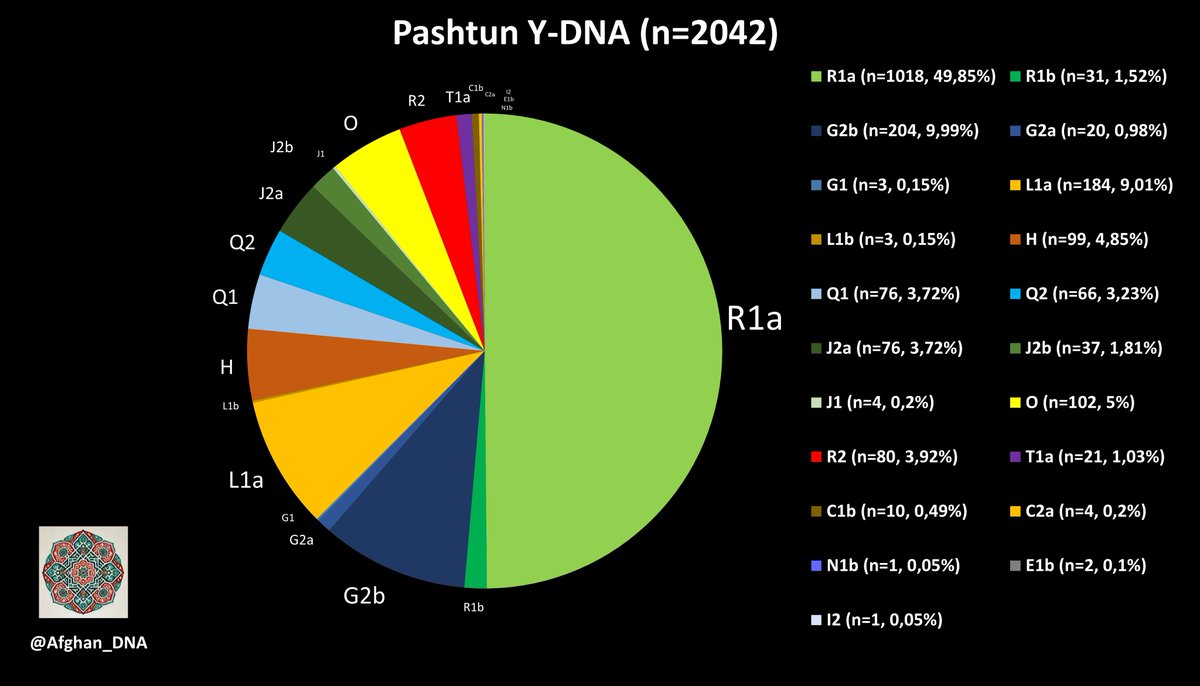
New updated Y-DNA chart for Pashtuns from Afghanistan, Pakistan, India (confirmed Pashtun lineages) and Arabia (Pashtun diaspora). The sample size is now n=2042, but some tribes are still overrepresented like Yusufzai (70% R1a) and Jadoon (70% Y-DNA O). So the frequency of lineages like G2b and L1a is likely a bit higher in reality and the frequency of lineages like O lower.
A third kit of a Tajik from Kapisa needs a second run, but was already determined to be R2a-F1758 https://t.co/AyLSEwG41C
This clade is today very common in Mizrahi Jews but was earlier found in Kalash and Nuristani too. But this Afghan Tajik F1758 would be the first F1758 with a full Y-DNA genome result.
@ylesinebir65650@BmacIvc Hello!
R-P267 is under R2. We help manage the R2 Project on FTDNA, which includes plenty of members under R-P267.
Please share any information about your paternal line and join! 🙏
https://t.co/oeIw0783G1
@kiami624912 @AnatolianRednek Hello!
R-SK2153 is under R2. We help manage the R2 Project on FTDNA, which includes plenty of members under R-SK2153.
Please share any information about your paternal line and join! 🙏
https://t.co/fdjHRzs9Uh