JP Morgan's investment research team just shared exactly how they built their multi-agent system "Ask David", and it's the same architecture pattern showing up everywhere:
- supervisor agent orchestrates
- specialized subagents handle retrieval, structured data, analytics
- LLM-as-judge reflection node before the answer ships
- human-in-the-loop for the last accuracy gap
worth watching for anyone building:
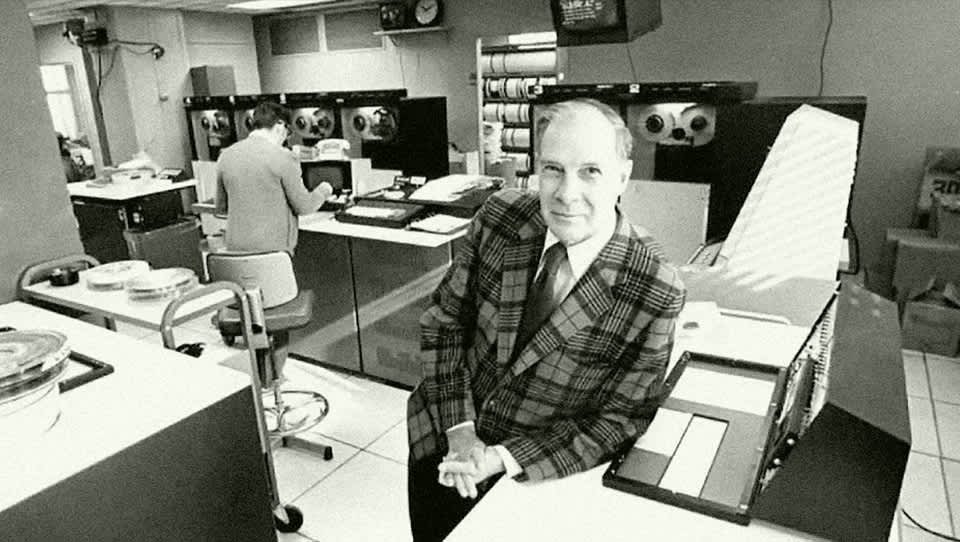
A mathematician who shared an office with Claude Shannon at Bell Labs gave one lecture in 1986 that explains why some people win Nobel Prizes and other equally smart people spend their whole lives doing forgettable work.
His name was Richard Hamming. He won the Turing Award. He invented error-correcting codes that made modern computing possible. And he spent 30 years at Bell Labs sitting in a cafeteria at lunch watching which scientists became legendary and which ones faded into nothing.
In March 1986, he walked into a Bellcore auditorium in front of 200 researchers and told them exactly what he had seen.
Here's the framework that has been quoted by every serious scientist for the last 40 years.
His opening line landed like a punch. He said most scientists he worked with at Bell Labs were just as smart as the Nobel Prize winners. Just as hardworking. Just as credentialed. And yet at the end of a 40-year career, one group had changed entire fields and the other group was forgotten by the time they retired.
He wanted to know what the difference actually was. And he said it wasn't luck. It wasn't IQ. It was a specific set of habits that almost nobody is willing to follow.
The first habit was the one that hurts the most to hear. He said most scientists deliberately avoid the most important problem in their field because the odds of failure are too high. They pick a safe adjacent problem, solve it cleanly, publish it, and move on. And because they never swing at the hard problem, they never hit it. He said if you do not work on an important problem, it is unlikely you will do important work. That is not a motivational line. That is a logical one.
The second habit was about doors. Literal doors. He noticed that the scientists at Bell Labs who kept their office doors closed got more done in the short term because they had no interruptions. But the scientists who kept their doors open got more done over a career. The open-door scientists were interrupted constantly. They also absorbed every new idea passing through the hallway. Ten years in, they were working on problems the closed-door scientists did not even know existed.
The third habit was inversion. When Bell Labs refused to give him the team of programmers he wanted, Hamming sat with the rejection for weeks. Then he flipped the question. Instead of asking for programmers to write the programs, he asked why machines could not write the programs themselves. That single inversion pushed him into the frontier of computer science. He said the pattern repeats everywhere. What looks like a defect, if you flip it correctly, becomes the exact thing that pushes you ahead of everyone else.
The fourth habit was the one that hit me the hardest. He said knowledge and productivity compound like interest. Someone who works 10 percent harder than you does not produce 10 percent more over a career. They produce twice as much. The gap doesn't add. It multiplies. And it compounds silently for years before anyone notices.
He finished the lecture with a line I have never been able to shake.
He said Pasteur's famous quote is right. Luck favors the prepared mind. But he meant it literally. You don't hope for luck. You engineer the conditions where luck can land on you. Open doors. Important problems. Inverted questions. Compounded hours. Those are not traits. Those are choices you make every single day.
The transcript has been sitting on the University of Virginia's computer science website for almost 30 years. The video is free on YouTube. Stripe Press reprinted the full lectures as a book in 2020 and Bret Victor wrote the foreword.
Hamming died in 1998. He gave his final lecture a few weeks before. He was 82.
The lecture that explains why some careers become legendary and others disappear is still free. Most people who could benefit from it will never open it.
@bcherny@karpathy I hope you are right about the en-slopification part. its comparing apples to oranges but foundational models have created a slopcopolypse on social media.
Big difference as to why i can see your view is code compiles and easier to eval than an X post.
if you do a lot of original research, I'd highly recommend using Claude Code with Obsidian. i've been linking different ideas from reports using voice mode and it's been super useful.
my workflow: I use a markdown folder, populate it with source material, then enter stream-of-consciousness with @usemonologue, basically asking "what's the idea I'm saying here?" and letting claude help me pull threads together. right now im using this with @ejames_c brilliant common cog curriculum to boost my business fundamentals.
i then have an active recall section, using @justinskycak approach to learning and memorizing so instead of just note taking im answering questions to make sure it stays in my memory.
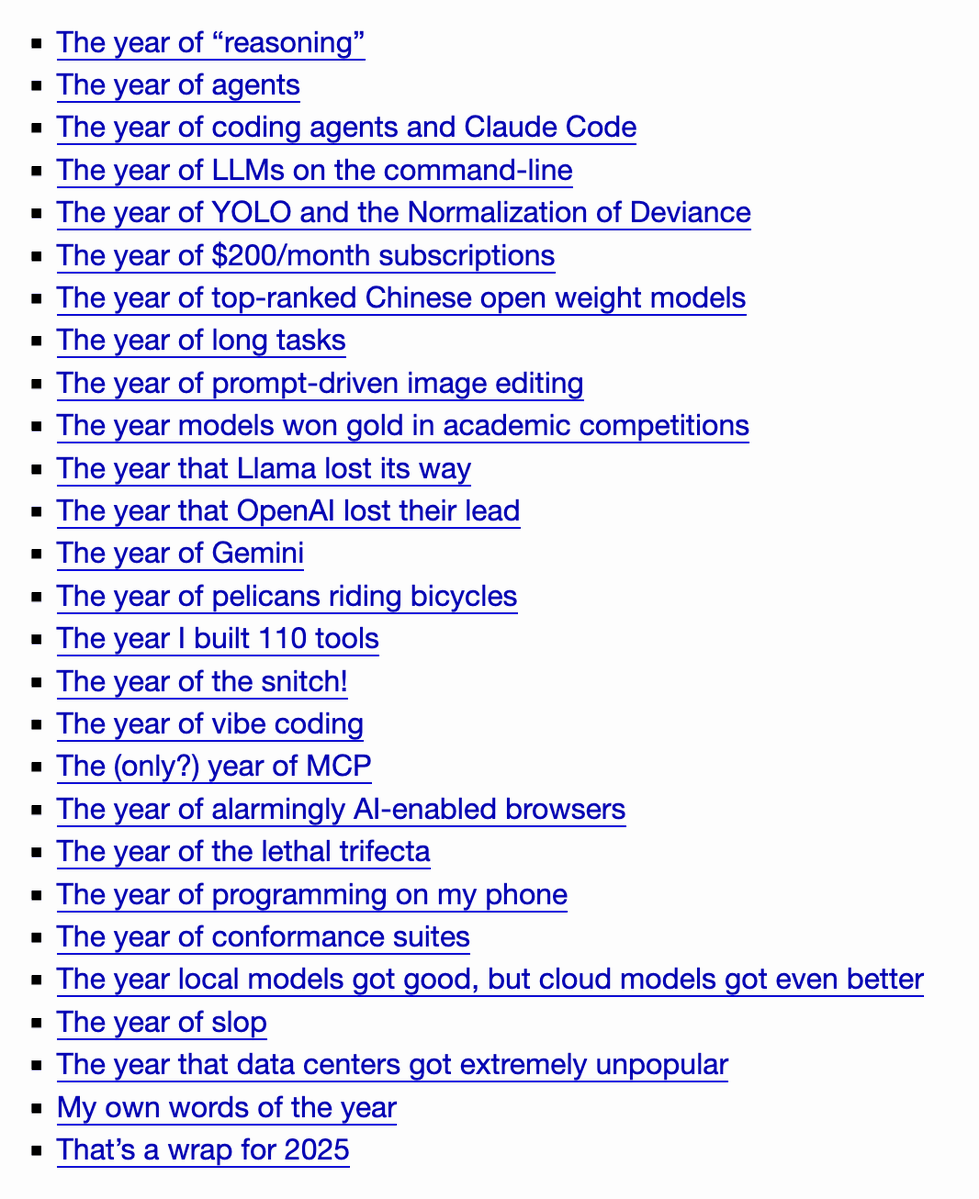
Here's my enormous round-up of everything we learned about LLMs in 2025 - the third in my annual series of reviews of the past twelve months
https://t.co/HD9Zf85SG2
This year it's divided into 26 sections! This is the table of contents:
Just created a complete analysis of AI infrastructure opportunities covering chip manufacturers, power companies and system integrators.
I shared this analysis with my 20,000+ students.
For 24 hours, it's yours for FREE.
Like, RT & Comment "AI" and I'll DM it to you.
🚨 Google just dropped 150 pages on Health AI Agents. 7,000 annotations. 1,100 expert hours — but the real value isn’t in the big metrics. It’s the shift in design philosophy.
Instead of a monolithic “Doctor-GPT,” Google’s Personal Health Agent (PHA) orchestrates 3 specialists:
✸ Data Science Agent → analyzes wearables + labs.
✸ Domain Expert Agent → grounds outputs in medical knowledge + checks facts.
✸ Health Coach Agent → guides conversations, goals, empathy.
10 benchmarks.
7,000 annotations.
1,100+ expert hours.
The outcome?
More accurate insights.
More trusted summaries.
Stronger engagement than baseline LLMs.
The orchestrator ties them together with memory (user goals, barriers, insights).
⚡ Results
✸ Outperformed baselines across 10 benchmarks.
✸ End-users preferred PHA over single-agent + parallel systems (20 participants, 50 personas).
✸ Experts rated it 5.7%–39% better than baselines on complex health queries.
⚡ Design principles
✸ Address comprehensive user needs.
✸ Adaptive support → dynamically combine agents.
✸ Low user burden → don’t ask for data you can infer.
✸ Keep it simple → avoid unnecessary latency.
⚡ User journeys tested
• General health Q&A
• Personal data interpretation (wearables, biomarkers)
• Wellness advice (sleep, nutrition, activity)
• Symptom assessment (still limited, no diagnosis)
⚡ Limitations + future
✸ Slower than single-agent (244s vs 36s avg).
✸ Needs safeguards: bias audits, privacy, regulatory compliance.
✸ Next frontier: adaptive style → empathy vs accountability depending on user state.
⚡ The takeaway
Google’s PHA shows the path forward:
Not a “super doctor bot.”
But modular, specialized, agentic crews.
Healthcare is just the first test.
Tomorrow: finance, law, education, science.
Google 150 Health AI Agents: https://t.co/cDp9kCiPxm
≣≣≣≣≣≣≣≣≣≣≣≣≣≣≣≣≣≣≣≣≣≣≣≣≣≣
⫸ From confused to confident AI agent builder in 30 days?
Stop watching tutorials. Start building.
𝟯𝟬 𝗗𝗮𝘆𝘀 × 𝟭 𝗛𝗼𝘂𝗿/𝗗𝗮𝘆 = 𝗔𝗜 𝗔𝗴𝗲𝗻𝘁 𝗠𝗮𝘀𝘁𝗲𝗿𝘆
✔ 9 real-world agents
✔ 5 frameworks: MCP · LangGraph · PydanticAI · CrewAI · Swarm
✔ Working code, not toy examples
1,500+ developers ⭐⭐⭐⭐⭐ | 90+ countries
👉 𝗦𝘁𝗮𝗿𝘁 𝗬𝗼𝘂𝗿 𝟯𝟬-𝗗𝗮𝘆 𝗝𝗼𝘂𝗿𝗻𝗲𝘆 (𝟱𝟲% 𝗢𝗙𝗙): https://t.co/5i2v1fIrhJ