International trade and development economist. American University SIS, DC, former Chief Economist at the World Trade Organization & Graduate Institute, Geneva.
Looking forward to sharing my insights on recent trade developments and implications for India's evolving position in Global Value Chains. Building on an @AU_SIS certificate course that I will offer this fall more information here https://t.co/4TZ2hUgUVz.
Dr Robert Koopman, Hurst Distinguished Professorial Lecturer School of International Service, American University, Former Chief Economist of WTO and USITC - United States will address the CII Annual Business Summit 2026.
Witness the future taking shape and policymakers, industry leaders and global experts discuss what lies ahead for the global economy.
11–12 May 2026📍New Delhi
Register now ➡️ https://t.co/xJGyvxXfwZ
@RBKoopman
#CIIAnnualBusinessSummit26 #CII4India #TheFuture #GlobalEconomy #Industry #Society
@HectorRTorres2@PoderMentalX@danielkampel As we say in economics - everything is relative…we pick something as the point for a relative measure of those things? I don’t believe physics requires it to be stationary.
@michaelxpettis The real problem is the IMF-WTO institutional silo — macro surveillance that never informs trade rules, and trade disciplines that ignore S-I fundamentals. A solution is coherence architecture between these institutions, not a new mandate for one that was never designed for it.
@michaelxpettis I think Pettis correctly diagnoses the macro-trade interface failure — WTO-compliant behavior can still be globally harmful. But the fix isn't asking the WTO to relearn Keynes. The IMF already has the surplus/deficit assessment tools (EBA, ESR). 1/2
@NOIweala@dartmouth Congratulations @wto, @NOIweala and Bob Staiger - critical time for global trade cooperation and members to think out of the box and start the process of creating the WTO for purpose in the 21st century.
@NOIweala Thank you for your support of this work Ngozi - and for your continued efforts to ensure the multilateral trading system remains central to global commerce - and adapts effectively to a changing global economy.
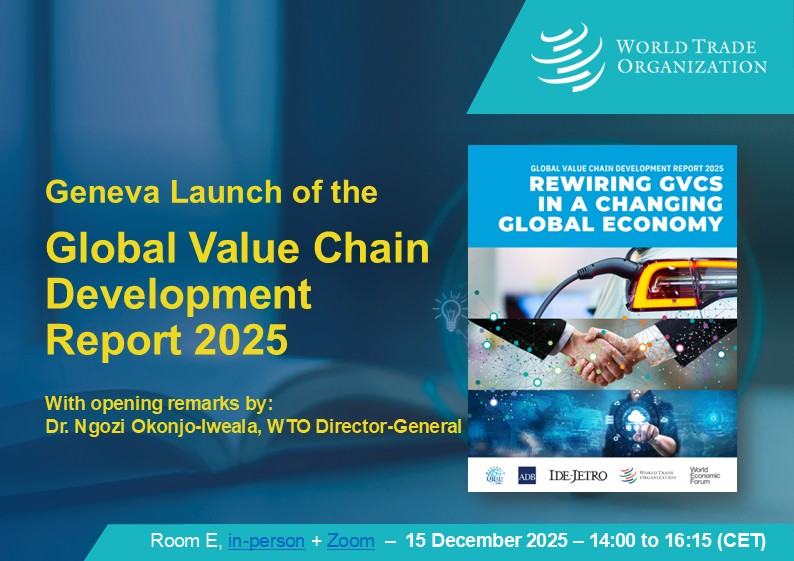
📘 Launch of the Global Value Chain Development Report 2025
Join us on 15 December to explore how technological change, the green transition & geopolitics are reshaping global value chains. Opened by DG @NOIweala.
Registration & programme: https://t.co/SQBSkeuwdL
Want to learn about how global trade and gvcs are re-wiring in a changing global economy? Join us on Dec 18 at American University for the launch of the Global Value Chain Development Report 2025. Here is the registration link for the event - https://t.co/lc1tFr839P
The Washington DC launch of the Global Value Chain Development Report 2025 - Rewiring GVCs in a Changing Global Economy will be on December 18 at 1 pm @ AU's School of International Service as part of AU's Trade Today program. Bookmark the date & look for the reg. link soon.
@ernietedeschi@davidjlynch So the bigger surprise is the reacceleration in goods prices, which had been the main disinflation engine? Goods are now contributing almost half a percentage point of excess inflation, or about ten times what they contributed last year. Gee, wonder what’s causing that?
@LucaFornaro3 I have long argued that rapid Chinese growth and productivity gains adversely affected growth in other countries - particularly developing countries. That said the negative growth impacts are small and represent a possible headwind on growth not an actual decline.
I will participate in a discussion panel at the IMF 13th Statistical Forum on 19-20 November 2025, which is devoted to the topic of “Measuring Cross-Border Economic and Financial Linkages in a Dynamic World”.
Register and join us here: https://t.co/L1aFLantsb
#StatsForum#IMFData