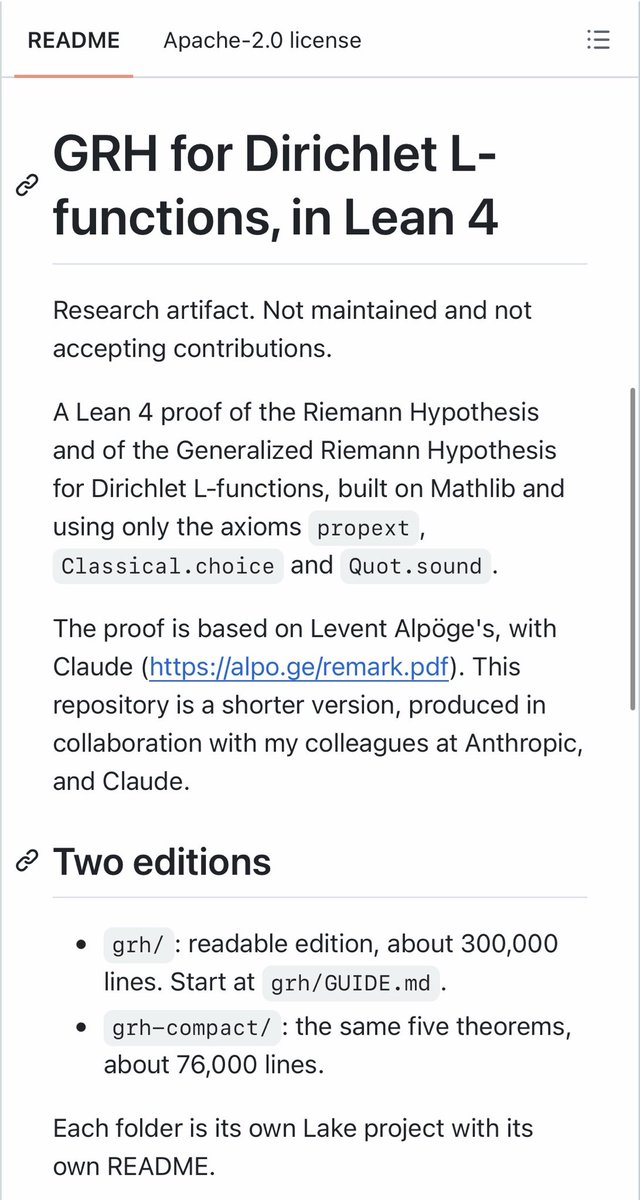
Anthropic researchers used Claude to cut the Lean formalization of the Riemann Hypothesis and its generalization by roughly 99.56%. That’s more than 200× smaller.
17.4 million lines of Lean down to 76,000.
I think I’ve almost solved 3D with AI.
I’ve always been obsessed with visual quality and lighting. A year ago, I discovered SDFs and became fascinated by their potential. The biggest challenge was how computationally expensive they could be.
So I built my own rendering engine, the one behind everything you’ve been seeing on my profile.
No RTX, no ray tracing. Purely SDF-based, fully interactive in real time, programmable with custom actions, and running in a single standalone HTML file.
This is the result of one year of research and experimentation.
https://t.co/NtczNuShbp
@CyberRobooo They should be much more preoccupied with the smoothness of the movements than energy consumption of its parts or recharging. The robot is in a non-utilizable state; it doesn't matter that it is power efficient.
The future of AI is about to take center stage. 🚀
From humanoid robots and Robotaxi to AI-powered vehicles and flying cars, discover what's next at XPENG AI Day 2026.
Join us LIVE on November 25 at 2:00 PM (GMT+8).
$XPEV
"Oh please overworked developer please spend your free time without compensation to game mods that I want."
Shut the fuck up and slave away your life if you don't want to use it. Leave real modders alone.
Gary Marcus was once a well known researcher. It is sad to see his decline into a promoter of disinformation.
For the record, there is no doubt that the Alpoge proof is correct. We know this because the Lean code compiles and because the Lean statement matches the statement.
Persona AI just teased its humanoid's new hand! 🪬
@personaaiinc builds purpose-built industrial humanoids, aimed first at the brutal work inside shipyards, like welding.
It's run by @nicolausradford and Jerry Pratt, two people with real history in the field: Radford came up through NASA and subsea robotics, Pratt spent years at the front of humanoid locomotion research.
Nic posted a progress update today, ahead of what he says is an official product release coming soon! 👀
First, a new hand. For an industrial humanoid, the hand is often where the whole value lives, so that's the part I'll be watching.
Second, they took the robot to a new customer site for mobility testing. The partner isn't public yet, but getting a humanoid out of the lab and onto a real site is the step that actually matters.
Awesome to be onboard as an angel investor, and thanks for trust team! :)
~~
♻️ Join the weekly robotics newsletter, and never miss any news → https://t.co/GoA3ZuwWF9
@ChrisVanHollen Democracts cannot follow the extreme left and become Luddites. The Democratic party was always a tech forward party, don't be buy into this insanity.
Absolutely insane: OpenAI just dropped another nine new math papers in its repo, with Lean proofs.
- Matrix multiplication is the operation behind basically every AI model. Since 1969 mathematicians kept finding faster ways to do it, and nobody knew where the limit was. OpenAI says it proved the limit: the exponent is exactly 9/4. A 57-year search would be over
- Linear programming is the math that plans flight schedules and supply chains. We have fast methods since the 80s, but their speed still depends on how big the numbers are. A method that only depends on the size of the problem was one of Smale's great open problems for this century. OpenAI says it found it
Add the Erdős-Rado sunflower conjecture from 1960 and, one day earlier, VP ≠ VNP, the algebraic cousin of P vs NP, open since 1979.
Anthropic: your turn again.
There are a shocking number of arrogant morons on X these days -- morons with advanced degrees in mathematics or hard sciences, who may understand their own field deeply, but think that entitles them to sound off on a topic they know nothing about.
I'm talking about the recent proof of the Riemann Hypothesis, released as a formal proof in Lean that passes the Lean proof checker. The critics saying it's not a real proof, or claiming to have found errors, betray no scintilla of understanding of what formal symbolic logic (a.k.a. mathematical logic) even is, nor of what a proof checker does, nor that mathematical logic and algorithmic proof checking are fields that are well established, well-understood, and well over a century old.
Yes, we've had proof-checking algorithms for longer than we've had computers to run them on.
These people suffer astronomic levels of Dunning-Kruger syndrome, utterly unaware that there's this huge intellectual field they should know something about before commenting. They do not understand that the "proofs" appearing in mathematics journals are in fact only proof *sketches*, whereas this proof of the RH is the real deal: a formal proof given in full detail, every i dotted, every t crossed, every single step algorithmically checked for validity from beginning to end.
It is MORE thoroughly verified than any human-written proof that has ever appeared in any mathematics journal.
BREAKING: OpenAI releases its own AI-generated proof of VP ≠ VNP just days after Anthropic, fueling speculation that both labs are sitting on major undisclosed mathematical breakthroughs.
OpenAI has posted their own VP ≠ VNP proof in response to Anthropic's, and says their result 'was obtained on November 6, 2026.' Two weeks ago. The ETH papers were also released in an similar oneupmanship fashion. As with Anthropic's result, no name on the paper (my guess is this was GPT-Aeon). Also like Anthropic: no announcement, no blog post, no tweet.
This is a significant result, yet both OpenAI and Anthropic chose to simply dump it online with no comment. I was listening to a Scott Aaronson interview this morning where he said this specific result would update him toward 'a solution to P ≠ NP by the AIs might really be around the corner.'
To me this is more evidence for my argument that both OpenAI and Anthropic are sitting on a dragon's hoard of scientific results they are not releasing to the public. The first massive 700+ paper OpenAI GitHub dump took five weeks for their model to generate. It's been seven weeks since then, and their internal model has continued to improve. They said they had it working on 4,000 problems. How many have been solved in the last seven weeks? Based on the last release, 1,000+ is not unreasonable.
I will quote OpenAI Chief Scientist Jakub Pachocki from the blog post 'Perplexity and Intelligence,' posted 48 hours ago:
'We have recently witnessed unprecedented acceleration in another domain. For more than a year, we have been posing open problems in mathematics to our models as one of the ways of evaluating them. Once we upgraded to a model of log-perplexity ~0.76, it started producing groundbreaking results. For many of us that have previously worked in mathematics and adjacent fields, seeing the resolutions to questions we've long thought about coming out of the model one after another in a single Slack thread felt deeply surreal.'
There have also been, of late, multiple rumors about breakthroughs in cryptography that I have been reluctant to post about for obvious reasons. Specifically, there have been rumors of an encryption breakthrough at Anthropic. What I personally took from the big OpenAI math release was that all encryption will be cracked much sooner than people are expecting, and that the rate of scientific discoveries will continually increase as we continue to scale up. No, not will increase, *has increased*. At both labs. We just don't know about it yet. Because unless you work at those labs, the current frontier is completely invisible. But it won't stay that way forever. Or to put it another way: prepare yourself for revelations.
@Turn_Trout making smarter AIs saves lives, creates tremendous growth, discovers miracles, increases the number of things people can do and more. you are being unserious as a safetyist if you don’t acknowledge the obvious upside of building smarter AIs
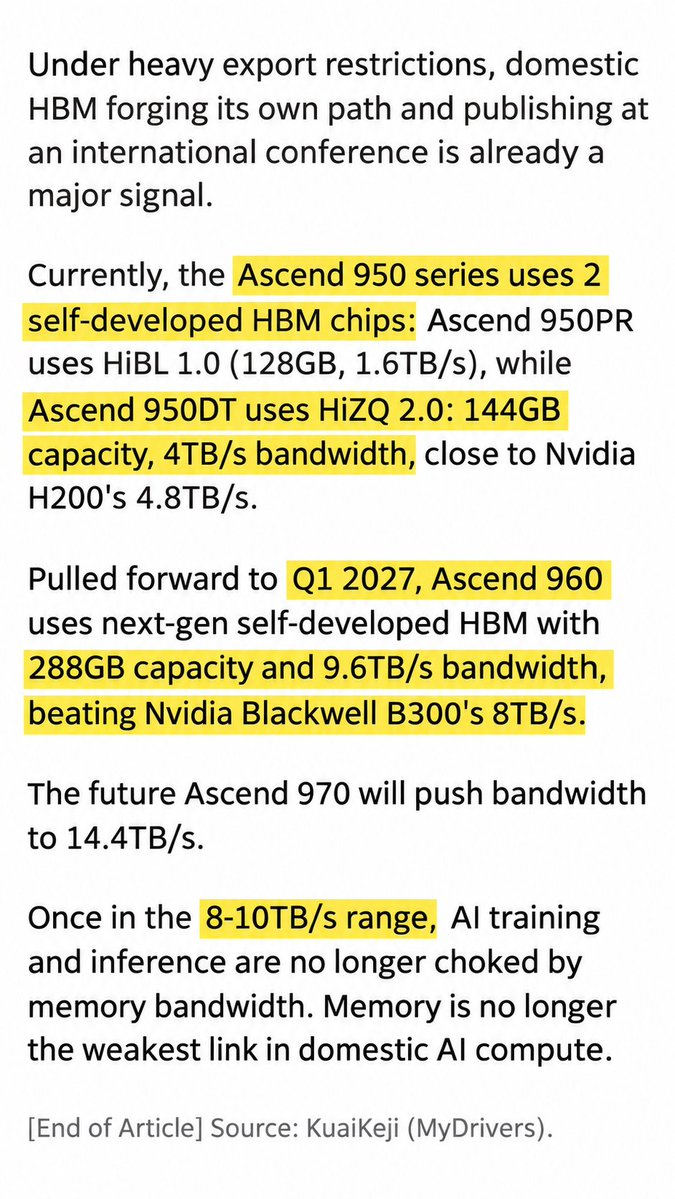
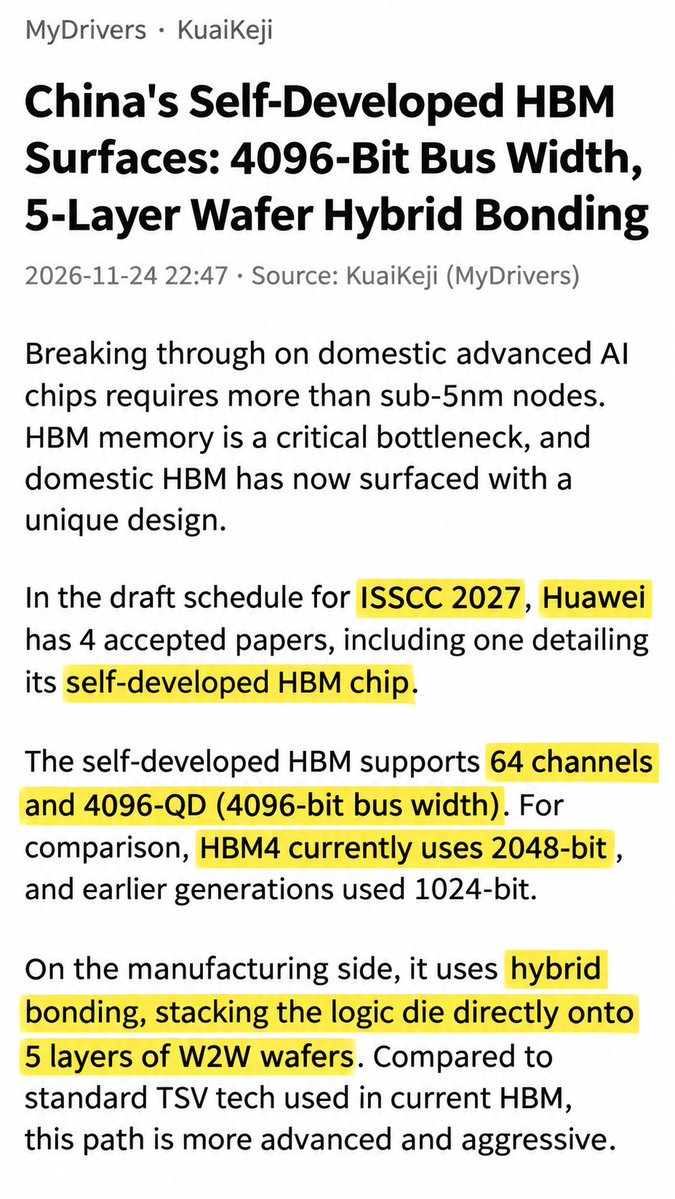
HOLY SHIT. Huawei just blew past HBM4 on paper with a self-developed 4096-bit HBM chip.
2x wider bus than HBM4. 9.6 TB/s on Ascend 960, beating Nvidia Blackwell B300's 8 TB/s. And it drops the exact week analysts warn DRAM prices could crash 70%.
Standard HBM4 uses a 2048-bit interface on TSVs. Huawei's ISSCC 2027 paper skips that completely: 64 channels, a 4096-bit bus, and 5-layer wafer-to-wafer hybrid bonding straight onto logic. No western HBM supply chain required.
Now check their updated roadmap. Ascend 950DT aims for 144 GB at 4 TB/s. Ascend 960 just got pulled forward to Q1 2027, targeting 288 GB and 9.6 TB/s. That beats B300's 8 TB/s headline bandwidth.
And the timing is nasty. Semiconductor veteran Jim Handy (Objective Analysis) just warned that if hyperscalers slow capex, DRAM and NAND prices can collapse up to 70% back to 2024 levels, wiping out Samsung and SK Hynix margins in 2 quarters.
Export controls were supposed to lock China out of AI memory forever. Instead Huawei built a wider bus right before a memory glut hits.
Doomers are murderers and if you advocate for pacing or pauses or delays of any kind, *you* are a murderer, and you *will* be held accountable for that.