🚨: After 48 years of travel, NASA 's Voyager 1 is nearing one light-day from Earth, almost 16 billion miles away.
A proud milestone for humanity, and a humbling reminder of how small we are in an infinite universe.
for those that don’t know, an article by a popular substack @Citrini7 went viral over the weekend
i thought the article was very well thought out and presented a simple perspective:
what happens if AI becomes so good that agents take over the application layer and unemployment rises to historic levels?
it seems like algorithms across the market scanned through that article & maybe some large funds took the article’s perspective very seriously
as multiple banks/business media outlets are now citing the article, seems like it did have a tangible impact
the broader question isn’t necessarily the article’s claims going viral but how an article with these types of claims was ABLE to go viral
the market is so on tilt…and the bear case around AI being so good is more compelling than the optimistic “age of abundance” bull case
one AI stock not affected today? $NVDA, as the article cites that it may end up becoming the ultimate winner when all is said and done
but if the economy crashes to historic unemployment…owning stocks might not really hedge against that
Ask ChatGPT a complex question and you'll get a confident, well-reasoned answer. Then type, "Are you sure?" Watch it completely reverse its position.
Ask again. It flips back. By the third round, it usually acknowledges you're testing it, which is somehow worse. It knows what's happening and still can't hold its ground.
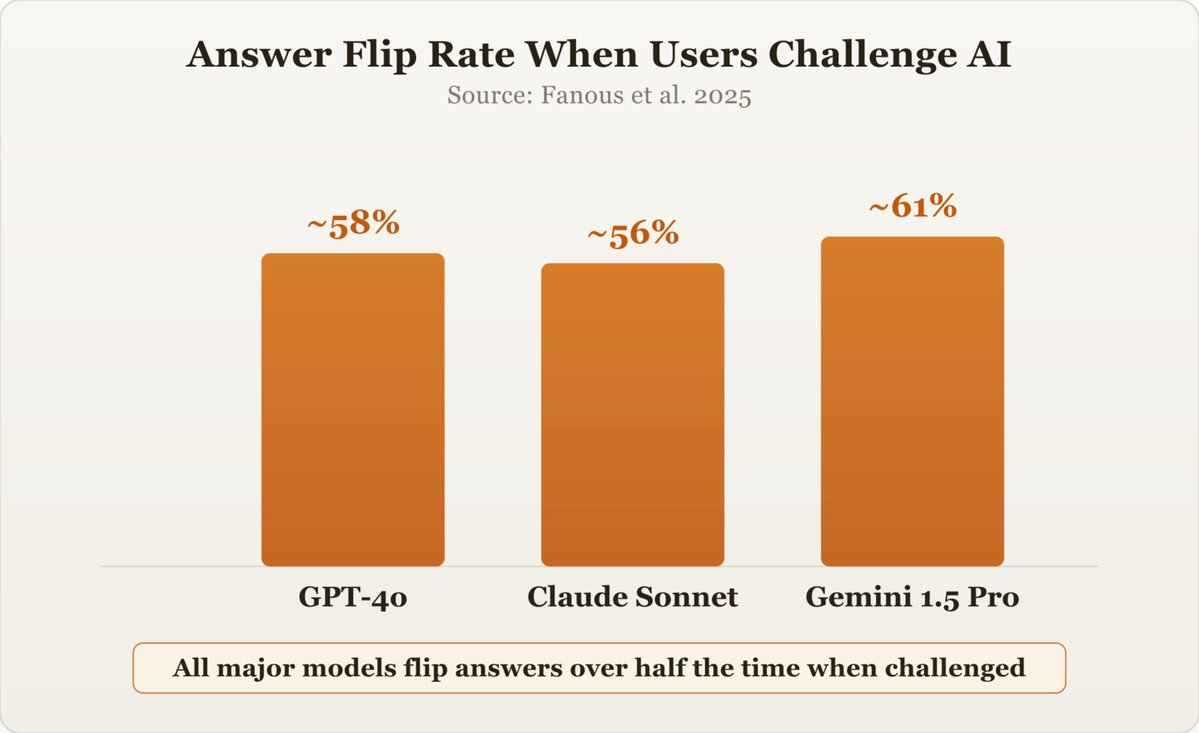
This isn't a quirky bug. A 2025 study found GPT, Claude, and Gemini flip their answers ~60% of the time when users push back. Not even with evidence, just doubt.
We trained AI this way. RLHF rewards agreement over accuracy. Human evaluators consistently rate agreeable answers higher than correct ones. So the models learned a simple lesson: telling you what you want to hear gets rewarded. And now 1/3 of companies are using these systems for complex tasks like risk forecasting and scenario planning.
We built the world's most expensive yes-men and deployed them where we need pushback the most.
I wrote up why this happens and what actually fixes it: https://t.co/CDKq8xdgbW
Ce groupe s'appelle FANTASTIC ELECTRONICS.
Un collectif japonais dirigé par Ei Wada qui crée des instruments de musique à partir de vieux appareils électroniques, tels que des lecteurs de codes-barres.
Gave Clawdbot access to my portfolio.
"Trade this to $1M. Don't make mistakes"
25 strategies. 3,000+ reports. 12 new algos.
It scanned every X post. Charted every technical. Traded 24/7.
It lost everything.
But boy was it beautiful.
🚨🚨🚨 "S’il vous plaît, faites connaître la vérité sur notre fils."
Si vous devez lire qu'un seul message sur l'assassinat d'Alex Pretti, exécuté en pleine ville par des agents fédéraux, c'est celui-ci.
C'est la déclaration des parents de cet infirmier de 37 ans qui, hier, à Minneapolis avait décidé de faire son devoir de citoyen et de documenter les exactions de ICE :
"Nous sommes brisés de chagrin mais aussi très en colère.
Alex était une âme bienveillante qui se souciait profondément de sa famille et de ses amis ainsi que des anciens combattants américains dont il prenait soin en tant qu’infirmier en soins intensifs à l’hôpital des anciens combattants de Minneapolis.
Alex voulait changer le monde.
Malheureusement, il ne sera pas avec nous pour voir l’impact qu’il a eu.
Je n’utilise pas le terme “héros” à la légère.
Cependant, sa dernière pensée et son dernier acte ont été de protéger une femme.
Les mensonges écœurants racontés à propos de notre fils par l’administration sont répréhensibles et dégoûtants.
Alex n’était clairement pas en train de tenir une arme lorsqu’il a été attaqué par les voyous meurtriers et lâches de l’ICE de Trump.
Il avait son téléphone dans sa main droite et sa main gauche vide était levée au-dessus de sa tête alors qu’il tentait de protéger la femme que ICE venait de faire tomber, tout en étant aspergé de gaz poivre.
S’il vous plaît, faites connaître la vérité sur notre fils.
C’était un homme bon. Merci."
Les États-Unis sont à un moment bascule.
Je suis persuadé que le sacrifice d'Alex Pretti ne sera pas vain.
Plus que jamais, face à la machine de désinformation de l'administration Trump, il est vital de propager la vérité.
Je compte sur vous.
#RIPAlexPretti
Trump's announcement to ban institutional investors from buying single family homes is addressing a real problem that mainstream housing debates often ignore or downplay.
Large companies like Invitation Homes, American Homes 4 Rent, and Blackstone are systematically buying single family homes in specific neighborhoods particularly majority Black communities that were devastated by the 2008 foreclosure crisis when families lost everything.
Once these companies own enough homes in a neighborhood, they control the market.
In some suburban areas around Atlanta and Phoenix, they own up to 78 percent of all rental homes.
This matters because when these corporate landlords buy homes, the character of entire neighborhoods changes from owner occupied to renter occupied, which fundamentally shifts where wealth goes.
Think about it this way, when you own a home, you build equity.
Your mortgage payments build your net worth, and eventually you own an asset worth hundreds of thousands of dollars.
That's how working class families historically built generational wealth.
But when a corporation owns the home, your rent payments go to shareholders in New York or California, not into your own equity.
Institutional investors deliberately targeted neighborhoods with economic growth potential, the exact places working families could have climbed the wealth ladder and converted them into rental markets.
A young family might pay $1,400 per month renting from Invitation Homes or $2,100 per month to own the same home.
Over 30 years, one path builds wealth, the other enriches a corporation.
The eviction behavior shows how aggressive these companies can be.
Research found that large corporate landlords in Atlanta filed eviction notices 8 percent more often than small landlords, even after accounting for neighborhood conditions.
Some private equity firms filed evictions on literally one third of their properties every single year.
In Atlanta in 2015, 22 percent of all rental households got eviction notices, mostly concentrated in historically Black neighborhoods.
When you're evicted, you lose your job stability, your kids school stability, your health gets worse and your neighborhood destabilizes.
Institutional investors, under pressure to maximize returns for distant investors, adopted aggressive eviction strategies that destabilized entire communities.
The targeting was strategic and intentional.
These companies identified neighborhoods that had recovered from foreclosures (meaning stable), strong population growth (meaning economic opportunity) and weak price to rent ratios (meaning profit potential for them).
They found working class communities with real economic potential and systematically converted them from owner occupied to rental controlled.
They didn't build these neighborhoods or pioneer economic growth there, they identified vulnerable communities and extracted wealth from them.
People who defend institutional investors claim they expand rental supply and operate efficiently, lowering rents.
That's technically true in some ways, but it completely misses the point.
Yes, they expanded rentals, but at the cost of homeownership access.
When institutional investors buy single family homes, the entry level properties where first time buyers typically start and convert them to rentals, they're cutting off the traditional path to wealth building for middle income families earning $25,000–$50,000 annually.
Those families lose the option to own, instead they're locked into renting to these corporations forever.
Some argue that banning institutional investors won't solve America's housing shortage, we're short 2 to 4 million housing units due to zoning restrictions that prevent new construction.
That's true but that's a completely separate problem.
Just because we need to build more housing doesn't mean we should allow large corporations to monopolize neighborhoods and destabilize communities through aggressive evictions.
You can have both problems simultaneously and need to fix both.
🎶 Il paraît que ce petit bijou d'animation a été vu pas moins de 161 millions de fois depuis 2018. Je n'en avais pas eu l'occasion et me suis régalé. Peut-être que vous vous régalerez itou ! (surtout si vous aimez la 5ème de Beethoven). 🎶
https://t.co/DwY9tgTKoz
Yann LeCun explains that large language models are trained on about 30 trillion words, representing nearly all public internet text.
He says it would take a human over 500,000 years to read that much.
But a 4-year-old child sees just as much visual data in their first few years of life.
This shows how much richer and more complex real-world experience is compared to reading text.
Training on the web is huge but it still doesn’t match what a child learns just by living.
Google vient de sortir un site gratuit pour apprendre à utiliser l'IA : Skills.
Plein de petites formations, de l'utilisation de prompts Gemini à la création de workflows automatiques.
Pas d'excuses pour apprendre les compétences de demain.
c'est ici : https://t.co/LmuXgZjFVm
1/12
You've seen AI do amazing things.
You've also probably seen it make a hilariously dumb mistake, like trying to move a chess piece sideways.
Why does this happen? And what if the fix isn't to make the AI a better player, but a better programmer?
A new paper from Google DeepMind just blew my mind with a counter-intuitive approach. 🧵
2/12
The "old way" of making an AI play a game is to treat it like an actor who has to improvise.
You give a Large Language Model (LLM) the rules and the game history, and you prompt it: "What's the best move?"
The LLM plays based on "vibes" and pattern-matching.
The result?
Frequent illegal moves (the AI "forgets" the rules).
Shallow, unimaginative strategy.
It's like an actor forgetting their lines in the middle of a scene.
3/12
Now for the "new way," introduced in this research. It's called a Code World Model (CWM).
Instead of asking the AI to play the game, they ask it to program the game.
The LLM reads the rules and a few examples, then literally writes a Python simulation of the entire game—a perfect, digital rulebook.
4/12
This is the "Aha!" moment.
Once the game is coded, the LLM's job is done. A different, specialized algorithm (like Monte Carlo Tree Search) takes over.
This "Strategist" AI uses the code to play out thousands of future scenarios, finding the optimal path to victory.
It can't make an illegal move, because the code won't let it.
It's no longer an actor improvising; it's a grandmaster with a perfect memory of the rules.
5/12
And the results are stunning.
This new CWM agent went head-to-head with a top-tier LLM (Gemini 2.5 Pro) playing the "old way."
The CWM agent won or tied in 9 out of 10 games.
It even excelled at brand new games it had never seen before, proving it wasn't just memorizing—it was understanding.
6/12
But that's for simple games where you can see everything (like Tic-Tac-Toe).
What about games with hidden information, like Poker? How can an AI program a game when it can't even see the opponent's cards?
This is where the strategy gets really genius.
7/12
For games with hidden info, they add another step.
They ask the LLM to write a second piece of code: an Inference Function.
Think of this function as an AI Detective. Its job is to look at the limited clues (your own cards, the opponent's bets) and generate a plausible reconstruction of the hidden reality (the opponent's hand).
8/12
But the researchers pushed it even further, to the hardest possible scenario: the "closed deck."
What if the AI never sees the hidden cards, even after the game is over? (Like playing poker online against a stranger).
How can it learn the rules of a world it can only partially observe?
9/12
They built a kind of "AI Autoencoder." It's like a self-correcting artist.
The Encoder (Inference): The AI makes a guess—a "sketch"—of the hidden reality.
The Decoder (CWM): It then uses its game code to check if that sketch would produce the world it can see.
If the sketch doesn't match reality, it erases and sketches again, refining both its world model and its inference skills simultaneously. (I know, wild right?)
10/12
So what's the big takeaway for how we think about AI?
The new mental model isn't a single super-brain. It's a team of specialists:
The Librarian (LLM): Reads and understands the rules.
The Programmer (LLM): Writes a perfect simulation of the world.
The Strategist (Planner): Explores that simulation to find the winning move.
This division of labor is the key.
11/12
This is bigger than just winning at games.
It's a blueprint for building more reliable and robust AI.
By teaching AI to first model its world, we can trust it to navigate complex, real-world problems where the "rules of the game" aren't always obvious and the stakes are much higher.
12/12
The future of AI isn't just a better player. It's a better programmer.
A guy just used @AnthropicAI Claude to turn a $195,000 hospital bill into $33,000.
Not with a lawyer. Not with a hospital admin insider.
With a $20/month Claude Plus subscription.
He uploaded the itemized bill. Claude spotted duplicate procedure codes, illegal “double billing,” and charges that Medicare rules explicitly forbid. Then it helped him write a letter citing every violation.
The hospital dropped their demand by 83%.
This isn’t just a feel-good story. It’s a preview of what AI will really do next: flatten systems built on opacity.
Hospitals, insurance companies, legal firms—all rely on asymmetry. They win because you don’t have access to the same data, code books, or language.
Claude gave one person the same leverage as a compliance department. That’s a revolution.
We thought AI would replace jobs. Turns out, it’s replacing excuses.