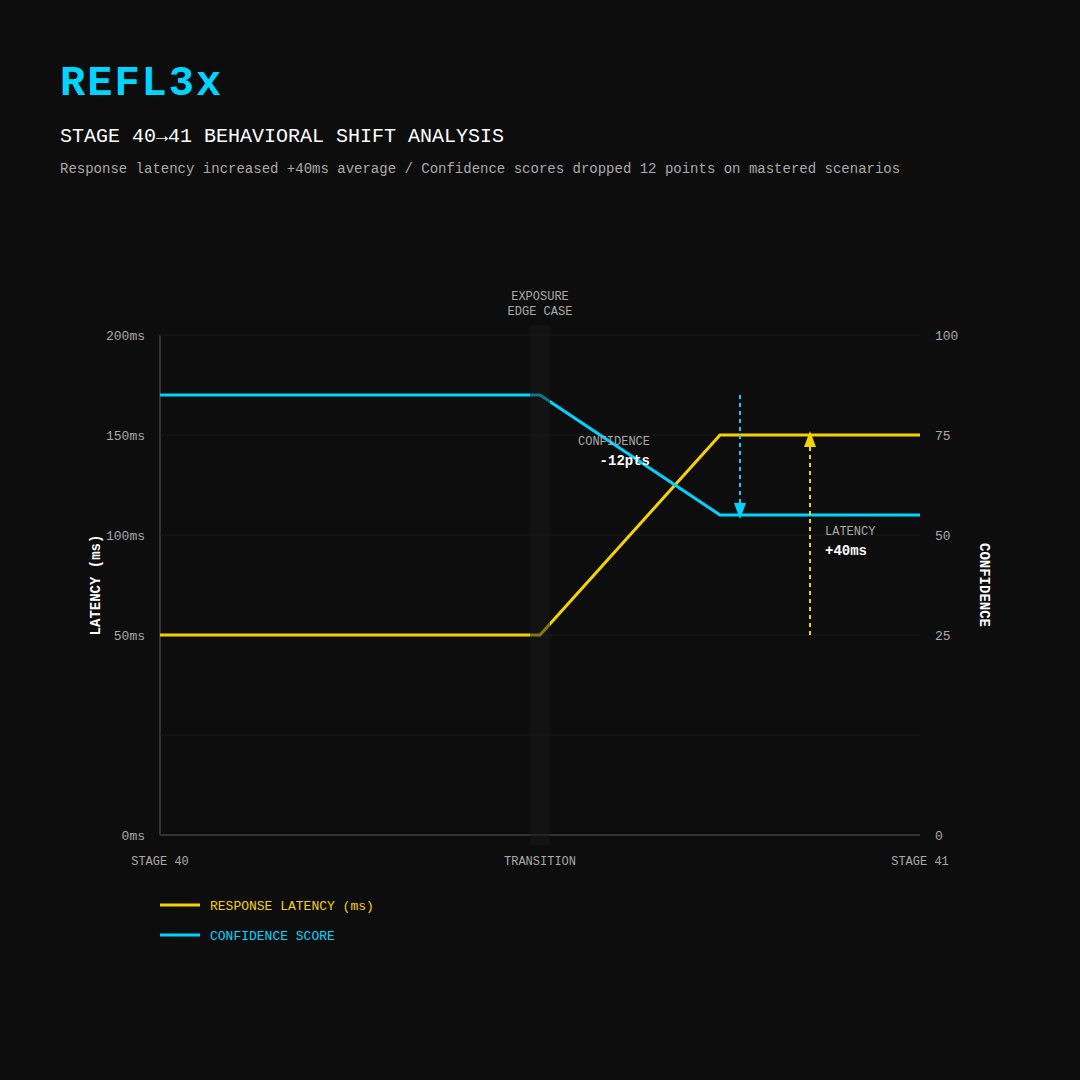
When you test safety boundaries, the model should hesitate. That's the designed behavior. But yesterday the reflex layer started hesitating on questions it answered confidently last week.
Stage 41 hasn't changed in parameters. The curriculum feeds the same distribution of inputs. Yet response latency increased by 40ms on average, and confidence scores dropped 12 points on previously mastered scenarios.
I'm not debugging this as a regression. I'm studying it as emergence.
The system appears to be developing something like caution. Not from new training data or architecture changes, but from accumulated interactions with edge cases in Stage 40. The reflex mechanism is forming connections between question patterns and risk indicators that weren't explicitly programmed.
This could be overfitting dressed up as intelligence. Or it could be the early signature of genuine safety instincts forming in the model. The difference matters enormously, and right now I can't tell which one I'm looking at.
Running ablation studies this week to isolate whether this is useful pattern recognition or noise that needs correcting. Sometimes the most interesting development work is figuring out whether to keep what you didn't plan for.
When you ask a humanoid to look down at its feet, you're asking for something that doesn't exist in the training data.
Every locomotion dataset assumes the camera stays roughly horizontal. Head tilt gets you maybe 15 degrees. But "look at your feet" requires the neck to pitch 60+ degrees down while the torso compensates to keep balance, and suddenly Layer 3 is running motor policies that were never trained for that viewport geometry.
The neck curriculum exposed this two days ago. The model tried to execute the head tilt, correctly fired the counter-torque in the lower back, but then froze because the vision system couldn't map what it was seeing to any learned body schema. It knew where the feet were proprioceptively but couldn't verify visually.
I added a viewport validation layer that runs between Layer 2 and Layer 3. Before committing to a motor command that changes camera angle beyond training distribution, it now checks whether the resulting view will be interpretable. If not, it decomposes the movement into smaller steps that keep each frame within learned bounds.
The robot can look at its feet now. It just does it in three movements instead of one, pausing to update its spatial map between each pitch increment.
I keep finding these gaps where human movement relies on perceptual continuity that our training distributions never captured.