The secret to being popular isn’t what you think.
A massive study on thousands of high school kids found the most liked students had one thing in common: they had the longest list of people they liked.
Not the funniest, hottest, smartest, or most athletic, just the ones who went around genuinely finding reasons to like others.
Vanessa Van Edwards says that’s the real hack: aggressively like people.
And it matters way beyond high school, it builds real friendships, stronger romantic connections, and better relationships at work and in life.
Simple shift. Huge difference.
What’s your take, does genuinely liking people more actually make you more likable?
Jimmy Carr nailed something a lot of us feel but can’t explain.
We’re living better than 99.9% of humans who ever walked the earth, hot showers, modern medicine, endless entertainment, kids that actually survive infancy, yet so many of us feel miserable.
He calls it “life dysmorphia.” We get used to how good we have it (the hedonic treadmill), then compare ourselves to everyone else and tank our own happiness.
As he puts it: happiness = quality of life minus envy.
Marcus Aurelius put it perfectly: “Very little is needed to make a happy life; it is all within yourself in your way of thinking.”
When was the last time you caught yourself feeling unhappy despite objectively having it pretty damn good?
🧬 PERSEUS ASCO 2026 Update: Celebrate the Success. Keep Pushing Forward.
Fellow:
Professor, PERSEUS achieved 75% MRD negativity. Should I switch my career from myeloma specialist to leukemia specialist? 😅
Professor:
Not so fast.
75% MRD negativity ≠ 75% sustained MRD negativity.
The updated PERSEUS analysis presented at ASCO 2026 reminded us that the more important endpoint may be durability.
Among patients receiving Dara-RVd + ASCT + Dara/Len maintenance:
🧬 75% achieved MRD negativity
🧬 56% achieved sustained MRD negativity ≥2 years
🧬 Patients with sustained MRD negativity ≥2 years had ~95% 4-year PFS
These are among the best frontline myeloma results ever reported.
But another way to look at the data:
Nearly half of patients did not achieve sustained MRD negativity ≥2 years, even in a transplant-eligible clinical trial population.
In the real world, the proportion achieving durable disease control is likely lower.
I am not being negative.
PERSEUS is a landmark success and has changed the standard of care.
At the same time, it reminds us that there is still substantial room for improvement.
The goal is not simply deeper responses.
The goal is more patients achieving durable disease control, with less toxicity.
Celebrate the success.
Keep pushing the field forward.
🦴 In Biology We Trust.
#Myeloma #ASCO2026 #PERSEUS #MRD
Interesting discussion, but I am not sure we can declare cilta-cel “dead” based on the current evidence.
At EHA 2026, we saw encouraging subgroup analyses from MajesTEC-3 suggesting Dara/Tec may perform well even in functional high-risk and ultra-high-risk patients. That is good news for patients and expands our options.
However, we still do not have a randomized comparison between Dara/Tec and cilta-cel. Cross-trial comparisons remain challenging given differences in patient populations, follow-up, and study design.
CAR-T continues to compare favorably in terms of depth of response (CR, MRD negativity), durability, and mature long-term follow-up. Sequencing also remains a critical unanswered question.
“Competitor catching up” is not the same as “incumbent is dead.”
The real debate is no longer CAR-T or bispecifics. It is patient selection, sequencing, T-cell fitness, durability, toxicity, access, and ultimately long-term outcomes.
In my view, CAR-T has certainly not lost its crown. The kingdom has simply become more crowded. 👑🧬
A British biologist looked at 200,000 years of human history and found that the entire reason humans broke out of poverty was not intelligence, not language, not even agriculture, but one mechanism so simple a 6-year-old could explain it.
His name is Matt Ridley.
He is a zoologist by training, an evolutionary biologist by career, and in 2010 he wrote a book called The Rational Optimist that quietly argued the most important fact about human progress had been hiding in plain sight for the entire history of economics.
Naval Ravikant has been telling people to read everything Ridley has ever written for the last 15 years. The reason is the argument inside this one book.
For 200,000 years, anatomically modern humans walked around with the same brain you have right now. Same skull size. Same neural architecture. Same raw capacity for language, planning, and abstract thought.
For roughly 190,000 of those years, almost nothing happened. Generation after generation lived and died inside the same Stone Age toolkit their great-great-grandparents had used. Then somewhere around 50,000 years ago, the line on the chart of human progress started to tick upward. Then it bent. Then it exploded.
The question Ridley spent years on was the only question that mattered. What changed.
It was not the brain. The brain had been the same for 190,000 years. It was not language, which had existed long before the takeoff. It was not even agriculture, which arrived only 10,000 years ago and was actually preceded by the upward bend, not the cause of it.
What changed was that humans started trading with strangers.
This sounds too small to be the answer. Ridley argues that it is the answer to almost everything. The moment one human exchanged a useful object with another human from a different group, something happened that no other species on earth had ever done.
Two ideas that had developed in isolation came into contact. The flint knapper learned what the spear maker had figured out. The fisherman from the coast learned what the hunter from the forest had figured out. The two pieces of knowledge fused into something neither side could have produced alone.
Ridley calls this ideas having sex. The phrase sounds frivolous and it is meant to. The point is that ideas, like genes, get better when they combine with other ideas from different lineages.
An idea sitting inside one head, no matter how brilliant the head, eventually hits a ceiling. The same idea exposed to ten thousand other ideas does something genes do under sexual reproduction. It mixes. It recombines. It produces offspring nobody planned.
The cleanest proof of this argument is the most uncomfortable case study in the book. Tasmania.
Around 10,000 years ago, rising sea levels cut Tasmania off from mainland Australia. A population of roughly 4,000 humans was now isolated on an island, with no possibility of contact with the rest of humanity. They had the same brains. The same language. The same starting toolkit as their cousins 150 kilometers north. The natural experiment was now running.
What happened next is something no economist or geneticist had ever predicted.
The mainland Australians kept inventing. Boomerangs. Spear-throwers. Fishing nets. Bone needles for sewing fitted clothes. Watercraft with paddles. Their technology compounded slowly across the centuries.
The Tasmanians went the other way. They did not just fail to invent the new tools their cousins were developing. They started losing the tools they already had. Fishing was abandoned within a few thousand years. Bone tools disappeared. Fitted clothing disappeared. They forgot how to make fire from scratch and started carrying lit firebrands from camp to camp instead, relighting their fires from a neighbor's whenever their own went out.
By the time European explorers arrived in the 17th century, the Tasmanians had the simplest toolkit of any human society ever recorded. Their material culture had gone backward for 8,000 years.
The archaeologist Rhys Jones called it a slow strangulation of the mind.
Joseph Henrich at Harvard later proved with formal mathematical models that there was nothing wrong with Tasmanian brains. There was something wrong with their network. A toolkit requires a critical mass of people exchanging skills to maintain itself.
The act of teaching a skill is imperfect. Every generation loses a small percentage of what the last generation knew. If your population is large enough and trading widely enough, those losses get caught and corrected by someone else who still remembers.
If your population shrinks below a certain threshold and stops mixing with outsiders, the small losses compound until entire technologies disappear.
This is the part that should haunt anyone reading this in 2026.
Intelligence is not a property of the individual brain. Intelligence is a property of the network the brain is connected to. A genius in isolation will produce less than a mediocre thinker inside a dense exchange of other mediocre thinkers.
The thing your ancestors needed in order to break out of 190,000 years of stagnation was not better brains. It was better connections between brains they already had.
The implication for any individual is direct and uncomfortable. If you are smart and isolated, you will be outproduced by people half as smart who are connected.
The most successful people in any field are almost never the smartest people in it. They are the ones positioned at the intersection of the most idea flows. They are reading more authors than their competitors. They are talking to more people from more disciplines. They are in the rooms where ideas from different lineages bump into each other.
Ridley ends the book on the line that sounds optimistic but is actually a warning its this "The future will be invented by people who connect ideas, not by people who guard them."
@HadidiSamer@VJHemOnc I think, with all limitations acknowledged, CART first, if possible. A key feature is that most CART upfront in this series is idecel, so difference is quite likely more pronounced with ciltacel. Some will point out this is not Majestec-3
https://t.co/z95A5uXqpk
Presented at #ASCO26:
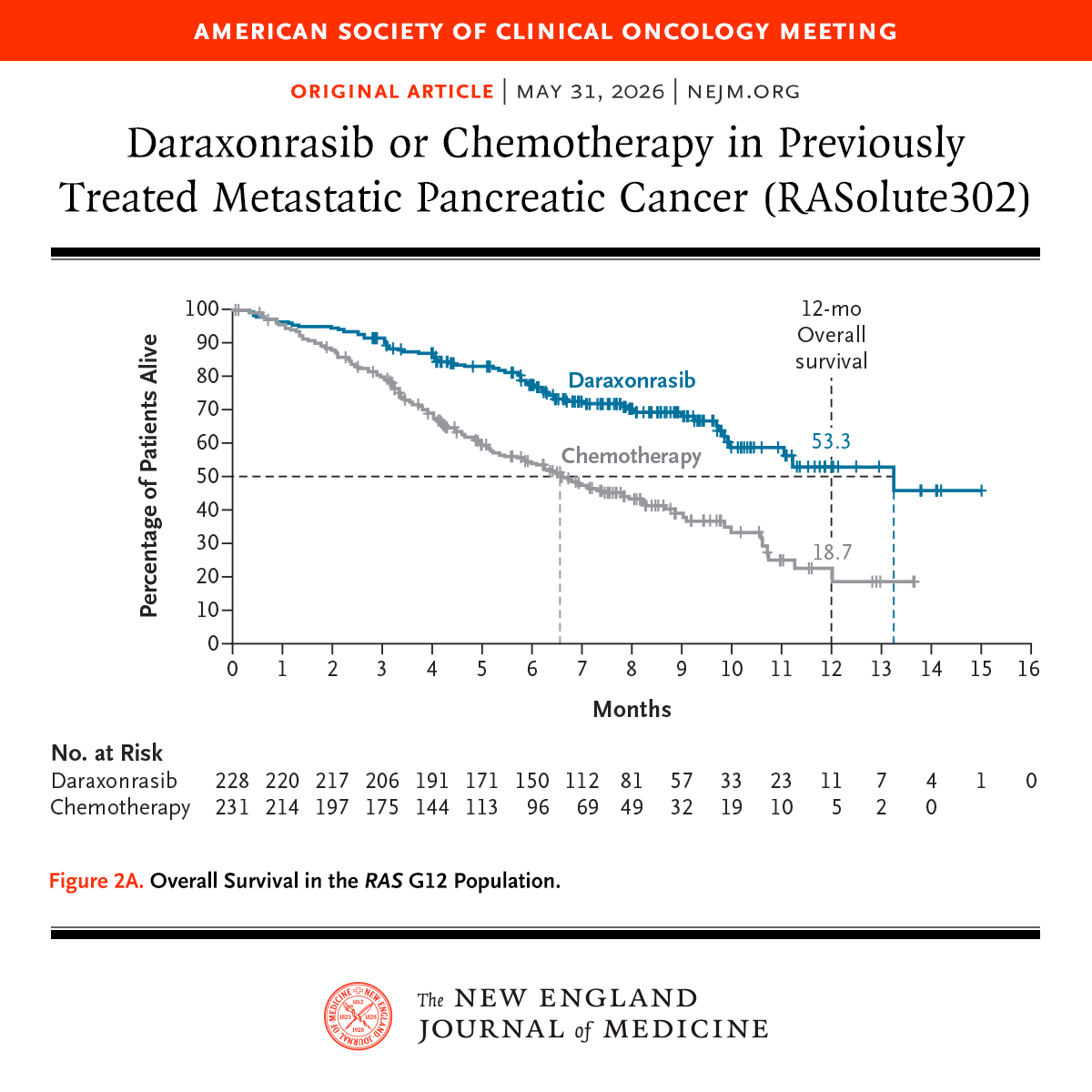
Among patients with previously treated metastatic pancreatic ductal adenocarcinoma, the RAS(ON) inhibitor daraxonrasib led to significantly longer overall survival and progression-free survival than chemotherapy. Full phase 3 RASolute 302 trial results: https://t.co/xwLWBZYRzq
@ASCO
Claude analysis of Top 30 Pharma clinical pipeline novelty score (%first-in-class, # breakthrough, novel biology) vs stock performance over 5 and 10 year periods. Interesting that past pipeline novelty correlates with forward performance, which correlates with current novelty.
5YR
1) MajesTEC-9 (Mina, 7507) - Teclistamab vs. (VPd or Kd). Full summary below. Tec clearly beats out some inferior and less-than-standard comparators.
I want to make 4 points about this study
1 - VPd and Kd are not strong comparators, but outside of CAR T/BsAb, there are not many FDA-approved regimens that would fit the bill (EloPd?).
2 - The high rates of len and anti-CD38 refractoriness here reflect a truly applicable population to the one we are encountering in our clinics. This is good!
3 - Most impressive: the 18-month PFS rate compares favorably even with the dara-exposed population in CARTITUDE-4 (though we should be careful about cross trial comparisons).
4 - We are still left with some questions about tec-dara vs. tec in anti-CD38-exposed (or even refractory) patients.
Either way, Tec appears firmly entrenched in the second-line and beyond!
https://t.co/6sgfwxnLY4
Important to track. Ive seen some. In the original AMG 701 and 420 BCMA bispecifics some was seen. Also there was that initial issue of combining elra with IMIDs. Can see cranial nerve palsies with cilta-cel but have not seen PN. Until we know otherwise could be a class effect though
In light of ASCO abstract release, reposting my earlier post where I analyzed 57k ASCO abstracts from 2016-2025 & 6 top learnings on the decade of oncology, on where the bar has moved vs. not, meta-trend on IO & ADC, path to 1L, etc. Working on a ASCO 2026 article and on the way!
A trolley is about to hit 5 people laying on the track
You can redirect the car, but the other track has not yet reached regulatory approval or completed its 1 year environmental testing period, so operating a train car on it is a violation of transit regulations
What do you do?
¿Que Piketty se equivocó y @JMilei tuvo razón?
Hombre, pero si a nadie debería sorprenderle eso. Era lo más lógico y predecible.
En estos temas no hay sorpresas.
Nada más hay sorprendidos.