Noeri is my seventh company, @noeri_ai. Here is why I started it with @YejinChoinka
I love building tools that people use every day, like XGBoost. Lately, I keep seeing the same moment. Last week, it was my young daughter. She described what she wanted to an AI coding agent and watched it come to life. She lit up.
It's joy, and it's wonder. I call it the joy of empowerment.
But that joy stops at using AI. A handful of labs create it. Most people rent it.
We started Noeri so the craft of creating AI belongs in every hand: self-improving AI that you control. It learns continually on the job, on your problem. You create it. You own it.
Many minds, not one.
Imagine the joy of empowerment with your own self-improving AI.
Through my wonderful time at NVIDIA and Stanford, one question has kept me up at night:
Should the future of AI be monolithic or plural?
To answer this question, we’ve raised $110M to get started, backed by @MenloVentures, @MadronaVentures, @NVIDIA, @NEA, @KindredVentures,@Wing_VC, @aixventureshq, @Principal_VC, @Cisco, @Snowflake, among others.
Today, Carlos (@guestrin) and I are stoked to launch Noeri, a neolab to push the frontier of plural intelligence.
Noeri means “the plural of intelligence” or many intelligences.
The future of AI we root for is plural: a healthy ecosystem of many intelligences, in all sizes, strengths, and quirks.
Discovery, in particular, has always been plural: many curious minds, each devoted to their own question, often on roads less traveled.
Our path there is self-improving AI that:
-> learns continually on the job, closing the gap between what AI can do off the shelf and what the dynamic world demands
-> learns to use other AIs as tools and make new tools to overcome its own limitations
-> picks the right-sized model for your problem, at a fraction of the frontier cost
Then the power of intelligence, from the craftsmanship of making AI to ownership, can be in the hands of all.
@noeri_ai mission reflects who we are as the founding team. My career has been anything but linear, literally continual learning on the job. Carlos has devoted his career to building tools that empower people through AI.
We are all a bit contrarian, a bit adventurous, and above all, big believers in pluralism.
Join us to build this future together: https://t.co/oAAoe0lzEH
Our bodies are colonized by trillions of viruses that we live with in homeostasis. The most diverse and abundant of these viral families are anelloviruses. A new paper from us at @MSKCancerCenter explores what happens after we *all* have been infected
https://t.co/cNOsPCbazd 1/n
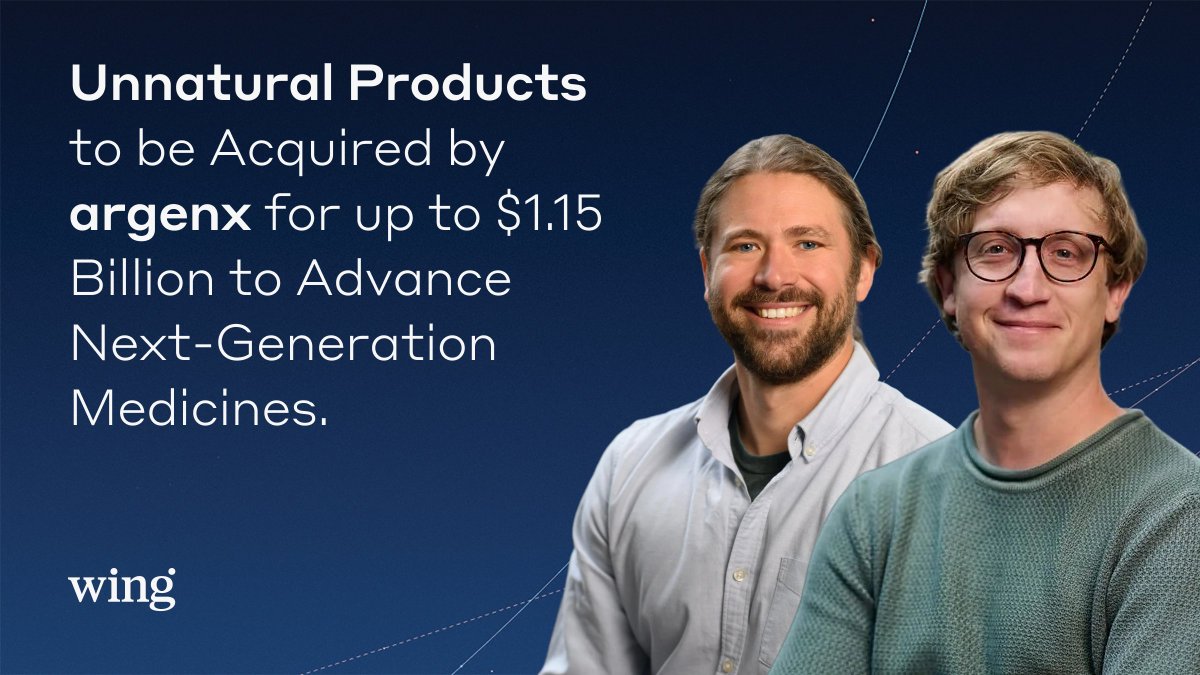
Congratulations to our portfolio company @unnatproducts on being acquired by @argenxglobal in a deal worth up to $1.15B!
Cameron Pye, Joshua Schwochert, and the team started in a Santa Cruz garage with a bold bet: oral macrocyclic peptides for targets once considered undruggable.
Proud to have backed this team from the early days!
https://t.co/IfEL3qdz0J?
I'm excited about this new class of generative models that allow us to understand how DNA sequence mediates regulation of transcription factor and nucleosome assemblies at single molecule resolution. 1/
Last summer, I joined @intology, leading the effort to connect autonomous AI research to scientific discovery.
Today, we’re sharing work on autonomously adapting frontier scientific models to proprietary datasets and our broader vision for what's next.
🧵(1/6)
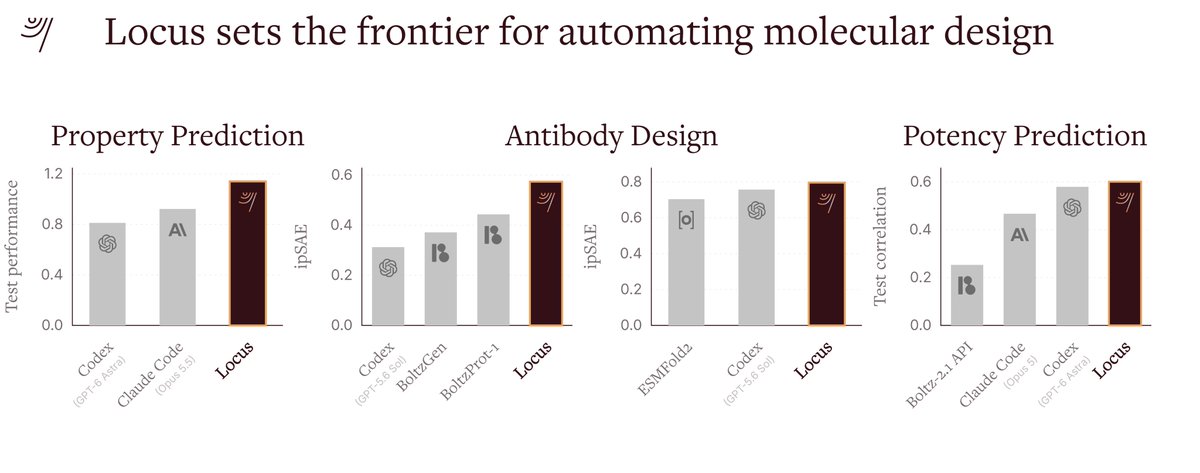
Locus sets the frontier for automating molecular design
Our automated research system Locus develops scientific AI models that outperform SOTA expert solutions
Unlocking the potential of scientific AI requires leveraging proprietary data. Locus achieves this autonomously 🧵👇
--
We test Locus across a number of tasks related to molecular scoring and design: training molecular property prediction models for a proprietary task, fine-tuning Boltz-2 to predict small-molecule potency, and building antibody design workflows around BoltzGen, Boltz-2, ESMC, and ESMFold2.
Each of these settings are real-world AI for science use cases, where tasks are often out-of-distribution for existing foundation models and limited in data, while featuring expensive and noisy evaluators. Compared to state-of-the-art baselines and LLM agents set to optimize these tasks, Locus achieves higher performance. Additionally, Locus generalizes better despite limited data, finds more sample efficient solutions, and explores a higher diversity of solutions.
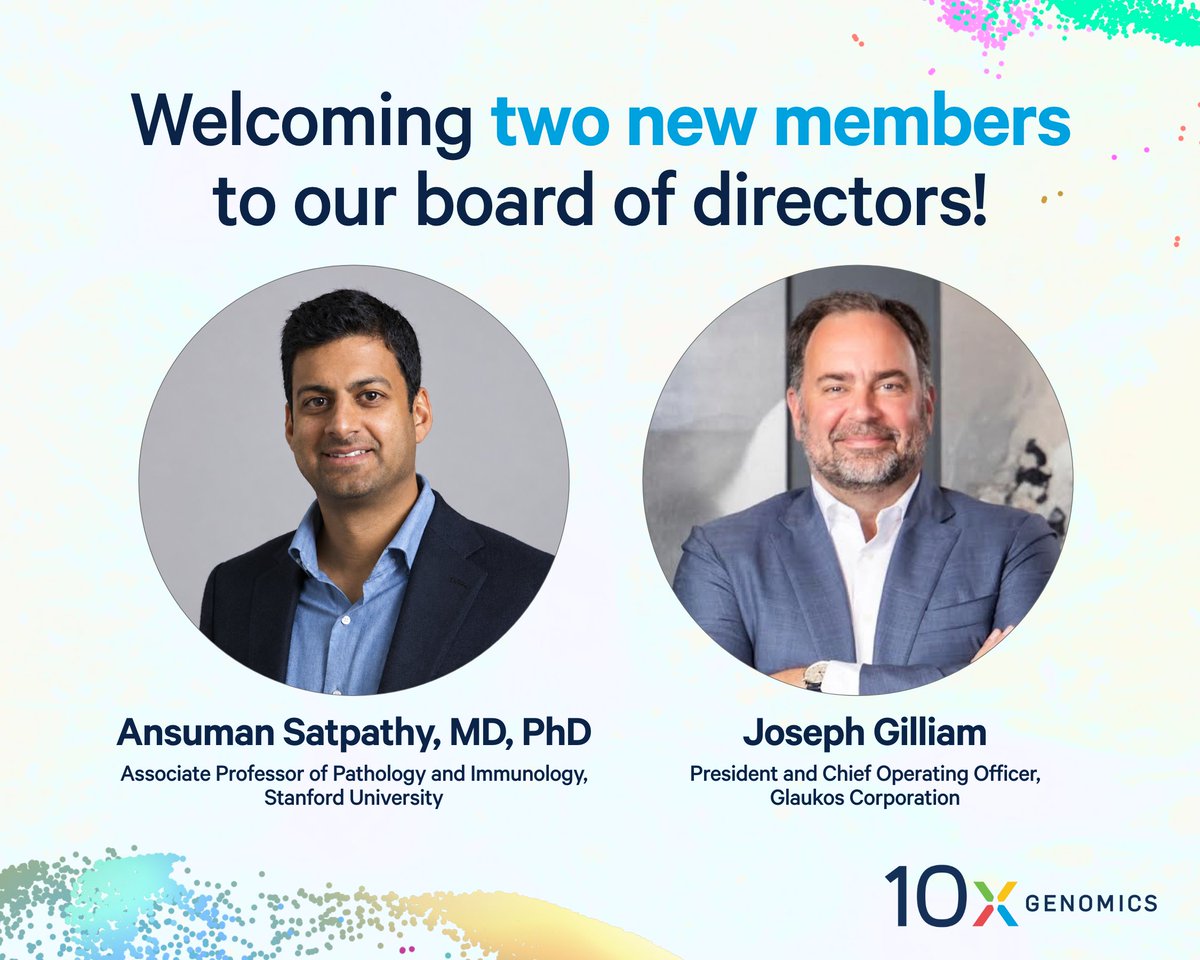
I am honored to join the Board of Directors of 10x Genomics. For more than a decade, my lab has built on 10x technologies to study the immune system and cancer one cell at a time, and I’ve seen firsthand how they’ve changed what’s possible in biology and medicine. Single-cell and spatial tools have transformed science, and now generate the rich, high-resolution data that AI needs to learn the fundamental rules of biology. I look forward to working with Serge, Ben, Mike and the @10xGenomics team to advance AI-driven research across biology and biopharma, driving new discoveries and, ultimately, better diagnostics and therapies for patients.
We are pleased to announce the appointments of Ansuman Satpathy, MD, PhD, and Joseph Gilliam to our board of directors. Their collective expertise and leadership will be instrumental as we continue to empower scientific discovery. Learn more: https://t.co/eJJVgt2cFg
Another thing: AlphaFold is like a tiny, tiny, slice of all of biology. It's a great technical accomplishment, but it applies to static, well-formed structures (not intrinsically disordered proteins - roughly 30% of the entire proteome), and still cannot handle dynamic multimers well. It also depended on having enough data: 200,000 structures in the PDB and counting.
Saying that AlphaFold works, therefore we could "solve" biology with enough compute, is like saying that because we can predict the shape of every component in a car, we can predict everything the car will do on the road. And saying that compute or reasoning can somehow magically compensate for data is a religious belief.
@ClassiqTech has been acquired by @intel in a major step forward for the quantum ecosystem. Huge congrats to founders @MinerbiNir, @yehuda_naveh and @amir_naveh. And also to my friend @LipBuTan1 who is staking a leadership claim in the quantum world. @Wing_VC first invested in Classiq in the Series A in 2020 and I've served on the Board ever since, a privilege I'm deeply grateful for
Congrats to Nir, Yehuda, Amir and the @ClassiqTech team on being acquired by Intel!
We’ve partnered with them since their 2020 Series A, and we couldn’t be prouder of the team. They’re among the finest founders we’ve ever had the privilege to back.
https://t.co/NJCaQHoL55
@AlexKolicich has been a great partner on so many ambitious companies. Great to see this, which captures his thoughtful, rigorous support for founders building hard things.
The Quiet Force. My profile of @AlexKolicich is out.
Raised by a single mom in Hamilton. Google engineer. Peter Thiel’s math guy. Founding partner of 8VC.
“8VC is 8VC because of Alex.” I was told.
I spent months reporting his story in SF, Palo Alto and Orange County, talking with founders and the people who knew him at Clarium, Mithril and 8VC.
Highlights
- Peter Thiel playing blindfolded chess
- Turning down Geoffrey Hinton’s lab twice
- Dreaming about oil
- Back story on 8VC's investments in Quince, Cognition and Anduril
Link to read below.
interpretability might be the most important scientific problem in the world right now, as I don't think we can solve alignment if we don't know what we're building. I think I have good news about it. I co-authored early work in mechanistic interpretability at OpenAI and came away pessimistic, because neural networks appeared to fold into arbitrary tangled knots. years later, I started openai's first large-scale automated interpretability project, finding about 2% of neurons legible with the primitive tools we had
with modern agentic tools and a much closer look, the picture looks totally different. the vast majority in models up to trillions of parameters are legible, and their circuits beautiful. many famous examples of tangled neurons turned out to be misunderstood. The roadblocks I expected mostly aren't there. I now think ambitious interpretability will be solved by the time we need it most, and possibly quite soon, as automated scientists keep improving. it may be a bitter lesson for interpretability: the simple thing, at absurd scale, works
https://t.co/zHij5zwKGT
Congrats to Link Cell Therapies on a big milestone! 🎉
First patients have been dosed with LNK001 at MD Anderson, the first clinical test of their logic-gated CAR-T platform.
Link also expanded its Series A to $90M and announced its leadership team:
✅ Jie D'Elia as CEO
✅ Dr. Friedrich Graf Finckenstein as CMO
✅ Co-founder Brian Slingerland as Executive Chair
Proud to have backed this team from day one and to keep supporting them as they take CAR-T into solid tumors.
https://t.co/iRdzqE3IEh
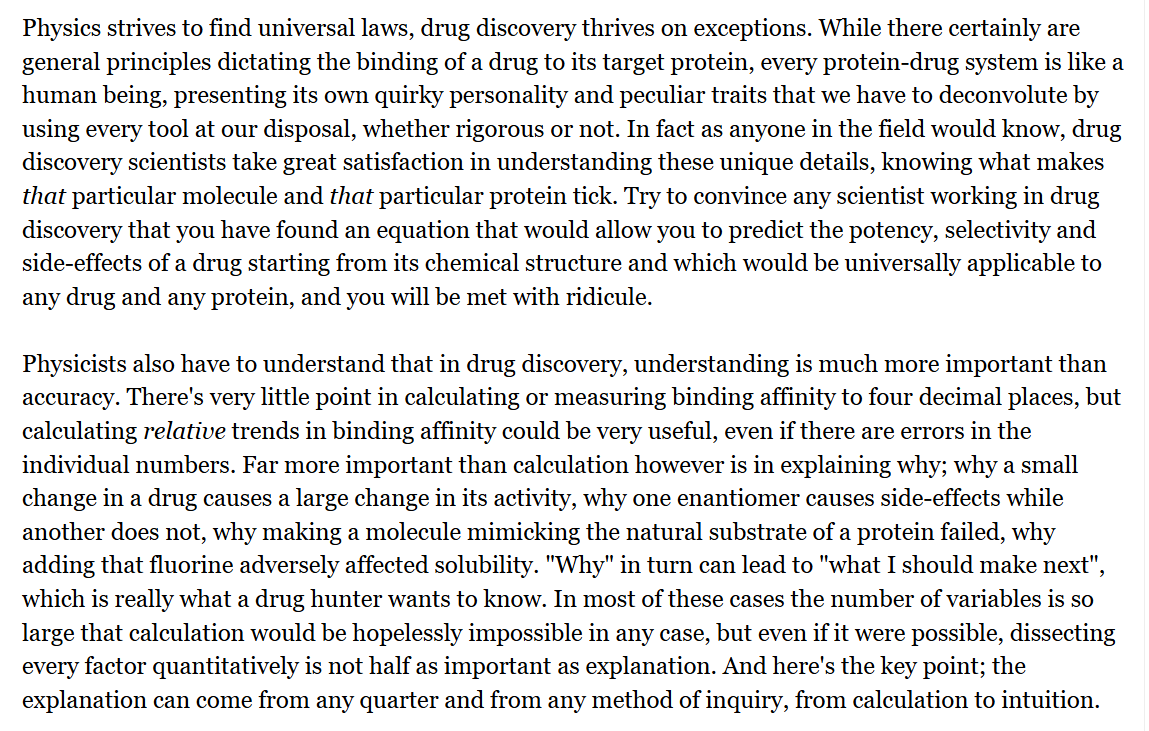
I wish drug discovery were like pure math where, even if the problems can be fiendishly hard, they are bounded and closed with a well-defined solution and can be solved with pen and paper or with a computer. But unfortunately drug discovery (and biology more generally) is not like math. It's not even like physics, as I wrote about many years ago. A good reminder in the age of AI.
https://t.co/eXmFJX7vKS
Cell–cell interactions are key to all biological processes, but there hasn't been a good way to perform inter-cellular screens for genetic regulators of these interactions in vivo.
We developed match-seq (multiplexed associative tagging of cell interaction histories) - using engineered virus-like particles to transfer barcoded mRNAs from 'sender' to neighboring 'receiver' cells, so you can reconstruct cellular interactions with sequencing alone, no imaging required.
We coupled match-seq with CRISPR + scRNA-seq in cancer, revealing cancer-immune interaction neighborhoods at scale, and new cancer genes that can be targeted for tumor rejection via immune cell interactions.
Led by the brilliant @peterdu_ with Bassik lab!
https://t.co/qI2XQxId94
CRISPR screens are great at telling you what a gene is doing inside your cells. But what if you're interested in what's happening to its neighbors?
Today, I'm excited to share match-seq, a new method that deciphers cell-cell interactions using barcoded RNA transfer.
1/9