He|Him PhD Candidate at the Australian National University in @HicksChem group | Main group chemistry | Lover of crystals, good food and succulents. 🏳️🌈👨🔬
Yay, my first first author paper has been accepted in @ChemEurJ!
Come check it out.
Thanks to all the authors for their help, especially @hicksChem for his support.
Now back to the lab.
First paper of the year for us, just accepted in @ChemEurJ. Using our recently reported anionic group 2 hydrides, we can stabilise hypercoordinate silicon anions. @ANUChemistry@ANSTO@RH_Chem@clairemcmullin
https://t.co/bxd6xaF8xN
Excited to share our last work 🥳🥳🥳. A photoexcited triplet Ge that lasts hours and, while being there, breaks a few molecules, including benzene. We hope you like it. Our feeling: there's plenty of space for discovery on low-valent MG photochemistry https://t.co/2rOkT22nn5
Diastereoselective alkene C-C coupling at Al(I)
Work from Deb Sarkar, in collaboration with Petra Vasko in Helsinki, on reductive C-C bond formation from ethene and propene mediated by an anionic Al(I) reagent is just out in JACS.
https://t.co/T39vCWCP6L
@OxfordChemistry
Fresh out of the oven, in @angew_chem. That's what happens when you replace P with Sb.
Structurally Constrained Stibenium: Metallomimetic C−Si Bond Activation
https://t.co/fXhbM3R9qQ
Congrats to our very talented @DoniaToami99 👏👏!
Our Review on masked silylenes is now online in #EJIC and available #OpenAccess🎉
This is Kei’s first corresponding-author paper at SU and Kanata’s first publication 👏
Happy to share our perspective on controlled access to reactive Si(II) species!
https://t.co/26s6cOT5LX
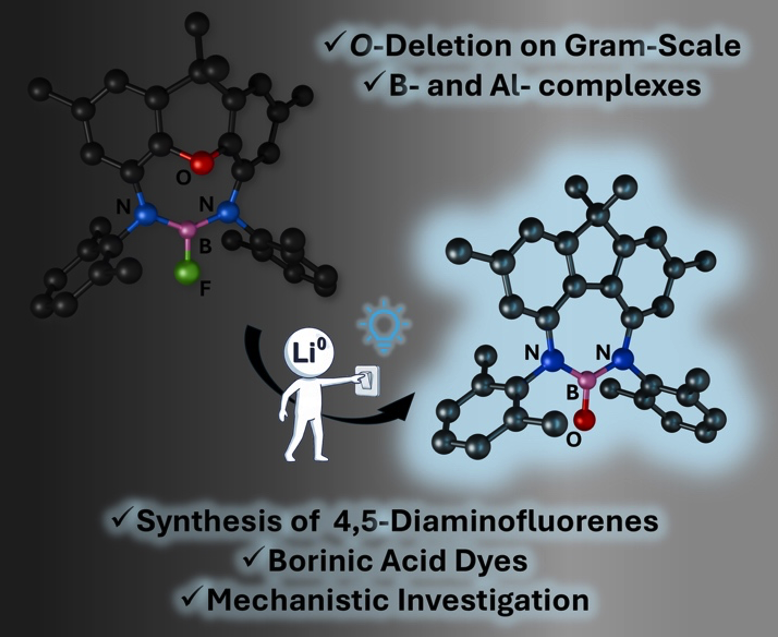
4,5-Diaminofluorenes are tough targets. In our new @ChemicalScience paper, Emily & Fabian use group 13 radicals for skeletal editing - deleting oxygen from xanthenes to access them on gram scale.
https://t.co/FLPl97cbM2
Aluminum: lightest p-block metal with very low electronegativity. Converting Al(III) to Al(I) in stoichiometric reactions is rare. But now, we've made Al redox catalysis a reality! Check it out @nature
https://t.co/T5SP88l7dg
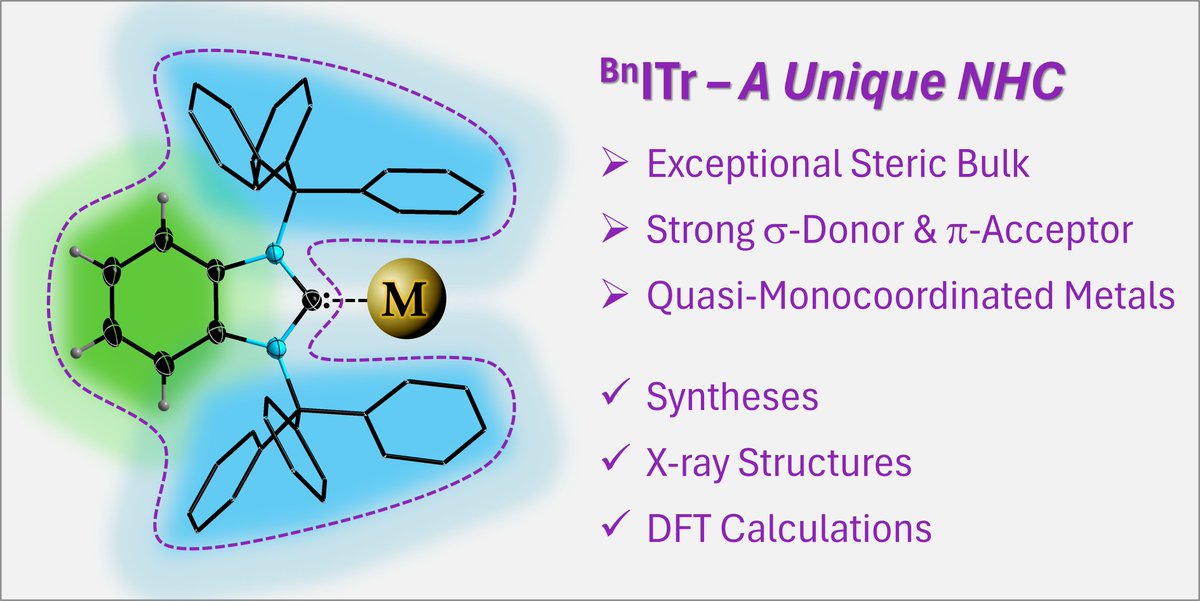
Check out Ludwig's (@LudwigZapf ) new paper exploring (quasi)-monocoordination in metal complexes with an exceptionally bulky carbene ligand — now published in Chemical Science!
🔗https://t.co/WWwnbsVZtM
@ChemicalScience@RoySocChem
FINALLY a complex of type LMg-CaL! This formally Mg(0)-Ca(II) complex shows a very long Mg-Ca bond with Mg(-)/Ca(+) polarization and is quite reactive! Our first 2026 paper is "In dear memory of Herbert Roesky" https://t.co/epFVfTQwRd
Jeremy and co’s paper on the 1st group 2 metal-alkane complexes has been accepted @J_A_C_S. Huge amount of work went into this one. Alkane C-H activation at the redox active Mg centre is the ultimate goal.⚗️#ozchem@AFOSR@Monash_Science @MonashChemistry https://t.co/Wo5TvgkB8p
Proposed closures of two of Australian Synchrotron’s beamlines may just be the beginning of cuts to the facility’s governing body.
https://t.co/oRkb9lhl7o
Reversible Enzymatic Switching of the Oxidation State of a EuIII/II Complex Controls Relaxivity | Journal of the American Chemical Society @UniofOxford https://t.co/jMy73Dpw83
TIRE CHANGE: First Mg(I) complex with a Cp* ligand enables facile ligand exchange. Reaction with RONa gives (BDI)Mg-MgOR and Cp*Na. This paves the way for syntheses of many new asymmetric Mg(I) complexes. @angew_chem https://t.co/BXyZlqfcJt
Tune in today to hear Dr. Fabian Kallmeier explain how to enhance the nucleophilicity of aluminum anions, which he recently published in @ChemicalScience, in a brand new Research Spotlight episode!
Link: https://t.co/qpfGjNy4ng
Key paper:
https://t.co/65f7NW8axk
In 2017, Mike Hill and team published the remarkable nucleophilic alkylation of benzene with neutral calcium alkyl complexes. Here we report their anionic equivalents, and show a switch in reactivity to superbasic - deprotonating benzene, twice!
https://t.co/gl8uqpIMzW
REDOX-REACTIVITY of Yb and Sm inverse sandwich benzene complexes. An interesting observation is that, depending on substrate, benzene(4-) can reduce Sm(III) to Sm(II). https://t.co/Hzy6EK1MMQ
BREAKING NEWS
The Royal Swedish Academy of Sciences has decided to award the 2025 #NobelPrize in Chemistry to Susumu Kitagawa, Richard Robson and Omar M. Yaghi “for the development of metal–organic frameworks.”