Our colleague Andrei Lungu wrote for @NikkeiAsia about the risks that the lack of preparation for younger leadership can pose to the future of #China.
https://t.co/0cknmF7201
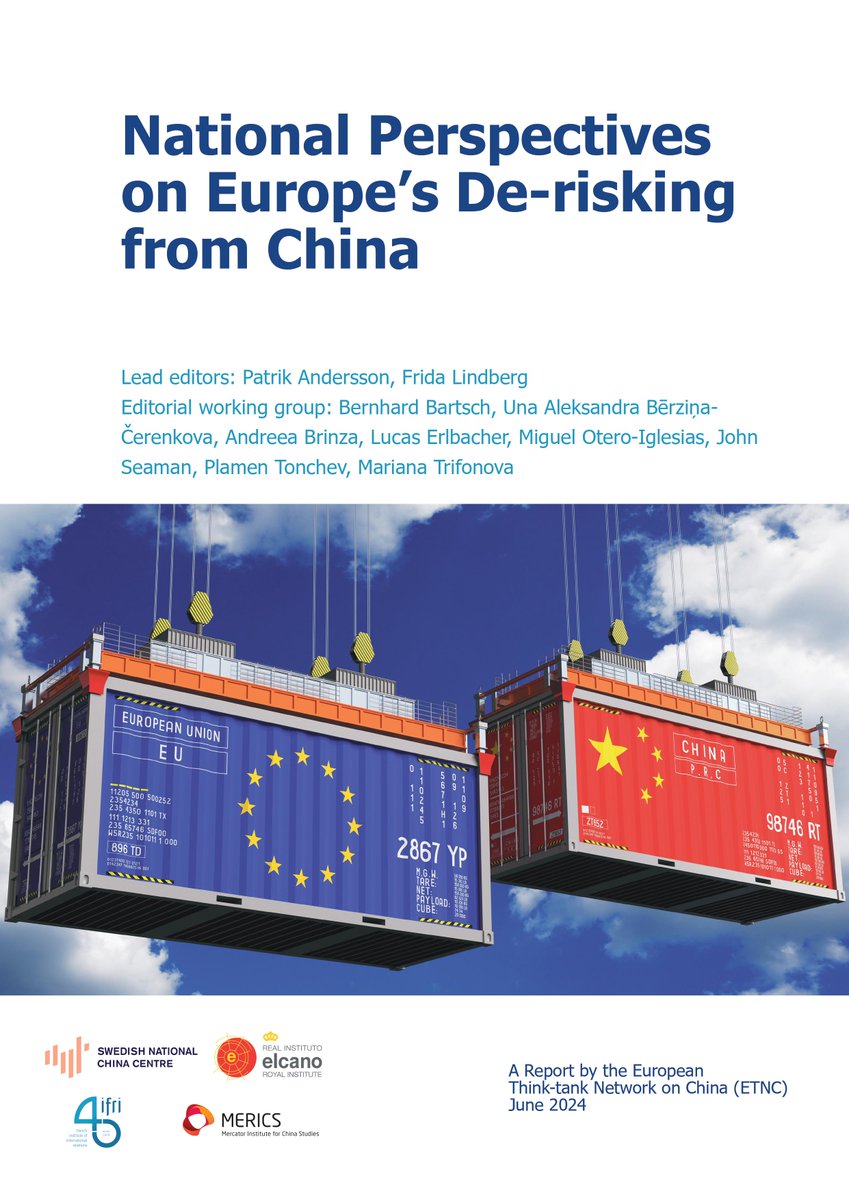
This year’s @ETNC17 report, with RISAP’s @Andreebrin’s contribution, analyzes how 21 European Union member states and the United Kingdom perceive de-risking from China. The report was edited and published by @kinacentrum.
The 2024 @ETNC17 report has now been released!
The report examines the viewpoints of 21 EU member states and the United Kingdom on “de-risking,” as well as the practical steps they have taken towards implementing this much-discussed policy 🇪🇺🇨🇳
In an op-ed for @POLITICOEurope, @Andreebrin argues that #China failed to gain influence in Central and Eastern Europe (#CEE), as once feared, and the greatest threat for #EU unity on China & de-risking is now about Western Europe’s business ties to China.
https://t.co/SM3ktszrWE
🆕This year's report by the European Think-tank Network on China (@ETNC17) explores national approaches to China in 24 European countries and the EU. https://t.co/LEOp4cZPdu 1/5
#Romania’s enthusiasm for #China & the #16+1 mechanism didn’t last long, as 🇷🇴🇨🇳 relations have cooled. Writing for @chinaobservers, @Andreebrin analyzes the evolution of 🇷🇴’s relations with 🇨🇳 & the 16+1 mechanism and whether Romania might formally leave.
https://t.co/naJkcJ60Zb
We are glad to announce RISAP has joined @ETNC17, the most important China-focused network of European think tanks. Our first contribution to the annual ETNC report will be out soon.
🚨 We have great news. We are proud to announce that we have two new institutions as members of our network. @epi_bg (from Bulgaria) and @RISAPOfficial (from Rumania). Both have a chapter in our forthcoming report mapping EU-China relations from around 20 national perspectives.
@ETNC17@epi_bg Thank you for the warm welcome and congratulations to our @epi_bg colleagues! It is a pleasure to be part of @ETNC17 and we are looking forward to working together on future ETNC reports!
Andreea talked about #China’s relations with #Romania, #Bulgaria, #Moldova and #Ukraine, highlighting Beijing’s limited presence and influence in the western part of the #BlackSea region and how these countries distanced themselves from China over the past few years.
This month, RISAP’s @Andreebrin participated in the conference “China’s growing presence in Central and Eastern Europe. A matter of concern?” organized in Budapest by @AndrassyUni and @KASonline.
Macron’s China visit & especially his later comments raised questions about the direction EU-China ties. But how close can Europe and China get? Writing for @ChinaObservers, RISAP’s Andrei Lungu analyzed the factors that influence Sino-European relations.
https://t.co/eURfcPOYkH
For the past decade #China’s strongest relations in #CentralandEasternEurope were based on close ties with politicians in power. RISAP's @Andreebrin argues that this strategy failed as many China-friendly #CEE leaders have been replaced by pro-Western ones
https://t.co/MUe7sxiOwI
E. Isaksson, E. Kandilarov, A. Kennis, D. Kozisek, A. Kumpis, E. Liias, X. Mellet, L. L. Molnar, M. Okano-Heijmans & K. van't Klooster, T. N. Papanastasiou, M. Perić, R. Vancel, T. Weber, R. Yamamoto, K. Żakowski, M. Zappa.
As part of a research project started in 2021, RISAP published the book “Developing the EU-Japan Strategic Partnership” in which researchers from 21 EU member states analyzed their country’s relations with Japan.
https://t.co/t09Ev9sbVd
The book also includes an overview and comparative analysis of relations, at the EU level.
We want to thank @ToshibaTifo for supporting this project and the excellent European scholars who participated: B. Bertalanič, G. Boghean, M. Boscariol, J. Castillo Iglesias, G. Diamantakos
The Shanghai Cooperation Organization's silence as deadly clashes erupted between 2 members just 200km from its leaders' summit underscores the hollow nature of 'Chinese style' international organizations, argues @RISAPOfficial's Andrei Lungu
https://t.co/uYUskJvo4k
Congratulations to @CEIAS_eu and our colleagues @Georg1anaB and Madalina Merlusca for their hard work in this project about #China-#Europe academic cooperation.
CHINA-EUROPE ACADEMIC ENGAGEMENT TRACKER
We are launching the #China-#Europe Academic Engagement Tracker to contribute to the emerging discussion about the sustainability and #security risks of China-Europe #AcademicCooperation.
https://t.co/kNQBT4umoV
🧵 1/7
In an op-ed for @NikkeiAsia, RISAP’s @Andreebrin offers a snapshot of how #China lost Central and Eastern Europe in the 10 years since it established the 16+1 mechanism.
https://t.co/8BGlnBotCO