Director, Program on Retirement Policy @urbaninstitute. Finding ways to help older people stay productive, healthy, and financially secure. Views are my own.
.@MFavreault and I discuss the prevalence and cost of severe cognitive impairment at older ages. We project that nearly 1 in 3 people born in the late 1950s (who just turned 65 or will soon) can expect to develop serious cognitive problems after age 65. https://t.co/DBwjfKDNAK
As a new AARP report explains, discrimination against older workers is pervasive. That's why older workers remain unemployed so long when they lose their jobs, and why today's economic downturn will have long lasting repercussions for older people. https://t.co/rzzffZtsXo
Bad news for the economy and workers’ future retirement incomes: One year into the global pandemic, the share of adults ages 65+ with a job dropped 13 percent, more than twice the decline for younger age groups. How can we lure older workers back? https://t.co/xLHWhmpBVS
Long-term services & supports and medical care create financial burdens for many seniors. In our new study, @MFavreault and I project that about half of adults ages 65+ will experience economic hardship lasting at least 3 years because of these expenses. https://t.co/fgYHI4WYKl
As the overall employment situation slowly improves, today’s #jobsreport shows that the share of older adults with a job continues to fall. In February we saw the largest 12-month decline on record in the employment-to-population ratio for adults ages 65 and older.
What did the pandemic teach us about caring for seniors? First, the need for better home- and community-based services. For more lessons, read @howard_gleckman’s & @MFavreault’s important new @urbaninstitute report. https://t.co/YPmhFY1iST.
Adding a meaningful minimum benefit to Social Security could nearly eliminate senior poverty without breaking the bank (or trust fund), according to a new report from my @urbaninstitute colleagues Gene Steuerle and Karen Smith. https://t.co/8WOxEBgBes
Critical info as Biden administration mulls ending public charge rule: In 2020, almost 1 in 7 immigrant families avoided a noncash govt benefit program because of concerns about future green card applications, per my colleague @hamutalb1 & team. https://t.co/Uj8Z2XMNT0
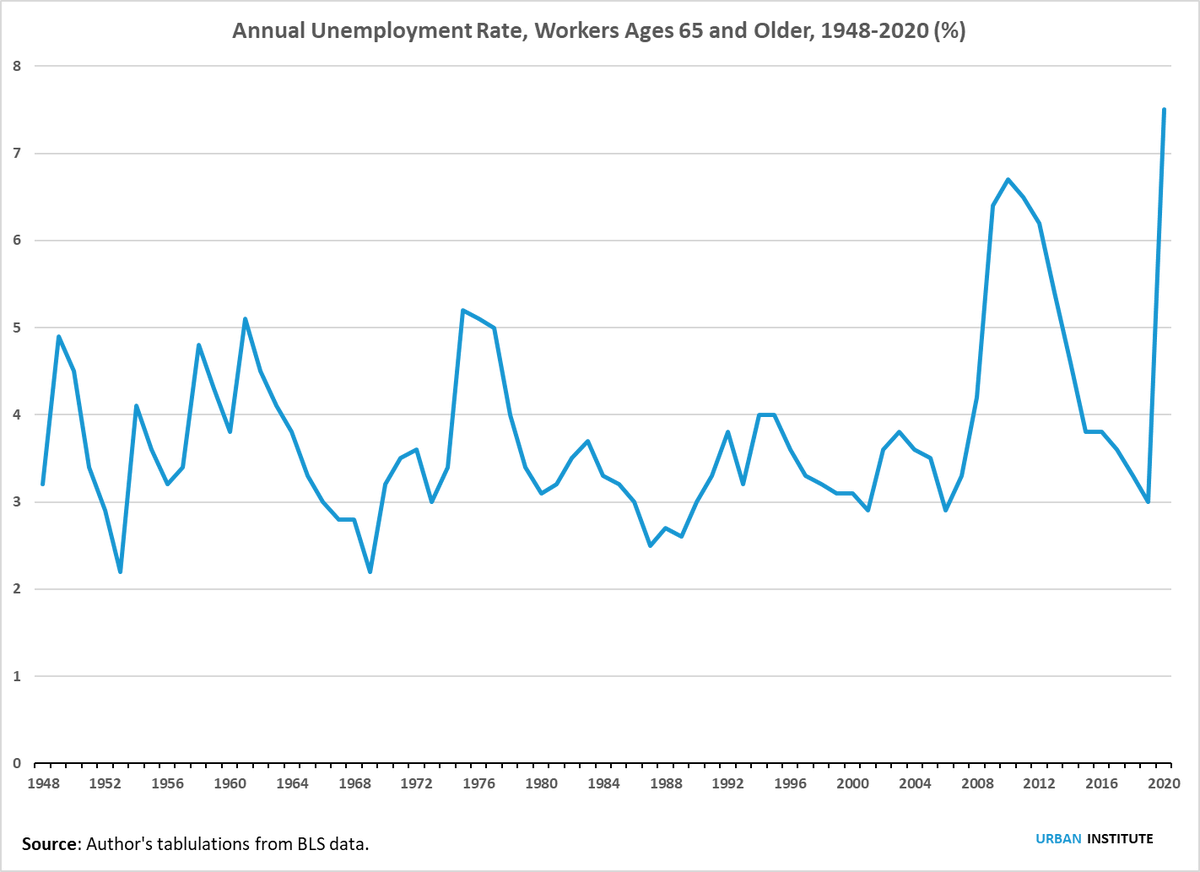
This morning’s #JobsReport makes it official: The 2020 unemployment rate for workers ages 65 and older was the highest on record (7.5%). Annual unemployment rates for younger workers were also high last year, but they didn’t break records.
Interesting idea: Secure Act 2.0 from @RepRichardNeal would allow employers to count student loan payments when making matching contributions to employee retirement accounts. BETTER idea: employers contribute fixed % of worker pay instead of matching employee contributions.
Excited to participate in today’s @1a discussion on our aging population at 10 AM ET. Tune in and also hear what two centenarians have learned after 100 years of living, from @NPR and @wamu885. https://t.co/DhPvXpAjkz
Unlike most movies, the sequel to the Secure Act might be better than the original. @RepRichardNeal’s bill would require all new employer retirement plans to autoenroll employees and autoescalate employee contributions to 10% of pay. That could nudge more to save for retirement.
Sure, many seniors don’t need financial assistance, but a $600 stimulus check will help the more than 400,000 adults ages 65 and older who left the labor force since the beginning of the pandemic. They’re disproportionately Black and Asian.
About a quarter of adults believe they are financially worse off now than at the beginning of the pandemic. But Gen Zers and young Millennials fared much worse than working-age boomers, writes @kmart_02. https://t.co/ppTryWrRt3
Big changes could be afoot at the Social Security Administration. @SSWorks wants the Biden administration to clean house and end the war on disability beneficiaries. https://t.co/TK5ARaWgmD
In just two weeks now, @CDCgov's national eviction moratorium ends. Extending it would keep families housed & prevent the spread of COVID-19, write @marykcunningham & @awbhart. https://t.co/je5lfXNpVu
There’s lots of ways to boost Social Security benefits, but an exciting new report from Urban's @MFavreault and Karen Smith shows that one of the best ways to help vulnerable retirees and people with disabilities is to guarantee a minimum benefit https://t.co/5dEW0hm6dO
New survey of retirement plan sponsors from @PSCA401k suggests the COVID-19 pandemic had a smaller impact on retirement savings than many of us feared back in March. Few employers have reduced their plan contributions since the beginning of the pandemic. https://t.co/2m33ckzdHr