@VerizonNews@Verizon My iPhone 12Max (running iOS Version 17.7) went into SOS mode early this morning shortly after 0900 hrs Eastern. My wife’s iPhone 12Max running iOS Version 17.6.1 didn’t go into SOS mode.
I searched online for how to fix this, tried everything I could find - nothing worked
Two legends. Same nine 16-inch guns. Very different stories.
USS Alabama (BB-60) was built for a fight, not a parade. At 680 feet and 35,000 tons, she was compact by battleship standards; a South Dakota-class bruiser designed to hit hard and absorb punishment. Top speed: 27.5 knots. Her war was the Pacific, and she earned it.
USS Iowa (BB-61) was something else entirely. At 887 feet and 45,000 tons, she was longer than three football fields and fast enough (33 knots) to keep pace with the carriers she was built to protect. That combination of size and speed made her not just a battleship, but a bodyguard for the entire fleet.
Alabama punched above her weight. Iowa simply outweighed everyone.
The gap between them isn't just numbers. It's a statement about what the Navy needed at different moments. Alabama was the workhorse of classic fleet engagements. Iowa was a different animal; a ship that outlasted WWII, showed up in Korea, came back from retirement during the Cold War, and was still firing her guns in the Gulf War four decades after her commissioning.
Both carry the same armament. Both are now museum ships. But Iowa's resume is longer, her hull is bigger, and her legacy is harder to summarize in a single war.
#OTD in 2002, Space Shuttle Endeavour lifted off on STS-111, which launched the Expedition 5 crew, took supplies to the International @Space_Station, and brought the Expedition 4 crew back to Earth.
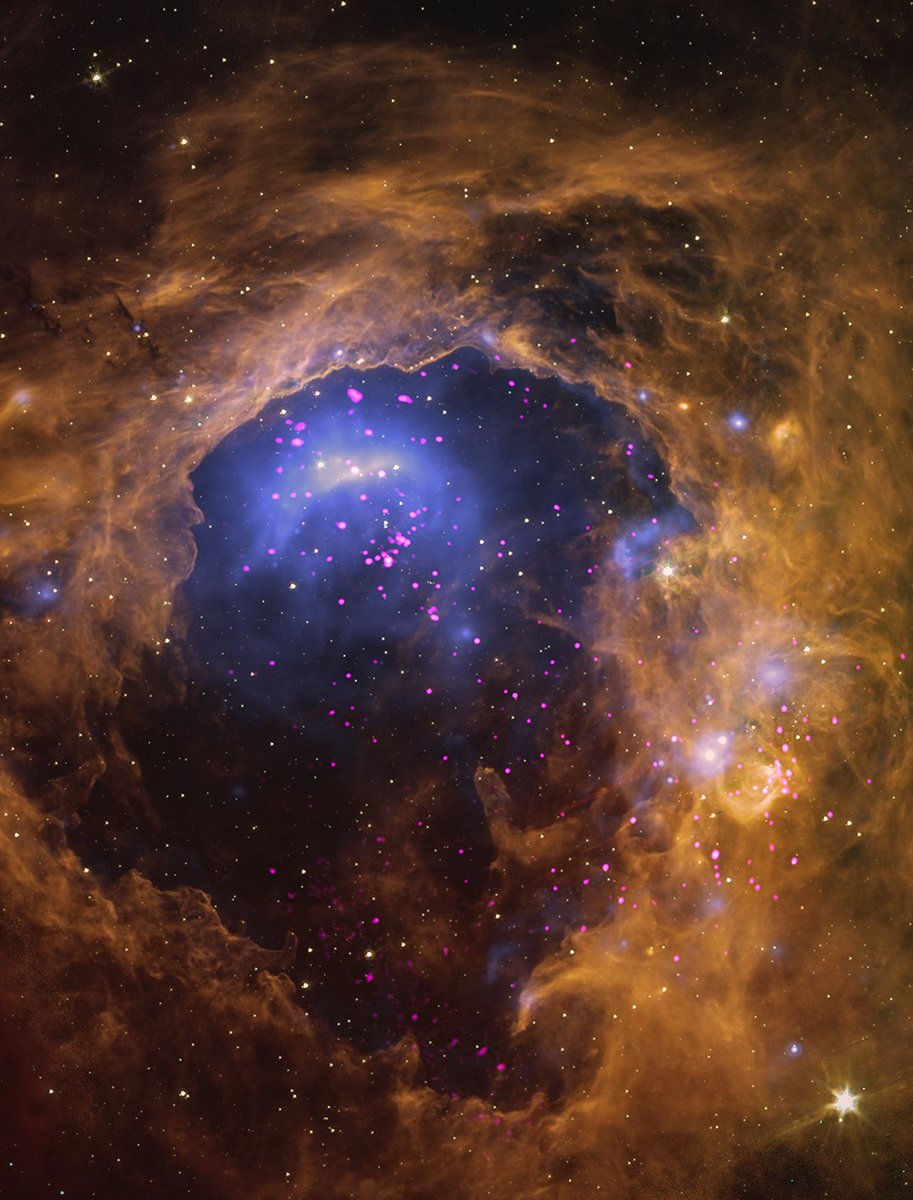
Some of our galaxy’s youngest, hottest, and most massive stars blaze to life in the nearby Carina Nebula. Winds from these powerful stars can carve out bubbles of hot gas, producing dramatic shapes in the surrounding clouds of colder gas and dust.✨
All that you touch
And all that you see
All that you taste
All you feel
And all that you love
And all that you hate
All you distrust
All you save
And all that you give
And all that you deal
And all that you buy
Beg, borrow or steal
And all you create
And all you destroy
And all that you do
And all that you say
And all that you eat
And everyone you meet
And all that you slight
And everyone you fight
And all that is now
And all that is gone
And all that's to come
And everything under the sun is in tune
But the sun is eclipsed by the moon
There is no dark side of the moon, really
Matter of fact, it's all dark
1962: NASA’s Early Vision for Landing on the MoonIn 1962, long before the Apollo program took its final shape, NASA produced a fascinating animated film that laid out one of the earliest detailed concepts for a crewed lunar mission. The animation showcased the vehicles and the full mission sequence as engineers imagined it at the time — a bold blueprint for humanity’s first voyage to another https://t.co/Hm1FM6NnUu of the most striking features of this early design was the robotic arm mounted on the Command and Service Module (CSM). In this concept, the arm would reach out and grapple the Lunar Excursion Module (the lunar lander), physically docking it to the Command Module after both had reached lunar orbit. It was an ambitious engineering solution intended to handle the delicate rendezvous and docking maneuvers in space.Why the Robotic Arm Was DroppedAs planning matured, NASA ultimately abandoned the robotic arm for several practical reasons:Added Mass: The arm, its mechanisms, and control systems would have consumed valuable payload weight that could be better used for fuel, life support, or scientific equipment.
Mechanical Complexity: Developing a reliable robotic system capable of operating flawlessly in the vacuum and temperature extremes of space introduced numerous technical risks and potential points of failure.
Simpler Alternative: Manual docking, performed by the astronauts themselves using the spacecraft’s thrusters and visual alignment, proved more mass-efficient and gave the crew direct control.
This shift placed greater responsibility on the astronauts’ piloting skills — a challenge that later proved critical during missions like Apollo 11. Neil Armstrong and Buzz Aldrin, for example, relied heavily on manual control during the final descent to the lunar surface.Despite this major change, the overall mission architecture shown in the 1962 animation was remarkably close to what eventually flew:Earth orbit rendezvous
Trans-lunar injection
Lunar orbit insertion
Separate lander descent and ascent
Return to Earth
The animation stands today as a captivating window into NASA’s evolving thinking during the frantic early years of the Space Race. It shows how engineers explored creative (if complex) solutions before settling on the elegant, crew-centric approach that ultimately carried humans to the Moon.A perfect example of how bold concepts are refined through hard engineering trade-offs — turning science fiction into reality.
Every February, Horsetail Fall on El Capitan turns into what looks like flowing lava. No fire involved. Just the setting sun hitting the waterfall at a precise angle for a few minutes before sunset, turning the water bright orange and red.
Three things have to align at once for it to happen. The sun’s path only lines up with that cliff face during a narrow window in mid to late February. The fall needs enough snowmelt to actually be flowing, and the sky has to be completely clear for the low angle light to hit with full intensity.
Photographers treat it like an eclipse and plan trips weeks out, knowing the whole event lasts roughly 5 to 15 minutes on any given evening. It is a reminder that some of the most dramatic visuals in nature come down to geometry, not spectacle.