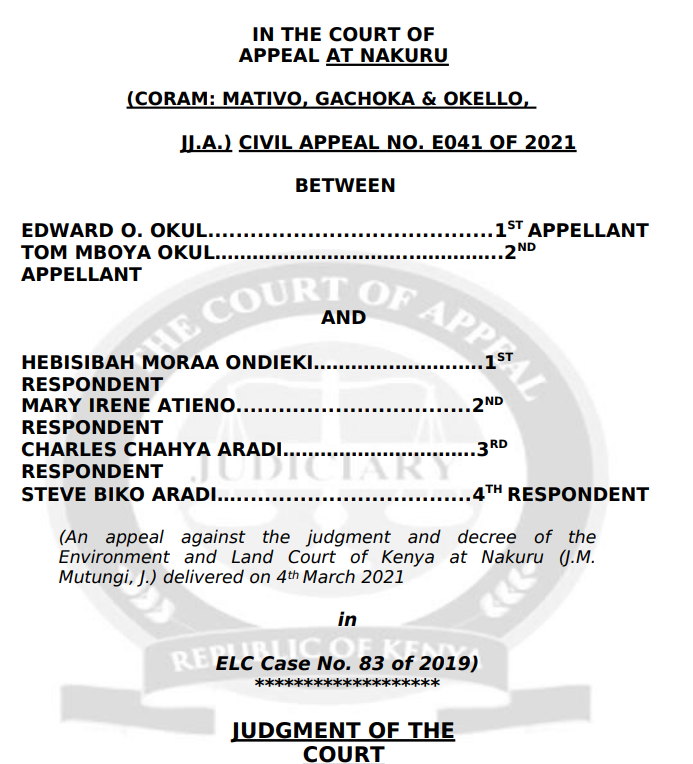
🔴🚨BREAKING: CoA says Paying for Land Is Not Enough - Occupation May Matter More Than the Title Deed
Many Kenyans assume that once a land sale agreement collapses, the buyer loses everything and the registered owner automatically keeps the property. The Court of Appeal has now shaken that assumption in Okul v Ondieki [2026]. The dispute revolved around a Nakuru property allegedly sold in 1985. The purchaser paid the agreed consideration, took possession, developed the land, erected rental structures, and remained in occupation for over three decades. Yet the transfer was never completed. Years later, after both the buyer and seller had died, the seller’s family claimed the property as part of the deceased’s estate and argued that no valid transfer had ever occurred.
The Court of Appeal was confronted with a question that keeps many investors, families, and estate administrators awake at night: can a person who never received a title deed still end up owning the land? The answer was a resounding yes. The Court held that where a purchaser enters land pursuant to a sale agreement, openly occupies it, develops it, collects rent, and remains there uninterrupted for the statutory period, that occupation can mature into adverse possession even if the sale transaction itself was never completed. In one of the most consequential statements in the judgment, the Court affirmed that entry into land under an incomplete sale agreement, particularly where the purchaser is not to blame for the failure to complete, can ultimately extinguish the registered owner's rights altogether.
The implication for landowners, investors, succession practitioners, and property developers is profound. A title deed is not always the end of the conversation. If another person occupies your property openly, treats it as their own, develops it, earns income from it, and you fail to assert your rights for years, the law may eventually recognize them rather than you. The decision reinforces a powerful principle in Kenyan property law: ownership is not protected by registration alone; it must also be defended through action. For those dealing with old land transactions, stalled transfers, family estates, or forgotten sale agreements, this judgment is a reminder that time can quietly transfer property just as effectively as a signed transfer form.
Kindly retweet. 🙏
Cheptongei Village Tribunal Judgement:
We agree with you that your neighour cut your fence & stole your cow. We can see the cow in his compound. But we are afraid we can’t return the cow as he has fixed the fence where he had cut. But to compensate you, we will give you a goat!
Case Dismissed.
🚨 Public Notice: Scheduled Maintenance – Integrated Customs Management System (ICMS)
We will conduct scheduled maintenance on the Integrated Customs Management System (ICMS) to enhance system performance, stability, and security.
🗓 Maintenance Window:
📌 Start: Saturday, 4th April 2026 at 6:00 PM
📌 End: Monday, 6th April 2026 at 6:00 AM
🔎 Advisory to Stakeholders:
1. Submit urgent declarations and complete payments in advance
2. Prioritize clearance of perishable and time-sensitive cargo
This upgrade is aimed at improving service delivery and user experience across the customs ecosystem.
We appreciate your cooperation and regret any inconvenience caused
KENYA MUST LOWER VAT ON FUEL AND REDUCE FUEL LEVY:
Fuel prices globally were higher in March of 2022 at around $100 Per Barell, reaching a peak over $116 Per Barell in May of 2022. Higher than the current global oil prices.
Yet, Petro was around Ksh 150 and diesel Ksh 131 at the peak in May. Even without a subsidy, it was still cheaper than now.
Even while global prices halved from a high of $116 Per barrel in 2022 to below $55 Per barrel in December 2025, Kenyans didn’t notice the drastic global price change at the pump.
The reason of high prices in Kenya includes the introduction of an extra 8% VAT in 2023 and an extra KSh 7 fuel levy in 2024. VAT is over Ksh 25 per liter. This is besides other excise taxes and levies.
More interesting is that the government has already taken a loan or collected the Ksh 7 in advance through illegal securitization. This amounts to Ksh 32 billion per year.
For non-oil-producing economies, their markets are price takers of the global prices; they are left with the tool of levies, taxes, or subsidies to deal with fuel prices. Taxes and levies account for around 50% of fuel prices in Kenya, among the highest in the World.
A time has now come for Kenya to remove the Ksh 7 in fuel levy added in 2024 and recede the 8% VAT on fuel.
The banks that participated in the illegal securitization should be made to pay for their greed. They either give a moratorium or laws must be changed.
The government must intervene. Consumers have done their bit by paying additional VAT and fuel levy when prices were coming down; now it is time for the government to reciprocate by removing the 8% additional VAT and Ksh 7 fuel levy. Our economy cannot afford to shoulder all these levies and taxes at this time in consideration of the global dynamics. Kenyans must be shielded. The economy must be supported.
It is unfathomable that fuel is cheaper in Uganda, yet their fuel requirements pass through Kenya. In Tanzania, Petro is below Ksh 155 in Kenyan shillings. Still cheaper in Rwanda.
We are African and Africa is our Business..
Here's a chance for you to invest in Nanyuki.
This two properties are very ideal for a retirement home, a boutique resort or for land banking.
#investmentproperty#propertyinvestment
The World Bank says Kenya is borrowing too much money locally, and this is making it hard for businesses to get loans.
Banks are choosing to lend to the government instead of helping companies that are already struggling
What’s Inside Your Braids? The Toxic Truth About Synthetic Hair Black Women Were NEVER Told…
Synthetic hair is not just a beauty choice ,it has become a silent health risk for millions of Black women. Recent scientific investigations have found carcinogens, endocrine disruptors, toxic fumes, and heavy metals inside the very braids we call “protective.” These chemicals are banned in Europe, tightly regulated in the U.S., but freely sold across Africa with zero warnings.
This video exposes the hidden dangers inside synthetic braids, the fumes we inhale in salons, the toxins released when the hair is burned, and the decades-long regulatory failure that allowed this industry to target Black women with the least-tested, most-toxic beauty products on the market.
Full episode here https://t.co/yshvbZelLP
Kenya is bleeding!
One young man fights for his life. Another hasn’t even been buried.
We’ve marched, we’ve mourned—but now, it’s time to Fast and Pray. Mark 9:29