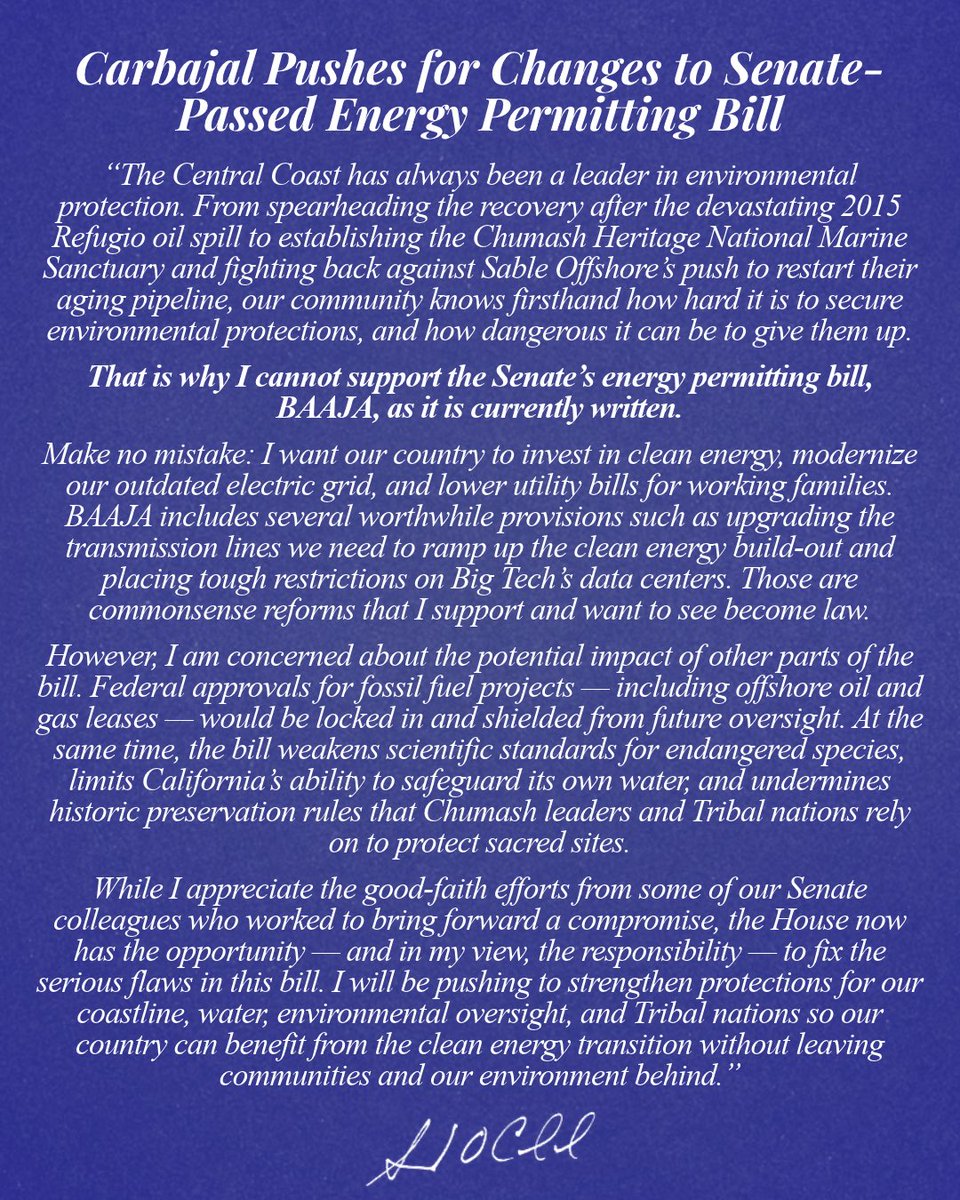
Although BAAJA includes some important provisions for our transition to clean energy, it is a deeply flawed bill and can hurt critical environmental protections the Central Coast depends on. Read my full statement on the Senate’s version of BAAJA.
This is a really good statement from one of the smartest climate hawks in the House. And, if his changes aren't acceptable to the Repubs pushing BAAJA, it's a good place to start in the 120th Congress on a better bill.
The Senate just passed BAAJA, a sweeping overhaul of how we permit energy projects. Now it's up to the House. After much deliberation, I can't support the bill as written. It asks us to give up protections we may never win back in exchange for gains we may never see.
I've spent my career fighting for clean energy, first as an environmental attorney and now in Congress. I want us to build power lines, solar, and wind faster, and parts of BAAJA would help. It would improve how we plan and build transmission lines, and it would require large data centers covered by the bill to pay their share of grid costs. Many of those ideas are also in the Energy Bills Relief Act that Sean Casten and I wrote, because families shouldn't have to pick up the tab for Big Tech.
I take the bird-in-the-hand argument seriously. BAAJA has already cleared the Senate with bipartisan support. If the House passes it up, we could wait years for another permitting bill that can get through both chambers and be signed into law.
Still, we have to weigh the whole trade.
BAAJA would limit how states protect their own water. It would give agencies less time to look at threats to endangered species. And it would make it much harder for courts to stop a project, even when an agency skipped the environmental review the law requires. By the time that review gets fixed, a wetland could be filled in or a Tribal sacred site destroyed, and that damage can't be undone.
The bill would also make it harder to change or pull back a permit once it's issued, even one that was issued illegally. Congress should make sure agencies can fix their mistakes and prevent serious harm before it happens.
Those limits would be written into law. The clean energy gains and lower bills, meanwhile, depend on what actually gets built, and on who's carrying out the law. Right now that's President Trump, and on clean energy, he can't be trusted. His administration has spent this year canceling offshore wind projects, and he has said he won't approve new wind turbines. Nothing in this bill stops him from slow-walking the clean energy side of the bargain while the rollbacks take effect right away.
Rhodium Group estimates that the provisions it modeled would cut the average household's annual electricity bill by $50 to $78 in 2040. I want those savings. But Rhodium didn't model the permitting certainty provisions, and it didn't assess what BAAJA would mean for water quality or Tribal consultation. Congress has to weigh those consequences too.
I've spent years fighting to keep new offshore drilling away from Southern California. When a federal approval threatens our coast, it matters whether a court can step in before the damage is done. I've also heard from hundreds of constituents about BAAJA, and among those who contacted me, opposition has run roughly two to one.
Here's what would get me to yes.
Keep the transmission reforms and make large data centers pay their share. Make sure the permitting certainty provisions can't block commonsense safeguards or keep a future administration from withdrawing an illegally issued permit. Preserve the ability of states to protect their own water. Keep endangered species decisions grounded in the best available science. Let courts halt projects when an agency skips required environmental or historic preservation review and the harm could be irreversible. And address the concerns Tribal nations have raised about sovereignty and the federal government's trust and treaty responsibilities.
If House and Senate leaders from both parties agree on those fixes, I'll be ready to vote yes.
Rep. Sean Casten now announces his opposition to permitting reform bill (BAAJA), following Rep. Levin's opposition announced this morning.
Two big climate/clean energy hawks in the House now against the bill:
We desperately need permitting reform to build out new infrastructure, bring costs down, and bring new, renewable sources of energy online. But it needs to be the right kind of regulatory reform, not oil and gas development masquerading as reform. And throughout the negotiation process, I have made my priorities clear: to bring down energy costs through new clean energy development, to lower emission rates, to support and protect tribal sovereignty, to stop the administration from attacking American clean energy projects, and to ensure that any permitting reform legislation cannot be weaponized by this or any future administration to single out states for adverse treatment and provide giveaways to the oil and gas industries. This is why I submitted more than a dozen amendments for consideration in both the managers’ package and on the Senate floor that would have made the bill better.
As it stands, this bill achieves some critically important priorities, but falls short on others. I appreciate the bipartisan work on this bill and the support of the 36 Senators who joined me in pushing for an amendment that would have struck the legislation’s changes to the National Historic Preservation Act (NHPA). In the new Congress, there will be a lot of opportunity to improve protections for tribal sovereignty, and I will continue consulting with California’s tribal leaders to ensure their voices are heard in the halls of Congress.
I strongly believe we need permitting reform and to build new infrastructure quickly and efficiently. But I also believe that this can be done in a way that does not needlessly degrade clean water, endanger wildlife, or disrespect tribal nations. And for those fundamental reasons, I opposed the bill. It is my hope that when this bill is again considered in the new Congress, that a Democrat majority can pass a more balanced work product that accomplishes all of these objectives.
And I'm prepared to argue with any good faith actor who put as much time and effort and $ into electing Casten and Levin as I have. Because my job is literally finding and helping elect climate hawks to Congress, and I win my races.
The rest of you, go away. 🎤
and YES this should be a priority in the 120th Congress and YES Sun Zia is a poster child for doing permitting wrong and YES the system needs fixing. (At the state/local level too, it's not just federal law)
@SenatorHeinrich This post is disingenuous. Voters elected Dems in November to fix Repub-created problems. You negotiated, in secret, and intro'd a bill in September that needed mostly Repub votes to pass. If you truly respected voters' message, you'd hold til January and then empower Dems.
Passing BAAJA in the Senate is a major step forward. Grateful to my colleagues and our friends in the labor movement and the clean energy industry for their hard work to make this happen.
Americans will quickly begin getting some relief on their energy bills if the House follows suit.
@SenRubenGallego Hey. I just took a poll/survey on this. Polled on whether I'd support a jobs/ retraining program for AI-displaced workers, financed by voluntary contributions from Big Tech. Is that yours?
Because I responded: no, but I'd support shooting Big Tech CEOs into the sun.
@chrislhayes You know that smart Dem climate hawks @seancasten and @MikeLevin have written not 1, not 2, but 3 solid permitting reform bills? They can negotiate off their bills in the next Congress and throw some crumbs to the minority. BAAJA is a mostly Repub bill with crumbs for Dems.