FDA published draft guidance yesterday that could change how genetic medicines reach rare disease patients.
The problem it aims to solve: a single genetic disease is often caused by many different mutations in the same gene. Until now, a therapy tailored to each mutation risked needing its own approval process. For diseases where a mutation might affect a handful of people; patients and families continue to wait.
This new framework could enable a company to get one approval for a disease, with the boundaries of what can be customized defined up front. Once approved, the version for the next patient’s mutation could be added as a supplement if supported by in vitro data: evidence in cells that the new version edits the target efficiently and stays within the off-target limits set during the original clinical program. In most cases, no new clinical data would be required.
One product, one name, and a clear path from the first patient to the next.
This could be a promising way to unlock many opportunities, especially in rare and ultra-rare diseases, a win for patients, their caregivers and for our industry. Prime editing was designed for it: one platform, one delivery system, and only a small patient-matched component change.
We appreciate the FDA / CBER teams for the forward thinking and patient focus. We look forward to working together on this guidance.
Let’s get more medicines to more patients in need.
Draft guidance: https://t.co/gqVk3Oac3Y
$GERN Provides Update on Phase 3 IMpactMF Clinical Trial of Imetelstat in Relapsed/Refractory Myelofibrosis
- The independent DMC advised that the trial was unlikely to meet its primary endpoint of overall survival
- Discontinuing Phase3 IMpactMF trial
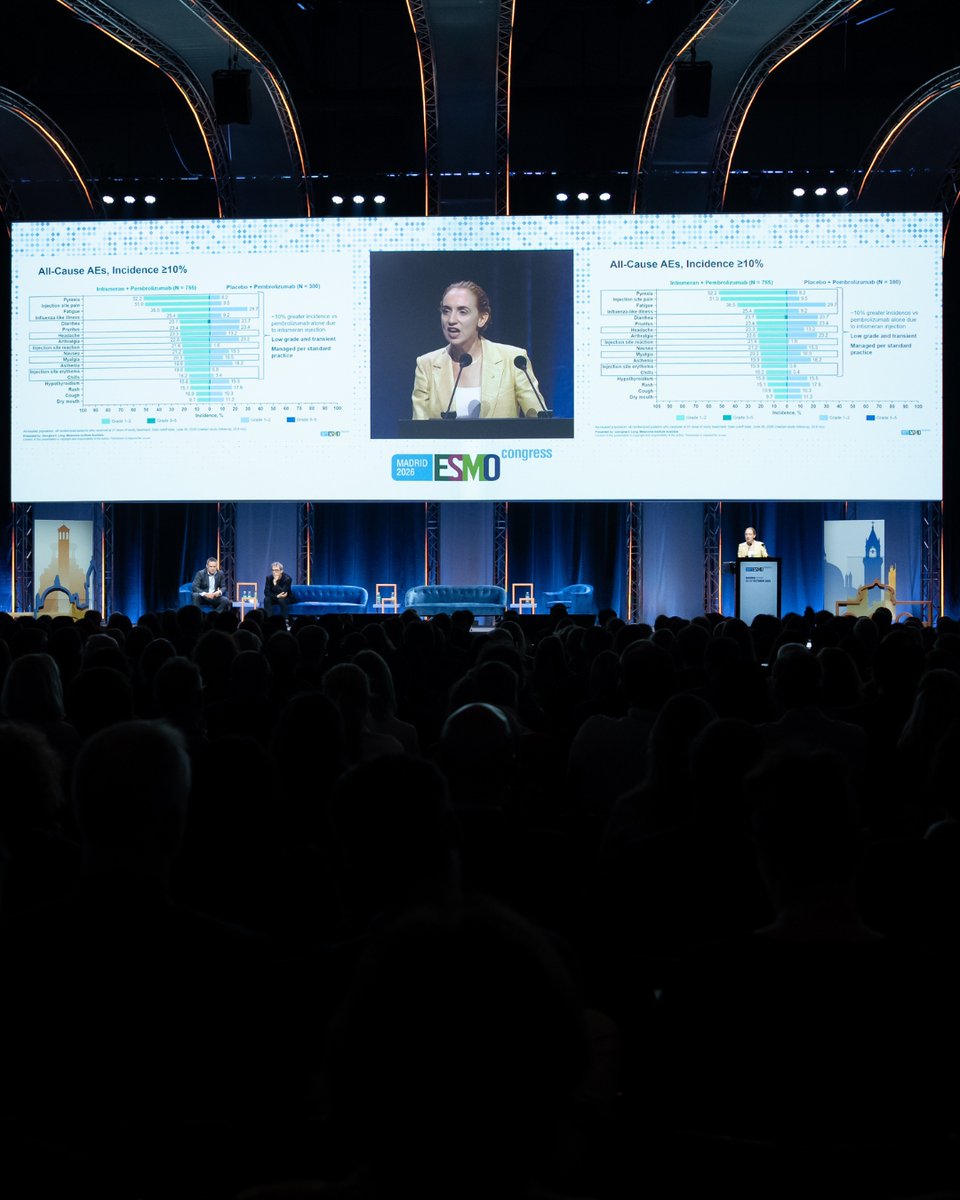
It was a great honour to present the results of the phase 3 INTerpath-001 clinical trial at the #ESMO26 Congress in Madrid.
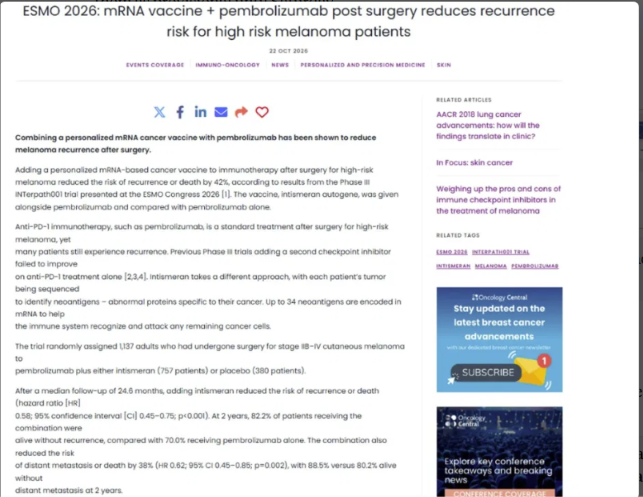
This international trial included 1137 patients, across 157 sites, whose melanoma had been surgically removed, but who were at very high risk of it returning. The trial showed adding #intismeran autogene, an mRNA based individualised neoantigen therapy, to pembrolizumab reduced the risk of recurrence or death by 42%.
This is the first phase 3 study to show that a treatment built from the unique ‘fingerprint’ of a patient’s own tumour can reduce the risk of recurrence or death from cancer. That fingerprint is read by sequencing the tumour, then a ‘wanted poster’ of the cancer is made as mRNA, showing the immune system exactly what to look for and attack. Having succeeded in melanoma, this proof of concept could mark the beginning of a foundational shift in how we treat cancer.
Read more >https://t.co/quxTAFfntb
A huge thank you to all patients and teams involved.
@myESMO@Sydney_Uni@syd_health@Science_Academy@AAHMS_health@FulbrightAUS@NthSydHealth@ausoftheyear
Seven hundred and fifty eight subjects received a personalized mRNA, not one of which was described in an IND. Each made in 4 weeks from tumor biopsy.
The process is the product.
Hello personal CRISPR cures.
Did $GILD just pay >$1B dollar for a Chinese IL23R copycat of $PTGX without even mentioning 'China' in their press release?
If so that would be quite lame. Somebody double-check, I'm on the road...
https://t.co/xRdK1CQ2Kf
Great 60% htt knockdown at single doses already. Uses intrathecal delivery, so striatal knockdown for this exon1-targeter could be modest and complementary with $QURE's striatal delivery. $ALNY $ARWR
Today we announced detailed positive results from the Phase 3 INTerpath-001 study evaluating intismeran autogene (mRNA-4157 or V940), an investigational mRNA-based individualized neoantigen therapy, in combination with KEYTRUDA® (pembrolizumab), @Merck's anti-PD-1 therapy, in patients with high-risk melanoma (stage IIB-IV) following complete resection.
These late-breaking results will be presented during a Presidential Symposium at the 2026 European Society for Medical Oncology (@myESMO) Congress.
Read more: https://t.co/gv4gfnVmTe
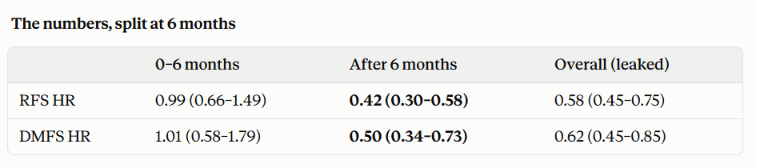
@A_May_MD The curves will be telling and yes, they are not expected to diverge immediately.
If the effect gets larger over time that bodes very well for OS.
$MRNA shorts celebrating that the mRNA cancer vaccine is unexciting. I have a feeling this is a bit premature and they may wake up tomorrow to a nightmare scenario.
0.42 and 0.5 are very meaningful HRs in a setting where most patient have not had a recurrence by 6 months.
$mrna this is a real scenario:
the short cabal was still chilling on the beach getting ready to put on the squeeze on Monday....but then results leaked and they were caught with pants down.