You have noticed it. ChatGPT feels dumber than it used to. Your prompts that worked six months ago produce worse results now. The writing sounds flatter. The ideas sound safer. The internet itself feels like it is shrinking. Every article reads the same. Every email sounds the same. Every answer sounds like it was written by the same voice.
You thought it was you. It is not you.
Researchers at Oxford and Cambridge published a paper in Nature proving what is happening. They call it Model Collapse.
Here is the mechanism in one sentence. AI trained on AI-generated data gets dumber every generation until it forgets what real human data looked like.
The internet is filling with AI-generated content. Blog posts. Articles. Reviews. Comments. Social media. AI companies scrape the internet to train the next generation of models. Which means the next generation of AI is being trained on the output of the current generation.
Each cycle loses information. Not randomly. It loses the rarest, most unusual, most creative parts first. The researchers call these the "tails of the distribution." The weird ideas. The unexpected perspectives. The things that made the internet feel human. Those disappear first.
What remains is the average. The safe. The expected. The bland.
Then the next generation trains on that. And loses more. And the next generation trains on that. And loses more. The researchers proved this is not a slow decline. Major degradation happens within just a few iterations. Even when some of the original human data is preserved.
They tested it on large language models. On image generators. On statistical models. The pattern was the same every time. The output converges toward a narrow, flattened version of reality that looks nothing like the original data.
The lead researcher put it plainly. "Large language models are like fire. A useful tool. But one that pollutes the environment."
The pollution is invisible. You cannot see which sentence on the internet was written by a human and which was written by AI. Neither can the AI that is about to train on it. And once the tails are gone, they do not come back. The damage is irreversible.
This is not a prediction anymore. It is a diagnosis.
The internet you grew up on was built by humans writing things no algorithm would have written. Strange, personal, imperfect, alive. That internet is being diluted. One generation of AI at a time. And the models trained on what remains are learning a smaller and smaller version of the world.
Model Collapse is not a technical problem. It is a cultural one. The thing that made the internet worth reading is the thing that disappears first.
When in 2007 the mayor of #Ljubljana proposed to close 12 hectares of its city center to private cars, just 40% of residents approved.
A decade later, no less than 97% were against reopening to motor traffic: “None of us can really imagine cars ever staging a comeback”.
Our work on isolable Ni-Alkyl complexes for alkyl-alkyl cross-coupling reactions is now out in @Nature!
Scope, mechanism, and more in another great collaboration with @DipaKalyani1 and @Merck. Congratulations to the entire team!
https://t.co/VI9s0upKSU
We are looking for a Postdoctoral Researcher for an open position in our group: if you are interested in photocatalysis applied to organic synthesis come and join us!
Starting date Nov 2024 - Jan 2025. More info below ⬇️
#chempostdoc#PhDposition#RealTimeChem RTs appreciated
Overcoming Challenges in Electrosynthesis Using High‐Throughput Electrochemistry: Hypervalent Iodine‐Mediated Phenol Dearomatization, a Case Study. https://t.co/KK4Q78eMMP
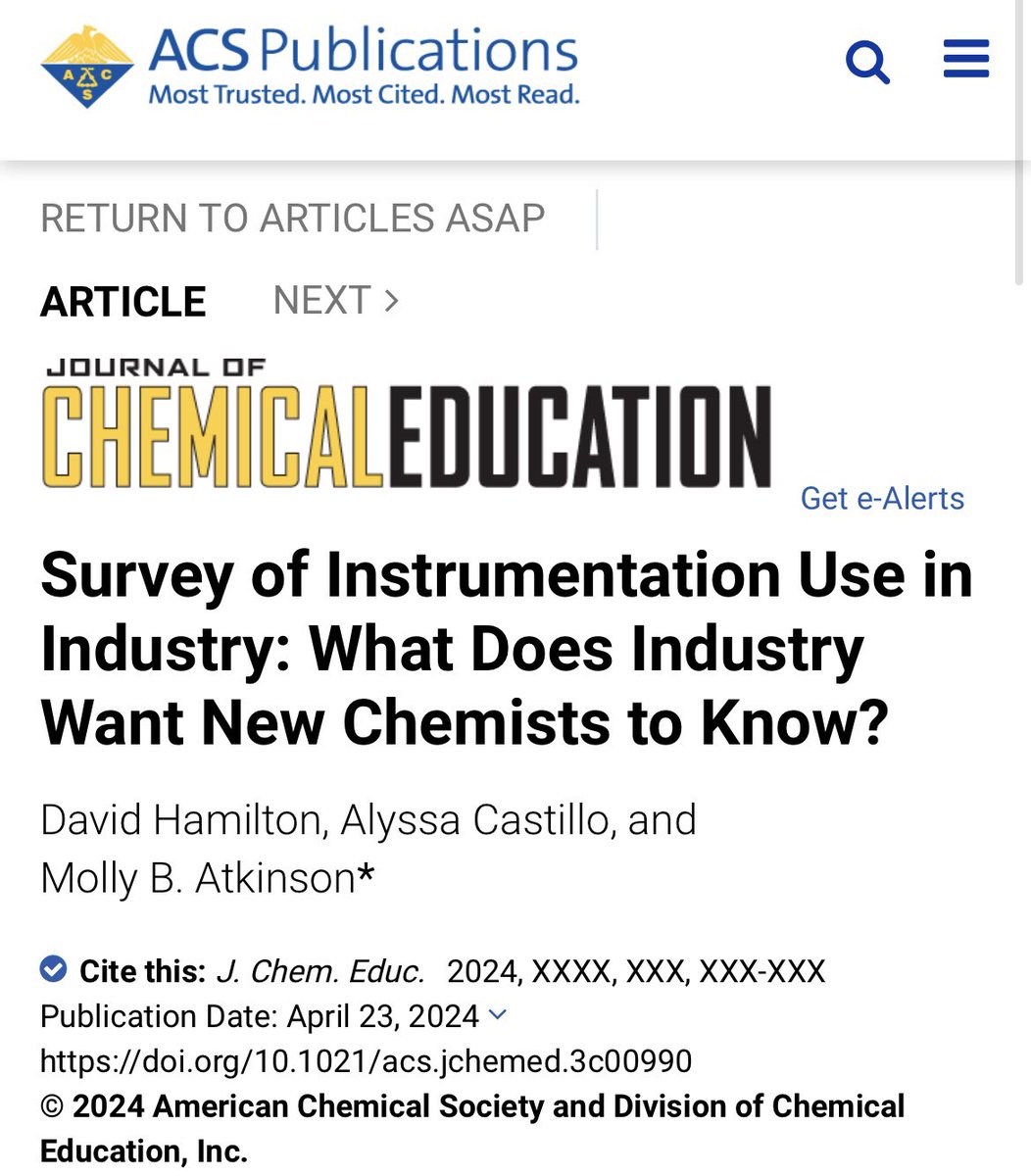
New JCE ASAP article! We surveyed industry chemists from 80 companies about the undergraduate instrumentation experience / skill development that best prepared them for chemical industry.
Happy first pub day to @DavidTHamilton and Alyssa Castillo!
https://t.co/W3wfUiNFTJ
Top 20 Influential AI-Based Technologies in Chemistry
Preprint of the future tutorial review
https://t.co/0obwb3uAnu
#AI#ML#DL#DigitalTwins#IoT#BigData
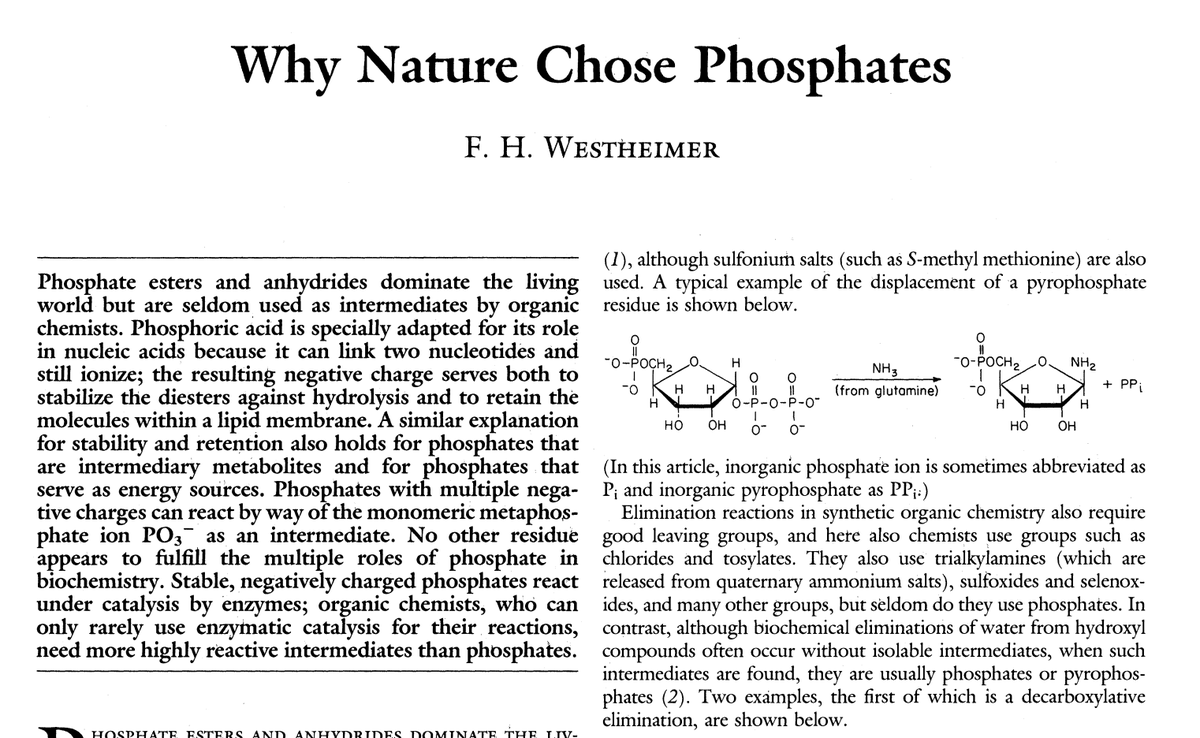
Frank Westheimer on why nature chose phosphates: phosphates are ubiquitous in DNA, RNA and other biomolecules. Why these and not sulfates, acetates or any other "ates"? What really jumps out from this paper are Westheimer's brilliantly simple explanations https://t.co/PQPq4fpt5D
Have a look at this novel approach for the stereocontrolled construction of functionalized azaspiro[n.m]alkane ring systems. @ChemEurJ
Congratulations to all authors! @compaingroup@LIMA_UMR7042@ECPM_Unistra
https://t.co/AXLh1g9oiy
So fast! Our paper on the synthesis of 1-azaspirocycles via decarboxylative radical cyclization accepted this morning @ChemEurJ & already online. Congrats to Nicolas & all authors @compaingroup & @ChemistryKoenig! @LIMA_UMR7042@ECPM_Unistra @INC_CNRS https://t.co/ALxX03hpVA
Industrial Fragrance Chemistry: A Brief Historical Perspective - David - European Journal of Organic Chemistry - Wiley Online Library https://t.co/I67uhVh40J
Turns out that giving nickel the freedom of choice enables all kinds of carbon-heteroatom cross-coupling reactions in a simple, predictable, and general manner. Check out our Nature paper (https://t.co/tQ1eODTydS) with the @AnanikovLab to learn more about the concept of AD-HoC!