The holy grail of investing is knowing how to balance.
When you can take equally good things where your expectation of return is equal, but because they are uncorrelated and move differently, they balance each other. That is how you can reduce your risk without reducing your returns.
You have to understand that the market is a zero-sum game. The consensus is already reflected in the price, and trying to beat it is a difficult game. In fact, it is more difficult to compete and be successful in the markets than it is to compete in the Olympics. We must be humble about that.
But achieving that balance so you can get a good return without losing a lot of money is everything. Most of my own money is invested in exactly that.
#Investing #AssetAllocation #RiskManagement #Principles
We created gyms because modern day work no longer required physical activity. Without exercise, our muscles atrophy.
I predict we’ll need gyms for our brains too, once AI starts doing our knowledge work.
If you really want to make it you have to live and breathe finance. There’s no shortcut, or alternative.
Every second of your waking day should be mostly dedicated to learning about assets or thinking about markets.
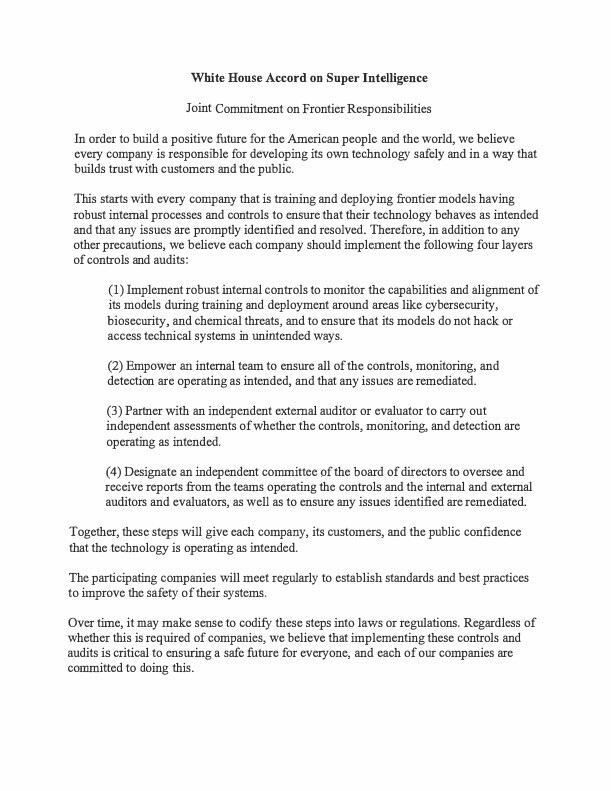
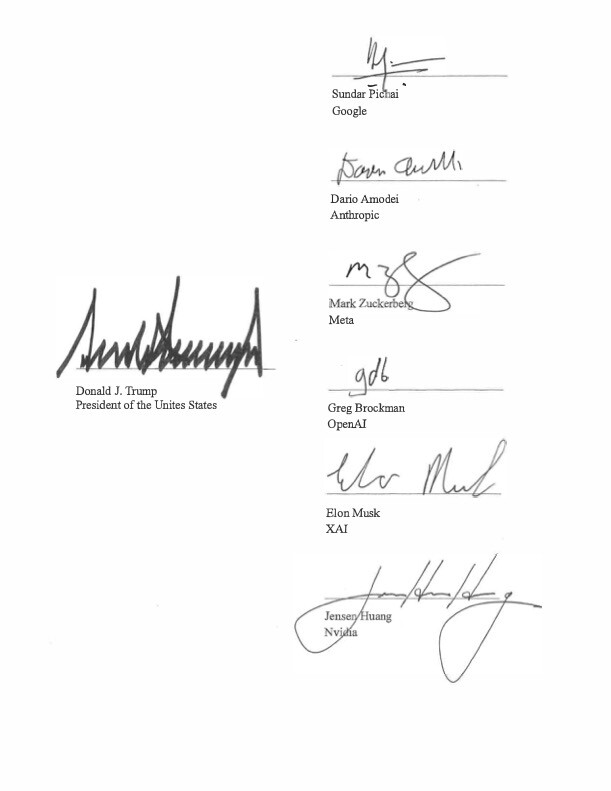
Yesterday at the White House, leaders from across our industry came together to sign the White House Accord on Super Intelligence.
The principle is simple: the companies building this technology have the primary responsibility to develop and deploy it safely, and to be accountable when they fall short.
The Accord reinforces that responsibility with robust internal controls, independent external evaluation, and board level oversight.
Super Intelligence offers an extraordinary opportunity to advance discovery, productivity, security, health, and prosperity.
The future of Super Intelligence will be shaped not only by what it can do, but by the confidence it earns. By building with ambition, rigor, and responsibility, we can help ensure this extraordinary technology expands opportunity and improves lives for generations to come.
My second conversation with @BillAckman is unlike anything I expected.
0:00 Intro
0:53 The Night His Daughter Nearly Died
17:07 How He Holds it Together
23:17 How Bubbles Pull You In
23:49 Is Venture in a Bubble?
25:23 When Easy Money Runs Out
28:05 He Hated the Idea but Invested
30:05 Who Actually Profits from AI?
35:53 The Rules He Carved in Stone
39:15 The Trade He Won't Make Again
42:02 AI
46:14 Waiting for a Cheaper Market?
48:20 Netflix: Why He Changed His Mind
51:36 The Assets Nobody Wanted
53:22 What If You Owned a City?
01:00:02 Berkshire’s Most Overlooked Advantage
01:04:36 From Watch Buyer to Company Owner
01:09:42 How He Judges CEOs in an Hour
01:14:19 What’s Left to Achieve at 60?
Enjoy!
Reuters just released a sneak peak of Anthropic financials, showing the company reported a net loss of $42 billion in 2025 - and this is before it started losing market share to dirt cheap open source models
Anyone still wondering why the company is threatening to end humanity unless the government shuts down their competition?
Did you know the original Claude — the chatbot’s namesake, according to Anthropic lore — was a renowned MIT professor? Claude Shannon SM ’40, PhD ’40, who taught at MIT from 1956 until his retirement in 1978, was known to many as the father of information theory and of modern digital communications.
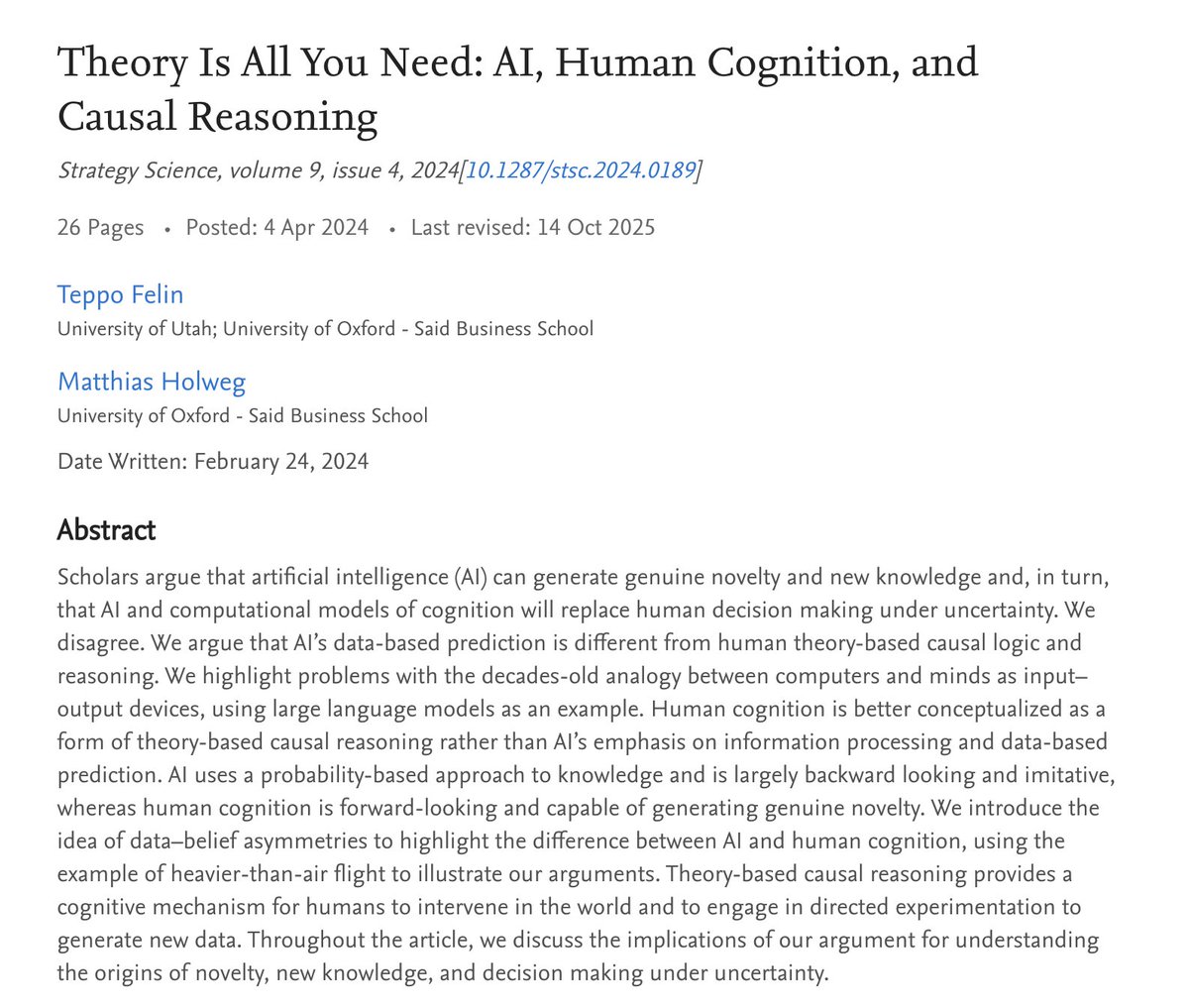
Oxford researchers argue that LLMs can never invent anything.
It is mathematically impossible.
They published a paper called “Theory Is All You Need" and it argues against the claim that computational models can generate genuine novelty or new knowledge.
They analyzed the limits of generative ai, and the results are a brutal reality check for the idea that ai will replace human decision making under uncertainty.
Here is why AI is stuck and human cognition wins:
backward-looking vs forward-looking.. llms are probability machines that look backward at existing data. human cognition is forward-looking and capable of generating genuine novelty. human cognition operates theoretically "top-down" rather than "bottom-up" from data.
the "data-belief asymmetry".. the researchers use the invention of "heavier-than-air flight" to illustrate this concept. an ai relies on data-based prediction, which is largely imitative. humans, however, use theory-based causal logic that allows them to hold beliefs that go beyond existing data.
the intervention gap.. humans don't just process information; we use theory to practically "intervene" in the world. we engage in directed experimentation to generate entirely new data. ai-based models are theory-free and place primacy on existing data and prediction.
tldr?
AI uses a probability-based approach to knowledge and ia largely imitative. It can process data and make predictions, but human cognition relies on theory-based causal reasoning.
The decades-old analogy comparing human minds and computers to mere "input-output" devices is fundamentally flawed.
Reminder that there are no women among the 21 current members of the Politburo Central Committee that controls the Chinese Communist Party.*
All are ethnic Han.
*Of the 24 original members, He Weidong, Zhang Youxia, and Ma Xingrui have been purged by fellow member Xi Jinping.
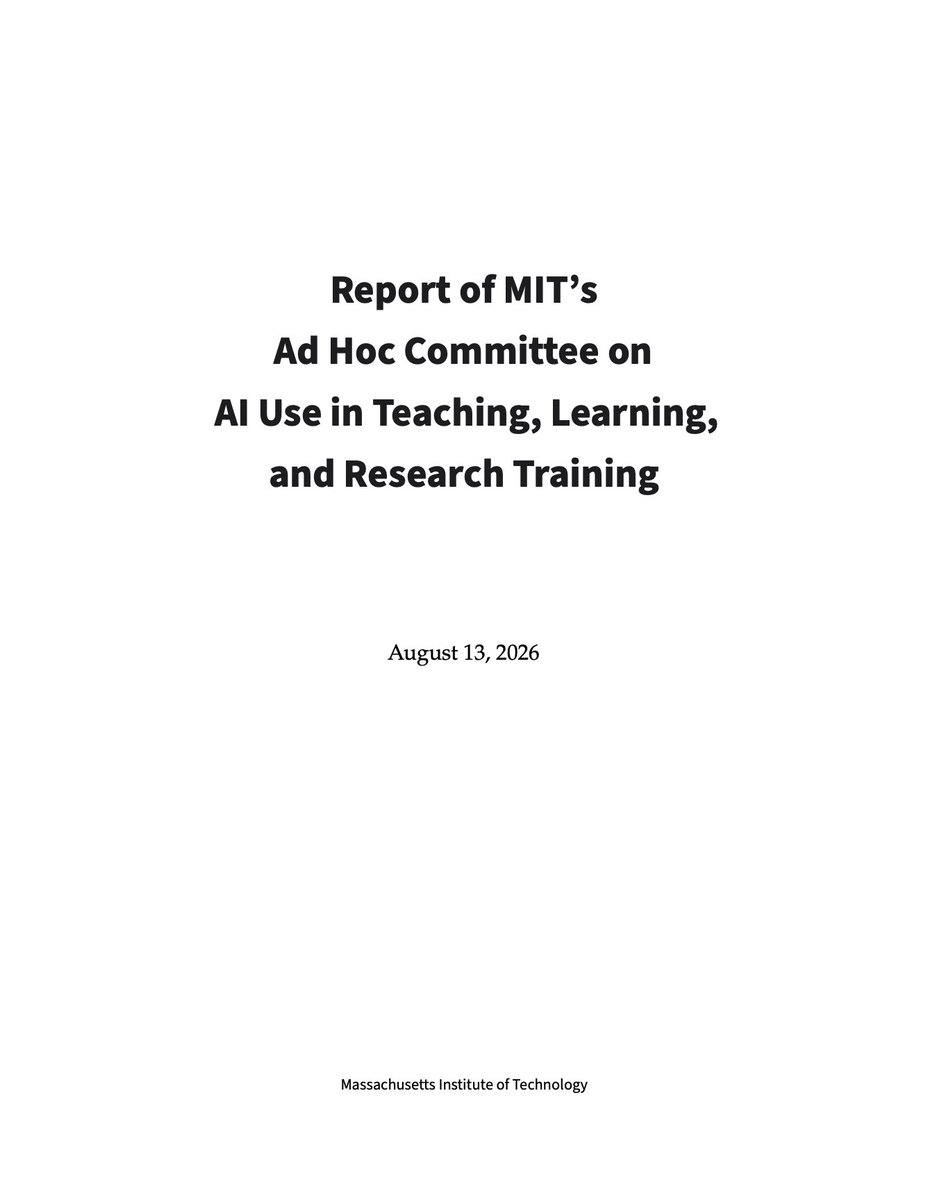
MIT published a brutally honest report on what AI is doing to students.
A committee of professors and students spent five months studying how AI changed learning on campus, and the findings read like a warning to every university on the planet.
Study groups are disappearing. Office hours are emptying out. Problem sets and take-home exams no longer prove anything, because AI can produce credible solutions to almost any written assignment in the undergraduate curriculum. Students who lean on chatbots lose mastery and confidence, and some slip into what the report calls cognitive surrender, reaching for AI at the first hint of struggle.
The numbers are rough. 46 percent of surveyed MIT undergrads use LLMs daily. 90 percent worry about their own overreliance. Undergrads who feel AI makes them replaceable now outnumber those who feel it makes them capable.
The committee's answer surprised me. They refused to fight AI with surveillance. The report calls AI detectors unreliable, says lockdown browsers feel like spying, and warns that policing students builds a classroom atmosphere of mutual distrust.
Instead, MIT wants to rebuild education around the things AI can't replace. That means oral exams, semester portfolios, in-person project work, and a required social component in every subject. The report even floats the idea of rethinking grades entirely, since without a GPA to optimize, much of the incentive to cheat with AI evaporates.
The committee warns professors against replacing undergrad research assistants with AI agents just because they're cheaper, because a university exists to grow people, not output.
The most famous tech school on earth admitted the machines broke its way of teaching. Its answer is more humans, not more software.
I agree with Dario that we need to pace the frontier. This has been a primary topic of discussions we've had at OpenAI in recent weeks.
Committing to having independent evaluators with employee-like access is a great idea, and we will do the same. We'll have more to share soon.
I resigned from Anthropic today. I spent the last three years doing pretraining research at both OpenAI and Anthropic. Neither company is acting responsibly. They are racing straight to self-improving superintelligence and gambling with our lives. More thoughts below.
Goldman Sachs made their entire optical networking sell-side report FREE to the public and posted it online for anyone to read, unlike one bank that decided to complain about some of their charts on X.
If you want to read this report, check the replies 👇
Such a remarkable story! Don’t miss it.
Saigon, April 1975.
The city has hours left before it falls.
A Navy evacuation crew pulls a family of seven out of the chaos — two suitcases between them, no time for anything else. Among them is a four-year-old boy named Hung Cao.
His father, Quan Cao, had worked inside South Vietnam's Ministry of Agriculture, close enough to the government to know exactly how little time was left. That closeness is what got the family a seat out. Would a few hours' delay have changed everything?
The Cao family lands in America with nothing familiar left behind. Hung grows up in Fairfax County, Virginia, and graduates from Thomas Jefferson High School for Science and Technology — one of the most competitive schools in the country. A refugee kid, chasing a very American kind of ambition.
In 1989, he enlists in the Navy as a Seaman Recruit, the lowest rank there is. Seven years later, in 1996, he graduates from the U.S. Naval Academy at Annapolis. The boy the Navy once rescued is now wearing its uniform.
He becomes a Navy diver and explosive ordnance disposal officer — the ones who walk toward the danger everyone else is trained to avoid. Over 25 years, he deploys to Iraq, Afghanistan, and Somalia. He earns a Bronze Star along the way. What does two and a half decades of that kind of service actually cost a person?
Near the end of his active-duty career, Cao moves into the Pentagon's budget side, overseeing roughly $140 billion in Navy spending decisions — the kind of number that quietly shapes which ships get built and which programs get cut. In 2021, he retires from active duty at the rank of captain.
Retirement doesn't stick for long. In 2022, he runs for Congress in Virginia's 10th District and loses. In 2024, he runs for U.S. Senate against Tim Kaine and loses again. Two defeats in a row — the kind of setback that ends most political careers before they start.
But in February 2025, President Trump nominates him for Under Secretary of the Navy. The Senate confirms him that October, by a vote of 52 to 45, and he's sworn in on October 3, 2025. The refugee who once needed the Navy to survive is now one rank from running it.
Then, on April 22, 2026, the Secretary of the Navy departs the administration without warning. Cao steps in as acting secretary that same day — 51 years, almost to the season, after a Navy ship carried him out of Saigon.
And now, in September 2026, Trump has nominated him to hold the job permanently. If confirmed, the four-year-old with two suitcases will run the largest, most powerful navy the world has ever built.
Some stories about the American dream are told in slogans. This one is told in dates, deployments, and vote counts — and it's still going. 🙏♥️🫡 ⚓️
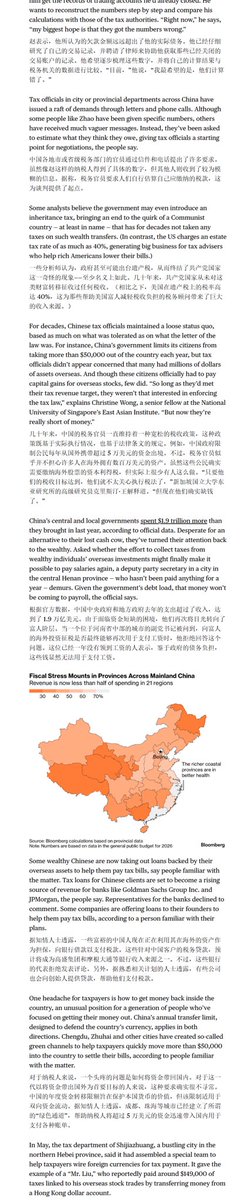
Appreciation of the renminbi is central to any realistic plan for reducing the global spillovers from China's ever-growing surplus.
In the Economist. Joint with David Waddill, formerly of Moore Capital and now at Columbia
1/many
https://t.co/pYDYYbTS10
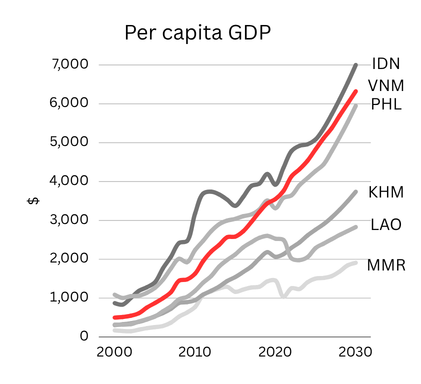
From CLMV to VIP.
Looking across a wide range of indicators, Vietnam is, without a doubt, one of the great development stories of the first quarter of 21st century.
A country of 100mn+ people, Vietnam recently became an upper-middle-income economy (WB).