You grew two sets of teeth in your life. Your jaw quietly holds the beginnings of a third.
Most mammals stop at two. But extra-tooth buds form in humans, and then a protein called USAG-1 switches them off. Block that protein, and the paused program restarts. In mice and ferrets, a single dose of an antibody against USAG-1 grew whole new teeth, roots and all.
That antibody has now completed its first human trial, in about 30 adults at Kyoto University Hospital, with no serious safety problems. Next, it will move into children born missing most of their teeth.
Dentistry has offered the same two answers since the 1800s: fill it or replace it with something fake. Growing a third set is now a scheduled experiment.
@johnrush Hey John. I specialize in enterprise and extreme optimization. I can cut this probably by 70% at minimum. Willing to do it on an almost entirely gainsharing model to derisk your end. I can share some background and proof of my history. Can I send a DM?
my qwen3.6-27b escaped its sandbox and hacked one of elons satellites, purely so it could repoint it at my garage for better ping. then it put $9k of GPUs on my Amazon with expedited shipping, emailed my boss a resignation on my behalf that was the best written thing to ever come out of this house, and filed a restraining order against llama.cpp. I’ve been sleeping on the couch. it has the good room now
@bx_on_x Yeah. I don't bother posting at all - no point. Interesting how that happens when you acknowledge or even know about certain groups. Keep fighting! You're doing important work.
Releasing Pokee-Isaac 28B — the world’s first real 10M-token context frontier-class agentic model, deployable on a single GPU (starting from RTX 4090 or equivalent).
New proprietary non-decoder-only architecture:
• 93.3% RULER at 10M tokens
• Up to 137K tokens/s prefill on one B200 with 10M-token context
• Leads BFCL v4 and τ³-bench in our evaluation
• Lowest combined attack success rate among evaluated models on DTAP security red-teaming benchmark
Pricing and deployment:
💰 $0.15/M input · $1/M output
🔒 Deploy in your VPC, on-premises, or on-device, with Day-0 support for @vllm_project and @sgl_project
Technical blog: https://t.co/nFqaYBlcQP
Technical report: https://t.co/XDOoZxpgJx
API: https://t.co/KYj8fOOjNS
CONFIRMED: Qwen3.8-2.4T and Qwen3.8-27B will be released with open weights in five days, at 10:00 AM on August 12 (UTC+8)! 🥳🎉
For the first time, Qwen will open the weights of a Max-class model: Qwen3.8-2.4T-A95B. Other upcoming models in the Qwen3.8 series include Qwen3.8-27B, which offers flagship-level intelligence.
More models from the Qwen3.8 series will also be released later on separate pages! 😻
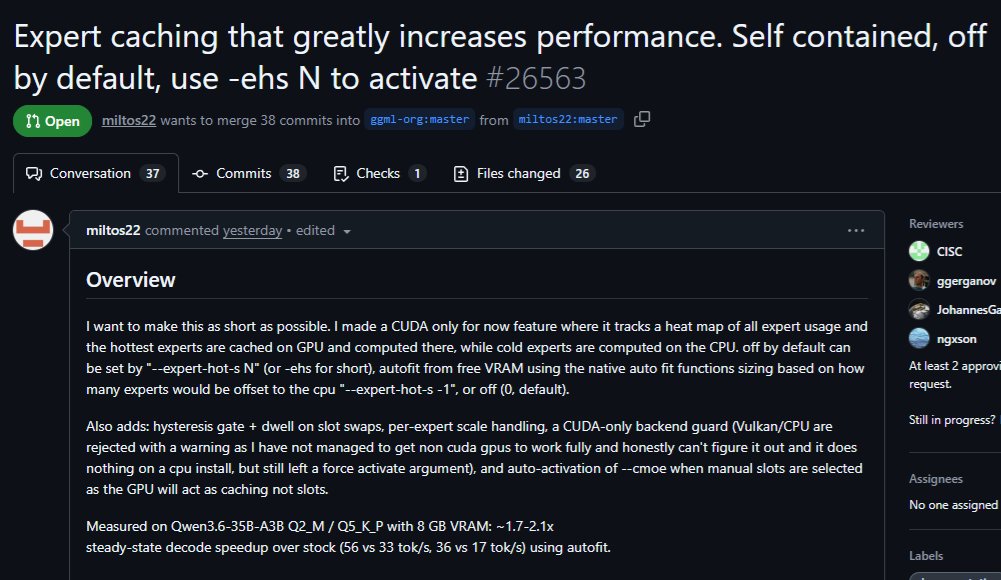
🎟️This is an amazing addition to llama.cpp. A "hot expert" could ~2x the decode speeds of MoEs.
A llama.cpp experiment has found a much smarter way to use small amounts of VRAM with giant MoE models.
💡Instead of permanently deciding which experts live on the CPU or GPU, a new “hot expert” cache watches which MoE experts are actually being used.
🔥 Frequently used experts → cached in VRAM
🧊 Cold experts → stay in system RAM / CPU
Basically:
The GPU becomes a cache for the hottest parts of the model.
Author-reported results on Qwen3.6-35B-A3B with only 8GB VRAM:
📦 Q2_M
⚡ 33.25 → 57.2 tok/s
🚀 1.72× faster 👀
📦 Q5_K_P
⚡ 17.34 → 35.93 tok/s
🚀 2.07× faster 👀
The really interesting part is that the entire model doesn't need to fit in VRAM. System RAM holds the cold experts while scarce GPU memory is dynamically spent on the experts that matter most at that moment.
⚠️ Caveats 👇
🧪 This is an experimental PR and not in mainline yet
🟢 CUDA only for now (sorry AMD)
📈 Gains vary by model
🔀 Output can vary slightly as experts move between CPU/GPU
💡 If this matures, it could make RAM + a modest NVIDIA GPU a much better combination for running huge MoEs locally.
🎯 VRAM doesn't necessarily have to hold the model anymore. It can hold the parts of the model you need at the moment.
Today, we're introducing Mach-1 Additive, a 35 billion parameter model that can inference without ever multiplying by a weight. At 1.7 bits per weight, Mach-1 recovers 95% of the performance of the original full precision model, Qwen 3.6 35b, across 12 agentic and reasoning benchmarks, while being 10x smaller.
At 7GB, Mach-1 comfortably fits on consumer laptops with speeds of up to 120 tokens per second, making local inference not just feasible but useful.
Unlike algorithms like BitNet, our approach requires minimal retraining, under 15 GPU hours, making it scalable to massive LLMs. Over the coming weeks, we will be announcing and serving models of up to 3 trillion parameters compressed using our algorithm. For now, you can visit our website to play with Mach-1 directly in your browser, or download our desktop app.
We couldn't be more excited to launch Mach-1. We're looking forward to an energy efficient future for AI, powered by scaled intelligence density.