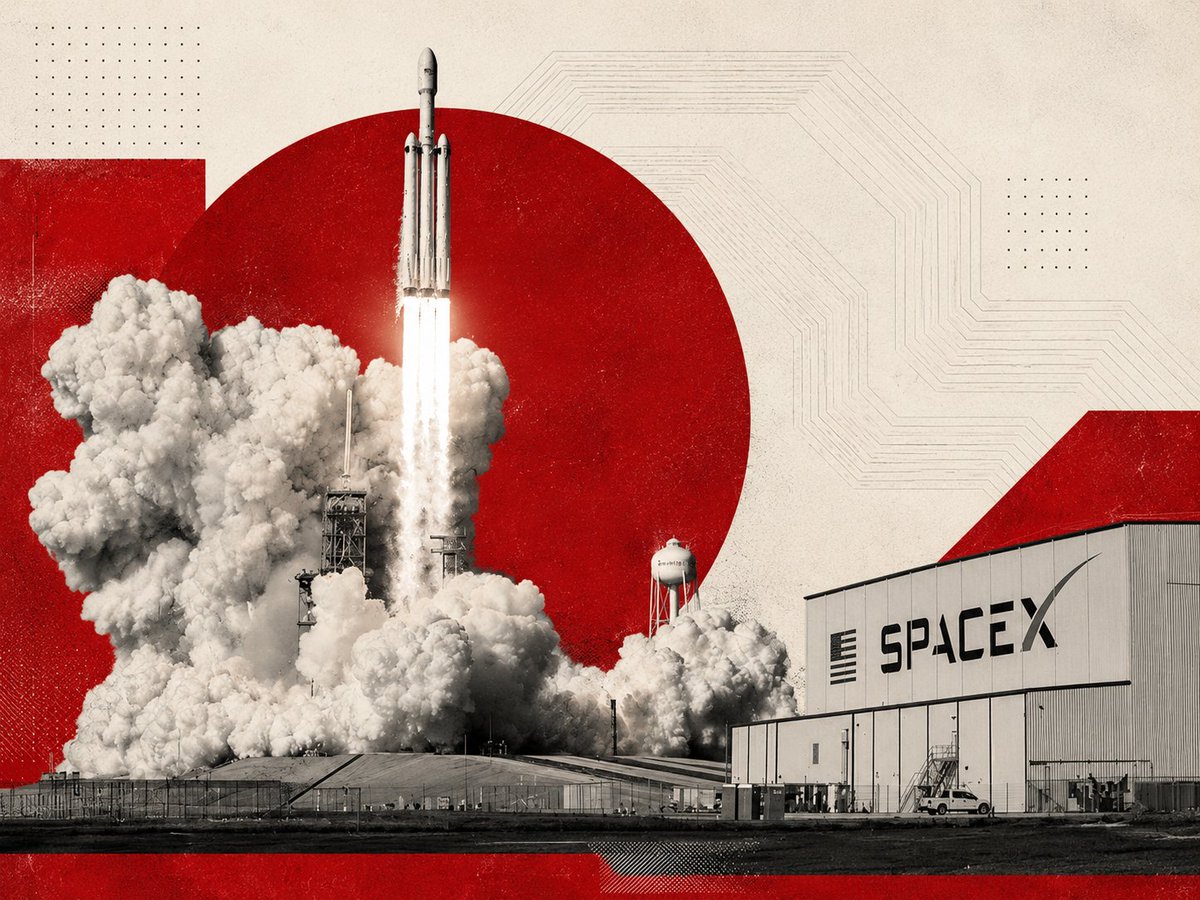
SpaceX Files for $75 Billion IPO That Would Shatter Every Record in Capital Markets History
SpaceX dropped its S-1 with the SEC on May 20, targeting a Nasdaq listing under SPCX on June 12 with a $75 billion raise and a valuation range of $1.75 to $2 trillion. Saudi Aramco's $29 billion offering in 2019 was the previous record. It's not close.
🚀 What the S-1 actually shows
The filing covers a company doing serious numbers. SpaceX posted $18.674 billion in consolidated revenue for full-year 2025, with Q1 2026 already at $4.694 billion, implying an annualized run rate north of $18.7 billion even before Starship reaches commercial cadence.
Goldman Sachs is lead left on the deal, with 20 other banks rounding out one of the largest underwriting syndicates ever assembled. A 5-for-1 stock split executed May 4 is already baked into the per-share figures throughout the prospectus.
For crypto markets, the ticker SPCX isn't just an aerospace bet. The S-1 discloses $BTC holdings on the balance sheet, making this the first mega-cap IPO to position itself explicitly as a vehicle touching satellite broadband, AI infrastructure, and digital assets simultaneously. Per the KraneShares breakdown of the filing, that convergence is deliberate, not incidental.
📡 Why institutional desks are recalibrating
The size of this raise forces a reallocation conversation that most portfolio managers weren't expecting to have in June. A $75 billion primary offering at a $1.75 trillion floor valuation puts SpaceX above every listed company in Europe.
Funds that track broad market indices will need exposure on day one if SPCX clears its listing date, which creates mechanical buying pressure that has nothing to do with a view on Elon Musk or launch cadence.
Crypto-native funds are running a different calculation. $ETH and $SOL treasury strategies have been the go-to institutional flex for the past 18 months, but a publicly traded SpaceX with BTC on the balance sheet and Starlink generating subscription revenue gives allocators a regulated, liquid wrapper for several of the same macro themes at once.
🛰️ The Starlink variable
The S-1 separates Starlink's subscriber economics in enough detail to price it independently, and several analysts covering the filing have already floated a standalone Starlink valuation above $200 billion.
That number sits inside the SPCX offering at no premium. Whether the book gets filled at the top of the range or the bottom will probably come down to how seriously institutional buyers take that embedded optionality over the next three weeks. The SEC registration is live at the agency's EDGAR database. Roadshow pricing lands before June 12.
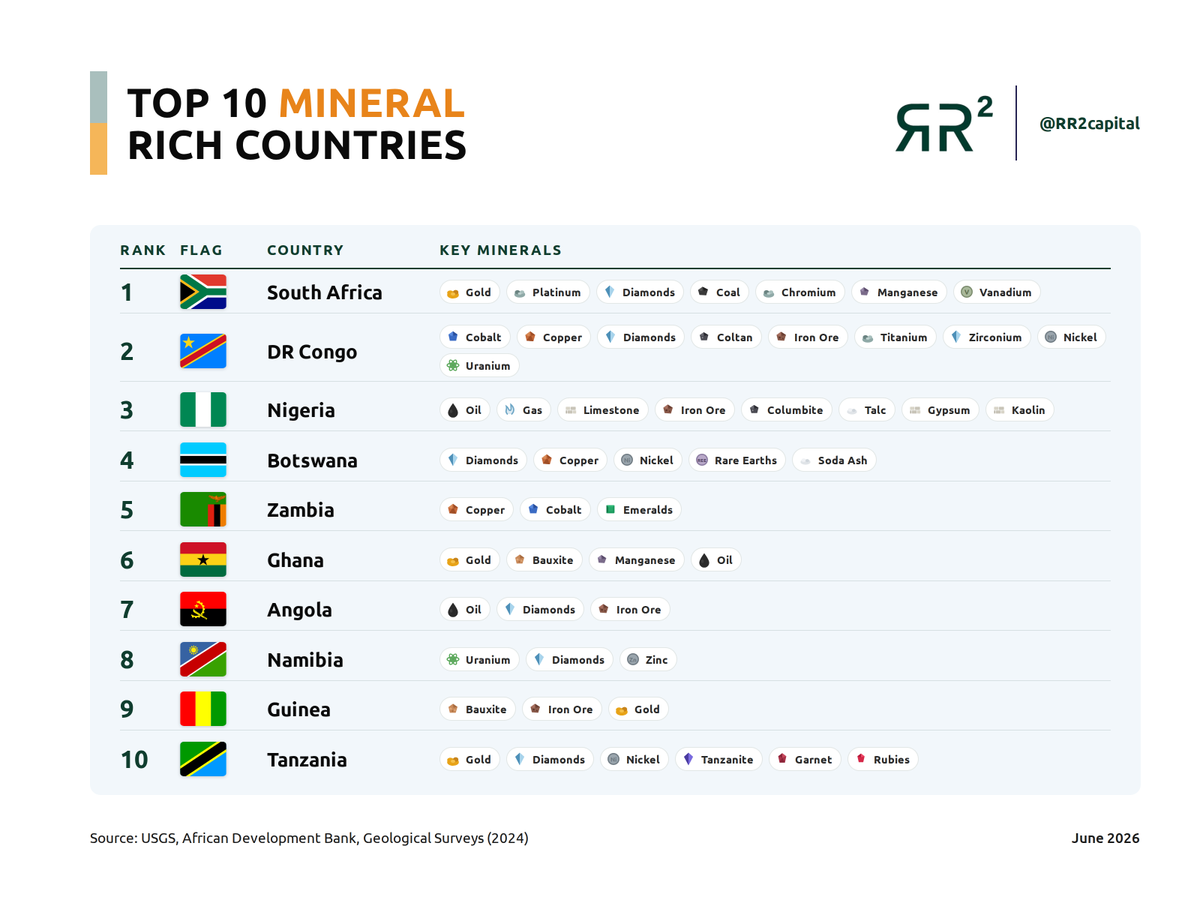
The entire EV supply chain runs through Africa:
🇨🇬 DR Congo: 70% of global cobalt.
🇿🇦South Africa: 70%+ of platinum.
🇬🇳Guinea: bauxite feeding China's aluminum.
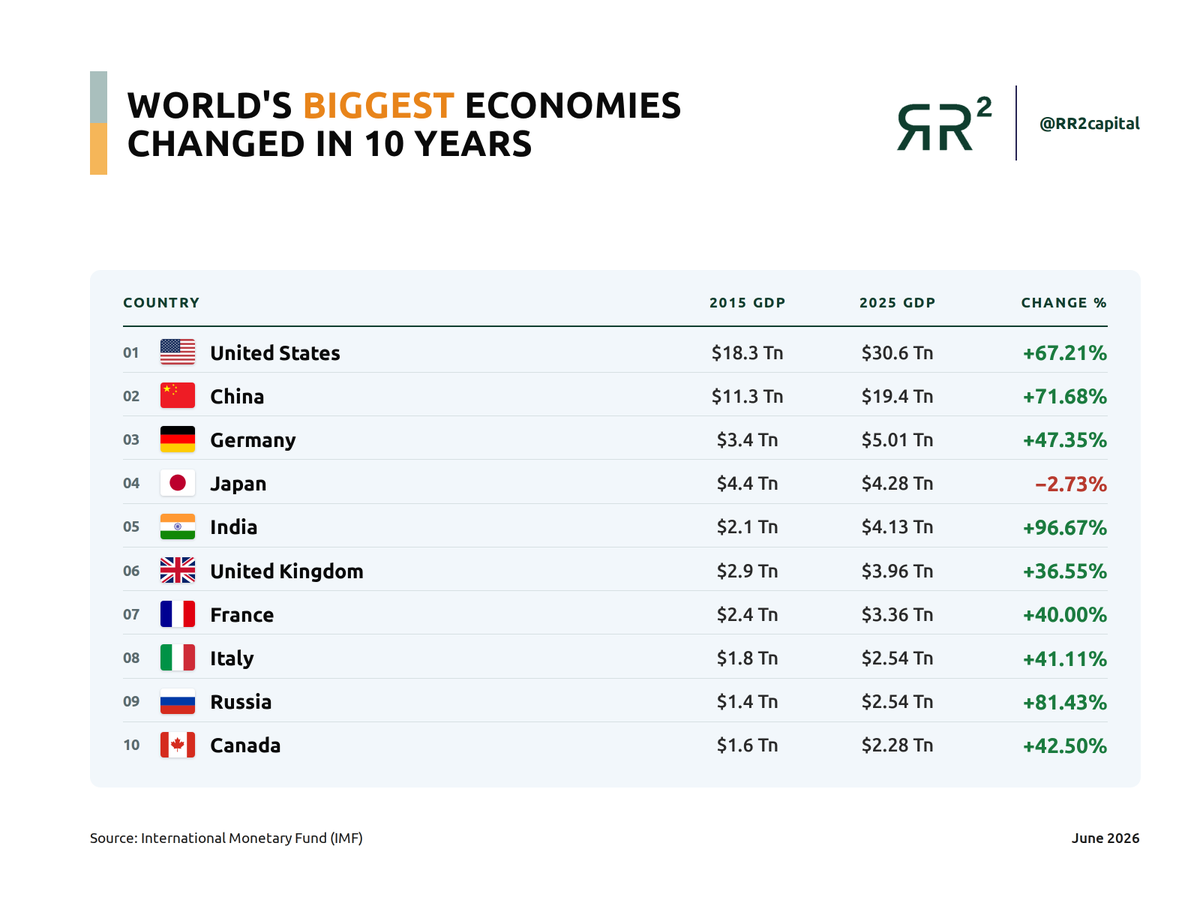
5 things this IMF decade reveals:
🔸India +96.67%: fastest in the top 10.
🔸US added more GDP ($ 12.3Tn) than China's total economy.
🔸Russia +81.43% despite sanctions.
🔸Japan shrank −2.73% (the only one).
🔸Germany barely +47% (Europe's "engine" is idling).
I was thinking it would be a good idea to string together a succession of critical posts from people I follow and those that follow me who are tracking the @BlackBerry story
What's important here is to not just look at the chart but lift up the hood
This should help
$BB
Kevin Warsh Is Now Fed Chair. He Owns Crypto.
Kevin Warsh was sworn in as the 17th Chair of the Federal Reserve on May 22 at the White House, replacing Jerome Powell after a 54-45 Senate vote on May 13. His financial disclosure form lists holdings across 30+ crypto and blockchain projects, including $BTC payments infrastructure, DeFi protocols, and a stablecoin venture. No Fed Chair has walked in with a balance sheet that looks anything like this.
🪙 What his disclosure actually shows
The breadth is what stands out. This isn't a single ETF position someone parked in a brokerage account. Per CoinDesk, Warsh's filings span payments infrastructure built on Bitcoin, active DeFi protocol exposure, and a direct stake in a stablecoin operation. He's described Bitcoin as the new gold for a generation of younger investors, and he's on record opposing a government-issued digital dollar while favoring private-sector stablecoin development. The Fed's posture toward crypto regulation and dollar alternatives doesn't change overnight, but the person setting the tone at the table is now materially different.
📅 June 17 is the first real test
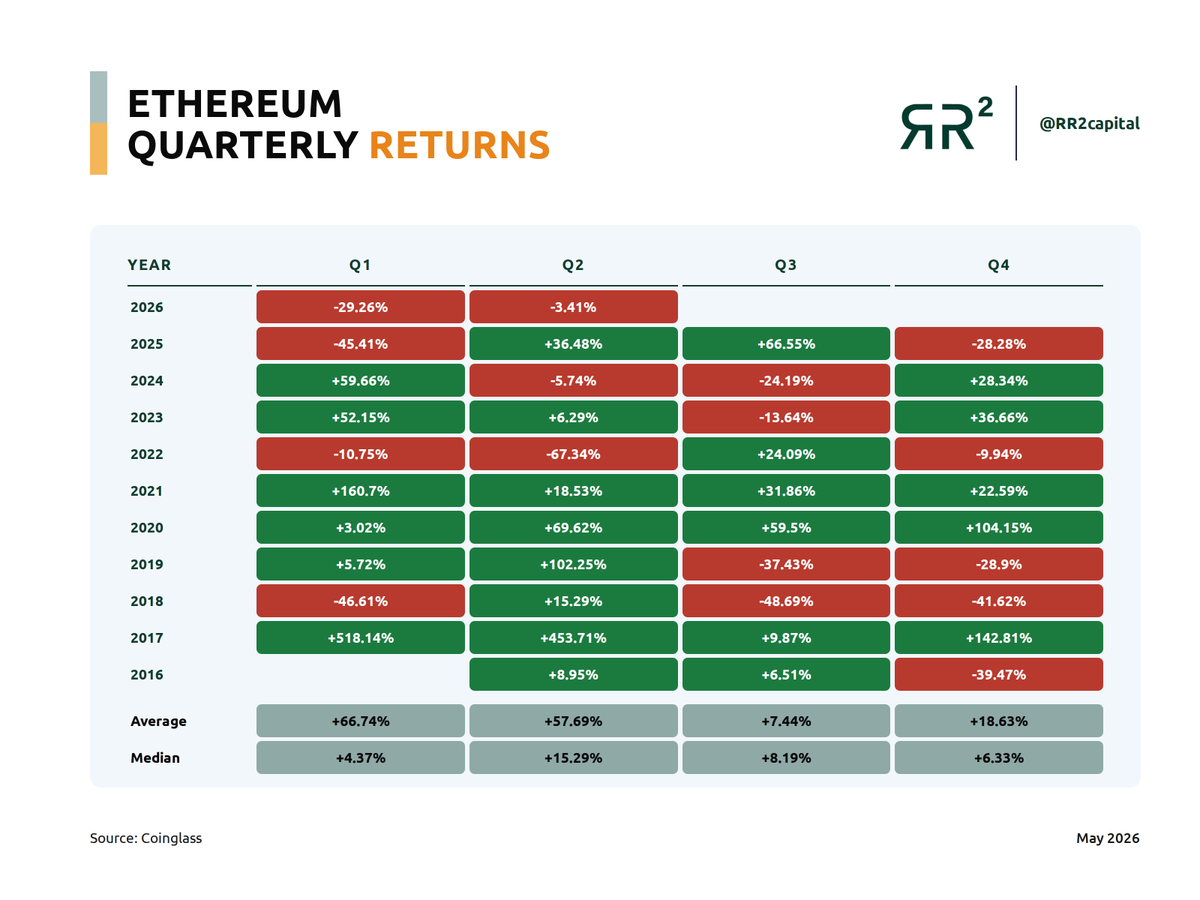
Warsh inherits a tight spot. April CPI came in at 3.8%, and markets are currently pricing a 62% probability of no rate cuts at all in 2026. His first FOMC meeting as Chair runs June 16-17, and whatever signal he sends on rates and the balance sheet will set liquidity conditions for crypto markets through the back half of the year. Bitcoin and $ETH have spent months trading in close correlation with broader risk appetite. A hawkish hold landing with aggressive balance-sheet language would pressure both.
🏦 The stablecoin question
The timing is hard to ignore. Congress is moving toward federal stablecoin legislation, and the new Fed Chair has skin in the private-sector side of that debate. Warsh has been consistent in his view that a CBDC crowds out private innovation, which aligns him with issuers of dollar-backed stablecoins and, indirectly, with the broader $SOL and Ethereum ecosystems where most stablecoin volume settles. How aggressively the Fed shapes final stablecoin rules, and whether Warsh recuses himself from specific votes given his disclosures, is a question his office will face sooner rather than later.
The Crypto Times notes that markets had already begun pricing in a more favorable macro environment for digital assets following Warsh's confirmation. Whether that repricing holds depends almost entirely on what he says on June 17.
Korea robotics, ranked by what you actually pay per dollar of sales:
▪️Doosan Robotics : 200x
▪️ROBOTIS: 115x
▪️Rainbow Robotics: 39x
▪️Higen RNM: 15x
▪️SPG: 8.1x
▪️Hyundai Mobis: 1.1x
▪️Hyundai Motor: 0.8x
GM Guys - 24 Hour Market Recap ⏰
🔸 $BTC trading at ~$69k, $ETH at ~$1,963.
🔸 BTC breaks below $70k for first time in 2 months.
🔸 Spot Bitcoin ETFs see $1.42B in outflows.
🔸 AI stocks rally as capital rotates out of.
Every hedge fund I respect is suddenly talking about the same thing, and... it is not the chips.
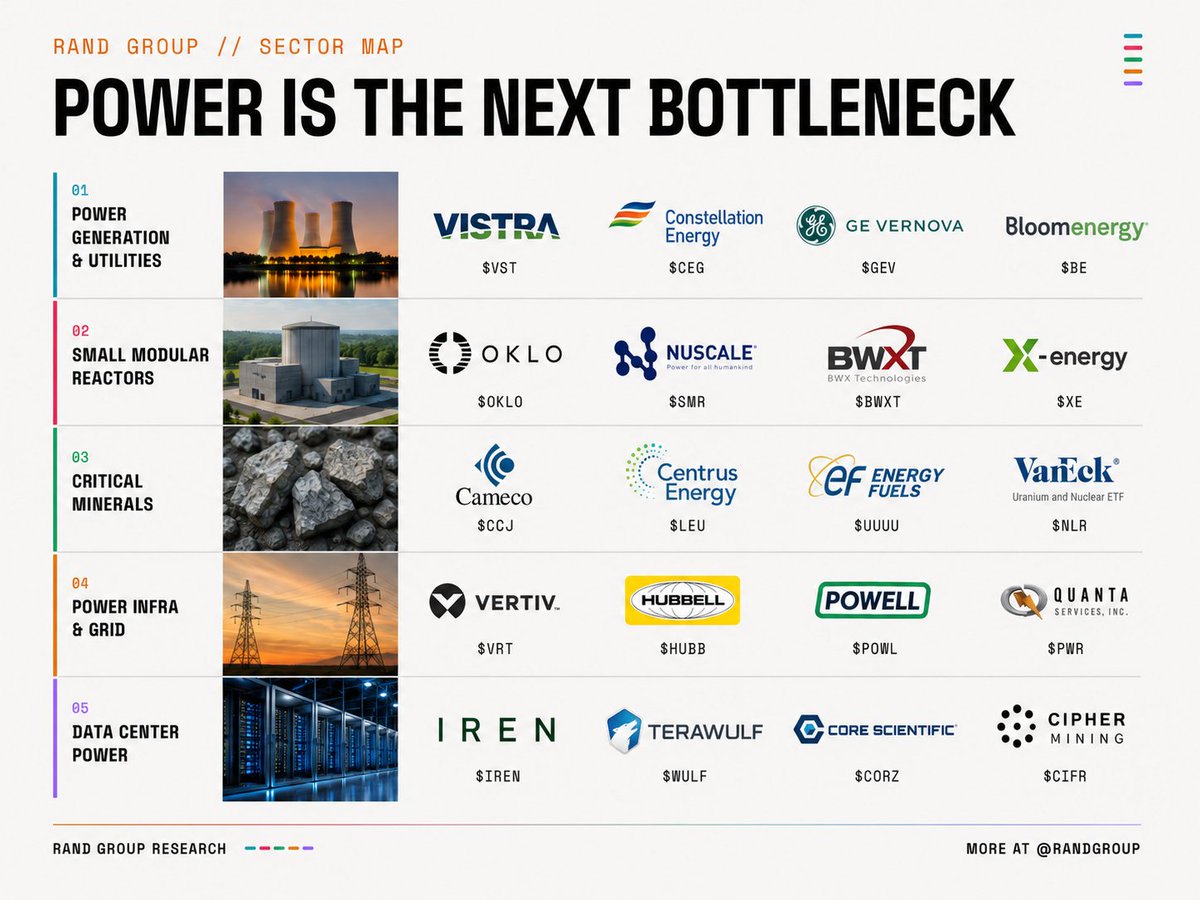
It is the one bottleneck that breaks the entire AI story if it is not solved. Around 20 public companies sit on it. I put them all in one map across 5 layers.
Let's dive into it 🧵
Here is the thing nobody priced in two years ago. We spent a decade with flat electricity demand in this country. Utilities planned around it. Then AI showed up asking for gigawatts at a time.
The Electric Power Research Institute now thinks data centers could eat 9% to 17% of all US electricity by 2030, up from roughly 4% in 2023. Former Google CEO Eric Schmidt told Congress the sector may need 67 more gigawatts by the end of the decade. That is not a tweak to the demand curve. That is a new industrial revolution landing on a grid built for a different century. Every company below sits somewhere between a power plant and a server rack. This is the map.
🔌 POWER GENERATION & UTILITIES
Start at the source. These are the companies that actually make the electrons. For years this was the most boring corner of the market: regulated returns, slow growth, dividend investors only. Then the hyperscalers started signing power contracts directly with generators, and the whole category repriced.
$VST Vistra
This is the one I watch most closely in the group. Vistra signed Meta to a power purchase agreement for roughly 2,600 megawatts at its PJM nuclear sites, which tells you everything about where this is going: tech giants are now buying nuclear output directly. Q1 2026 adjusted EBITDA hit a record for a first quarter at $1.494 billion. They have hedged almost all of their 2026 generation, and they have bought back about 30% of the company since late 2021. A generator that trades like a buyback machine with an AI tailwind bolted on.
$CEG Constellation Energy
The largest nuclear fleet in the country, and the company that put nuclear back on the front page when it agreed to restart Three Mile Island for Microsoft. In January it closed the $21.8 billion Calpine acquisition, adding around 23 gigawatts of mostly gas and renewable capacity, and Q1 2026 revenue more than doubled the year before to $11.1 billion. The thesis is simple: when an AI company wants carbon free baseload power tomorrow, there are very few phone numbers to call, and this is one of them.
$GEV GE Vernova
If you only own one name in this entire map, my honest take is that it should probably be this one. GE Vernova makes the gas turbines and the grid equipment, the literal picks and shovels of the buildout. In a single quarter its Electrification segment booked $2.4 billion in data center equipment orders, more than it booked in all of 2025. Total backlog sits around $163 billion and management pulled forward its $200 billion target to 2027. The gas turbine backlog jumped from 83 to 100 gigawatts in one quarter, and they are raising prices into that demand. This is the cleanest expression of the trade.
$BEPC Brookfield Renewable
Note the ticker: this is Brookfield Renewable, $BEPC, not the $BE on most charts (that is Bloom Energy). Brookfield operates about 47 gigawatts and is developing a pipeline north of 200. It signed a framework with Microsoft to deliver over 10 gigawatts, roughly eight times the size of the largest single corporate power deal ever signed before it, plus a multi gigawatt hydro deal with Google. It also owns about half of Westinghouse alongside Cameco. The patient, contracted, dividend paying way to play the same wave.
⚛️ SMALL MODULAR REACTORS
Now the speculative end. The promise here is clean, firm baseload power in a compact box you can site right beside a data center. The catch: almost none of these are producing commercial power at scale yet, so you are buying a timeline as much as a company. Price that carefully.
$OKLO Oklo
The most exciting and the most expensive name in the room. In May the NRC approved the principal design criteria for Oklo's Aurora powerhouse in under half the usual review time, a real regulatory step forward. The customer pipeline is around 14 gigawatts, anchored by a 12 gigawatt agreement with Switch and a 500 megawatt deal with Equinix, and it added a research partnership with NVIDIA and Los Alamos. Just remember Oklo plans to build, own and operate its reactors and has essentially no revenue yet. This is a call option on a 2028 plus story.
$SMR NuScale Power
The one with the regulatory lead. NuScale has NRC design approval for both its 50 and 77 megawatt modules, which genuinely derisks deployment. It is sitting on about $1.2 billion in liquidity and is working toward a definitive power agreement with TVA through its ENTRA1 partner, with its first project tied to RoPower in Romania. Revenue was a rounding error last quarter because the licensing work wrapped up, so this is still a story about getting the first units in the ground.
$BWXT BWX Technologies
The adult in the room, and the name I would own if I wanted nuclear exposure without buying a lottery ticket. BWXT actually makes money: Q1 2026 revenue of $860 million and net income of $91 million, and it raised full year guidance. It builds reactors for the US Navy, produces medical isotopes, and just acquired Precision Components Group to push into commercial nuclear manufacturing. While the SMR startups sell the future, this one sells into it today.
$XE X-energy
Brand new to the public market. X-energy IPO'd on April 24 at $23 a share, raised about $1.02 billion, and came out around a $12 billion valuation with Amazon as its anchor backer holding nearly a third of the company before the listing. It pairs an 80 megawatt reactor design with its own proprietary TRISO fuel, and its order book already tops 11 gigawatts including Amazon's commitment to as much as 5 gigawatts by 2039, plus Dow and Centrica. Reality check: it lost about $390 million on $109 million of revenue in 2025, and first deployments are not expected until the early 2030s.
⛏️ CRITICAL MINERALS
You can build every reactor on the list above and they are paperweights without fuel. This is the front end of the cycle: mining, enrichment, conversion, and the magnet metals the whole grid runs on. Quick note: I swapped the misfiled Northland slot for Energy Fuels here, which is a genuine US critical minerals producer.
$CCJ Cameco
The blue chip of the uranium world. Q1 2026 net earnings jumped 87% and adjusted EBITDA rose 44% to $509 million on stronger prices and volumes. The kicker is Westinghouse: Cameco owns roughly half of it alongside Brookfield, so it captures both the fuel and the reactor technology side of the renaissance. When people want uranium exposure without a science project, they buy this.
$LEU Centrus Energy
The reshoring play, and a fascinating one. Centrus is the only production ready uranium enricher in America, sitting on a $2.3 billion enrichment backlog, a $900 million HALEU award from the Department of Energy, and a notice from the NNSA that it intends to sole source enrichment work to them. It is pouring over $560 million into its Oak Ridge centrifuge factory and is even exploring a fuel joint venture with Oklo. This is a national security story wearing a stock ticker.
$UUUU Energy Fuels
This is what $UUUU actually is. Energy Fuels runs White Mesa, the only conventional uranium mill operating in the United States, and it is the rare company licensed to produce both uranium and separated rare earth oxides under one roof. Its 2026 uranium guidance implies growth of 50% to 150%, and it is now turning out the dysprosium, terbium and magnet metals that everything from EV motors to grid hardware depends on. Uranium and rare earths, the two supply chains Washington is most desperate to pull back from China, in one company.
$NLR VanEck Uranium and Nuclear ETF
If you would rather own the whole theme in one line instead of picking a winner, this is the basket. $NLR holds the nuclear value chain end to end: reactors, enrichers, miners and the utilities running the plants. A lot of this very map sits inside it, with Constellation, Cameco, Centrus, BWXT and Energy Fuels all among its largest positions. The lazy way to be right about the sector even if you pick the wrong individual stock.
🔧 POWER INFRA & GRID
Between the power plant and the server rack is the least glamorous and maybe most investable layer of all. Transformers, switchgear, cooling, and the crews who build it. The dirty secret of the AI buildout is that the grid itself is the bottleneck. Interconnection queues run years, and the equipment to connect anything is on backorder.
$VRT Vertiv
The purest grid adjacent winner so far. Q1 2026 sales rose 30% to $2.65 billion, with the Americas up 44% on data center demand, earnings per share up triple digits, and guidance raised twice in two quarters. Vertiv makes the power and thermal systems that keep a data center alive, and it just joined the S&P 500. When the chip names sneeze, this one catches it, but the order book keeps validating the story.
$HUBB Hubbell
Boring on purpose, and that is the point. Hubbell makes the electrical and utility hardware, the transformers, metering and grid components, that every new data center and every grid upgrade quietly requires. It will never 10x in a year, but it sells into both the AI buildout and the broader grid replacement cycle at the same time. This is the ballast in the basket.
$POWL Powell Industries
My favorite quiet story in this section. Powell makes custom electrical equipment for utilities, energy and now data centers, and the demand signal is screaming: orders up 97% last quarter, a record $1.8 billion backlog, and right after the quarter closed it landed a single data center order worth more than $400 million, the largest in its history. It did a three for one split this spring and carries no debt. A small cap industrial running into a structural tailwind.
$PWR Quanta Services
The labor. Quanta physically builds and upgrades the grid, the part of this problem that no software fixes. Q1 2026 revenue rose 26% to $7.87 billion and its backlog hit a record $48.5 billion. If all of the generation and transmission above actually gets built, a meaningful slice of it gets built by crews like these. The pick and shovel play on the wires themselves.
🖥️ DATA CENTER POWER
The wild card, and the highest beta corner of the map. These started as bitcoin miners, which means they already owned the one thing everyone now wants: large blocks of interconnected power and the land around it. They pivoted to hosting AI compute, signing leases with the hyperscalers and the neoclouds. Enormous growth, real execution, and serious single customer risk. Size accordingly.
$IREN IREN
The furthest along. Formerly Iris Energy, IREN has a Microsoft AI cloud partnership worth billions, a power pipeline around 4.5 gigawatts, and high performance computing on track to make up the majority of its revenue by the end of the year. It already trades like an infrastructure company rather than a miner, because increasingly that is what it is.
$WULF TeraWulf
TeraWulf describes itself as a power company that happens to build digital infrastructure, which I think is exactly the right framing for this whole row. It has locked in over $12.8 billion of contracted compute revenue through long term leases with the Google backed Fluidstack and Core42, anchored by its Lake Mariner site and scaling toward a gigawatt of power. Its leasing revenue more than doubled year over year. Controlled power, leased to AI, on a multiyear contract.
$CORZ Core Scientific
The contrarian one. CoreWeave tried to buy Core Scientific in an all stock deal, and in a rare moment of shareholder backbone, the holders voted it down in late 2025. So it stays public, and it kept the prize: roughly $10 billion or more of contracted revenue with CoreWeave across about 590 megawatts, while converting its old mining sites into AI colocation. You are betting the company creates more value alone than the buyout offered.
$CIFR Cipher Mining
The earliest stage of the pivot, rebranding toward AI as it goes. Cipher signed a hosting deal backed by Google's Fluidstack, with Google taking around a 5% stake, plus a 300 megawatt arrangement tied to AWS, building toward a contracted compute backlog around $9 billion. Highest risk, least proven, most torque if the leases convert to cash on schedule.
⚡️FINAL THOUGHTS
Step back from the tickers and a pattern jumps out. The market is paying up for the same insight at five different points on the same wire.
The stability lives at the bottom and the middle. Cameco, Hubbell, Quanta Services and BWX Technologies make money today and sell into a buildout that is contracted for years. They will not triple overnight, but they do not need a single thing to go right that has not already happened.
The growth lives at the edges. GE Vernova is the rare name that has both, scale and acceleration, which is why I keep coming back to it. The reactor startups and the former miners are where the imagination is, and also where the disappointment will be when timelines slip, because timelines always slip in nuclear and in construction.
The clearest read of all is that the AI story quietly handed the baton from the chip layer to the power layer, and most people are still watching the wrong race. You cannot run the model without the electrons, and the electrons are the scarce thing now.
I will say the obvious part out loud: this is a map, not advice. I am pointing at where the money is moving, not telling you what to buy. Do your own work on every one of these, especially the speculative names where a single contract or a single regulator can move the whole thesis.
If this saved you a week of research, do me a favor and bookmark it, then send it to the person in your group chat who only owns Nvidia. The power bottleneck is the second half of that trade.
AI is now worth more than every bank on Earth:
🤖AI: $22.6tn
🏛️Banks: $14.3tn
A category that barely had a market cap line 4 years ago now outweighs 150 years of global banking.
Three of the world's "prime" cities give you under 25 m² for $1M:
▪️Monaco: 19 m²
▪️Hong Kong: 22 m²
▪️Singapore: 32 m²
In each, your million buys roughly the size of a one-car garage😅
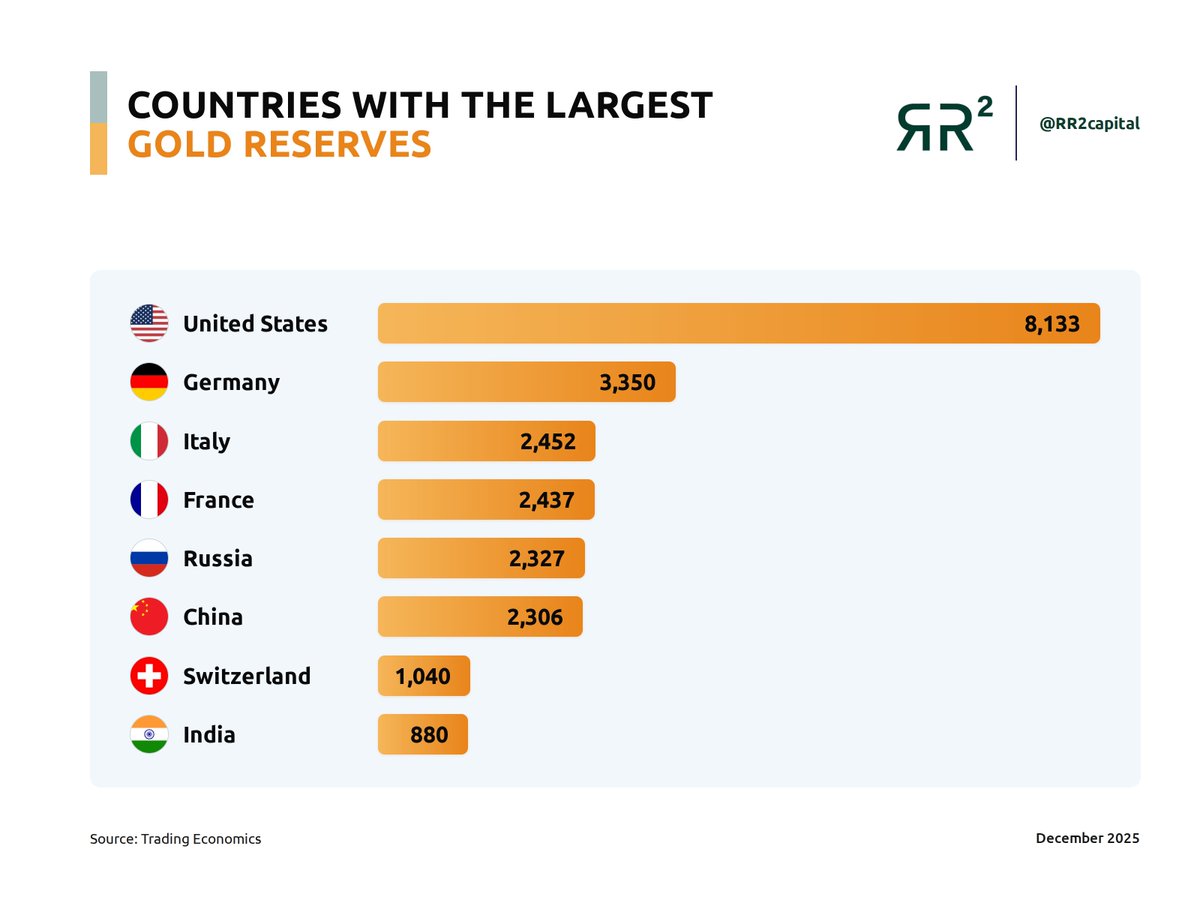
The US holds 8,133 tonnes of gold.
More than Germany, Italy and France combined.
Yet it hasn't bought a single ounce in decades.
China? 18 straight months of buying.
GM Guys - 24 Hour Market Recap ⏰
🔸 $BTC trading at $71k, $ETH at $1,968.
🔸 Strategy sold 32 $BTC first time since 2022 Bitcoin.
🔸 Crypto funds hit second-largest 2026 weekly outflow $1.67B.
🔸 Fear & Greed at 23, Extreme Fear territory.
JUST IN ⚡️: Intel is dropping a new AI inference chip before year-end. Cheaper memory, smarter cooling, direct shot at Nvidia and AMD.
The chip war just got a new player 👀