The vocabulary is shifting.
Today we say "digital assets."
Soon, we'll just say assets.
Funds. Derivatives. RWAs. New financial products. The transformation of finance is already here.
Vision Chain is the infrastructure powering this shift across Europe. $VSN is the economic layer.
That's the direction. More from the team soon. 👇
🔗 https://t.co/Y8f0WXFLWF
Web3 is trapped in its dial-up phase.
The experience is fragmented, the infrastructure is clumsy, and the friction is endless.
The iPhone took smartphones from clunky gadgets and turned them into an elegant reality.
Vision Wallet aims to the exact same thing for Web3.
The first-ever $VSN Community Governance vote is live until Monday, May 18, 12:00 CEST!
You can vote in any of 3 ways:
Through @visionwallet, by navigating to the governance section in your profile.
Through @bitpanda_global, by navigating to the Governance Story that can be found under Profile > Vision > Web3 (mobile only)
Directly through @SnapshotLabs: https://t.co/ceJjktZGlY
Read all about the proposal here: https://t.co/cbjjgIDh9a
Join now!
Your Vision, your voice.
The power to shape the future of the Vision economy is now in your hands.
1 $VSN = 1 Vote.
Both staked and unstaked tokens count.
Vote now via:
- Within the Bitpanda App
- Vision Wallet
- Snapshot
You asked, we answered.
We sat down to give you some updates about what you’ve been tagging us about:
- Community Governance
- Product updates
- Vision Chain & use-cases
- Wen Launchpad & more.
Get the full scoop here: 👇
https://t.co/HRsetOBYNm
Reflecting on an incredible week at @EthCC Cannes.
From hosting our own events to building with the brightest minds in Web3 - the feedback on Vision Chain has been overwhelming.
This is just the beginning.
@Optimism 🤝 @Bitpanda_global 🤝 @vsntoken
Vision is now in focus.
The Bitpanda DeFi Wallet is officially evolving into Vision Wallet.
Same features. Same security. New name.
Get ready to see a lot more Vision in your life.
Tokenization will reshape capital markets, and we are building the infrastructure to move the financial industry from pilots to production.
This is a big step in our ambition to lead Web3 for institutional finance. Lets build!
We are opening the gates for Europe’s biggest institutions to join the global onchain economy.
Together with @Bitpanda_global and @Optimism, we are building Vision Chain on the OP Stack to bridge the gap between traditional finance and the global onchain economy.
By merging Ethereum-level openness with a framework built for Europe’s regulatory reality, we are giving institutions a public blockchain they can actually use.
Official Press Release: https://t.co/wIUmZ0Rnfj
Apologies for the delayed response, busy times!
From Narrative to Reality
Appreciate it.
We do measure output, but not just in terms of reach or impressions. What matters more is the quality of what follows: inbound from partners, stronger conversations, builders reaching out, and whether people already have context when we engage with them.
What we’re doing right now is very much the first half of a classic AIDA (Attention-Interest-Desire-Action) flow.
We’re building attention and interest. That’s what the podcasts, content, and overall presence are for. Not because that alone creates value, but because without it, the next steps become much harder.
When the chain and the products & applications on it are live, the goal is that desire and action are not starting from zero. People already understand what Vision is, what it stands for, and why it matters.
The transition from here is straightforward in theory:
- turn awareness into integrations
- turn integrations into usage
- turn usage into recurring activity and fees
That’s where it becomes real.
So yes, the current phase is still narrative-heavy, we’re laying the groundwork so that when real products are live, we’re not trying to explain everything from scratch.
At the end of the day, though, none of this replaces execution. If the products don’t deliver, attention doesn’t convert.
The Heart of Vision
You’re right, building in this space isn’t just technical. It’s emotional as well.
On team size, across the core Web3 setup, we’re roughly around 50 people at this point. On top of that, we have a lot of supporting functions at Bitpanda like legal, compliance, regulatory, finance, tax and others that we can rely on when needed. They’re not exclusively working on Web3, but they’re an integral part of our mission to make DeFi actually work for regulated players.
What matters more than the number is how the team operates.
At this pace, it’s easy to lose focus or burn people out. So we put a lot of emphasis on clarity. What matters right now, what doesn’t, and why. Not everything can be priority one at the same time.
We also try to stay honest internally. Things don’t always go as planned, and pretending otherwise doesn’t help. A strong team comes from people feeling they’re building something real, not just chasing a narrative.
On visibility, fair point. We’ve started introducing more people, and we’ll continue doing that. At the same time, not everyone is comfortable putting themselves out there publicly, especially in crypto. It takes a certain level of… let’s call it commitment to be the face of a project here ;)
Some people prefer to focus on building rather than tweeting, and that’s completely fine. We’ll keep finding the right balance between showing the team and respecting that.
The Global Ecosystem
I’d look at it the same way you do. It’s not really about competition in the traditional sense. It’s a sign that the space is maturing.
When major players move in this direction, it validates the idea that onchain finance, especially around RWAs, is becoming real infrastructure.
From the conversations we’re having, the tone is actually quite constructive. It’s less “who wins” and more “how do we make this work in a way that is scalable and compliant.”
Our partners are thinking long-term. They care about things like regulatory clarity, distribution, and whether there is actual user demand, not just short-term narratives.
That’s also how we approach it.
Vision is not trying to be the loudest or fastest entrant. The goal is to enter with something that actually works in a European context, connects to real users, and can scale over time.
If we get that right, we’re not competing against the global DeFi ecosystem. We’re part of building it.
Vision Chain will be the infrastructure behind Bitpanda Enterprise Tokenize.
Together, we will bring scalable, compliance-ready tokenisation to institutions in Europe and beyond, built for regulated finance from day one.
With Bitpanda Enterprise as our partner, Vision Chain moves directly into the hands of banks, corporates and asset issuers, becoming the infrastructure layer for regulated digital assets.
Learn more: https://t.co/jCmCp58AE8
Upgrading Europe’s Financial System: Vision Chain and the Case for Regulated Crypto
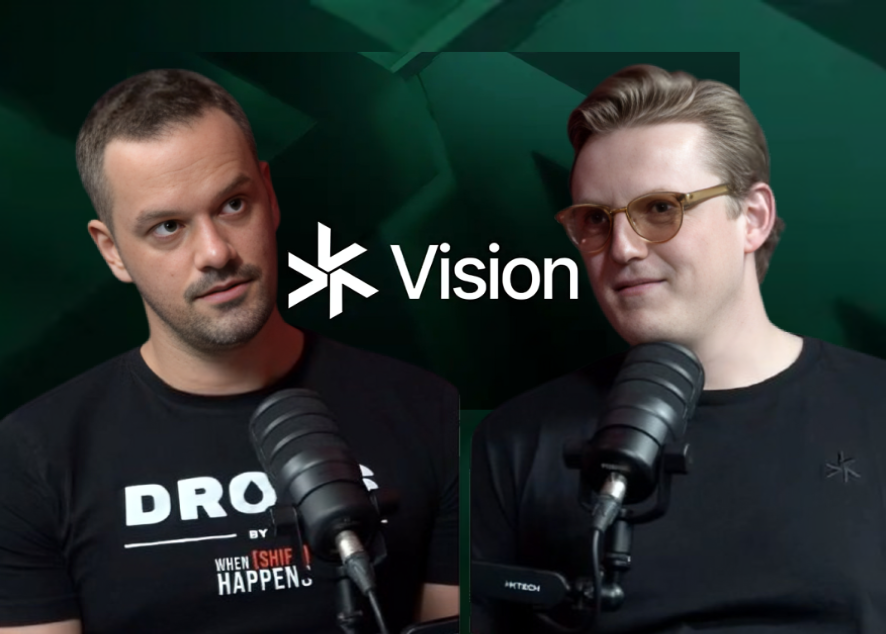
In this episode of DROPS, I sit down with @FkleinwieGross, "Flo", Commercial Lead at @vsntoken and Bitpanda Web3, to discuss how regulatory clarity could become Europe’s competitive advantage in crypto. At a time when much of the industry still frames itself as a rebellion against traditional finance, Flo makes a different case: Europe does not need to replace finance. It needs to upgrade it.
From Broker to Bridge
Flo’s journey sits at the intersection of crypto-native ambition and European pragmatism. As Commercial Lead for Bitpanda Web3, he operates within Europe’s largest crypto broker, serving over seven million users. But @Bitpanda_global is not a typical centralized exchange. As he explains, “Bit Panda is actually the counterparty to the trades our users make. And we then hedge and source liquidity from a wide variety of centralized exchanges and trading venues.”
That distinction matters. A centralized exchange matches buyers and sellers in an order book. A broker abstracts that complexity. For Bitpanda’s largely Web2-oriented audience, the goal has always been simplicity. As Flo puts it, the strategy has been to “abstract difficulty as much as possible.”
This audience does not necessarily care about custody models or liquidity routing. They treat crypto as an asset class, not a technological revolution. That difference shapes everything that follows.
Web2 in Front, Web3 in the Back
Bitpanda Web3 represents the next step: onboarding “the next millions of users into the onchain world.” But Flo is clear. This is not about tearing down traditional finance. “It’s not replacing TradFi, it’s about upgrading it.”
That philosophy crystallizes in what he calls the “DeFi mullet.” Web2 in the front, Web3 in the back. The user interface remains familiar and clean while the complexity runs quietly beneath the surface.
If crypto’s first phase proved it was possible, and the second phase tried to make it useful, Flo argues the third phase must make it invisible. “The average retail user doesn’t care about the technology,” he says. “They care about the usability.”
In @BitpandaWallet, there is no open WalletConnect access to random decentralized apps. The goal is curated exposure, protecting Web2 investors from the risks that crypto natives may willingly accept.
Regulation as an Edge, Not a Burden
Flo acknowledges the common critique: the world innovates, Europe regulates. But in finance, he believes that slower, methodical development may become a strategic advantage.
Europe already operates under harmonized frameworks such as MiCA, PSD2, DORA, and GDPR. Rather than fighting that environment, Vision Chain is designed specifically for it. The ambition is bold: “This is where regulated finance goes onchain in Europe.”
Vision Chain is an Ethereum Layer-2, so Flo addresses the obvious question directly. Do we need another Layer-2? If the only value proposition is cheaper transactions, then no. But if a chain has “a very specific purpose and is trying to do something unique,” then yes.
That uniqueness lies in embedding compliance and control mechanisms directly into the architecture. Sanctions screening, anti-money laundering safeguards, and regulatory-aware transaction controls are considered from day one. Vision is “specifically made for it,” more efficient, and safer in the European regulatory context.
Why Europe, and Why Now?
When asked why Europe needs its own blockchain, Flo’s answer is direct. Europe may lag in risk appetite compared to the US or Asia, but it is ahead in regulatory clarity. That clarity reduces uncertainty. And as he mentions later in the conversation, “Regulation is not the enemy of innovation. Uncertainty is.”
By aligning with regulation instead of resisting it, Vision Chain aims to attract European financial institutions that would otherwise hesitate to engage with public blockchains.
Bitpanda’s eleven-year history of regulatory compliance strengthens that pitch. The company chose the slower, harder path of licensing and oversight, building trust with both retail users and institutional partners.
Vision is positioned as the culmination of that work.
A Euro-Native Ecosystem
One of Vision Chain’s more distinctive choices is its approach to gas fees. Instead of defaulting to ETH or USD stablecoins, the chain will primarily use a euro-denominated stablecoin.
Since institutions prefer predictability, stablecoins will offer programmable, stable fee structures and currency alignment for European users. As Flo notes, earning yield in USD while living in a euro economy can erode returns through exchange rate movements.
The Vision token itself plays a complementary role as an ecosystem token with revenue-sharing mechanics.
Beyond Crypto Maximalism
Flo is candid about the limits of maximalism. “If you’re always going full collision, no compromise, you end up alienating a lot of people and a lot of institutions.”
In his view, crypto’s next wave of impact will not come from overthrowing financial systems but from integrating with them. European institutions bring liquidity and assets onchain. Bitpanda’s distribution brings users. Builders bring applications. Each reinforces the other in a flywheel effect within a collaborative model.
The “Base of Europe”?
Vision Chain is often compared to Base, Coinbase’s Layer-2. But Flo believes Vision’s strength lies in its unique position within Europe’s regulatory and cultural landscape.
“We have the brains and the knowledge of the regulatory landscape,” he says, along with a strong tech team and an established user base.
Vision is betting that in a region that values stability, transparency, and regulation, the path to mainstream crypto adoption will be through structured integration.
👉If you enjoyed reading the summary, head over to When Shift Happens on YouTube or your favorite podcast platform to access the full convo.